Leadership will always be important to organizations. The need for effective
leadership and the difficulty of providing it has increased rapidly because of the
changes experienced by the organization.
Leadership is the activity of influencing people to strive willingly for achieving
organization goals and objective. In any situation where one tries to influence the
behavior of another individual or group, leadership is operating. Thus each one of
us tries leadership at one time or the other, whether our activities are centered
around a business, education institution, hospital, government organization or
even a family. In this process the person who attempts to influence the behavior
of other becomes a potential leader and the persons he is attempting to influence
are the potential followers. This may happen irrespective of the fact that the
leader may be their boss, associate, subordinate, friend or relative. Hence,
though a style of functioning a leader influences attitude encourages the
follower’s activity and achievements, which in turn enhances the followers
commitment to the work.
Leadership is the process of developing ideas and vision, living by the values
that support these ideas and vision. And then influencing others to embrace them
in their behavior. And in today’s world, leadership is accomplished less and less
through command and control and more and more through changing people’s
mind sets, which intern alters the way they behave, Today leadership is being
able to mobilize ideas and values that energize other people.
The leader leading the group of people must have the skills of understanding the
values, personality, perception and attitudes of these people. Each individual act
differently from one another because these values personalities, perception and
attitude. Leadership skills require understanding and working with different
people. Thus the management skill of leadership reflects the ability to influence
the followers by understanding the leader, behavior and situation in which it is
applied.
Thus leaders are ordinary people with extraordinary vision. They create the
vision, share with teammates, and involve them. Listen to them, learn from them
and make them work “with” you.
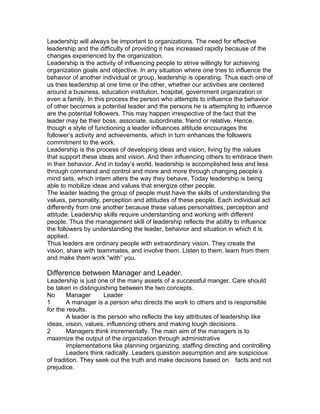
Difference between Manager and Leader.
Leadership is just one of the many assets of a successful manger. Care should
be taken in distinguishing between the two concepts.
No Manager Leader
1 A manager is a person who directs the work to others and is responsible
for the results.
A leader is the person who reflects the key attributes of leadership like
ideas, vision, values, influencing others and making tough decisions.
2 Managers think incrementally. The main aim of the managers is to
maximize the output of the organization through administrative
implementations like planning organizing, staffing directing and controlling
Leaders think radically. Leaders question assumption and are suspicious
of tradition. They seek out the truth and make decisions based on facts and not
prejudice.
3 Mangers do things right. This means that managers do things by the
books and follow company policies.
Leaders are do right things. Leaders follow their own intuition, which may
in turn be of more benefit to the company.
4 Mangers rule. The managers must be obeyed because his position of
authority through time and loyalty given to the company.
Leaders are followed. Leaders unites people behind him as he takes
responsibility in areas such as
- Taking the blame when things go wrong.
- Celebrating group achievements.
- Giving credit where it is due.
5 Manger instructs their subordinates.
Leaders learn with their subordinates.
6 Managers are principally administrators who write business plan, set
budgets and more progress.
Leaders energize an organization and its people to change motivating,
selecting talent, coaching and building trust.
7 Managers are the brains of the business. Mangers establish systems
create rules and operating procedures.
Leader is heart of the business. Leaders motivate, console and work with
people by keeping them bonded and eager to move forward.
8 A manger directs energy towards goals. Resources, organization
structure, determining the problems to be solved.
A leader directs energy towards guiding and inspiring people to come
together for a common goal by setting direction and communicating it to all.
9 Managers view work as an enabling process, involving a combination of
idea, skills, timing and people.
Leaders view work as developing fresh approaches to old problems,
finding new option for old issues.
10 Managers views work as something that must be done or treated.
Leader views work as something challenging and exiting.
11 Manager focuses on how and when things need to be done.
Leader focuses on what needs to be done, leaving decisions to people
involved.
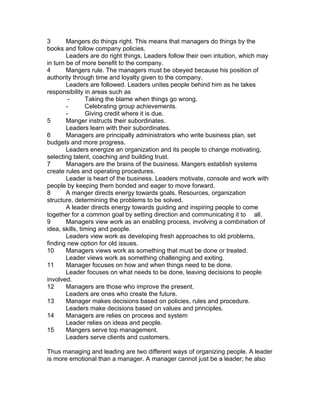
12 Managers are those who improve the present.
Leaders are ones who create the future.
13 Manager makes decisions based on policies, rules and procedure.
Leaders make decisions based on values and principles.
14 Managers are relies on process and system
Leader relies on ideas and people.
15 Mangers serve top management.
Leaders serve clients and customers.
Thus managing and leading are two different ways of organizing people. A leader
is more emotional than a manager. A manager cannot just be a leader; he also
needs formal authority to be effective. The manager uses a formal, rational
method while the leaders uses passion and stirs emotion.

Manager vs leadership

  • 1.
    Leadership will alwaysbe important to organizations. The need for effective leadership and the difficulty of providing it has increased rapidly because of the changes experienced by the organization. Leadership is the activity of influencing people to strive willingly for achieving organization goals and objective. In any situation where one tries to influence the behavior of another individual or group, leadership is operating. Thus each one of us tries leadership at one time or the other, whether our activities are centered around a business, education institution, hospital, government organization or even a family. In this process the person who attempts to influence the behavior of other becomes a potential leader and the persons he is attempting to influence are the potential followers. This may happen irrespective of the fact that the leader may be their boss, associate, subordinate, friend or relative. Hence, though a style of functioning a leader influences attitude encourages the follower’s activity and achievements, which in turn enhances the followers commitment to the work. Leadership is the process of developing ideas and vision, living by the values that support these ideas and vision. And then influencing others to embrace them in their behavior. And in today’s world, leadership is accomplished less and less through command and control and more and more through changing people’s mind sets, which intern alters the way they behave, Today leadership is being able to mobilize ideas and values that energize other people. The leader leading the group of people must have the skills of understanding the values, personality, perception and attitudes of these people. Each individual act differently from one another because these values personalities, perception and attitude. Leadership skills require understanding and working with different people. Thus the management skill of leadership reflects the ability to influence the followers by understanding the leader, behavior and situation in which it is applied. Thus leaders are ordinary people with extraordinary vision. They create the vision, share with teammates, and involve them. Listen to them, learn from them and make them work “with” you. Difference between Manager and Leader. Leadership is just one of the many assets of a successful manger. Care should be taken in distinguishing between the two concepts. No Manager Leader 1 A manager is a person who directs the work to others and is responsible for the results. A leader is the person who reflects the key attributes of leadership like ideas, vision, values, influencing others and making tough decisions. 2 Managers think incrementally. The main aim of the managers is to maximize the output of the organization through administrative implementations like planning organizing, staffing directing and controlling Leaders think radically. Leaders question assumption and are suspicious of tradition. They seek out the truth and make decisions based on facts and not prejudice.
  • 2.
    3 Mangers dothings right. This means that managers do things by the books and follow company policies. Leaders are do right things. Leaders follow their own intuition, which may in turn be of more benefit to the company. 4 Mangers rule. The managers must be obeyed because his position of authority through time and loyalty given to the company. Leaders are followed. Leaders unites people behind him as he takes responsibility in areas such as - Taking the blame when things go wrong. - Celebrating group achievements. - Giving credit where it is due. 5 Manger instructs their subordinates. Leaders learn with their subordinates. 6 Managers are principally administrators who write business plan, set budgets and more progress. Leaders energize an organization and its people to change motivating, selecting talent, coaching and building trust. 7 Managers are the brains of the business. Mangers establish systems create rules and operating procedures. Leader is heart of the business. Leaders motivate, console and work with people by keeping them bonded and eager to move forward. 8 A manger directs energy towards goals. Resources, organization structure, determining the problems to be solved. A leader directs energy towards guiding and inspiring people to come together for a common goal by setting direction and communicating it to all. 9 Managers view work as an enabling process, involving a combination of idea, skills, timing and people. Leaders view work as developing fresh approaches to old problems, finding new option for old issues. 10 Managers views work as something that must be done or treated. Leader views work as something challenging and exiting. 11 Manager focuses on how and when things need to be done. Leader focuses on what needs to be done, leaving decisions to people involved. 12 Managers are those who improve the present. Leaders are ones who create the future. 13 Manager makes decisions based on policies, rules and procedure. Leaders make decisions based on values and principles. 14 Managers are relies on process and system Leader relies on ideas and people. 15 Mangers serve top management. Leaders serve clients and customers. Thus managing and leading are two different ways of organizing people. A leader is more emotional than a manager. A manager cannot just be a leader; he also
  • 3.
    needs formal authorityto be effective. The manager uses a formal, rational method while the leaders uses passion and stirs emotion.