

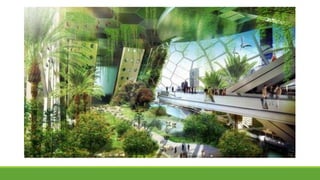
Examples of Arcology
1.LILYPAD
2.DRAGONFLY
AKHIL THOMAS
11110006
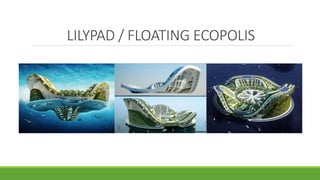
LILYPAD / FLOATING ECOPOLIS
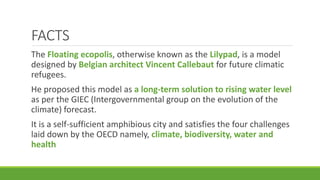
FACTS
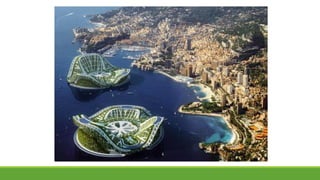
The Floating ecopolis, otherwise known as the Lilypad, is a model
designed by Belgian architect Vincent Callebaut for future climatic
refugees.
He proposed this model as a long-term solution to rising water level
as per the GIEC (Intergovernmental group on the evolution of the
climate) forecast.
It is a self-sufficient amphibious city and satisfies the four challenges
laid down by the OECD namely, climate, biodiversity, water and
health
FACTS
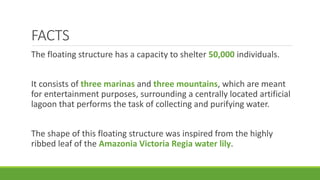
The floating structure has a capacity to shelter 50,000 individuals.
It consists of three marinas and three mountains, which are meant
for entertainment purposes, surrounding a centrally located artificial
lagoon that performs the task of collecting and purifying water.
The shape of this floating structure was inspired from the highly
ribbed leaf of the Amazonia Victoria Regia water lily.
FACTS
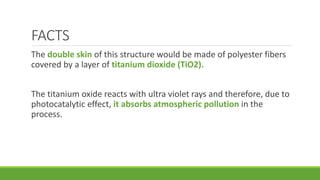
The double skin of this structure would be made of polyester fibers
covered by a layer of titanium dioxide (TiO2).
The titanium oxide reacts with ultra violet rays and therefore, due to
photocatalytic effect, it absorbs atmospheric pollution in the
process.
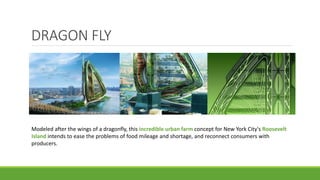
DRAGON FLY
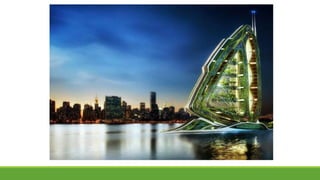
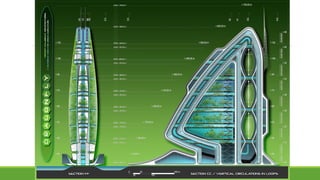
Modeled after the wings of a dragonfly, this incredible urban farm concept for New York City's Roosevelt
Island intends to ease the problems of food mileage and shortage, and reconnect consumers with
producers.
FACTS
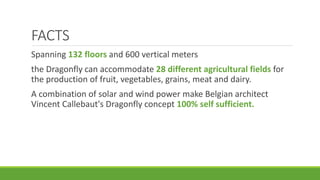
Spanning 132 floors and 600 vertical meters
the Dragonfly can accommodate 28 different agricultural fields for
the production of fruit, vegetables, grains, meat and dairy.
A combination of solar and wind power make Belgian architect
Vincent Callebaut's Dragonfly concept 100% self sufficient.
Arcology
Arcology
Arcology

Arcology

  • 1.
  • 2.
  • 3.
    FACTS The Floating ecopolis,otherwise known as the Lilypad, is a model designed by Belgian architect Vincent Callebaut for future climatic refugees. He proposed this model as a long-term solution to rising water level as per the GIEC (Intergovernmental group on the evolution of the climate) forecast. It is a self-sufficient amphibious city and satisfies the four challenges laid down by the OECD namely, climate, biodiversity, water and health
  • 4.
    FACTS The floating structurehas a capacity to shelter 50,000 individuals. It consists of three marinas and three mountains, which are meant for entertainment purposes, surrounding a centrally located artificial lagoon that performs the task of collecting and purifying water. The shape of this floating structure was inspired from the highly ribbed leaf of the Amazonia Victoria Regia water lily.
  • 5.
    FACTS The double skinof this structure would be made of polyester fibers covered by a layer of titanium dioxide (TiO2). The titanium oxide reacts with ultra violet rays and therefore, due to photocatalytic effect, it absorbs atmospheric pollution in the process.
  • 7.
    DRAGON FLY Modeled afterthe wings of a dragonfly, this incredible urban farm concept for New York City's Roosevelt Island intends to ease the problems of food mileage and shortage, and reconnect consumers with producers.
  • 8.
    FACTS Spanning 132 floorsand 600 vertical meters the Dragonfly can accommodate 28 different agricultural fields for the production of fruit, vegetables, grains, meat and dairy. A combination of solar and wind power make Belgian architect Vincent Callebaut's Dragonfly concept 100% self sufficient.