Le Chatelier's
Principle
Le Chatelier's Principle (1884)
When a system at equilibrium
is subjected to a stress, the system
will adjust to relieve the stress and
return to equilibrium.
Remember: Kc value is constant.
BEFORE the stress, and AFTER the reaction
adjusts.
It is like the “undo” button
on your computer!
Types of Stress
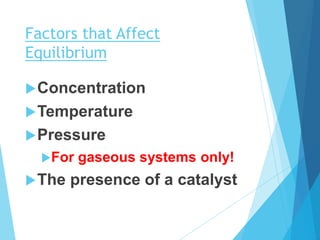
Factors that Affect
Equilibrium
Concentration
Temperature
Pressure
For gaseous systems only!
The presence of a catalyst
1. Concentration Stress
Stress: a change in concentration
of products or reactants by adding or
removing.
Adjustment: change in collision rate and
redistribution of particles.
• [Add] – system shifts to use it up.
• [Remove] – system shifts to make more.
• More C means increased rate of reverse reaction.
Kc = [C]
[A][B]
C
B
A +
Kc = 1.35
We say “shifts left”
We mean:
• Excess C used up until ratio of product to reactant
concentrations is equal to Kc once again.
Increase [C]:
Kc = [C]
[A][B]
B C
A +
Kc = 1.35
• Forward reaction is favoured
We say “shifts right”
We mean:
• New concentrations re-establish Kc.
Increase [B]:
Kc = [C]
[A][B]
B C
A +
Kc = 1.35
Removing a particle is like decreasing [ ].
• Decreased rate of forward reaction collisions.
We say “shifts left”
We mean:
• Reverse is favoured, ↑ reactants, Kc the same.
Decrease [A]:
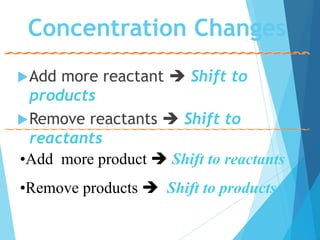
Concentration Changes
Add more reactant  Shift to
products
Remove reactants  Shift to
reactants
•Add more product  Shift to reactants
•Remove products  Shift to products
2 NO2 (g) N2O4 (g)
car exhaust smog
Huge spike indicates that [ ] was changed by adding more particles.
2 NO2 (g) N2O4 (g)
car exhaust smog
A huge spike indicates that [ ] was changed by removing particles.
Temperature
Temperature stress addressed the SAME way as
concentration by changing collision rates.
**Re-establishes new eqlbm (with new [ ]s)
at new temperature – SO…changes the Kc.
Exothermic: A B (- ∆H )
Endothermic: A B (+ ∆H)
HEAT +
+ HEAT
2. Temperature stress
Temperature increase / add heat
• Reaction shifts left.
• Endothermic collisions (reverse) favored.
Temperature decrease / removing heat
• Reaction shifts right.
• Exothermic collisions (forward) favored.
+ heat
heat
A B
+
A B
= [B]
[A]
= [B]
[A]
Kc
Kc
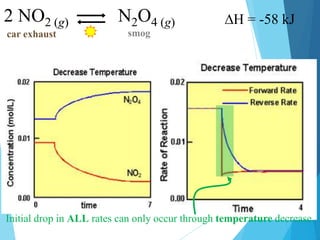
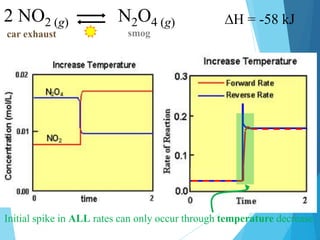
∆H = -58 kJ
2 NO2 (g) N2O4 (g)
car exhaust smog
Initial drop in ALL rates can only occur through temperature decrease.
∆H = -58 kJ
2 NO2 (g) N2O4 (g)
car exhaust smog
Initial spike in ALL rates can only occur through temperature decrease.
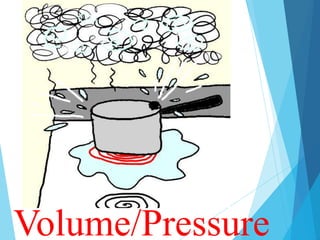
Volume/Pressure
Pressure Changes
Only affects equilibrium
systems with unequal
moles of gaseous
reactants and products.
Changing the pressure of a system only
affects those equilibria with gaseous
reactants and/or products.
3. Volume stress
Rates of collisions change with pressure and
effect all concentrations – BUT, Kc
will re-establish***.
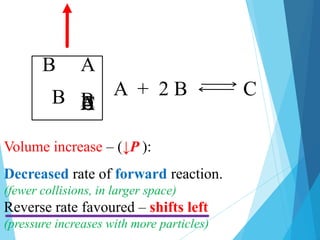
A + 2 B  C
A + 2 B C
Volume increase – (↓P ):
A
B
B
C
Decreased rate of forward reaction.
(fewer collisions, in larger space)
Reverse rate favoured – shifts left
(pressure increases with more particles)
B
B
A
A + 2 B C
A
B
B
C
C
Volume decrease– (↑P ):
Increased rate of forward reaction.
(MORE collisions, in smaller space)
Forward rate favoured – shifts right
(pressure reduced with fewer particles)
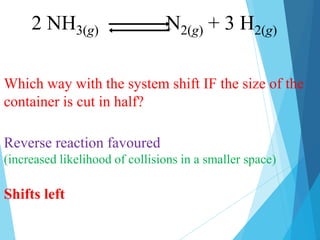
Which way with the system shift IF the size of the
container is cut in half?
Reverse reaction favoured
(increased likelihood of collisions in a smaller space)
Shifts left
2 NH3(g) N2(g) + 3 H2(g)
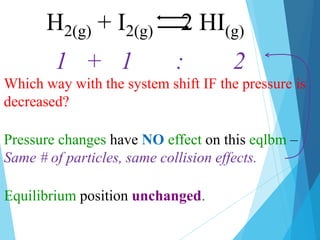
Equilibrium position unchanged.
H2(g) + I2(g) 2 HI(g)
Which way with the system shift IF the pressure is
decreased?
1 + 1 : 2
Pressure changes have NO effect on this eqlbm –
Same # of particles, same collision effects.
Factors (stresses)
that do not affect
Equilibrium Systems
Catalysts
Lowers activation energy for both forward and
reverse reaction equally.
Equilibrium established more quickly, but position
and ratios of concentrations will remain the same.
K value remains the same.
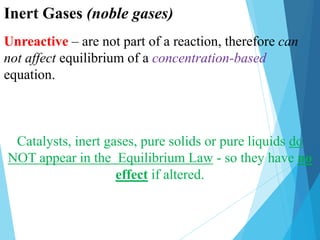
Inert Gases (noble gases)
Unreactive – are not part of a reaction, therefore can
not affect equilibrium of a concentration-based
equation.
Catalysts, inert gases, pure solids or pure liquids do
NOT appear in the Equilibrium Law - so they have no
effect if altered.
Le Chatelier's
AND
life
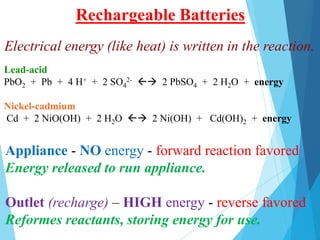
Appliance - NO energy - forward reaction favored
Energy released to run appliance.
Outlet (recharge) – HIGH energy - reverse favored
Reformes reactants, storing energy for use.
Rechargeable Batteries
Lead-acid
PbO2 + Pb + 4 H+ + 2 SO4
2-  2 PbSO4 + 2 H2O + energy
Nickel-cadmium
Cd + 2 NiO(OH) + 2 H2O  2 Ni(OH) + Cd(OH)2 + energy
Electrical energy (like heat) is written in the reaction.
Haemoglobin protein used to transport O2 from lungs to
body tissue.
Lungs - [O2] is high - forward reaction favored
Haemoglobin binds O2
Tissue - [CO2] is high and [O2] is low - reverse
reaction favored. Hb releases O2
Hb (aq) + O2 (g)  HbO2 (aq)
Haemoglobin AND Oxygen
CAN YOU / HAVE YOU?
• Use Le Chatelier’s principle to predict and
explain shifts in equilibrium.
Include: temperature, pressure/volume,
reactant/product concentration, catalyst, inert gas
• Interpret concentration versus time graphs.
Include: temp, concentration, catalyst changes.
• Describe practical applications of Le Chatelier’s
principle.

Le Chateliers Principle 2 chemistry grade 12

  • 1.
  • 2.
    Le Chatelier's Principle(1884) When a system at equilibrium is subjected to a stress, the system will adjust to relieve the stress and return to equilibrium. Remember: Kc value is constant. BEFORE the stress, and AFTER the reaction adjusts. It is like the “undo” button on your computer!
  • 3.
  • 4.
  • 5.
    1. Concentration Stress Stress:a change in concentration of products or reactants by adding or removing. Adjustment: change in collision rate and redistribution of particles. • [Add] – system shifts to use it up. • [Remove] – system shifts to make more.
  • 6.
    • More Cmeans increased rate of reverse reaction. Kc = [C] [A][B] C B A + Kc = 1.35 We say “shifts left” We mean: • Excess C used up until ratio of product to reactant concentrations is equal to Kc once again. Increase [C]:
  • 7.
    Kc = [C] [A][B] BC A + Kc = 1.35 • Forward reaction is favoured We say “shifts right” We mean: • New concentrations re-establish Kc. Increase [B]:
  • 8.
    Kc = [C] [A][B] BC A + Kc = 1.35 Removing a particle is like decreasing [ ]. • Decreased rate of forward reaction collisions. We say “shifts left” We mean: • Reverse is favoured, ↑ reactants, Kc the same. Decrease [A]:
  • 9.
    Concentration Changes Add morereactant  Shift to products Remove reactants  Shift to reactants •Add more product  Shift to reactants •Remove products  Shift to products
  • 10.
    2 NO2 (g)N2O4 (g) car exhaust smog Huge spike indicates that [ ] was changed by adding more particles.
  • 11.
    2 NO2 (g)N2O4 (g) car exhaust smog A huge spike indicates that [ ] was changed by removing particles.
  • 12.
  • 13.
    Temperature stress addressedthe SAME way as concentration by changing collision rates. **Re-establishes new eqlbm (with new [ ]s) at new temperature – SO…changes the Kc. Exothermic: A B (- ∆H ) Endothermic: A B (+ ∆H) HEAT + + HEAT 2. Temperature stress
  • 14.
    Temperature increase /add heat • Reaction shifts left. • Endothermic collisions (reverse) favored. Temperature decrease / removing heat • Reaction shifts right. • Exothermic collisions (forward) favored. + heat heat A B + A B = [B] [A] = [B] [A] Kc Kc
  • 15.
    ∆H = -58kJ 2 NO2 (g) N2O4 (g) car exhaust smog Initial drop in ALL rates can only occur through temperature decrease.
  • 16.
    ∆H = -58kJ 2 NO2 (g) N2O4 (g) car exhaust smog Initial spike in ALL rates can only occur through temperature decrease.
  • 17.
  • 18.
    Pressure Changes Only affectsequilibrium systems with unequal moles of gaseous reactants and products.
  • 19.
    Changing the pressureof a system only affects those equilibria with gaseous reactants and/or products. 3. Volume stress Rates of collisions change with pressure and effect all concentrations – BUT, Kc will re-establish***. A + 2 B  C
  • 20.
    A + 2B C Volume increase – (↓P ): A B B C Decreased rate of forward reaction. (fewer collisions, in larger space) Reverse rate favoured – shifts left (pressure increases with more particles) B B A
  • 21.
    A + 2B C A B B C C Volume decrease– (↑P ): Increased rate of forward reaction. (MORE collisions, in smaller space) Forward rate favoured – shifts right (pressure reduced with fewer particles)
  • 22.
    Which way withthe system shift IF the size of the container is cut in half? Reverse reaction favoured (increased likelihood of collisions in a smaller space) Shifts left 2 NH3(g) N2(g) + 3 H2(g)
  • 23.
    Equilibrium position unchanged. H2(g)+ I2(g) 2 HI(g) Which way with the system shift IF the pressure is decreased? 1 + 1 : 2 Pressure changes have NO effect on this eqlbm – Same # of particles, same collision effects.
  • 24.
    Factors (stresses) that donot affect Equilibrium Systems
  • 25.
    Catalysts Lowers activation energyfor both forward and reverse reaction equally. Equilibrium established more quickly, but position and ratios of concentrations will remain the same. K value remains the same.
  • 26.
    Inert Gases (noblegases) Unreactive – are not part of a reaction, therefore can not affect equilibrium of a concentration-based equation. Catalysts, inert gases, pure solids or pure liquids do NOT appear in the Equilibrium Law - so they have no effect if altered.
  • 27.
  • 28.
    Appliance - NOenergy - forward reaction favored Energy released to run appliance. Outlet (recharge) – HIGH energy - reverse favored Reformes reactants, storing energy for use. Rechargeable Batteries Lead-acid PbO2 + Pb + 4 H+ + 2 SO4 2-  2 PbSO4 + 2 H2O + energy Nickel-cadmium Cd + 2 NiO(OH) + 2 H2O  2 Ni(OH) + Cd(OH)2 + energy Electrical energy (like heat) is written in the reaction.
  • 29.
    Haemoglobin protein usedto transport O2 from lungs to body tissue. Lungs - [O2] is high - forward reaction favored Haemoglobin binds O2 Tissue - [CO2] is high and [O2] is low - reverse reaction favored. Hb releases O2 Hb (aq) + O2 (g)  HbO2 (aq) Haemoglobin AND Oxygen
  • 30.
    CAN YOU /HAVE YOU? • Use Le Chatelier’s principle to predict and explain shifts in equilibrium. Include: temperature, pressure/volume, reactant/product concentration, catalyst, inert gas • Interpret concentration versus time graphs. Include: temp, concentration, catalyst changes. • Describe practical applications of Le Chatelier’s principle.