Equilibrium

By: Ali Wagih
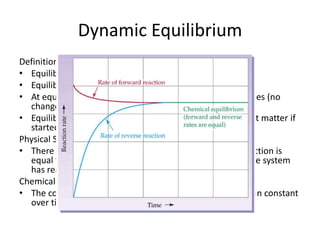
Dynamic Equilibrium
Definition:
• Equilibrium is dynamic (reactions doesn’t stop)
• Equilibrium is achieved in a closed system
• At equilibrium there's no change in macroscopic properties (no
  change in color and density)
• Equilibrium can be reached from either direction (doesn’t matter if
  started with all reactants or all products)
Physical Systems:
• There will come a time when the rate of the forward reaction is
  equal to the rate of the reverse reaction. At this point, the system
  has reached equilibrium.
Chemical Systems:
• The concentrations of both reactants and products remain constant
  over time
Equilibrium Constant
• For the hypothetical homogeneous chemical reaction:
                    aA+bB cC+dD
      The equilibrium constant is defined as
KC = [C]^c [D]^d       , where [A] signifies the molar
                          concentration of species
       [A]^a [B]^b
• Note that the expression for the equilibrium constant
  includes only solutes and gases; pure solids and liquids
  do not appear in the expression.
Magnitude of the Equilibrium Constant
• When Kc >> 1, the reaction goes almost to completion
• When Kc << 1, the reaction hardly proceeds
If the value of Kc is large (Kc >> 1 ):
• the equilibrium lies to the right hand side - i.e. there is
    a much greater concentration of the products than the
    reactants
If the value of Kc is small (Kc << 1):
• the equilibrium lies to the left hand side - i.e. there is a
    much greater concentration of reactants than
    products.
Le Chatelier’s Principle
• States: when a stress is brought to bear on a
  system at equilibrium, the system will react in
  the direction that serves to relieve the stress.
Temperature
• The only thing which can change the value of Kc for a given
  reaction is a change in temperature.
• The effect of a change of temperature on a reaction will
  depend on whether the reaction is exothermic or
  endothermic
• When the temperature increases, Le Chatelier's principle
  says the reaction will proceed in such a way as to
  counteract this change, i.e. lower the temperature.
• Endothermic reactions (Hrxn > 0 )will move forward, and
  exothermic reactions (Hrxn < 0 )will move backwards
• The reverse is true for a lowering of temperature.
Pressure
• According to Le Chatelier, the position of equilibrium
  will move in such a way as to counteract the change.
  That means that the position of equilibrium will move
  so that the pressure is reduced again.
• Increasing the pressure on a gas reaction shifts the
  position of equilibrium towards the side with fewer
  molecules.
• In the case of the same number of molecules on both
  sides of the equilibrium reaction, increasing the
  pressure has no effect whatsoever on the position of
  the equilibrium.
Concentration
• When the concentration of a product is
  increased, the reaction proceeds in reverse to
  decrease the concentration of the products.
      a+b c+d , reaction moves backwards
• When the concentration of a reactant is
  increased, the reaction proceeds forward to
  decrease the concentration of reactants.
      a+b c+d , reaction moves forward
Value of the Equilibrium Constant
Equilibrium constants aren't changed if you
change the pressure of the system.
Equilibrium constants aren't changed if you add
a catalyst.
Temperature:
• Equilibrium constants are changed if you
  change the temperature of the system
• As the temperature increases, the value of Kc
  falls.
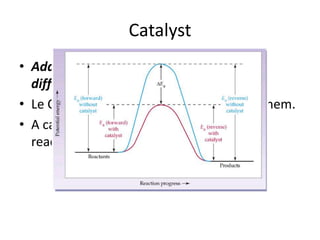
Catalyst
• Adding a catalyst makes absolutely no
  difference to the position of equilibrium
• Le Chatelier's Principle doesn't apply to them.
• A catalyst speeds up the rate at which a
  reaction reaches dynamic equilibrium.
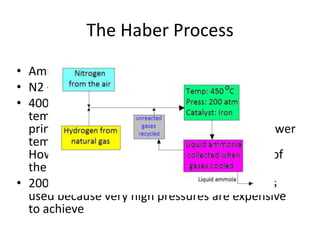
The Haber Process
• Ammonia: (Haber Process)
• N2 + 3H2 2NH3          -92kJ/mol
• 400-450 degrees Celsius is not a low
  temperature, which defies the Le Chatelier’s
  principle, as it would be expected to have a lower
  temperature to produce more ammonia.
  However, this was done to speed up the rate of
  the process
• 200 atm is not a very high pressure, but it was
  used because very high pressures are expensive
  to achieve
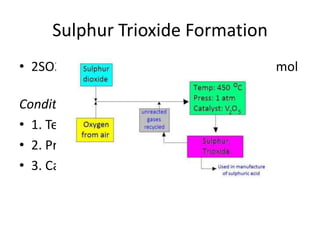
Sulphur Trioxide Formation
• 2SO2(g) + O2(g) <=> 2SO3(g) ∆H = -196 kJ/mol

Conditions required for the reaction:
• 1. Temperature: 450 oC
• 2. Pressure : 1 atm
• 3. Catalyst: Vanadium (V) oxide

Equilibrium

  • 1.
  • 2.
    Dynamic Equilibrium Definition: • Equilibriumis dynamic (reactions doesn’t stop) • Equilibrium is achieved in a closed system • At equilibrium there's no change in macroscopic properties (no change in color and density) • Equilibrium can be reached from either direction (doesn’t matter if started with all reactants or all products) Physical Systems: • There will come a time when the rate of the forward reaction is equal to the rate of the reverse reaction. At this point, the system has reached equilibrium. Chemical Systems: • The concentrations of both reactants and products remain constant over time
  • 3.
    Equilibrium Constant • Forthe hypothetical homogeneous chemical reaction: aA+bB cC+dD The equilibrium constant is defined as KC = [C]^c [D]^d , where [A] signifies the molar concentration of species [A]^a [B]^b • Note that the expression for the equilibrium constant includes only solutes and gases; pure solids and liquids do not appear in the expression.
  • 4.
    Magnitude of theEquilibrium Constant • When Kc >> 1, the reaction goes almost to completion • When Kc << 1, the reaction hardly proceeds If the value of Kc is large (Kc >> 1 ): • the equilibrium lies to the right hand side - i.e. there is a much greater concentration of the products than the reactants If the value of Kc is small (Kc << 1): • the equilibrium lies to the left hand side - i.e. there is a much greater concentration of reactants than products.
  • 5.
    Le Chatelier’s Principle •States: when a stress is brought to bear on a system at equilibrium, the system will react in the direction that serves to relieve the stress.
  • 6.
    Temperature • The onlything which can change the value of Kc for a given reaction is a change in temperature. • The effect of a change of temperature on a reaction will depend on whether the reaction is exothermic or endothermic • When the temperature increases, Le Chatelier's principle says the reaction will proceed in such a way as to counteract this change, i.e. lower the temperature. • Endothermic reactions (Hrxn > 0 )will move forward, and exothermic reactions (Hrxn < 0 )will move backwards • The reverse is true for a lowering of temperature.
  • 7.
    Pressure • According toLe Chatelier, the position of equilibrium will move in such a way as to counteract the change. That means that the position of equilibrium will move so that the pressure is reduced again. • Increasing the pressure on a gas reaction shifts the position of equilibrium towards the side with fewer molecules. • In the case of the same number of molecules on both sides of the equilibrium reaction, increasing the pressure has no effect whatsoever on the position of the equilibrium.
  • 8.
    Concentration • When theconcentration of a product is increased, the reaction proceeds in reverse to decrease the concentration of the products. a+b c+d , reaction moves backwards • When the concentration of a reactant is increased, the reaction proceeds forward to decrease the concentration of reactants. a+b c+d , reaction moves forward
  • 9.
    Value of theEquilibrium Constant Equilibrium constants aren't changed if you change the pressure of the system. Equilibrium constants aren't changed if you add a catalyst. Temperature: • Equilibrium constants are changed if you change the temperature of the system • As the temperature increases, the value of Kc falls.
  • 10.
    Catalyst • Adding acatalyst makes absolutely no difference to the position of equilibrium • Le Chatelier's Principle doesn't apply to them. • A catalyst speeds up the rate at which a reaction reaches dynamic equilibrium.
  • 11.
    The Haber Process •Ammonia: (Haber Process) • N2 + 3H2 2NH3 -92kJ/mol • 400-450 degrees Celsius is not a low temperature, which defies the Le Chatelier’s principle, as it would be expected to have a lower temperature to produce more ammonia. However, this was done to speed up the rate of the process • 200 atm is not a very high pressure, but it was used because very high pressures are expensive to achieve
  • 12.
    Sulphur Trioxide Formation •2SO2(g) + O2(g) <=> 2SO3(g) ∆H = -196 kJ/mol Conditions required for the reaction: • 1. Temperature: 450 oC • 2. Pressure : 1 atm • 3. Catalyst: Vanadium (V) oxide