Layout  : Layout involves the allocation of space and the arrangement of equipment in such a manner that the overall operating costs are minimized. Plant Layout Er.Sartaj Singh Bajwa
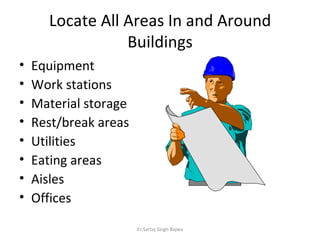
Locate All Areas In and Around Buildings Equipment Work stations Material storage Rest/break areas Utilities Eating areas Aisles Offices Er.Sartaj Singh Bajwa
Characteristics of the Facility Layout Decision Location of these various areas impacts the flow through the system. The layout can affect productivity and costs generated by the system. Layout alternatives are limited by the amount and type of space required for the various areas the amount and type of space available Er.Sartaj Singh Bajwa
Objectives of the Lay out Strategy Develop an economical layout which will meet the requirements of: product design and volume (product strategy) Process equipment and capacity (process strategy) quality of work life (human resource strategy) building and site constraints (location strategy) Er.Sartaj Singh Bajwa
Requirements of a Good Layout A good layout requires: an understanding of capacity & space requirements selection of appropriate material handling equipment decisions regarding environment identification and understanding of the requirements for information flow identification of the cost of moving between the various work areas Er.Sartaj Singh Bajwa
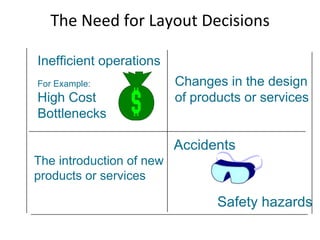
The Need for Layout Decisions Inefficient operations For Example: High Cost Bottlenecks Changes in the design of products or services The introduction of new products or services Accidents Safety hazards
The Need for Layout Designs (Cont’d) Changes in environmental or other legal requirements Changes in volume of output or mix of products Changes in methods and equipment Morale problems
Requires substantial investments of money and effort Involves long-term commitments Has significant impact on cost and efficiency of short-term operations Importance of Layout Decisions Er.Sartaj Singh Bajwa
Advantages Of A Good Layout To the worker In manufacturing costs In production control & Supervision Optimum utilization Er.Sartaj Singh Bajwa
To the worker Lesser number of operations & material handling More labor productivity More safety and security to workers Better working conditions resulting improved efficiency Er.Sartaj Singh Bajwa
In Manufacturing Costs Maintenance & replacement costs are reduced Loss due to wastage & spoilage is minimized Better cost control Improved quality of product with reduction in handling Er.Sartaj Singh Bajwa
In Production Control & Supervision Provide more space for production operations Better and convenient storage facilities Results in less inspection activity Control and supervision operations are provided at appropriate points Er.Sartaj Singh Bajwa
Optimum Utilization Efficient use of machines Per unit production time is minimized Effective utilization of floor space  Er.Sartaj Singh Bajwa

Layout intro

  • 1.
    Layout :Layout involves the allocation of space and the arrangement of equipment in such a manner that the overall operating costs are minimized. Plant Layout Er.Sartaj Singh Bajwa
  • 2.
    Locate All AreasIn and Around Buildings Equipment Work stations Material storage Rest/break areas Utilities Eating areas Aisles Offices Er.Sartaj Singh Bajwa
  • 3.
    Characteristics of theFacility Layout Decision Location of these various areas impacts the flow through the system. The layout can affect productivity and costs generated by the system. Layout alternatives are limited by the amount and type of space required for the various areas the amount and type of space available Er.Sartaj Singh Bajwa
  • 4.
    Objectives of theLay out Strategy Develop an economical layout which will meet the requirements of: product design and volume (product strategy) Process equipment and capacity (process strategy) quality of work life (human resource strategy) building and site constraints (location strategy) Er.Sartaj Singh Bajwa
  • 5.
    Requirements of aGood Layout A good layout requires: an understanding of capacity & space requirements selection of appropriate material handling equipment decisions regarding environment identification and understanding of the requirements for information flow identification of the cost of moving between the various work areas Er.Sartaj Singh Bajwa
  • 6.
    The Need forLayout Decisions Inefficient operations For Example: High Cost Bottlenecks Changes in the design of products or services The introduction of new products or services Accidents Safety hazards
  • 7.
    The Need forLayout Designs (Cont’d) Changes in environmental or other legal requirements Changes in volume of output or mix of products Changes in methods and equipment Morale problems
  • 8.
    Requires substantial investmentsof money and effort Involves long-term commitments Has significant impact on cost and efficiency of short-term operations Importance of Layout Decisions Er.Sartaj Singh Bajwa
  • 9.
    Advantages Of AGood Layout To the worker In manufacturing costs In production control & Supervision Optimum utilization Er.Sartaj Singh Bajwa
  • 10.
    To the workerLesser number of operations & material handling More labor productivity More safety and security to workers Better working conditions resulting improved efficiency Er.Sartaj Singh Bajwa
  • 11.
    In Manufacturing CostsMaintenance & replacement costs are reduced Loss due to wastage & spoilage is minimized Better cost control Improved quality of product with reduction in handling Er.Sartaj Singh Bajwa
  • 12.
    In Production Control& Supervision Provide more space for production operations Better and convenient storage facilities Results in less inspection activity Control and supervision operations are provided at appropriate points Er.Sartaj Singh Bajwa
  • 13.
    Optimum Utilization Efficientuse of machines Per unit production time is minimized Effective utilization of floor space Er.Sartaj Singh Bajwa