Kohlberg's
Theory of Moral
Development
Lawrence Kohlberg
YEAR EVENT
October
15,
1927
 born in Bronxville, New York
1948
 enters The University of
Chicago and completes his
bachelor’s degree in
Psychology in one year
1949
 begins his doctoral work at The
University of Chicago
1957-
1958
 completes his doctoral
dissertation research on the
moral development of children
1968
 As a result of his dissertation
research, Kohlberg found
professional fame
1969
 Influenced by the kibbutz in his
travel in Israel, Kohlberg returns to
US and founds several “just
communities”
1971
 While conducting cross-cultural
work in Belize, Kohlberg contracts
a tropical disease that plague
him physically and mentally for
the next sixteen years
1987
from a
 On leave
Massachusetts
where he
treatment for
hospital
is seeking
the above
Kohlberg
by
commit
s
drowning
illness,
suicide
himself in Boston Harbor.
He was 59 years old
Kohlberg extended Piaget's theory;
proposed that moral development is a
continual process that occurs throughout
the lifespan.
used Piaget’s story-telling technique to tell
people stories involving moral dilemmas.
Theory of Moral Development
He based his theory upon research and
interviews with groups of young children.
A series of moral dilemmas were presented
to these participants and they were also
interviewed to determine the reasoning
behind their judgments of each scenario.
One of the best known stories of Kohlberg’s
(1958) concerns a man called Heinz who
lived somewhere in Europe.
A woman was near death from cancer. One drug might
save her, a form of radium that a druggist in the same town
had recently discovered. The druggist was charging
$2,000.00,tentimeswhat thedrugcost himto make.
The sick woman's husband, Heinz, went to everyone he
knew to borrow the money, but he could only get together
about half of what it cost. He told the druggist that his wife
wasdying and asked himto sell it cheaper or let himpay later.
But the druggist said "no."
The husband got desperate and broke into the man's
store to steal the drugfor his wife. Should the husband have
done that? ....Why do you thinkso?
3 Levels of Moral Reasoning
1
Preconventional
2
Conventional
3
Post-Conventional
Stage 1
Obedience and Punishment
Stage 2
Individualism and Exchange
Stage 3
Interpersonal Relationships
Stage 4
Maintaining Social Order
Stage 5
Social Contract & Individual Rights
Stage 6
Universal Principles
 (age 4 - 10)
a person is motivated by obedience to
authority.
commonly associated with young children
involves little thought about morality.
moral code is shaped by the standards of
adults and the consequences of following or
breaking their rules.
A. Stage 1 - Obedience & Punishment
earliest stage of moral development
common in young children
children see rules as fixed and absolute.
Obeying the rules is important to avoid
punishment.
morality is motivated solely by punishment
B. Stage 2 - Individualism & Exchange
children account individual points of view
judge actions based on how they serve
individual needs.
Reciprocity is possible but only if it serves
one's own interests.
B. Stage 2 - Individualism & Exchange
children recognize that there is not just
one right view and that different
individuals have different viewpoints.
different
focuses on individualism and
perspectives,
the goal isto avoid punishment.
E X A M P L E S :
S tage1:
“I willkeep quiet so that teacher won’tget madat me.”
S tage2:
“I willlet you copy mineif you do myhomework.”
(age 10 - 13)
people focus on following social norms and
customs.
begin to internalize the moral standards of
valued adult role models.
Reasoning is based on the norms of the
group to which the person belongs.
C. Stage 3 - Interpersonal Relationships
Also known as "good boy-good girl"
orientation
focused on living up to social expectations
and roles
emphasis on conformity, being "nice,"
consider how choices influence
relationships.
C. Stage 3 - Interpersonal Relationships
emphasizes the maintenance happy
interpersonal relationships and pleasing
others.
a need to avoid rejection, disaffection, or
disapproval from others.
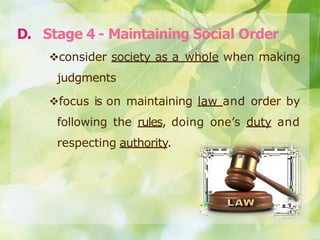
D. Stage 4 - Maintaining Social Order
consider society as a whole when making
judgments
focus is on maintaining law and order by
following the rules, doing one’s duty and
respecting authority.
D. Stage 4 - Maintaining Social Order
please individuals to maintaining social order
by following social norms, customs, and laws.
becomes aware of the wider rules of society
to avoid guilt.
a need to not be criticized by a true authority
figure
E X A M P L E S :
S tage3:
“I willbuy that dress sothat myfriends willlikeme.”
S tage4:
“You shouldnot cut the classbecause it’s against
school rules.”
(adolescence - adulthood)
people look beyond convention to
determine moral norms and appropriate
social interactions.
judgment isbased on self-chosen principles
moral reasoning is based on individual rights
and justice
E. Stage 5 - Social Contract &Individual
Rights
begin to account the differing values,
opinions and beliefs of other people.
Laws are important but members of the
society should agree upon these
standards.
E. Stage 5 - Social Contract &Individual
Rights
becomes aware there are times when
they will work against rules or the interest of
particular individuals
emphasis on the social contract and the
maintenance of individual rights
F. Stage 6 - Universal Principles
reasoning is based on universal ethical
principles and abstract reasoning
follow these internalized principles of
justice, even if its against the law
moral judgment is motivated by one's own
conscience
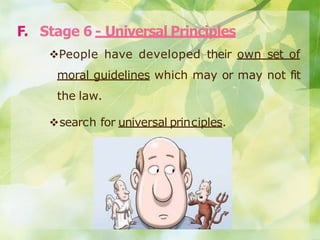
F. Stage 6 - Universal Principles
People have developed their own set of
moral guidelines which may or may not fit
the law.
search for universal principles.
E X A M P L E S :
S tage5:
“It is her owndecision, weshouldjust respect that.”
S tage6:
“If abortion becamelegal inourcountry, I willbe one
of the people whowillbe against it because it’s
against God’s Law.”
Resources:
http://psychology.about.com/od/developmentalp
sychology/a/kohlberg.htm
http://www.simplypsychology.org/kohlberg.html
http://www.goodtherapy.org/blog/psychpedia/ko
hlberg-moral-development
http://relong.myweb.uga.edu/#who
http://tigger.uic.edu/~lnucci/MoralEd/articles/n
uccisynthesis.html
Thank You!
THE END

TPIC 8 MORAL DEVELOPMENT.pptx

  • 1.
  • 2.
  • 3.
    YEAR EVENT October 15, 1927  bornin Bronxville, New York 1948  enters The University of Chicago and completes his bachelor’s degree in Psychology in one year
  • 4.
    1949  begins hisdoctoral work at The University of Chicago 1957- 1958  completes his doctoral dissertation research on the moral development of children 1968  As a result of his dissertation research, Kohlberg found professional fame
  • 5.
    1969  Influenced bythe kibbutz in his travel in Israel, Kohlberg returns to US and founds several “just communities” 1971  While conducting cross-cultural work in Belize, Kohlberg contracts a tropical disease that plague him physically and mentally for the next sixteen years
  • 6.
    1987 from a  Onleave Massachusetts where he treatment for hospital is seeking the above Kohlberg by commit s drowning illness, suicide himself in Boston Harbor. He was 59 years old
  • 7.
    Kohlberg extended Piaget'stheory; proposed that moral development is a continual process that occurs throughout the lifespan. used Piaget’s story-telling technique to tell people stories involving moral dilemmas. Theory of Moral Development
  • 8.
    He based histheory upon research and interviews with groups of young children. A series of moral dilemmas were presented to these participants and they were also interviewed to determine the reasoning behind their judgments of each scenario.
  • 9.
    One of thebest known stories of Kohlberg’s (1958) concerns a man called Heinz who lived somewhere in Europe.
  • 10.
    A woman wasnear death from cancer. One drug might save her, a form of radium that a druggist in the same town had recently discovered. The druggist was charging $2,000.00,tentimeswhat thedrugcost himto make. The sick woman's husband, Heinz, went to everyone he knew to borrow the money, but he could only get together about half of what it cost. He told the druggist that his wife wasdying and asked himto sell it cheaper or let himpay later. But the druggist said "no." The husband got desperate and broke into the man's store to steal the drugfor his wife. Should the husband have done that? ....Why do you thinkso?
  • 11.
    3 Levels ofMoral Reasoning
  • 12.
    1 Preconventional 2 Conventional 3 Post-Conventional Stage 1 Obedience andPunishment Stage 2 Individualism and Exchange Stage 3 Interpersonal Relationships Stage 4 Maintaining Social Order Stage 5 Social Contract & Individual Rights Stage 6 Universal Principles
  • 13.
     (age 4- 10) a person is motivated by obedience to authority. commonly associated with young children involves little thought about morality. moral code is shaped by the standards of adults and the consequences of following or breaking their rules.
  • 14.
    A. Stage 1- Obedience & Punishment earliest stage of moral development common in young children children see rules as fixed and absolute. Obeying the rules is important to avoid punishment. morality is motivated solely by punishment
  • 15.
    B. Stage 2- Individualism & Exchange children account individual points of view judge actions based on how they serve individual needs. Reciprocity is possible but only if it serves one's own interests.
  • 16.
    B. Stage 2- Individualism & Exchange children recognize that there is not just one right view and that different individuals have different viewpoints. different focuses on individualism and perspectives, the goal isto avoid punishment.
  • 17.
    E X AM P L E S : S tage1: “I willkeep quiet so that teacher won’tget madat me.” S tage2: “I willlet you copy mineif you do myhomework.”
  • 18.
    (age 10 -13) people focus on following social norms and customs. begin to internalize the moral standards of valued adult role models. Reasoning is based on the norms of the group to which the person belongs.
  • 19.
    C. Stage 3- Interpersonal Relationships Also known as "good boy-good girl" orientation focused on living up to social expectations and roles emphasis on conformity, being "nice," consider how choices influence relationships.
  • 20.
    C. Stage 3- Interpersonal Relationships emphasizes the maintenance happy interpersonal relationships and pleasing others. a need to avoid rejection, disaffection, or disapproval from others.
  • 21.
    D. Stage 4- Maintaining Social Order consider society as a whole when making judgments focus is on maintaining law and order by following the rules, doing one’s duty and respecting authority.
  • 22.
    D. Stage 4- Maintaining Social Order please individuals to maintaining social order by following social norms, customs, and laws. becomes aware of the wider rules of society to avoid guilt. a need to not be criticized by a true authority figure
  • 23.
    E X AM P L E S : S tage3: “I willbuy that dress sothat myfriends willlikeme.” S tage4: “You shouldnot cut the classbecause it’s against school rules.”
  • 24.
    (adolescence - adulthood) peoplelook beyond convention to determine moral norms and appropriate social interactions. judgment isbased on self-chosen principles moral reasoning is based on individual rights and justice
  • 25.
    E. Stage 5- Social Contract &Individual Rights begin to account the differing values, opinions and beliefs of other people. Laws are important but members of the society should agree upon these standards.
  • 26.
    E. Stage 5- Social Contract &Individual Rights becomes aware there are times when they will work against rules or the interest of particular individuals emphasis on the social contract and the maintenance of individual rights
  • 27.
    F. Stage 6- Universal Principles reasoning is based on universal ethical principles and abstract reasoning follow these internalized principles of justice, even if its against the law moral judgment is motivated by one's own conscience
  • 28.
    F. Stage 6- Universal Principles People have developed their own set of moral guidelines which may or may not fit the law. search for universal principles.
  • 29.
    E X AM P L E S : S tage5: “It is her owndecision, weshouldjust respect that.” S tage6: “If abortion becamelegal inourcountry, I willbe one of the people whowillbe against it because it’s against God’s Law.”
  • 30.
  • 31.