Law Libraries and
       Emerging Technologies


Saskia Mehlhorn, Assessor jur., LL.M.
            March 2009
Emerging Technologies
   Nanotechnology
   Semantic Web
   Cognitive Science
   Artificial Intelligence
                           and
   Web 2.0 with an assortment of tools suitable
    for use in law libraries
Web 2.0
Has no hard boundary but rather a
  gravitational core.
Visualize Web 2.0 as a set of principles and
  practices that tie together a veritable solar
  system of sites that demonstrate some or all
  of those principles, at a varying distance from
  that core.
Blogs:
                              Participation
       Flickr, diigo:                         Wiki’s: trust in
         Tagging                               Universal
       not taxonomy                            knowledge


                                                        Services,
“Attitude not                  The Web
                                                       not packaged
 Technolgy”                   as a Platform
                                                         software


       Software gets better                    Harnessing
        with the growing                        collective
         number of users
                                               intelligence

                                Playful
Applications

   Social networking
   Social bookmarking
   Participation and Expression
   Initiation of virtual realities
flickr


   One of the earliest web 2.0 platforms
   Image, video hosting website, web service
    suite, and online community platform
flickr
     This is a snapshot of the Thomas Fisher Rare Book Library on flickr
Facebook
   Social network website, especially used by
    students other than LinkedIn which is for
    “older” professionals or myspace which is
    popular among high school students
   Useful to stay in touch with friends and
    colleagues around the country and the globe
   Excellent tool for alumni associations
Facebook
diigo

   Digest of Internet Information, Groups and
    Other things
   Social bookmarking website which allows
    users to bookmark and tag web-pages
   Can be shared with friends and groups
   In 2006 named one of the 10 best research
    tools
diigo
Wiki
   Comes from the Hawaiian and means “fast”
   Designed to enable anyone who accesses to
    contribute and modify content
   Can be open, and for anyone, or access-
    restricted
   Often used in business to provide Knowledge
    Management
Wiki
Twitter
   Twitter is a free social networking and micro-
    blogging service launched in 2006
   Allows users to send and read other users'
    updates which are up to 140 characters in
    length
   Public or private
   Ideal for exchange of links etc.
   In August 2008 it was used the first time for
    up-to-the-minute court reporting
Twitter
Twitter Applications

   Twitter is elegant, but limiting. As a result,
    hundreds of third-party tools were developed
    to enhance Twitter.
   TweetBeep
   Twellow
   TwitterFeed
TweetBeep
Twellow
TwitterFeed
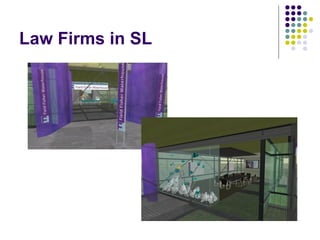
Second Life

   Internet-based virtual world launched in 2003,
    became widely known in 2006/2007
   Used by companies as a training tool
   Info Island offers a variety of specialty
    libraries among them law libraries
Law Firms in SL
Open House of Law Libraries
Law Library of Nova
Southeastern University
Second Life
legallyminded
   Provided by the ABA
   Currently in the beta phase
   Geared towards legal community
   Combines networking features (People Map,
    blog, wiki etc.) with news and articles and the
    possibility to schedule meetings within your
    sub-community.
Use of emerging technologies

   As a research tool
   As a teaching tool
   As a knowledge management tool
   As a marketing tool
Research Tool


   Diigo – bookmark once – share with a group
   Facebook – network, connect and share
   Twitter – write and share
Teaching Tool
   Second Life – Set up a session in SL – a
    different set of students will respond
   Wiki – assign every student a topic to report
    on
   Blog – widely used in private law libraries,
    good way to prepare for practice
   Twitter – in trial (or moot court) instant
    connection - train now - use later
Knowledge Management Tool

   Creation
   Capture/Harvest
   Organize
   Share
   Refine
Marketing Tool
   Flickr – present your library and your school
   Facebook – connect with alumni, current and
    future students
   Twitter – through Hein Online, WestLaw and
    the like stay connected
   SL – have a presence
   Diigo – search and find where you are
    present
The Future of Law Libraries

  is connected to technology.
 We librarians have the training
   to use technology, but we
  have to raise our voice and
        make it be heard.

Law Libraries And Emerging Technologies

  • 1.
    Law Libraries and Emerging Technologies Saskia Mehlhorn, Assessor jur., LL.M. March 2009
  • 2.
    Emerging Technologies  Nanotechnology  Semantic Web  Cognitive Science  Artificial Intelligence and  Web 2.0 with an assortment of tools suitable for use in law libraries
  • 3.
    Web 2.0 Has nohard boundary but rather a gravitational core. Visualize Web 2.0 as a set of principles and practices that tie together a veritable solar system of sites that demonstrate some or all of those principles, at a varying distance from that core.
  • 4.
    Blogs: Participation Flickr, diigo: Wiki’s: trust in Tagging Universal not taxonomy knowledge Services, “Attitude not The Web not packaged Technolgy” as a Platform software Software gets better Harnessing with the growing collective number of users intelligence Playful
  • 5.
    Applications  Social networking  Social bookmarking  Participation and Expression  Initiation of virtual realities
  • 6.
    flickr  One of the earliest web 2.0 platforms  Image, video hosting website, web service suite, and online community platform
  • 7.
    flickr This is a snapshot of the Thomas Fisher Rare Book Library on flickr
  • 8.
    Facebook  Social network website, especially used by students other than LinkedIn which is for “older” professionals or myspace which is popular among high school students  Useful to stay in touch with friends and colleagues around the country and the globe  Excellent tool for alumni associations
  • 9.
  • 10.
    diigo  Digest of Internet Information, Groups and Other things  Social bookmarking website which allows users to bookmark and tag web-pages  Can be shared with friends and groups  In 2006 named one of the 10 best research tools
  • 11.
  • 12.
    Wiki  Comes from the Hawaiian and means “fast”  Designed to enable anyone who accesses to contribute and modify content  Can be open, and for anyone, or access- restricted  Often used in business to provide Knowledge Management
  • 13.
  • 14.
    Twitter  Twitter is a free social networking and micro- blogging service launched in 2006  Allows users to send and read other users' updates which are up to 140 characters in length  Public or private  Ideal for exchange of links etc.  In August 2008 it was used the first time for up-to-the-minute court reporting
  • 15.
  • 16.
    Twitter Applications  Twitter is elegant, but limiting. As a result, hundreds of third-party tools were developed to enhance Twitter.  TweetBeep  Twellow  TwitterFeed
  • 17.
  • 18.
  • 19.
  • 20.
    Second Life  Internet-based virtual world launched in 2003, became widely known in 2006/2007  Used by companies as a training tool  Info Island offers a variety of specialty libraries among them law libraries
  • 21.
  • 22.
    Open House ofLaw Libraries
  • 23.
    Law Library ofNova Southeastern University
  • 24.
  • 25.
    legallyminded  Provided by the ABA  Currently in the beta phase  Geared towards legal community  Combines networking features (People Map, blog, wiki etc.) with news and articles and the possibility to schedule meetings within your sub-community.
  • 26.
    Use of emergingtechnologies  As a research tool  As a teaching tool  As a knowledge management tool  As a marketing tool
  • 27.
    Research Tool  Diigo – bookmark once – share with a group  Facebook – network, connect and share  Twitter – write and share
  • 28.
    Teaching Tool  Second Life – Set up a session in SL – a different set of students will respond  Wiki – assign every student a topic to report on  Blog – widely used in private law libraries, good way to prepare for practice  Twitter – in trial (or moot court) instant connection - train now - use later
  • 29.
    Knowledge Management Tool  Creation  Capture/Harvest  Organize  Share  Refine
  • 30.
    Marketing Tool  Flickr – present your library and your school  Facebook – connect with alumni, current and future students  Twitter – through Hein Online, WestLaw and the like stay connected  SL – have a presence  Diigo – search and find where you are present
  • 31.
    The Future ofLaw Libraries is connected to technology. We librarians have the training to use technology, but we have to raise our voice and make it be heard.