Nausicaa Compression Suture
Presenter: Mah JM
Supervisor: Dr Woon SY
Introduction
 Placenta accreta spectrum (PAS) remain the major cause of postpartum
haemorrhage (PPH), even with adequate diagnosis and surgical planning
 It remains a challenge in keeping patients safe and preserve the uterus
during a crisis involving major PPH
 “Nausicaa” compression suture - as a method for haemostatic control in
major PPH - how it controls bleeding and its potential merits
Methods
• 68 consecutive patients were enrolled between October 2014 and May
2018
• Inclusion criteria: Major PPH during Caesarean section and refractory to
conservative management (oxytocin and misoprostol or uterine massage)
• Exclusion criteria: Patient with unstable vital signs
• All operations were performed by the same surgeon and assisted by other
senior obstetricians
Surgical procedure
• Patients placed in lithotomy position so that vaginal bleeding could be
checked after compression sutures were applied
• After fetus was delivered, uterus was exteriorised and bleeding sites
directly inspected while Caesarean wound was still open
• A 3/8-circle curved needle (70mm in length, with a tapered point)
threaded with a pre-cut, 45cm long, 1-0 coated Vicryl suture (Polyglactin
910, Sutupak V906E; Ethicon, Somerville, NJ, USA) for the uterine
compression suture (UCS)
• tensile strength that lasted at least 14 days after the initial haemostasis
was achieved
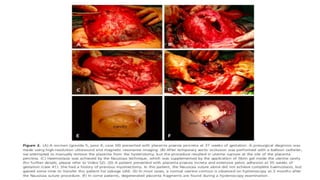
• Began with needle-transfixing from the uterine serosa lateral to the
bleeding area (or invaded myometrium) inside the uterine cavity
• The needle was then threaded along a horizontal course inside the uterine
cavity until it encompassed the bleeding area, then finally emerged at the
other side of the uterine serosa
• The sutures penetrated the full thickness of the myometrium without
stitching the anterior and posterior walls together
• A flat surgical knot was tied as tightly as possible above the serosa
• The assistant often needed to clench the sutured myometrium while the
operator tied off the knots for better compressive effect
• Additional sutures were made approximately 1.5-2.0cm parallel with the
previous stitches until hemostasis was achieved
• The UV fold needed to be dissected to expose the serosa of the lower
uterine segment
• The Nausicaa UCS can be applied over both the anterior and posterior
walls in cases of extensive PAS or uterine atony
• If no more bleeding is observed, the caesarean incision was closed
• A successful procedure was defined as one that required only the UCS
technique to achieve adequate hemostasis, some with the prophylactic use
of uterine artery embolisation (UAE) or the adjunct use of fibrin glue
Follow up
• 6 weeks after discharge - pelvic ultrasound to identify any pelvic
abnormalities
• 3 months after discharge - hysteroscopy examination of the uterine cavity
to identify any intrauterine adhesion
Results
• Causes of PPH among the participants of the study
• 36 Placenta praevia totalis with PAS (26 accreta, 7 increta, 3 percreta)
• 7 PAS over posterior or fundal wall
• 20 Placenta praevia totalis without PAS
• 5 uterine atony
• Mean time: 8.5 minutes (Range: 5-22 minutes) required to complete the
procedure
• NONE of the patient required further hysterectomy
• Success rate of Nausicaa to achieve adequate hemostasis was 97% (Failed
in 2 patients with extensive placenta increta, both patients sent for UAE
twice)
• Another 5 patients sent for prophylactic UAE to ensure safe recovery
• No cases of maternal mortality or severe morbidities
• Blood loss ranged: 500mls to 4100mls (mean 1244mls)
• 38% required perioperative blood transfusion
• Postoperative, 2 patients developed fever and formed intra-abdominal
abscess resulting from partial uterine mecrosis on day 4 and 10 after
surgery
• First patient require open debridement
• Second patient undergone CT guided pigtail drainage
• Both had an uncomplicated recovery
• 6 weeks postpartum follow up > no apparent retention of placenta or
haematometra
• Only 13 of the patients willing to undergo hysteroscopy
• 10 have smooth uterine contour
• 2 had intrauterine adhesion over the sutured site
• 1 failed to examine due to cervical stenosis
• 3 patients conceive spontaneously and underwent a repeated caesarean
section that showed no signs of apparent intraperitoneal adhesion
Discussion
• UCS should fulfill 3 essential prerequisites: easy to perform, effective and safe
• In comparison with other well-known UCS
• B-Lynch: Involves the use of long-length threading with a large area of
compression, which may encounter suture tension > may not be strong
enough to halt all of the uterine flow
• Cho’s suture (square sutures):
• Compression area provided by each single Cho’s square suture only
encompasses a small region > haemostatic effect only achieved in a
focal region
• Needle must penetrate through the anterior and posterior walls, may be
difficult in hypertrophic myometrium (such as adenomyosis) and
theoretically increased the risk of uterine synechiae
• Potential merits of Nausicaa suture:
• Relatively simple to perform and recall
• Compression sutures are tied off while leaving the caesarean incision
open > failure rate lower as it allows direct observation to confirm
haemostasis
• The thread traverses a short distance (5-10cm in length)
• The suture does not stitch the anterior and posterior walls together >
reduce risk of pyometra formation
• Weakness:
• Cannot be applied if uterine serosa (overlying the invaded
myometrium) cannot be discreted (extensive peritoneal adhesion)
• Hysterectomy with placenta left in situ is considered the standard
treatment for PAS by ACOG, but it might not be appropriate in women
with strong desire for future fertility
• Placenta was removed manually in 43 patients with PAS in this study,
and then apply with Nausicaa suture
• Despite the risk of immediate bleeding, removing the placenta decreases
the risk of delayed haemorrhage and sepsis
Conclusion
• Nausicaa suture is simple to perform and provides an effective alternative
to hysterectomy in case of PPH
• Helpful in preserving fertility and avoiding extensive surgery in cases od
PAS without parametrial invasion
• Further studies should be conducted to review the fertility outcomes and
potential complications
Nausicaa Compression Suture

Nausicaa Compression Suture

  • 1.
    Nausicaa Compression Suture Presenter:Mah JM Supervisor: Dr Woon SY
  • 3.
    Introduction  Placenta accretaspectrum (PAS) remain the major cause of postpartum haemorrhage (PPH), even with adequate diagnosis and surgical planning  It remains a challenge in keeping patients safe and preserve the uterus during a crisis involving major PPH  “Nausicaa” compression suture - as a method for haemostatic control in major PPH - how it controls bleeding and its potential merits
  • 4.
    Methods • 68 consecutivepatients were enrolled between October 2014 and May 2018 • Inclusion criteria: Major PPH during Caesarean section and refractory to conservative management (oxytocin and misoprostol or uterine massage) • Exclusion criteria: Patient with unstable vital signs • All operations were performed by the same surgeon and assisted by other senior obstetricians
  • 5.
    Surgical procedure • Patientsplaced in lithotomy position so that vaginal bleeding could be checked after compression sutures were applied • After fetus was delivered, uterus was exteriorised and bleeding sites directly inspected while Caesarean wound was still open • A 3/8-circle curved needle (70mm in length, with a tapered point) threaded with a pre-cut, 45cm long, 1-0 coated Vicryl suture (Polyglactin 910, Sutupak V906E; Ethicon, Somerville, NJ, USA) for the uterine compression suture (UCS) • tensile strength that lasted at least 14 days after the initial haemostasis was achieved
  • 6.
    • Began withneedle-transfixing from the uterine serosa lateral to the bleeding area (or invaded myometrium) inside the uterine cavity • The needle was then threaded along a horizontal course inside the uterine cavity until it encompassed the bleeding area, then finally emerged at the other side of the uterine serosa • The sutures penetrated the full thickness of the myometrium without stitching the anterior and posterior walls together • A flat surgical knot was tied as tightly as possible above the serosa • The assistant often needed to clench the sutured myometrium while the operator tied off the knots for better compressive effect • Additional sutures were made approximately 1.5-2.0cm parallel with the previous stitches until hemostasis was achieved
  • 8.
    • The UVfold needed to be dissected to expose the serosa of the lower uterine segment • The Nausicaa UCS can be applied over both the anterior and posterior walls in cases of extensive PAS or uterine atony • If no more bleeding is observed, the caesarean incision was closed • A successful procedure was defined as one that required only the UCS technique to achieve adequate hemostasis, some with the prophylactic use of uterine artery embolisation (UAE) or the adjunct use of fibrin glue
  • 9.
    Follow up • 6weeks after discharge - pelvic ultrasound to identify any pelvic abnormalities • 3 months after discharge - hysteroscopy examination of the uterine cavity to identify any intrauterine adhesion
  • 10.
    Results • Causes ofPPH among the participants of the study • 36 Placenta praevia totalis with PAS (26 accreta, 7 increta, 3 percreta) • 7 PAS over posterior or fundal wall • 20 Placenta praevia totalis without PAS • 5 uterine atony • Mean time: 8.5 minutes (Range: 5-22 minutes) required to complete the procedure • NONE of the patient required further hysterectomy • Success rate of Nausicaa to achieve adequate hemostasis was 97% (Failed in 2 patients with extensive placenta increta, both patients sent for UAE twice) • Another 5 patients sent for prophylactic UAE to ensure safe recovery
  • 11.
    • No casesof maternal mortality or severe morbidities • Blood loss ranged: 500mls to 4100mls (mean 1244mls) • 38% required perioperative blood transfusion • Postoperative, 2 patients developed fever and formed intra-abdominal abscess resulting from partial uterine mecrosis on day 4 and 10 after surgery • First patient require open debridement • Second patient undergone CT guided pigtail drainage • Both had an uncomplicated recovery
  • 12.
    • 6 weekspostpartum follow up > no apparent retention of placenta or haematometra • Only 13 of the patients willing to undergo hysteroscopy • 10 have smooth uterine contour • 2 had intrauterine adhesion over the sutured site • 1 failed to examine due to cervical stenosis • 3 patients conceive spontaneously and underwent a repeated caesarean section that showed no signs of apparent intraperitoneal adhesion
  • 14.
    Discussion • UCS shouldfulfill 3 essential prerequisites: easy to perform, effective and safe • In comparison with other well-known UCS • B-Lynch: Involves the use of long-length threading with a large area of compression, which may encounter suture tension > may not be strong enough to halt all of the uterine flow • Cho’s suture (square sutures): • Compression area provided by each single Cho’s square suture only encompasses a small region > haemostatic effect only achieved in a focal region • Needle must penetrate through the anterior and posterior walls, may be difficult in hypertrophic myometrium (such as adenomyosis) and theoretically increased the risk of uterine synechiae
  • 15.
    • Potential meritsof Nausicaa suture: • Relatively simple to perform and recall • Compression sutures are tied off while leaving the caesarean incision open > failure rate lower as it allows direct observation to confirm haemostasis • The thread traverses a short distance (5-10cm in length) • The suture does not stitch the anterior and posterior walls together > reduce risk of pyometra formation • Weakness: • Cannot be applied if uterine serosa (overlying the invaded myometrium) cannot be discreted (extensive peritoneal adhesion)
  • 16.
    • Hysterectomy withplacenta left in situ is considered the standard treatment for PAS by ACOG, but it might not be appropriate in women with strong desire for future fertility • Placenta was removed manually in 43 patients with PAS in this study, and then apply with Nausicaa suture • Despite the risk of immediate bleeding, removing the placenta decreases the risk of delayed haemorrhage and sepsis
  • 17.
    Conclusion • Nausicaa sutureis simple to perform and provides an effective alternative to hysterectomy in case of PPH • Helpful in preserving fertility and avoiding extensive surgery in cases od PAS without parametrial invasion • Further studies should be conducted to review the fertility outcomes and potential complications