LASSWELL’S COMMUNICATION
SEQUENCE
ODISHA UNIVERSITY OF AGRICULTURE & TECHNOLOGY
EXT 502: DEVELOPMENT COMMUNICATION & INFORMATION
MANAGEMENT
SUBMITTED TO: PROF.(DR) BISHNUPRIYA MISHRA
SUBMITTED BY: MONALISA HOTA (201221713)
MAYURIKA BASU (201221714)
INTRODUCTION
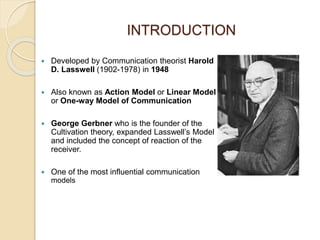
 Developed by Communication theorist Harold
D. Lasswell (1902-1978) in 1948
 Also known as Action Model or Linear Model
or One-way Model of Communication
 George Gerbner who is the founder of the
Cultivation theory, expanded Lasswell’s Model
and included the concept of reaction of the
receiver.
 One of the most influential communication
models
COMPONENTS OF LASSWELL’S
MODEL
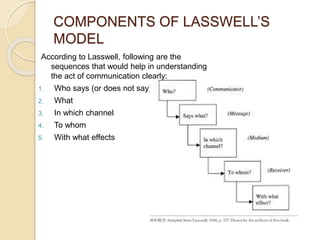
According to Lasswell, following are the
sequences that would help in understanding
the act of communication clearly:
1. Who says (or does not say)
2. What
3. In which channel
4. To whom
5. With what effects
VARIOUS ANALYSIS
 Control Analysis (Who) helps the sender to have all the power.
 Content Analysis (Says what) is associated to stereotyping and
representation of different groups politically. It is also related to the
purpose or the ulterior motives of the message.
 Media Analysis (In which channel) represents which medium
should be used to exercise maximum power against the receivers.
 Audience Analysis (To whom) shows who are the target
population to be manipulated or brain-washed.
 Effect Analysis (With what effect) is done before the process
starts. It is used to predict the effect of message over the target
population to be exploited.
ADVANTAGES AND DISADVANTAGES
ADVANTAGES
1. It is easy and simple.
2. It suits for almost all types of communication
DISADVANTAGES
1. Ignores the possibility of noise
2. Very linear and does not consider barriers in the communication
process
3. General and only includes very traditional topics
CONCLUSION
Lasswell’s model of communication has been widely adopted. Without
feedback, a communication process can not be fruitful. It is more
focused on the resulting outcome and generally used for media
persuasion.
LASSWELL’S COMMUNICATION SEQUENCE.pptx

LASSWELL’S COMMUNICATION SEQUENCE.pptx

  • 1.
    LASSWELL’S COMMUNICATION SEQUENCE ODISHA UNIVERSITYOF AGRICULTURE & TECHNOLOGY EXT 502: DEVELOPMENT COMMUNICATION & INFORMATION MANAGEMENT SUBMITTED TO: PROF.(DR) BISHNUPRIYA MISHRA SUBMITTED BY: MONALISA HOTA (201221713) MAYURIKA BASU (201221714)
  • 2.
    INTRODUCTION  Developed byCommunication theorist Harold D. Lasswell (1902-1978) in 1948  Also known as Action Model or Linear Model or One-way Model of Communication  George Gerbner who is the founder of the Cultivation theory, expanded Lasswell’s Model and included the concept of reaction of the receiver.  One of the most influential communication models
  • 3.
    COMPONENTS OF LASSWELL’S MODEL Accordingto Lasswell, following are the sequences that would help in understanding the act of communication clearly: 1. Who says (or does not say) 2. What 3. In which channel 4. To whom 5. With what effects
  • 4.
    VARIOUS ANALYSIS  ControlAnalysis (Who) helps the sender to have all the power.  Content Analysis (Says what) is associated to stereotyping and representation of different groups politically. It is also related to the purpose or the ulterior motives of the message.  Media Analysis (In which channel) represents which medium should be used to exercise maximum power against the receivers.  Audience Analysis (To whom) shows who are the target population to be manipulated or brain-washed.  Effect Analysis (With what effect) is done before the process starts. It is used to predict the effect of message over the target population to be exploited.
  • 5.
    ADVANTAGES AND DISADVANTAGES ADVANTAGES 1.It is easy and simple. 2. It suits for almost all types of communication DISADVANTAGES 1. Ignores the possibility of noise 2. Very linear and does not consider barriers in the communication process 3. General and only includes very traditional topics CONCLUSION Lasswell’s model of communication has been widely adopted. Without feedback, a communication process can not be fruitful. It is more focused on the resulting outcome and generally used for media persuasion.