PRESENTED BY:
D. M. Parshuramkar
ASSISTANT PROFESSOR (PHYSICS)
N. H. College, Bramhapuri
LASER
(Light Amplification by Stimulated
Emission of Radiation)
What Is Laser
Properties Of Laser
Basic Concept Of Laser
Absorption
Spontaneous Emission
Stimulated Emission
The operation of the Laser
How a Laser Works
Population Inversion
Types of Laser
Applications of laser
Overview
What is Laser?
Light Amplification by Stimulated Emission of
Radiation
• A device produces a coherent beam of optical radiation
by stimulating electronic, ionic, or molecular transitions
to higher energy levels
• Mainly used in Single Mode Systems
• Light Emission range: 5 to 10 degrees
• Require Higher complex driver circuitry than LEDs
• Laser action occurs from three main processes: photon
absorption, spontaneous emission, and stimulated
emission.
Properties of Laser
• Monochromatic
Concentrate in a narrow range of wavelengths
(one specific colour).
• Coherent
All the emitted photons bear a constant phase
relationship with each other in both time and phase
• Directional
A very tight beam which is very strong and
concentrated.
Basic concepts for a laser
• Absorption
• Spontaneous Emission
• Stimulated Emission
• Population inversion
Absorption
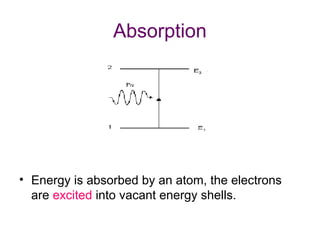
• Energy is absorbed by an atom, the electrons
are excited into vacant energy shells.
Spontaneous Emission
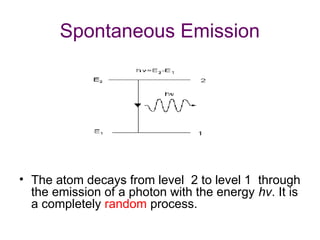
• The atom decays from level 2 to level 1 through
the emission of a photon with the energy hv. It is
a completely random process.
Stimulated Emission
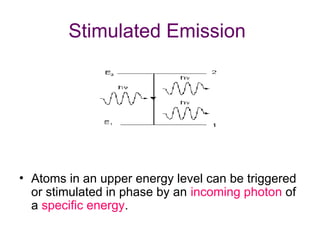
• Atoms in an upper energy level can be triggered
or stimulated in phase by an incoming photon of
a specific energy.
Stimulated Emission
The stimulated photons have unique properties:
– In phase with the incident photon
– Same wavelength as the incident photon
– Travel in same direction as incident photon
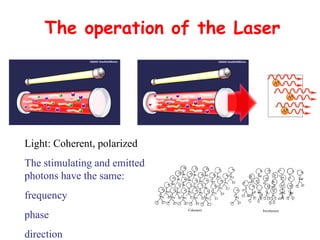
The operation of the Laser
Light: Coherent, polarized
The stimulating and emitted
photons have the same:
frequency
phase
direction
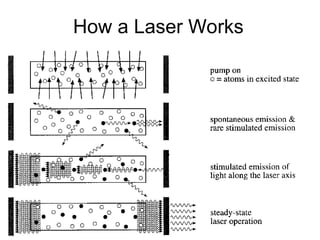
How a Laser Works
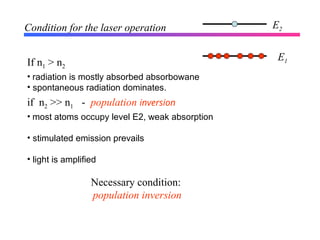
Condition for the laser operation
If n1 > n2
• radiation is mostly absorbed absorbowane
• spontaneous radiation dominates.
• most atoms occupy level E2, weak absorption
• stimulated emission prevails
• light is amplified
if n2 >> n1 - population inversion
Necessary condition:
population inversion
E1
E2
Population Inversion
• A state in which a substance has been
energized, or excited to specific energy levels.
• More atoms or molecules are in a higher excited
state.
• The process of producing a population inversion
is called pumping.
• Examples:
→by lamps of appropriate intensity
→by electrical discharge
Types of Laser
• According to the active material:
solid-state, liquid, gas, excimer or
semiconductor lasers.
• According to the wavelength:
infra-red, visible, ultra-violet (UV) or x-ray
lasers.
Applications of laser
1. Scientific
• Spectroscopy
• Lunar laser ranging
• Photochemistry
• Laser cooling
• Nuclear fusion
2. Military
• Death ray
• Defensive
applications
• Strategic defense
initiative
• Laser sight
• Illuminator
• Rangefinder
• Target
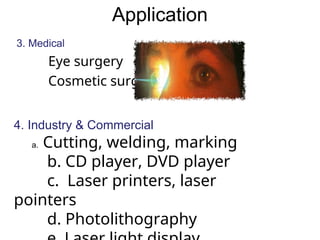
3. Medical
Eye surgery
Cosmetic surgery
Application
4. Industry & Commercial
a. Cutting, welding, marking
b. CD player, DVD player
c. Laser printers, laser
pointers
d. Photolithography
THANK YOU

LASER-concepts principle working and Theory.ppt

  • 1.
    PRESENTED BY: D. M.Parshuramkar ASSISTANT PROFESSOR (PHYSICS) N. H. College, Bramhapuri
  • 2.
    LASER (Light Amplification byStimulated Emission of Radiation)
  • 3.
    What Is Laser PropertiesOf Laser Basic Concept Of Laser Absorption Spontaneous Emission Stimulated Emission The operation of the Laser How a Laser Works Population Inversion Types of Laser Applications of laser Overview
  • 4.
    What is Laser? LightAmplification by Stimulated Emission of Radiation • A device produces a coherent beam of optical radiation by stimulating electronic, ionic, or molecular transitions to higher energy levels • Mainly used in Single Mode Systems • Light Emission range: 5 to 10 degrees • Require Higher complex driver circuitry than LEDs • Laser action occurs from three main processes: photon absorption, spontaneous emission, and stimulated emission.
  • 5.
    Properties of Laser •Monochromatic Concentrate in a narrow range of wavelengths (one specific colour). • Coherent All the emitted photons bear a constant phase relationship with each other in both time and phase • Directional A very tight beam which is very strong and concentrated.
  • 6.
    Basic concepts fora laser • Absorption • Spontaneous Emission • Stimulated Emission • Population inversion
  • 7.
    Absorption • Energy isabsorbed by an atom, the electrons are excited into vacant energy shells.
  • 8.
    Spontaneous Emission • Theatom decays from level 2 to level 1 through the emission of a photon with the energy hv. It is a completely random process.
  • 9.
    Stimulated Emission • Atomsin an upper energy level can be triggered or stimulated in phase by an incoming photon of a specific energy.
  • 10.
    Stimulated Emission The stimulatedphotons have unique properties: – In phase with the incident photon – Same wavelength as the incident photon – Travel in same direction as incident photon
  • 11.
    The operation ofthe Laser Light: Coherent, polarized The stimulating and emitted photons have the same: frequency phase direction
  • 12.
  • 13.
    Condition for thelaser operation If n1 > n2 • radiation is mostly absorbed absorbowane • spontaneous radiation dominates. • most atoms occupy level E2, weak absorption • stimulated emission prevails • light is amplified if n2 >> n1 - population inversion Necessary condition: population inversion E1 E2
  • 14.
    Population Inversion • Astate in which a substance has been energized, or excited to specific energy levels. • More atoms or molecules are in a higher excited state. • The process of producing a population inversion is called pumping. • Examples: →by lamps of appropriate intensity →by electrical discharge
  • 15.
    Types of Laser •According to the active material: solid-state, liquid, gas, excimer or semiconductor lasers. • According to the wavelength: infra-red, visible, ultra-violet (UV) or x-ray lasers.
  • 16.
    Applications of laser 1.Scientific • Spectroscopy • Lunar laser ranging • Photochemistry • Laser cooling • Nuclear fusion 2. Military • Death ray • Defensive applications • Strategic defense initiative • Laser sight • Illuminator • Rangefinder • Target
  • 17.
    3. Medical Eye surgery Cosmeticsurgery Application 4. Industry & Commercial a. Cutting, welding, marking b. CD player, DVD player c. Laser printers, laser pointers d. Photolithography
  • 18.