Polish and English:
A Language Comparison
                 By Andrea Derr
Data Analysis Journal
 Information about my subject:
   Name: Monika
   Gender: Female
   Born: Pabianice, Poland
   Age: 33 years old
   Occupation: Works as a receptionist at a local plastic
    surgeons office
   English Training:
       Learned British English in a classroom setting in Poland
       Enrolled in college in America when she was 19, relied on ESL
        classes to help her get through school. Her college professors
        were not helpful at all to her even though she barely spoke
        English.
       Speaks Polish to her family and friends from Poland, speak English
        in everyday situations
Data Analysis Journal: Errors
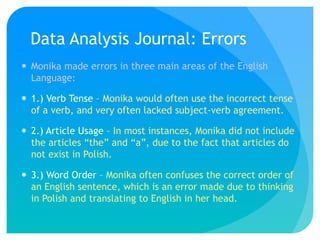
 Monika made errors in three main areas of the English
  Language:

 1.) Verb Tense – Monika would often use the incorrect tense
  of a verb, and very often lacked subject-verb agreement.

 2.) Article Usage – In most instances, Monika did not include
  the articles “the” and “a”, due to the fact that articles do
  not exist in Polish.

 3.) Word Order – Monika often confuses the correct order of
  an English sentence, which is an error made due to thinking
  in Polish and translating to English in her head.
Data Analysis Journal : Errors
Verb Tense Errors             Article Usage Errors          Word Form Errors
- he go to store              - we go to store              - In Poland are lots of shops
                              - I saw dog                   - and occurs in past and
- we was doing that
                              - when I got here in              future the same problem
- they was trying                                           - I hope a little bit this
                                  summer
- each night I did watch TV   - some of teachers were       helps
- In polish I learn           writing in cursive            - we have three tenses only
- when you get marry          - my friends were taking      - we have not many of them
                              me to outdoor football        - now only I have to paint
- when she get bigger
                              game                          ceiling
- she decide it is fun to                                   - still not 100% sure what
                              - I was working on totally
buried Mom in the sand        room make-over                was it
- I gone with him             - now only I have to paint    - she is getting it right or
- Dad do that with me         ceiling and put another       what?
                              coat on walls                 -it’s from the watching TV
- she done that
                              -she will go to movies with   shows
- we does not use those                                     - he did enroll right away
                              me
- she did got very smart      - she buried mom in sand      me in college
- I turn 20 when I arrived    - she made me carry her
                              around house
Data Analysis Journal: Errors
     Types of Errors Made and Frequency
                       0%
                 Word Order
                    6%


        Article Usage
             39%              Verb Tense
                                 55%
Data Analysis Journal : Errors
 To summarize:
All of Monika’s errors that I noticed were due
to the extreme differences between the L1
and the L2, and interference.
The Polish Language
 Polish is an Indo-European language, which belongs to the West
  Slavonic group

 Polish is made up of five different dialects

 Although Polish has many borrowings from other languages, such
  as English, French, German, Latin and Russian, it is difficult to
  see the signs of some of these languages within the complex and
  elaborate Polish text and speech

 Some key features of Polish that are noticeably different are the
  alphabet, aspects of grammar, word order, and gender.
Language Comparison:
     The Polish Alphabet

 The Polish alphabet is derived from the Latin alphabet

 It contains many letters that are not found in any other
  language and are very difficult to pronounce.

 Polish features six oral vowels as well as two nasal vowels

 Also, when some of these letters are combined, they make
  sounds that are very exclusive to the Polish language

                                         , d, e, ę, f, g, h, I, j, k,
    l, ł      , o, ó                          , ż
Language Comparison:
    The Case System
 Due to the fact that Polish is a Slavic language, it uses a case
  system.
 According to Polish-Translations.com (2008)…“The case system
  means that nouns and adjectives are declined to provide the
  meaning that prepositions tend to provide in English. In
  English, whether it's "on the table", "under the table", or "behind
  the table", the word "table" always remains the same. Not so in
  Polish. There are seven different cases and so seven different
  words for "table" depending on the relation of the object in
  question to the table. As if that didn't make things hard
  enough, you also have to decline the adjectives as well so there
  are seven ways of saying "wooden table". And to make things
  even more complicated you've got three different genders of
  nouns which all decline in different ways. Polish grammar is no
  walk in the park.”
Language Comparison:
 Article Usage
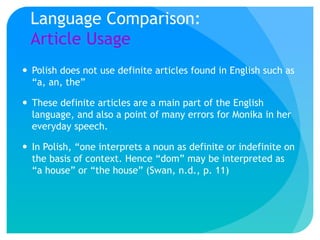
 Polish does not use definite articles found in English such as
  “a, an, the”

 These definite articles are a main part of the English
  language, and also a point of many errors for Monika in her
  everyday speech.

 In Polish, “one interprets a noun as definite or indefinite on
  the basis of context. Hence “dom” may be interpreted as
  “a house” or “the house” (Swan, n.d., p. 11)
Language Comparison:
Gender
 In Polish, there are three different genders:
  masculine, feminine, and neuter

 Gender in this case is mainly used to form grammatical
  agreement.

 Also in Polish the ending of nouns tells its gender

 In order to have a proper Polish sentence, there must be
  agreement and cohesion with all of the words.
  However, in English, whether we say “the red house” or
  “the red car”, the word red does not change based on
  gender .
Language Comparison:
Word Order
 Word order in Polish and English is not the same.

 Word order in Polish tends to reflect the increasing
  informational prominence of the elements in a sentence
  as one proceeds from left to right. Background
  information is typically placed in the first part of a
  sentence

 The orders in which we place and prioritize the parts of
  the sentence are quite different in the two languages.
Language Comparison
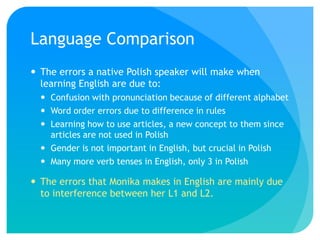
 The errors a native Polish speaker will make when
  learning English are due to:
   Confusion with pronunciation because of different alphabet
   Word order errors due to difference in rules
   Learning how to use articles, a new concept to them since
    articles are not used in Polish
   Gender is not important in English, but crucial in Polish
   Many more verb tenses in English, only 3 in Polish

 The errors that Monika makes in English are mainly due
  to interference between her L1 and L2.
Language Comparison:
 Instructional Implications
 Teacher must develop lessons that help the students to
  learn & practice new concepts, and then reinforce them.
 Lessons should also point out the distinct differences
  between the L1 and L2 in order to help the ELL make
  connections.
 Using role-play situations in the classroom would help the
  ELL to get a better grasp on how to use English in everyday
  situations.
 Use raw materials such as TV shows and movies in English.
  Monika learned a lot of her everyday English by watching
  “King of Queens” every night when she moved to the US.
References
 Is It Difficult For an English Native Speaker to Learn Polish?. (2008).
  Polish-Translations.com. Retrieved November 03, 2011, from
  http://www.polish-translations.com/PolishTranslation/polishenglish-
  nativespeaker.html

 The Polish Language. (2008). Polska Official Promotional Website of the
  Republic of Poland. Retrieved November 04, 2011, from
  http://en.poland.gov.pl/The,Polish,Language,317.Html

 Swan, O.E. (n.d.).Polish Grammar in a Nutshell. Retrieved
  November, 05, 2011, from
  http://polish.slavic.pitt.edu/firstyear/nutshell.pdf

Language Comparison Poster Presentation

  • 1.
    Polish and English: ALanguage Comparison By Andrea Derr
  • 2.
    Data Analysis Journal Information about my subject:  Name: Monika  Gender: Female  Born: Pabianice, Poland  Age: 33 years old  Occupation: Works as a receptionist at a local plastic surgeons office  English Training:  Learned British English in a classroom setting in Poland  Enrolled in college in America when she was 19, relied on ESL classes to help her get through school. Her college professors were not helpful at all to her even though she barely spoke English.  Speaks Polish to her family and friends from Poland, speak English in everyday situations
  • 3.
    Data Analysis Journal:Errors  Monika made errors in three main areas of the English Language:  1.) Verb Tense – Monika would often use the incorrect tense of a verb, and very often lacked subject-verb agreement.  2.) Article Usage – In most instances, Monika did not include the articles “the” and “a”, due to the fact that articles do not exist in Polish.  3.) Word Order – Monika often confuses the correct order of an English sentence, which is an error made due to thinking in Polish and translating to English in her head.
  • 4.
    Data Analysis Journal: Errors Verb Tense Errors Article Usage Errors Word Form Errors - he go to store - we go to store - In Poland are lots of shops - I saw dog - and occurs in past and - we was doing that - when I got here in future the same problem - they was trying - I hope a little bit this summer - each night I did watch TV - some of teachers were helps - In polish I learn writing in cursive - we have three tenses only - when you get marry - my friends were taking - we have not many of them me to outdoor football - now only I have to paint - when she get bigger game ceiling - she decide it is fun to - still not 100% sure what - I was working on totally buried Mom in the sand room make-over was it - I gone with him - now only I have to paint - she is getting it right or - Dad do that with me ceiling and put another what? coat on walls -it’s from the watching TV - she done that -she will go to movies with shows - we does not use those - he did enroll right away me - she did got very smart - she buried mom in sand me in college - I turn 20 when I arrived - she made me carry her around house
  • 5.
    Data Analysis Journal:Errors Types of Errors Made and Frequency 0% Word Order 6% Article Usage 39% Verb Tense 55%
  • 6.
    Data Analysis Journal: Errors  To summarize: All of Monika’s errors that I noticed were due to the extreme differences between the L1 and the L2, and interference.
  • 7.
    The Polish Language Polish is an Indo-European language, which belongs to the West Slavonic group  Polish is made up of five different dialects  Although Polish has many borrowings from other languages, such as English, French, German, Latin and Russian, it is difficult to see the signs of some of these languages within the complex and elaborate Polish text and speech  Some key features of Polish that are noticeably different are the alphabet, aspects of grammar, word order, and gender.
  • 8.
    Language Comparison: The Polish Alphabet  The Polish alphabet is derived from the Latin alphabet  It contains many letters that are not found in any other language and are very difficult to pronounce.  Polish features six oral vowels as well as two nasal vowels  Also, when some of these letters are combined, they make sounds that are very exclusive to the Polish language  , d, e, ę, f, g, h, I, j, k, l, ł , o, ó , ż
  • 9.
    Language Comparison: The Case System  Due to the fact that Polish is a Slavic language, it uses a case system.  According to Polish-Translations.com (2008)…“The case system means that nouns and adjectives are declined to provide the meaning that prepositions tend to provide in English. In English, whether it's "on the table", "under the table", or "behind the table", the word "table" always remains the same. Not so in Polish. There are seven different cases and so seven different words for "table" depending on the relation of the object in question to the table. As if that didn't make things hard enough, you also have to decline the adjectives as well so there are seven ways of saying "wooden table". And to make things even more complicated you've got three different genders of nouns which all decline in different ways. Polish grammar is no walk in the park.”
  • 10.
    Language Comparison: ArticleUsage  Polish does not use definite articles found in English such as “a, an, the”  These definite articles are a main part of the English language, and also a point of many errors for Monika in her everyday speech.  In Polish, “one interprets a noun as definite or indefinite on the basis of context. Hence “dom” may be interpreted as “a house” or “the house” (Swan, n.d., p. 11)
  • 11.
    Language Comparison: Gender  InPolish, there are three different genders: masculine, feminine, and neuter  Gender in this case is mainly used to form grammatical agreement.  Also in Polish the ending of nouns tells its gender  In order to have a proper Polish sentence, there must be agreement and cohesion with all of the words. However, in English, whether we say “the red house” or “the red car”, the word red does not change based on gender .
  • 12.
    Language Comparison: Word Order Word order in Polish and English is not the same.  Word order in Polish tends to reflect the increasing informational prominence of the elements in a sentence as one proceeds from left to right. Background information is typically placed in the first part of a sentence  The orders in which we place and prioritize the parts of the sentence are quite different in the two languages.
  • 13.
    Language Comparison  Theerrors a native Polish speaker will make when learning English are due to:  Confusion with pronunciation because of different alphabet  Word order errors due to difference in rules  Learning how to use articles, a new concept to them since articles are not used in Polish  Gender is not important in English, but crucial in Polish  Many more verb tenses in English, only 3 in Polish  The errors that Monika makes in English are mainly due to interference between her L1 and L2.
  • 14.
    Language Comparison: InstructionalImplications  Teacher must develop lessons that help the students to learn & practice new concepts, and then reinforce them.  Lessons should also point out the distinct differences between the L1 and L2 in order to help the ELL make connections.  Using role-play situations in the classroom would help the ELL to get a better grasp on how to use English in everyday situations.  Use raw materials such as TV shows and movies in English. Monika learned a lot of her everyday English by watching “King of Queens” every night when she moved to the US.
  • 15.
    References  Is ItDifficult For an English Native Speaker to Learn Polish?. (2008). Polish-Translations.com. Retrieved November 03, 2011, from http://www.polish-translations.com/PolishTranslation/polishenglish- nativespeaker.html  The Polish Language. (2008). Polska Official Promotional Website of the Republic of Poland. Retrieved November 04, 2011, from http://en.poland.gov.pl/The,Polish,Language,317.Html  Swan, O.E. (n.d.).Polish Grammar in a Nutshell. Retrieved November, 05, 2011, from http://polish.slavic.pitt.edu/firstyear/nutshell.pdf