Language Objectives
Discuss these questions:
 What is a content objective?
 What is a language objective?
 What is the purpose of having language and content
objectives?
 What should the relationship be between language
and content objectives?
Connections
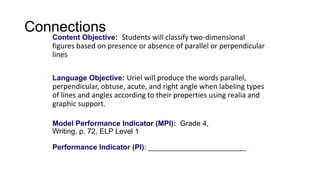
Content Objective: Students will classify two-dimensional
figures based on presence or absence of parallel or perpendicular
lines
Language Objective: Uriel will produce the words parallel,
perpendicular, obtuse, acute, and right angle when labeling types
of lines and angles according to their properties using realia and
graphic support.
Model Performance Indicator (MPI): Grade 4,
Writing, p. 72, ELP Level 1
Performance Indicator (PI): ________________________
Analysis of language
• What language does the student need to…?
Make
predictions on
states of matter
with a partner.
Linguistic Complexity:
Uses expanded clauses
(e.g., I predict the ice will
melt when exposed…”
Vocabulary Usage:
Liquid, solid, gas, stat
es of matter
Forms and
Conventions:
Future tense
(e.g., I predict
the ice will
melt…”
Sample language objectives
• Students will use the future tense to make predictions of change
in states of matter.
• Students will produce expanded sentences using clauses to
make predictions of change in states of matter.

MNPS WIDA Language objectives

  • 1.
  • 2.
    Discuss these questions: What is a content objective?  What is a language objective?  What is the purpose of having language and content objectives?  What should the relationship be between language and content objectives?
  • 3.
    Connections Content Objective: Studentswill classify two-dimensional figures based on presence or absence of parallel or perpendicular lines Language Objective: Uriel will produce the words parallel, perpendicular, obtuse, acute, and right angle when labeling types of lines and angles according to their properties using realia and graphic support. Model Performance Indicator (MPI): Grade 4, Writing, p. 72, ELP Level 1 Performance Indicator (PI): ________________________
  • 4.
    Analysis of language •What language does the student need to…? Make predictions on states of matter with a partner. Linguistic Complexity: Uses expanded clauses (e.g., I predict the ice will melt when exposed…” Vocabulary Usage: Liquid, solid, gas, stat es of matter Forms and Conventions: Future tense (e.g., I predict the ice will melt…”
  • 5.
    Sample language objectives •Students will use the future tense to make predictions of change in states of matter. • Students will produce expanded sentences using clauses to make predictions of change in states of matter.

Editor's Notes

  • #4 What pieces of the matrix did I use?I used supports.I used topic related language.Content & Language Objectives – posted> Model Performance Indicator – direct participants to p. 36 ELP Standards book. We’re assuming differentiating instruction for a student who demonstrated Reading ELP at Level 2. Level 3 would be appropriate, one level above, for assessment/instructional purposes.> Performance Indicator has been transformed to the content/language objective. This level 2 ELL, being instructed/assessed, at level cannot “Define…in paragraphs using the conditional…” However, this student can, “Sequence descriptive sentences, including conditional sentences…” Perhaps, supports could be sentence strips that are to be sequenced and/or cloze procedure, adding sequenced, conditional vocabulary.