3/23/15	
  
1	
  
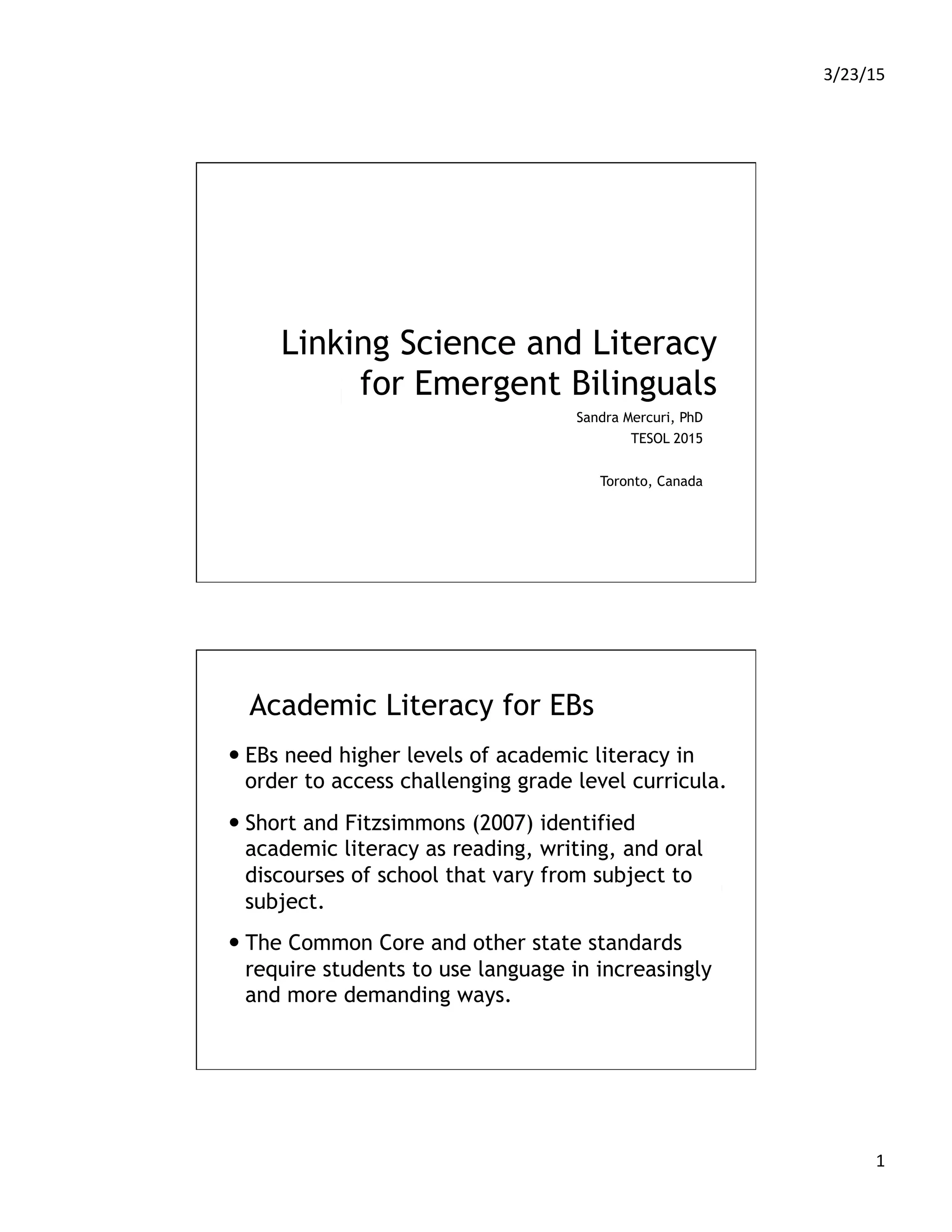
Linking Science and Literacy
for Emergent Bilinguals
Sandra Mercuri, PhD
TESOL 2015
Toronto, Canada
Academic Literacy for EBs
— EBs need higher levels of academic literacy in
order to access challenging grade level curricula.
— Short and Fitzsimmons (2007) identified
academic literacy as reading, writing, and oral
discourses of school that vary from subject to
subject.
— The Common Core and other state standards
require students to use language in increasingly
and more demanding ways.
3/23/15	
  
2	
  
The challenge
—  There is growing evidence that schools are not meeting
the needs of emergent bilinguals (EB).
—  According to national assessments results (Rampey,
Dion, & Donahue, 2009), the literacy results show that
only 4% of fourth-grade EBs scored at the proficient or
advanced levels.
—  The CCSS for ELA/Literacy standards present new and
complex challenges for students who are now required
to analyze complex texts, use academic vocabulary, and
write logical, research-based arguments
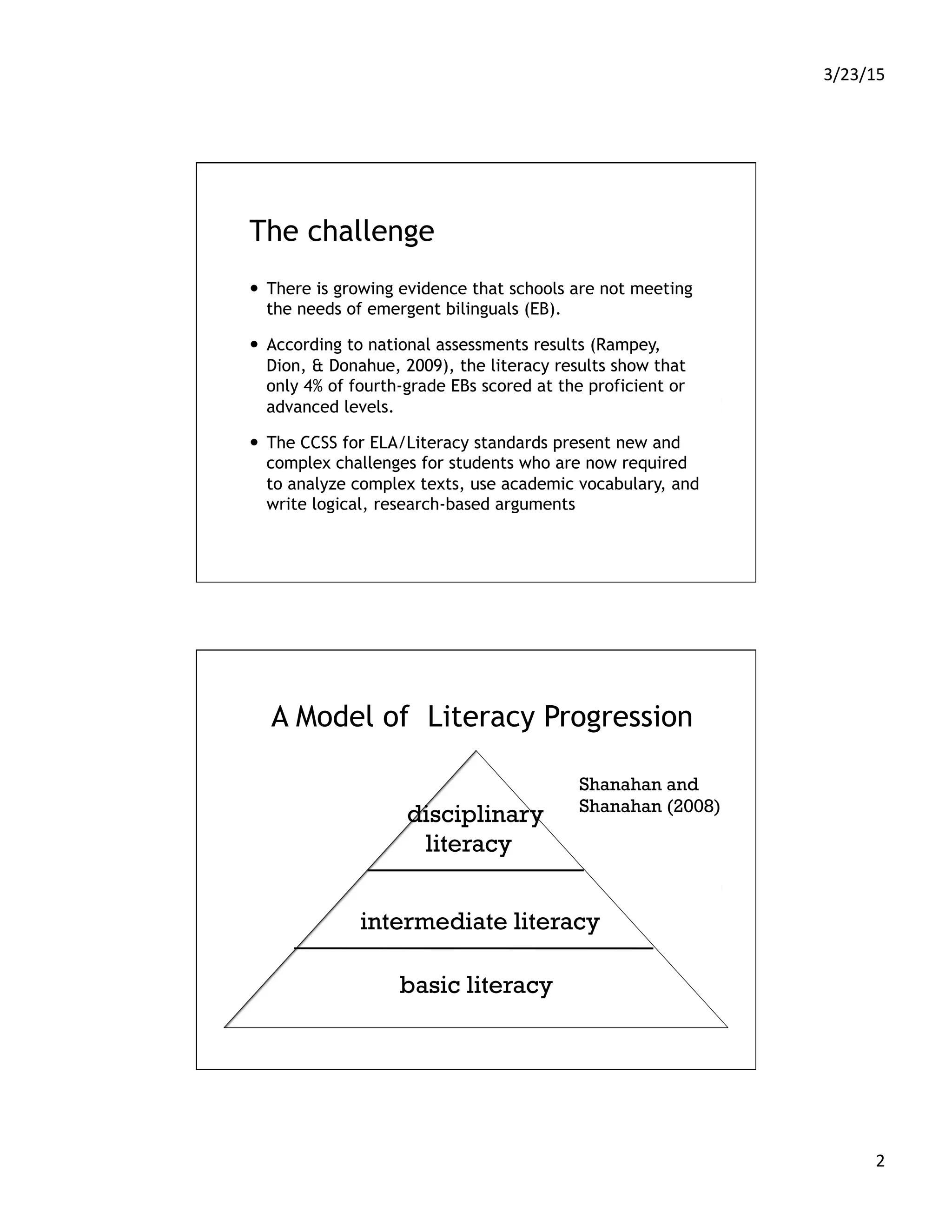
A Model of Literacy Progression
basic literacy
disciplinary
literacy
intermediate literacy
Shanahan and
Shanahan (2008)
3/23/15	
  
3	
  
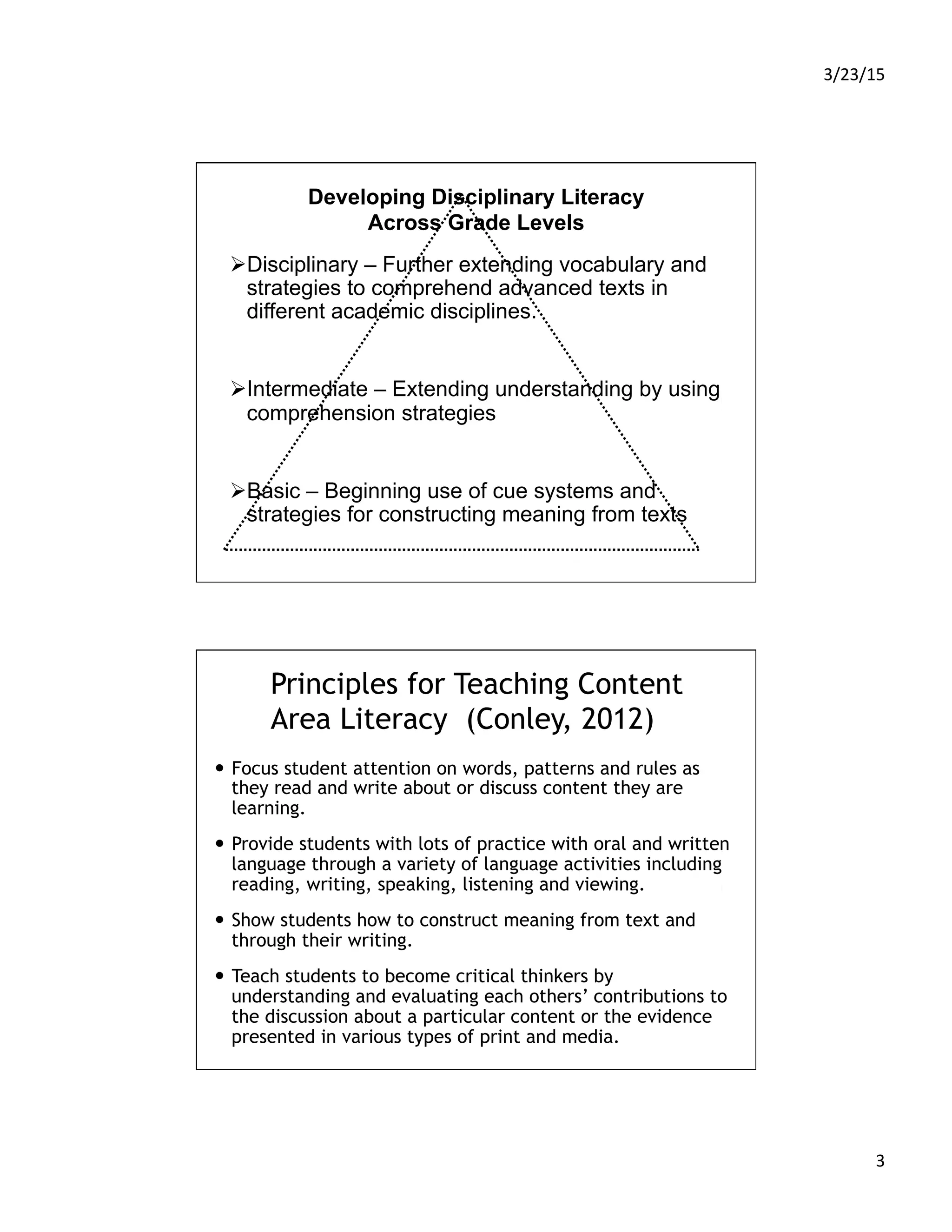
Developing Disciplinary Literacy
Across Grade Levels
Ø Disciplinary – Further extending vocabulary and
strategies to comprehend advanced texts in
different academic disciplines.
Ø Intermediate – Extending understanding by using
comprehension strategies
Ø Basic – Beginning use of cue systems and
strategies for constructing meaning from texts
Principles for Teaching Content
Area Literacy (Conley, 2012)
—  Focus student attention on words, patterns and rules as
they read and write about or discuss content they are
learning.
—  Provide students with lots of practice with oral and written
language through a variety of language activities including
reading, writing, speaking, listening and viewing.
—  Show students how to construct meaning from text and
through their writing.
—  Teach students to become critical thinkers by
understanding and evaluating each others’ contributions to
the discussion about a particular content or the evidence
presented in various types of print and media.
3/23/15	
  
4	
  
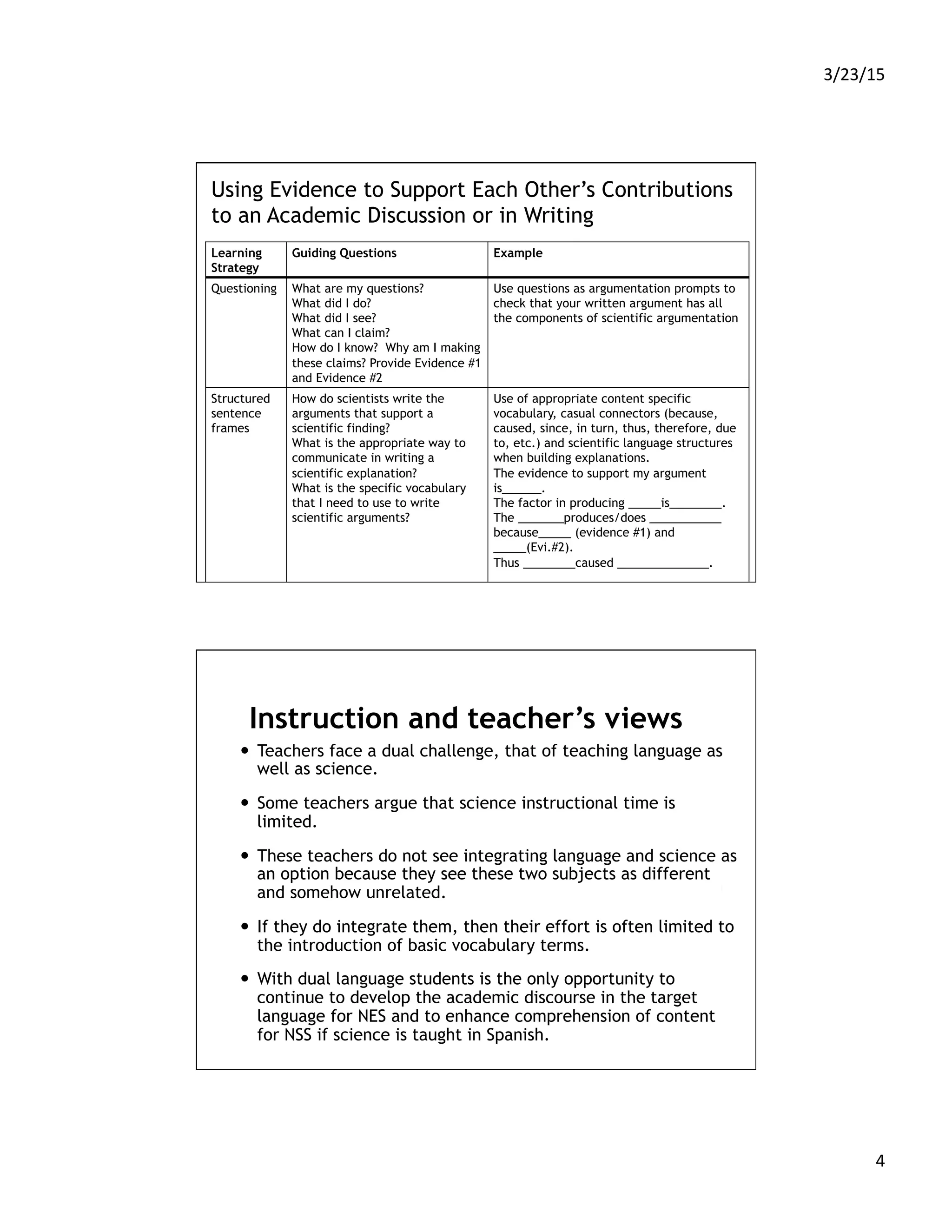
Using Evidence to Support Each Other’s Contributions
to an Academic Discussion or in Writing
Learning
Strategy
Guiding Questions Example
Questioning What are my questions?
What did I do?
What did I see? 
What can I claim?
How do I know?  Why am I making
these claims? Provide Evidence #1
and Evidence #2
Use questions as argumentation prompts to
check that your written argument has all
the components of scientific argumentation
Structured
sentence
frames
How do scientists write the
arguments that support a
scientific finding?
What is the appropriate way to
communicate in writing a
scientific explanation?
What is the specific vocabulary
that I need to use to write
scientific arguments?
Use of appropriate content specific
vocabulary, casual connectors (because,
caused, since, in turn, thus, therefore, due
to, etc.) and scientific language structures
when building explanations.
The evidence to support my argument
is______.
The factor in producing _____is________.
The _______produces/does ___________
because_____ (evidence #1) and
_____(Evi.#2).
Thus ________caused ______________.
Instruction and teacher’s views
—  Teachers face a dual challenge, that of teaching language as
well as science.
—  Some teachers argue that science instructional time is
limited.
—  These teachers do not see integrating language and science as
an option because they see these two subjects as different
and somehow unrelated.
—  If they do integrate them, then their effort is often limited to
the introduction of basic vocabulary terms.
—  With dual language students is the only opportunity to
continue to develop the academic discourse in the target
language for NES and to enhance comprehension of content
for NSS if science is taught in Spanish.
3/23/15	
  
5	
  
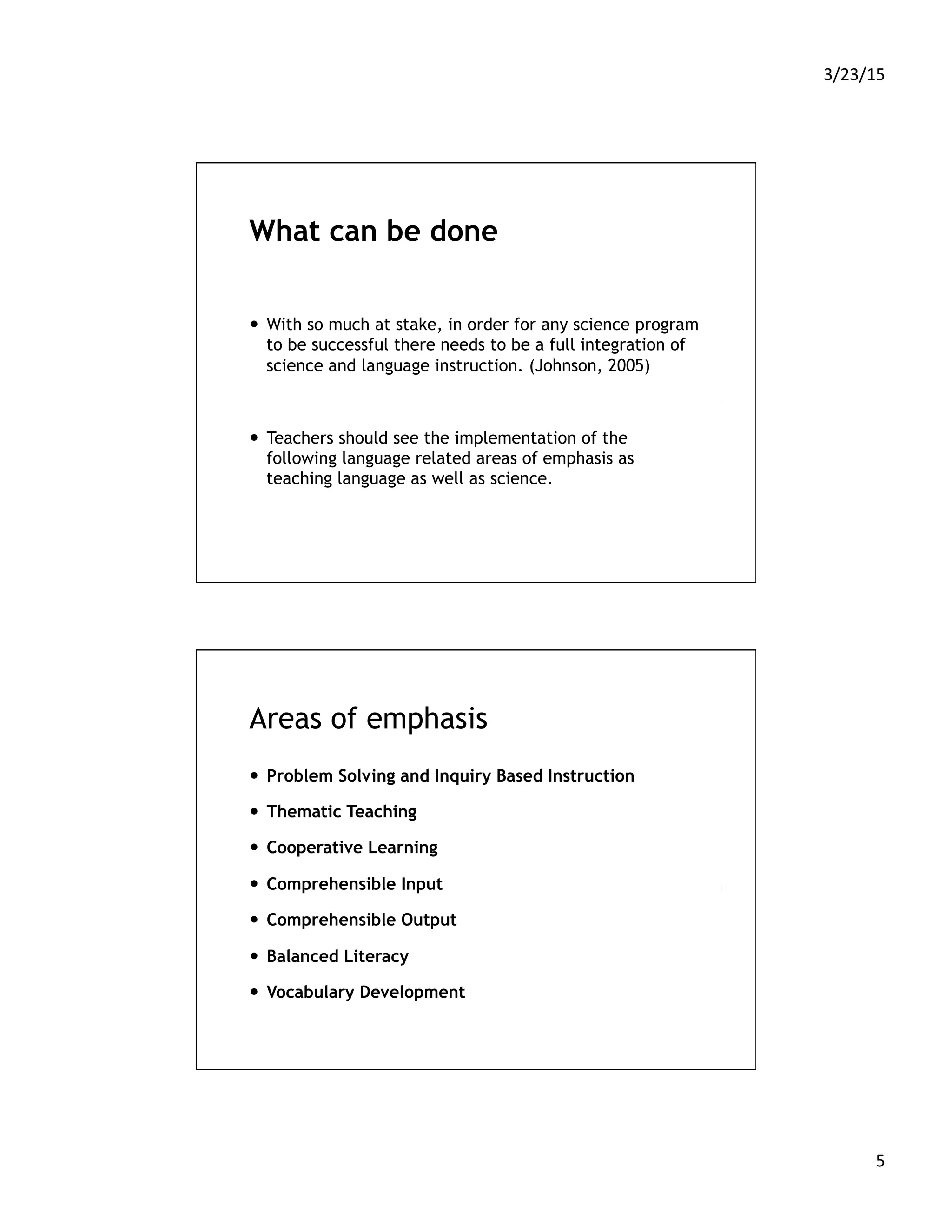
What can be done
—  With so much at stake, in order for any science program
to be successful there needs to be a full integration of
science and language instruction. (Johnson, 2005)
—  Teachers should see the implementation of the
following language related areas of emphasis as
teaching language as well as science.
Areas of emphasis
—  Problem Solving and Inquiry Based Instruction
—  Thematic Teaching
—  Cooperative Learning
—  Comprehensible Input
—  Comprehensible Output
—  Balanced Literacy
—  Vocabulary Development
3/23/15	
  
6	
  
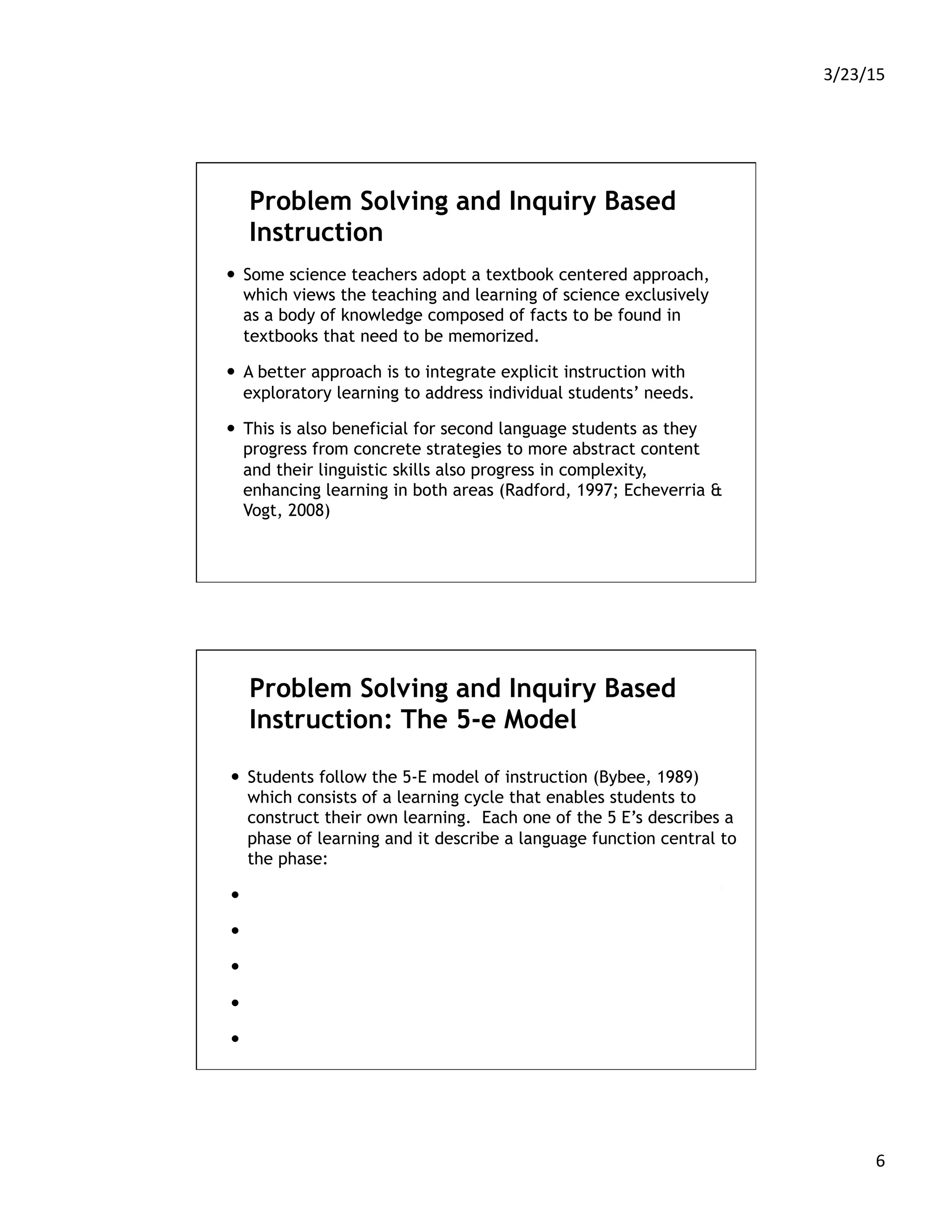
Problem Solving and Inquiry Based
Instruction
—  Some science teachers adopt a textbook centered approach,
which views the teaching and learning of science exclusively
as a body of knowledge composed of facts to be found in
textbooks that need to be memorized.
—  A better approach is to integrate explicit instruction with
exploratory learning to address individual students’ needs.
—  This is also beneficial for second language students as they
progress from concrete strategies to more abstract content
and their linguistic skills also progress in complexity,
enhancing learning in both areas (Radford, 1997; Echeverria &
Vogt, 2008)
Problem Solving and Inquiry Based
Instruction: The 5-e Model
—  Students follow the 5-E model of instruction (Bybee, 1989)
which consists of a learning cycle that enables students to
construct their own learning. Each one of the 5 E’s describes a
phase of learning and it describe a language function central to
the phase:
—  Engage
—  Explore
—  Explain
—  Elaborate
—  Evaluate.
3/23/15	
  
7	
  
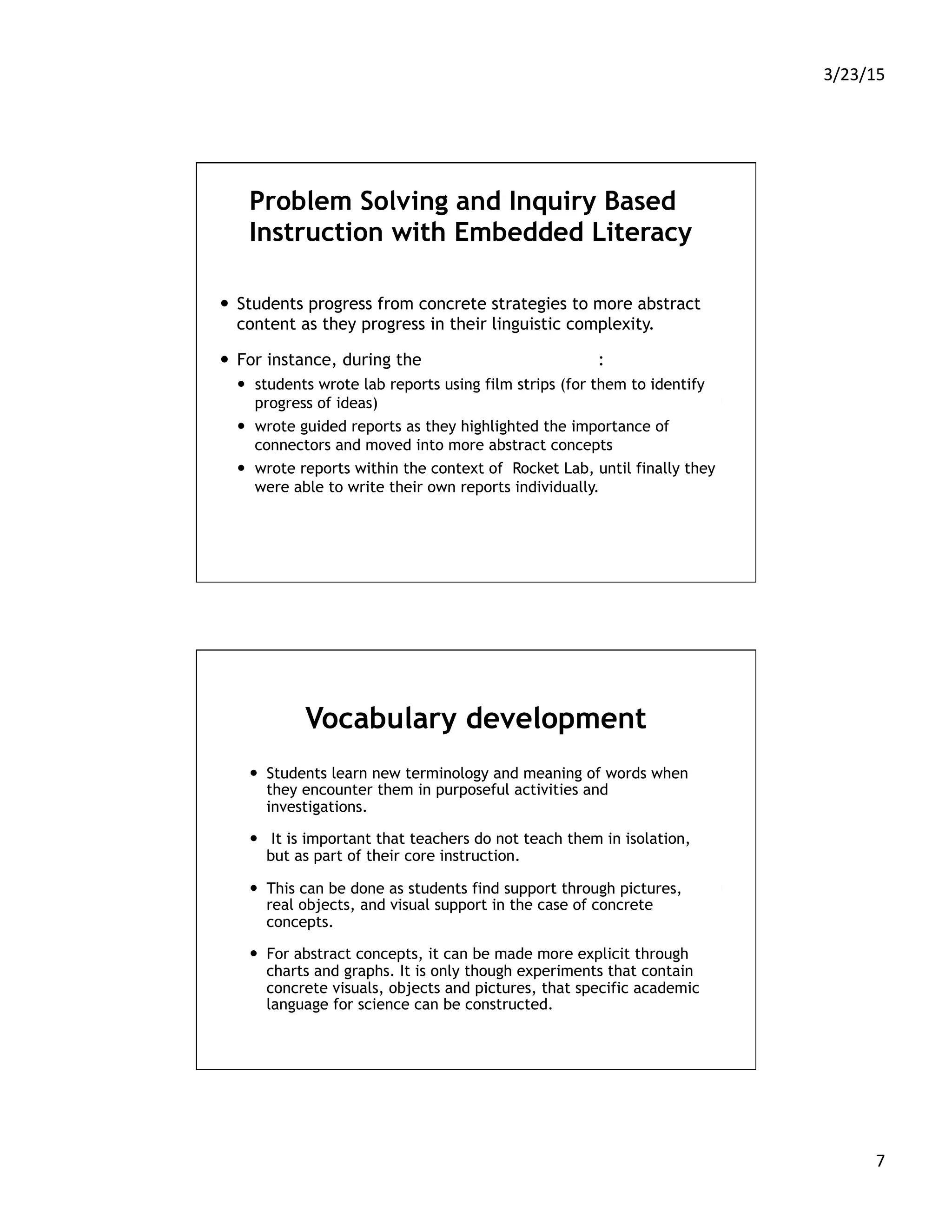
Problem Solving and Inquiry Based
Instruction with Embedded Literacy
—  Students progress from concrete strategies to more abstract
content as they progress in their linguistic complexity.
—  For instance, during the Scientific Method unit:
—  students wrote lab reports using film strips (for them to identify
progress of ideas)
—  wrote guided reports as they highlighted the importance of
connectors and moved into more abstract concepts
—  wrote reports within the context of Rocket Lab, until finally they
were able to write their own reports individually.
Vocabulary development
—  Students learn new terminology and meaning of words when
they encounter them in purposeful activities and
investigations.
—  It is important that teachers do not teach them in isolation,
but as part of their core instruction.
—  This can be done as students find support through pictures,
real objects, and visual support in the case of concrete
concepts.
—  For abstract concepts, it can be made more explicit through
charts and graphs. It is only though experiments that contain
concrete visuals, objects and pictures, that specific academic
language for science can be constructed.
3/23/15	
  
8	
  
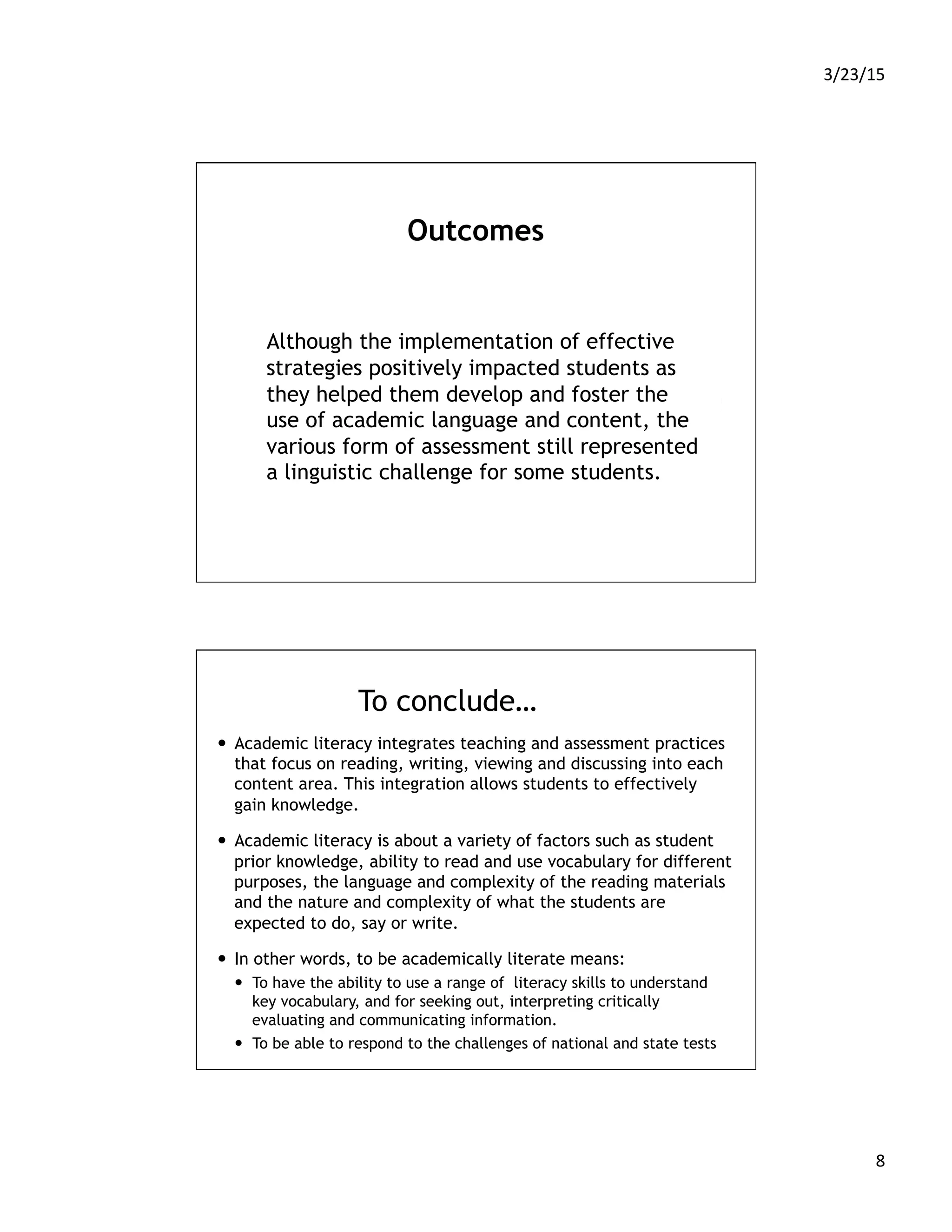
Outcomes
Although the implementation of effective
strategies positively impacted students as
they helped them develop and foster the
use of academic language and content, the
various form of assessment still represented
a linguistic challenge for some students.
To conclude…
—  Academic literacy integrates teaching and assessment practices
that focus on reading, writing, viewing and discussing into each
content area. This integration allows students to effectively
gain knowledge.
—  Academic literacy is about a variety of factors such as student
prior knowledge, ability to read and use vocabulary for different
purposes, the language and complexity of the reading materials
and the nature and complexity of what the students are
expected to do, say or write.
—  In other words, to be academically literate means:
—  To have the ability to use a range of literacy skills to understand
key vocabulary, and for seeking out, interpreting critically
evaluating and communicating information.
—  To be able to respond to the challenges of national and state tests

Handout science literacy - tesol 2015

  • 1.
    3/23/15   1   LinkingScience and Literacy for Emergent Bilinguals Sandra Mercuri, PhD TESOL 2015 Toronto, Canada Academic Literacy for EBs — EBs need higher levels of academic literacy in order to access challenging grade level curricula. — Short and Fitzsimmons (2007) identified academic literacy as reading, writing, and oral discourses of school that vary from subject to subject. — The Common Core and other state standards require students to use language in increasingly and more demanding ways.
  • 2.
    3/23/15   2   Thechallenge —  There is growing evidence that schools are not meeting the needs of emergent bilinguals (EB). —  According to national assessments results (Rampey, Dion, & Donahue, 2009), the literacy results show that only 4% of fourth-grade EBs scored at the proficient or advanced levels. —  The CCSS for ELA/Literacy standards present new and complex challenges for students who are now required to analyze complex texts, use academic vocabulary, and write logical, research-based arguments A Model of Literacy Progression basic literacy disciplinary literacy intermediate literacy Shanahan and Shanahan (2008)
  • 3.
    3/23/15   3   DevelopingDisciplinary Literacy Across Grade Levels Ø Disciplinary – Further extending vocabulary and strategies to comprehend advanced texts in different academic disciplines. Ø Intermediate – Extending understanding by using comprehension strategies Ø Basic – Beginning use of cue systems and strategies for constructing meaning from texts Principles for Teaching Content Area Literacy (Conley, 2012) —  Focus student attention on words, patterns and rules as they read and write about or discuss content they are learning. —  Provide students with lots of practice with oral and written language through a variety of language activities including reading, writing, speaking, listening and viewing. —  Show students how to construct meaning from text and through their writing. —  Teach students to become critical thinkers by understanding and evaluating each others’ contributions to the discussion about a particular content or the evidence presented in various types of print and media.
  • 4.
    3/23/15   4   UsingEvidence to Support Each Other’s Contributions to an Academic Discussion or in Writing Learning Strategy Guiding Questions Example Questioning What are my questions? What did I do? What did I see?  What can I claim? How do I know?  Why am I making these claims? Provide Evidence #1 and Evidence #2 Use questions as argumentation prompts to check that your written argument has all the components of scientific argumentation Structured sentence frames How do scientists write the arguments that support a scientific finding? What is the appropriate way to communicate in writing a scientific explanation? What is the specific vocabulary that I need to use to write scientific arguments? Use of appropriate content specific vocabulary, casual connectors (because, caused, since, in turn, thus, therefore, due to, etc.) and scientific language structures when building explanations. The evidence to support my argument is______. The factor in producing _____is________. The _______produces/does ___________ because_____ (evidence #1) and _____(Evi.#2). Thus ________caused ______________. Instruction and teacher’s views —  Teachers face a dual challenge, that of teaching language as well as science. —  Some teachers argue that science instructional time is limited. —  These teachers do not see integrating language and science as an option because they see these two subjects as different and somehow unrelated. —  If they do integrate them, then their effort is often limited to the introduction of basic vocabulary terms. —  With dual language students is the only opportunity to continue to develop the academic discourse in the target language for NES and to enhance comprehension of content for NSS if science is taught in Spanish.
  • 5.
    3/23/15   5   Whatcan be done —  With so much at stake, in order for any science program to be successful there needs to be a full integration of science and language instruction. (Johnson, 2005) —  Teachers should see the implementation of the following language related areas of emphasis as teaching language as well as science. Areas of emphasis —  Problem Solving and Inquiry Based Instruction —  Thematic Teaching —  Cooperative Learning —  Comprehensible Input —  Comprehensible Output —  Balanced Literacy —  Vocabulary Development
  • 6.
    3/23/15   6   ProblemSolving and Inquiry Based Instruction —  Some science teachers adopt a textbook centered approach, which views the teaching and learning of science exclusively as a body of knowledge composed of facts to be found in textbooks that need to be memorized. —  A better approach is to integrate explicit instruction with exploratory learning to address individual students’ needs. —  This is also beneficial for second language students as they progress from concrete strategies to more abstract content and their linguistic skills also progress in complexity, enhancing learning in both areas (Radford, 1997; Echeverria & Vogt, 2008) Problem Solving and Inquiry Based Instruction: The 5-e Model —  Students follow the 5-E model of instruction (Bybee, 1989) which consists of a learning cycle that enables students to construct their own learning. Each one of the 5 E’s describes a phase of learning and it describe a language function central to the phase: —  Engage —  Explore —  Explain —  Elaborate —  Evaluate.
  • 7.
    3/23/15   7   ProblemSolving and Inquiry Based Instruction with Embedded Literacy —  Students progress from concrete strategies to more abstract content as they progress in their linguistic complexity. —  For instance, during the Scientific Method unit: —  students wrote lab reports using film strips (for them to identify progress of ideas) —  wrote guided reports as they highlighted the importance of connectors and moved into more abstract concepts —  wrote reports within the context of Rocket Lab, until finally they were able to write their own reports individually. Vocabulary development —  Students learn new terminology and meaning of words when they encounter them in purposeful activities and investigations. —  It is important that teachers do not teach them in isolation, but as part of their core instruction. —  This can be done as students find support through pictures, real objects, and visual support in the case of concrete concepts. —  For abstract concepts, it can be made more explicit through charts and graphs. It is only though experiments that contain concrete visuals, objects and pictures, that specific academic language for science can be constructed.
  • 8.
    3/23/15   8   Outcomes Althoughthe implementation of effective strategies positively impacted students as they helped them develop and foster the use of academic language and content, the various form of assessment still represented a linguistic challenge for some students. To conclude… —  Academic literacy integrates teaching and assessment practices that focus on reading, writing, viewing and discussing into each content area. This integration allows students to effectively gain knowledge. —  Academic literacy is about a variety of factors such as student prior knowledge, ability to read and use vocabulary for different purposes, the language and complexity of the reading materials and the nature and complexity of what the students are expected to do, say or write. —  In other words, to be academically literate means: —  To have the ability to use a range of literacy skills to understand key vocabulary, and for seeking out, interpreting critically evaluating and communicating information. —  To be able to respond to the challenges of national and state tests