WIDA Consortium
WIDA Consortium
Variations of Language
Adapted from Zwiers (2008)
Academic Language
• Functional Approach (Halliday, 1975)
• BICS and CALP (Cummins, 1979)
• Sociocultural context of language learning
(Brice Heath, Richard-Amato, Snow, 1986)
• Academic LanguageS (Lemke, 1990)
• Discourses (Gee, 1996, 2004)
WIDA Consortium
Academic Language in Context
• Culturally responsive pedagogy
(Ladson-Billings, 1994)
• Language of schooling
(Schleppegrell, 2004)
• Funds of Knowledge
(Gonzalez, Moll & Amanti, 2005)
• WIDA’s Can Do Philosophy
(2004, 2007, 2012)
WIDA Consortium
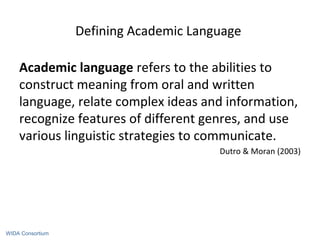
Defining Academic Language
Academic language refers to the abilities to
construct meaning from oral and written
language, relate complex ideas and information,
recognize features of different genres, and use
various linguistic strategies to communicate.
Dutro & Moran (2003)
WIDA Consortium
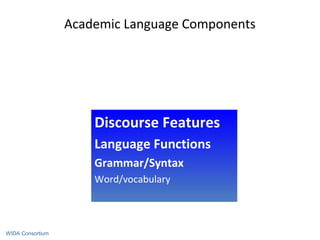
Academic Language Components
Discourse Features
Language Functions
Grammar/Syntax
Word/vocabulary
WIDA Consortium
Language & Content
• Language proficiency involves the language associated with the
content areas.
• Content knowledge reflects the declarative (what) and
procedural knowledge (how) associated with the content.
WIDA Consortium

MNPS WIDA Academic language- 1st presentation

  • 1.
  • 2.
    WIDA Consortium Variations ofLanguage Adapted from Zwiers (2008)
  • 3.
    Academic Language • FunctionalApproach (Halliday, 1975) • BICS and CALP (Cummins, 1979) • Sociocultural context of language learning (Brice Heath, Richard-Amato, Snow, 1986) • Academic LanguageS (Lemke, 1990) • Discourses (Gee, 1996, 2004) WIDA Consortium
  • 4.
    Academic Language inContext • Culturally responsive pedagogy (Ladson-Billings, 1994) • Language of schooling (Schleppegrell, 2004) • Funds of Knowledge (Gonzalez, Moll & Amanti, 2005) • WIDA’s Can Do Philosophy (2004, 2007, 2012) WIDA Consortium
  • 5.
    Defining Academic Language Academiclanguage refers to the abilities to construct meaning from oral and written language, relate complex ideas and information, recognize features of different genres, and use various linguistic strategies to communicate. Dutro & Moran (2003) WIDA Consortium
  • 6.
    Academic Language Components DiscourseFeatures Language Functions Grammar/Syntax Word/vocabulary WIDA Consortium
  • 7.
    Language & Content •Language proficiency involves the language associated with the content areas. • Content knowledge reflects the declarative (what) and procedural knowledge (how) associated with the content. WIDA Consortium

Editor's Notes

  • #2 Introduce the Features of Academic Language.
  • #3 Zweirs’ visual can be used as additional support for the importance of the sociocultural context in learning the language of content.
  • #4 Now that we have talked about our locus in the linguistic continuum in our society and that we have explored issues about language acquisition, we’d like to provide a theoretical framework to academic language. Why? Because as educators, academic language is one of the ways in which we can provide to our students to level the field (address educational equity for ELLs) Therefore, what is AL? According to Research: functional linguistics, socio cultural and discourse theory
  • #5 Continue discussion of AL
  • #6 The WIDA ELP Standards guide the teaching and learning of academic language for English Language Learners.
  • #8 The WIDA Standards measure English language proficiency (ELP) in the academic content areas – not the academic content knowledge itself; the language of math, for example, what “greater than[>]” and “less than[<]” mean, not the math/computation itself (e.g., 6 [>/<] 5).