LANGUAGE LEARNING AND TEACHING
APPROACHES TO TEACHING LANGUAGE ARTS
Group members:
Japhia Beckford
Kesian Bennett
Rashida Harrison
Tashana Tulloch
Myesha Wilson
DEFINITION OF APPROACH
COMMUNICATIVE LANGUAGE TEACHING
 The communicative approach is based on the idea that
learning language successfully comes through having to
communicate real meaning and as such this is what
communicative language teaching is about. With
communicative language teaching the learners are
involved in real communication, their natural strategies for
language acquisition is being used, and this will allow
them to learn to use the language well.
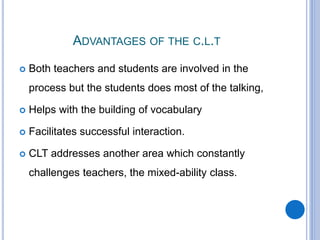
ADVANTAGES OF THE C.L.T
 Both teachers and students are involved in the
process but the students does most of the talking,
 Helps with the building of vocabulary
 Facilitates successful interaction.
 CLT addresses another area which constantly
challenges teachers, the mixed-ability class.
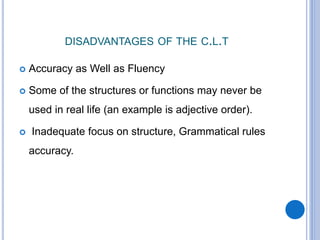
DISADVANTAGES OF THE C.L.T
 Accuracy as Well as Fluency
 Some of the structures or functions may never be
used in real life (an example is adjective order).
 Inadequate focus on structure, Grammatical rules
accuracy.
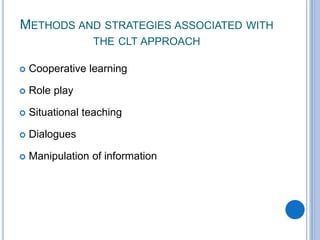
METHODS AND STRATEGIES ASSOCIATED WITH
THE CLT APPROACH
 Cooperative learning
 Role play
 Situational teaching
 Dialogues
 Manipulation of information
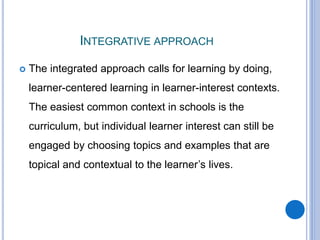
INTEGRATIVE APPROACH
 The integrated approach calls for learning by doing,
learner-centered learning in learner-interest contexts.
The easiest common context in schools is the
curriculum, but individual learner interest can still be
engaged by choosing topics and examples that are
topical and contextual to the learner’s lives.
INTEGRATIVE APPROACH
 Learning through an integrated studies approach is
enhanced when students are actively engaged in meaningful
and relative topics. Learners construct and produce
knowledge by solving problems, conducting inquiry,
engaging in reflection and building a repertoire of effective
strategies. Integrated studies help students to become life
long learners and allow efficient coverage and delivery of
curriculum in terms of expertise, resources and time.
ADVANTAGES OF THE INTEGRATIVE APPROACH
 Facilitates reinforcement of learning
 Variety within Learning
 Classroom Culture
 Curriculum Advancements
DISADVANTAGES OF THE INTEGRATIVE
APPROACH
 Interest Issues
 Content Issues
 A Turn with Classroom Culture
METHODS AND STRATEGIES ASSOCIATED WITH
THE INTEGRATIVE APPROACH
 An instructional approach in which reading, writing,
listening, speaking, and viewing activities are connected
through the use of literature.
 A multi-sensory method to give students experiences to
watch and listen to the interactive video. Employ live on-
screen stories followed by thought-provoking questions.
METHODS AND STRATEGIES ASSOCIATED WITH
THE INTEGRATIVE APPROACH
 Collaborate with other teachers in the grade you teach.
 Create your lesson plans with the collaborative details in
mind.
 Deliver the lesson to students and have them participate in
the planned activities.
 Meet with the other teachers in your grade team to check
how the lessons are going.
 Setting tasks that are open-ended in order to support
problem solving and critical thinking.
THEMATIC APPROACH
 “This is a way of teaching and learning, whereby many
areas of the curriculum are connected together and
integrated within a theme” (show-me-wow.com)
 It is a whole school approach where the national
curriculum areas are based around a theme. This
method encourages children to use, apply and develop
their knowledge and skills within relevant situations to
then be used in real life.
ADVANTAGES OF THE THEMATIC APPROACH
 Connections
 Basic critical thinking skills applied to meaningful
contexts.
 Variety of learning
 Classroom Culture
DISADVANTAGES OF THE THEMATIC APPROACH
 Lack of learning material to support theme e.g. in
Literature
 Prescribed theme not suitable for some students.
 Academic
 Ability
METHODS AND STRATEGIES ASSOCIATED WITH
THE THEMATIC APPROACH
 Research projects
 Drama
 Reports
 Discussion of relevance of theme to students’
experience
TEACHING ENGLISH AS A SECOND LANGUAGE
 Teaching English as a second language (TESL) refers to
teaching English to students whose first language is not
English, usually offered in a region where English is the
dominant language and natural English language
immersion situations are apt to be plentiful.
Communicative language teaching (CLT) emphasizes
interaction as both the means and the ultimate goal of
learning a language.
ADVANTAGES OF TEACHING ENGLISH AS A
SECOND LANGUAGE
 Reinforces identity
 Boosts confidence
 Acknowledgement of language competence in 1st
language.
DISADVANTAGES OF TEACHING ENGLISH AS A
SECOND LANGUAGE
 Jamaican Creole not used internationally.
 Ambivalent attitude towards Jamaican Creole.
 Stigma attached to Jamaican Creole.
 Jamaican Creole not easily written or read.
METHODS AND STRATEGIES ASSOCIATED WITH
TESL
 The Direct Approach
 The Reading Approach
 The Audio-lingual Method
 Total Physical Response
REFERENCES

Language learning and teaching power point to be edited

  • 1.
    LANGUAGE LEARNING ANDTEACHING APPROACHES TO TEACHING LANGUAGE ARTS Group members: Japhia Beckford Kesian Bennett Rashida Harrison Tashana Tulloch Myesha Wilson
  • 2.
  • 3.
    COMMUNICATIVE LANGUAGE TEACHING The communicative approach is based on the idea that learning language successfully comes through having to communicate real meaning and as such this is what communicative language teaching is about. With communicative language teaching the learners are involved in real communication, their natural strategies for language acquisition is being used, and this will allow them to learn to use the language well.
  • 4.
    ADVANTAGES OF THEC.L.T  Both teachers and students are involved in the process but the students does most of the talking,  Helps with the building of vocabulary  Facilitates successful interaction.  CLT addresses another area which constantly challenges teachers, the mixed-ability class.
  • 5.
    DISADVANTAGES OF THEC.L.T  Accuracy as Well as Fluency  Some of the structures or functions may never be used in real life (an example is adjective order).  Inadequate focus on structure, Grammatical rules accuracy.
  • 6.
    METHODS AND STRATEGIESASSOCIATED WITH THE CLT APPROACH  Cooperative learning  Role play  Situational teaching  Dialogues  Manipulation of information
  • 7.
    INTEGRATIVE APPROACH  Theintegrated approach calls for learning by doing, learner-centered learning in learner-interest contexts. The easiest common context in schools is the curriculum, but individual learner interest can still be engaged by choosing topics and examples that are topical and contextual to the learner’s lives.
  • 8.
    INTEGRATIVE APPROACH  Learningthrough an integrated studies approach is enhanced when students are actively engaged in meaningful and relative topics. Learners construct and produce knowledge by solving problems, conducting inquiry, engaging in reflection and building a repertoire of effective strategies. Integrated studies help students to become life long learners and allow efficient coverage and delivery of curriculum in terms of expertise, resources and time.
  • 9.
    ADVANTAGES OF THEINTEGRATIVE APPROACH  Facilitates reinforcement of learning  Variety within Learning  Classroom Culture  Curriculum Advancements
  • 10.
    DISADVANTAGES OF THEINTEGRATIVE APPROACH  Interest Issues  Content Issues  A Turn with Classroom Culture
  • 11.
    METHODS AND STRATEGIESASSOCIATED WITH THE INTEGRATIVE APPROACH  An instructional approach in which reading, writing, listening, speaking, and viewing activities are connected through the use of literature.  A multi-sensory method to give students experiences to watch and listen to the interactive video. Employ live on- screen stories followed by thought-provoking questions.
  • 12.
    METHODS AND STRATEGIESASSOCIATED WITH THE INTEGRATIVE APPROACH  Collaborate with other teachers in the grade you teach.  Create your lesson plans with the collaborative details in mind.  Deliver the lesson to students and have them participate in the planned activities.  Meet with the other teachers in your grade team to check how the lessons are going.  Setting tasks that are open-ended in order to support problem solving and critical thinking.
  • 13.
    THEMATIC APPROACH  “Thisis a way of teaching and learning, whereby many areas of the curriculum are connected together and integrated within a theme” (show-me-wow.com)  It is a whole school approach where the national curriculum areas are based around a theme. This method encourages children to use, apply and develop their knowledge and skills within relevant situations to then be used in real life.
  • 14.
    ADVANTAGES OF THETHEMATIC APPROACH  Connections  Basic critical thinking skills applied to meaningful contexts.  Variety of learning  Classroom Culture
  • 15.
    DISADVANTAGES OF THETHEMATIC APPROACH  Lack of learning material to support theme e.g. in Literature  Prescribed theme not suitable for some students.  Academic  Ability
  • 16.
    METHODS AND STRATEGIESASSOCIATED WITH THE THEMATIC APPROACH  Research projects  Drama  Reports  Discussion of relevance of theme to students’ experience
  • 17.
    TEACHING ENGLISH ASA SECOND LANGUAGE  Teaching English as a second language (TESL) refers to teaching English to students whose first language is not English, usually offered in a region where English is the dominant language and natural English language immersion situations are apt to be plentiful. Communicative language teaching (CLT) emphasizes interaction as both the means and the ultimate goal of learning a language.
  • 18.
    ADVANTAGES OF TEACHINGENGLISH AS A SECOND LANGUAGE  Reinforces identity  Boosts confidence  Acknowledgement of language competence in 1st language.
  • 19.
    DISADVANTAGES OF TEACHINGENGLISH AS A SECOND LANGUAGE  Jamaican Creole not used internationally.  Ambivalent attitude towards Jamaican Creole.  Stigma attached to Jamaican Creole.  Jamaican Creole not easily written or read.
  • 20.
    METHODS AND STRATEGIESASSOCIATED WITH TESL  The Direct Approach  The Reading Approach  The Audio-lingual Method  Total Physical Response
  • 21.