LANGUAGE DEVELOPMENT
A PRESANTATION BY
ABDUL MANAF CHALIYAMPURATH
KSTC THALIPARAMBA
LANGUAGE DEVELOPMENT
Language development is a process starting
early in human life. When a person begins to
acquire language by learning it as it is spoken or
mimicry
Stages of language
development
Infant
Toddlers
Two year old
Thee-four year old
Five year old
Six year old
Infant (0-1 year)
It is called pre production stage. The infant
comprehends minimum, vocalisation with
intonation, responds to his name, responds to
human voices without visual cues by turning his
head and eyes
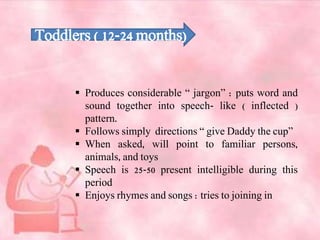
Toddlers ( 12-24 months)
 Produces considerable “ jargon” : puts word and
sound together into speech- like ( inflected )
pattern.
 Follows simply directions “ give Daddy the cup”
 When asked, will point to familiar persons,
animals, and toys
 Speech is 25-50 present intelligible during this
period
 Enjoys rhymes and songs : tries to joining in
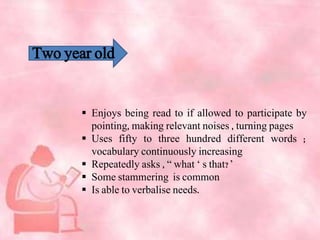
Two year old
 Enjoys being read to if allowed to participate by
pointing, making relevant noises , turning pages
 Uses fifty to three hundred different words ;
vocabulary continuously increasing
 Repeatedly asks , “ what ‘ s that?’
 Some stammering is common
 Is able to verbalise needs.
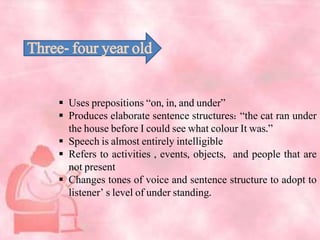
Three- four year old
 Uses prepositions “on, in, and under”
 Produces elaborate sentence structures: “the cat ran under
the house before I could see what colour It was.”
 Speech is almost entirely intelligible
 Refers to activities , events, objects, and people that are
not present
 Changes tones of voice and sentence structure to adopt to
listener’ s level of under standing.
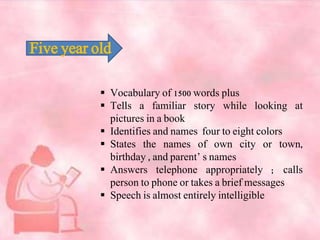
Five year old
 Vocabulary of 1500 words plus
 Tells a familiar story while looking at
pictures in a book
 Identifies and names four to eight colors
 States the names of own city or town,
birthday , and parent’ s names
 Answers telephone appropriately ; calls
person to phone or takes a brief messages
 Speech is almost entirely intelligible
Six year old
 Can identify right and left hands fairly consistently
 Talks a lot
 Experiments with slang and profanity and finds It funny
 Able to carry on adult –like conversations ;asks many
questions
 Learns 5-10 words daily ; vocabulary of10000-14000
 Can’t handle things not going their own way
 Has mood swings towards primary caregiver depending on
the day
 Loves telling jokes and riddles ; often, humour is far from
subtle
language development in human

language development in human

  • 1.
    LANGUAGE DEVELOPMENT A PRESANTATIONBY ABDUL MANAF CHALIYAMPURATH KSTC THALIPARAMBA
  • 2.
    LANGUAGE DEVELOPMENT Language developmentis a process starting early in human life. When a person begins to acquire language by learning it as it is spoken or mimicry
  • 3.
    Stages of language development Infant Toddlers Twoyear old Thee-four year old Five year old Six year old
  • 4.
    Infant (0-1 year) Itis called pre production stage. The infant comprehends minimum, vocalisation with intonation, responds to his name, responds to human voices without visual cues by turning his head and eyes
  • 5.
    Toddlers ( 12-24months)  Produces considerable “ jargon” : puts word and sound together into speech- like ( inflected ) pattern.  Follows simply directions “ give Daddy the cup”  When asked, will point to familiar persons, animals, and toys  Speech is 25-50 present intelligible during this period  Enjoys rhymes and songs : tries to joining in
  • 6.
    Two year old Enjoys being read to if allowed to participate by pointing, making relevant noises , turning pages  Uses fifty to three hundred different words ; vocabulary continuously increasing  Repeatedly asks , “ what ‘ s that?’  Some stammering is common  Is able to verbalise needs.
  • 7.
    Three- four yearold  Uses prepositions “on, in, and under”  Produces elaborate sentence structures: “the cat ran under the house before I could see what colour It was.”  Speech is almost entirely intelligible  Refers to activities , events, objects, and people that are not present  Changes tones of voice and sentence structure to adopt to listener’ s level of under standing.
  • 8.
    Five year old Vocabulary of 1500 words plus  Tells a familiar story while looking at pictures in a book  Identifies and names four to eight colors  States the names of own city or town, birthday , and parent’ s names  Answers telephone appropriately ; calls person to phone or takes a brief messages  Speech is almost entirely intelligible
  • 9.
    Six year old Can identify right and left hands fairly consistently  Talks a lot  Experiments with slang and profanity and finds It funny  Able to carry on adult –like conversations ;asks many questions  Learns 5-10 words daily ; vocabulary of10000-14000  Can’t handle things not going their own way  Has mood swings towards primary caregiver depending on the day  Loves telling jokes and riddles ; often, humour is far from subtle