LANGUAGE AWARENESS
Answer the questions What is awareness? What is language awareness? How do you acquire awareness?
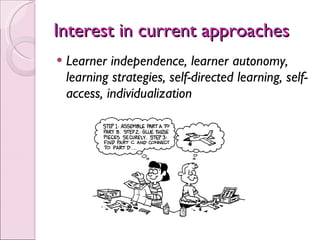
Interest in current approaches  Learner independence, learner autonomy, learning strategies, self-directed learning, self­access, individualization
Explicit learner-centred approaches Cognitive sciences   Studies in individual differences   “ Good language learner” research   Humanistic approaches   “ Study skills” tradition   Social changes and changes in the labour market.   http://www.learningpaths.org/papers/paperawareness.htm
AWARENESS State or ability to perceive, to feel, or to be  conscious  of events,  objects  or sensory  patterns . More broadly, it is the state or quality of being aware of something. In  biological psychology , awareness is defined as a human's or an animal's  perception  and  cognitive  reaction to a condition or event.
Language Awareness explicit knowledge about language, and conscious perception and sensitivity in language learning, language teaching and language use .  good knowledge about language, a conscious understanding of how languages work, of how people learn them and use them.
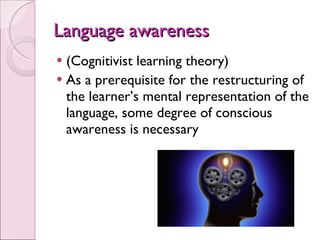
Language awareness (Cognitivist learning theory) As a prerequisite for the restructuring of the learner’s mental representation of the language, some degree of conscious awareness is necessary
Awereness-raising activities Explicit focus on the rules of the system Help learners uncover gaps in their knowledge
Attention: Pay attention, alert, interested, involved and curious- features of target skill Noticing: Conscious registering of the occurrence of some event. When do you notice things of language? - make connections - familiarity - absence of something - noticing the gap Understanding: no awareness without understanding, recognition of general rules, principles or patterns
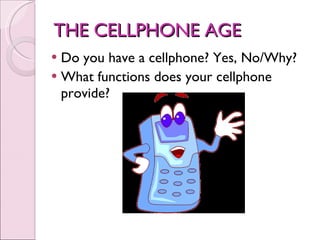
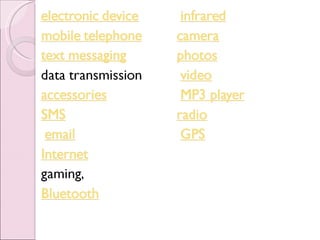
THE CELLPHONE AGE Do you have a cellphone? Yes, No/Why? What functions does your cellphone provide?
 
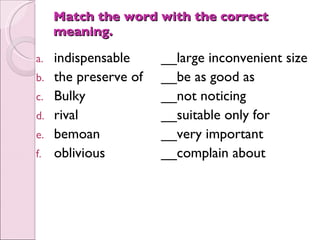
Match the word with the correct meaning. indispensable  __large inconvenient size the preserve of  __be as good as Bulky __not noticing rival  __suitable only for bemoan  __very important oblivious  __complain about
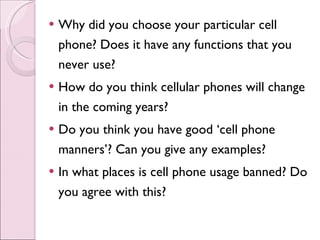
Why did you choose your particular cell phone? Does it have any functions that you never use? How do you think cellular phones will change in the coming years? Do you think you have good ‘cell phone manners’? Can you give any examples? In what places is cell phone usage banned? Do you agree with this?
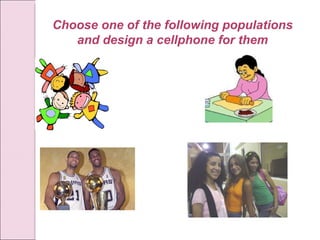
Choose one of the following populations and design a cellphone for them
Consider Features Uses Restrictions Price Shape Population Advantages
NOW… Choose a topic and plan a set of activities to teach a specialized language
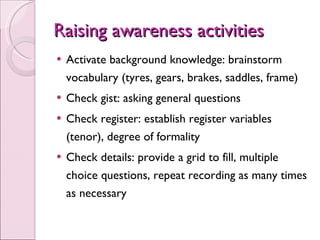
Raising awareness activities Activate background knowledge: brainstorm vocabulary (tyres, gears, brakes, saddles, frame) Check gist: asking general questions Check register: establish register variables (tenor), degree of formality Check details: provide a grid to fill, multiple choice questions, repeat recording as many times as necessary
Listen and read: hand out the transcript Resolve doubts: residual doubts about the topic and the reading Focus on language features: identifying, counting, classifying, matching, connecting, comparing and contrasting

Language awareness

  • 1.
  • 2.
    Answer the questionsWhat is awareness? What is language awareness? How do you acquire awareness?
  • 3.
    Interest in currentapproaches Learner independence, learner autonomy, learning strategies, self-directed learning, self­access, individualization
  • 4.
    Explicit learner-centred approachesCognitive sciences Studies in individual differences “ Good language learner” research Humanistic approaches “ Study skills” tradition Social changes and changes in the labour market. http://www.learningpaths.org/papers/paperawareness.htm
  • 5.
    AWARENESS State orability to perceive, to feel, or to be conscious of events, objects or sensory patterns . More broadly, it is the state or quality of being aware of something. In biological psychology , awareness is defined as a human's or an animal's perception and cognitive reaction to a condition or event.
  • 6.
    Language Awareness explicitknowledge about language, and conscious perception and sensitivity in language learning, language teaching and language use . good knowledge about language, a conscious understanding of how languages work, of how people learn them and use them.
  • 7.
    Language awareness (Cognitivistlearning theory) As a prerequisite for the restructuring of the learner’s mental representation of the language, some degree of conscious awareness is necessary
  • 8.
    Awereness-raising activities Explicitfocus on the rules of the system Help learners uncover gaps in their knowledge
  • 9.
    Attention: Pay attention,alert, interested, involved and curious- features of target skill Noticing: Conscious registering of the occurrence of some event. When do you notice things of language? - make connections - familiarity - absence of something - noticing the gap Understanding: no awareness without understanding, recognition of general rules, principles or patterns
  • 10.
    THE CELLPHONE AGEDo you have a cellphone? Yes, No/Why? What functions does your cellphone provide?
  • 11.
  • 12.
    Match the wordwith the correct meaning. indispensable __large inconvenient size the preserve of __be as good as Bulky __not noticing rival __suitable only for bemoan __very important oblivious __complain about
  • 13.
    Why did youchoose your particular cell phone? Does it have any functions that you never use? How do you think cellular phones will change in the coming years? Do you think you have good ‘cell phone manners’? Can you give any examples? In what places is cell phone usage banned? Do you agree with this?
  • 14.
    Choose one ofthe following populations and design a cellphone for them
  • 15.
    Consider Features UsesRestrictions Price Shape Population Advantages
  • 16.
    NOW… Choose atopic and plan a set of activities to teach a specialized language
  • 17.
    Raising awareness activitiesActivate background knowledge: brainstorm vocabulary (tyres, gears, brakes, saddles, frame) Check gist: asking general questions Check register: establish register variables (tenor), degree of formality Check details: provide a grid to fill, multiple choice questions, repeat recording as many times as necessary
  • 18.
    Listen and read:hand out the transcript Resolve doubts: residual doubts about the topic and the reading Focus on language features: identifying, counting, classifying, matching, connecting, comparing and contrasting