Ifal Sukatri (22202249007)
Moh Rafli (22202289009)
Jen Ulitami (222022)
Language
and Gender
Defining terms:
GENDER, SEX CATEGORY AND SEXUALITY
Defining Terms:
Gender, Sex
Category, and
Sexuality
01
Theories about
Gender
02
Representation of
Gender
03
Defining terms:
GENDER, SEX CATEGORY AND SEXUALITY
Sexist Language
04
Grammatical Gender
Marking
05
Language Change
Categories of
Gender in Language
06
07
The term “gender” is sometimes misunderstood by some certain people by
considering it is the same as “sex”. In fact, they have different definitions, “Sex is
designation based on biology, whereas gender is socially and psychologically
constructed by the process of interactions in the family, social and education
settings.” In other words, “gender is not something we have, but something we do,
something we perform. Sex is a biological categorization based primarily on
reproductive potential, whereas gender is the social elaboration of biological sex.”
Gender, Sex Category
and Sexuality
DEFINITION OF GENDER AND SEX
Theories about Gender and
Spoken Language
Talk more than men, talk too
much, are more polite, are
indecisive/hesitant, complain
and nag, ask more questions,
support each other, are more
co-operative
WOMEN
Don't talk about emotions, talk
about sport more, talk about
women and machines in the same
way, insult each other frequently,
are competitive in conversation,
dominate conversation
MEN
Representation of Gender
The advertisement appears to
be just a bottle of FruitWater
with a pretty blonde standing
next to it to capture interest.
The advertisement draws as
many connections as it can
between this woman and the
FruitWater bottle.
By describing the woman as
"bubbly" and the bottle as
"lovely," they subvert
expectations by making a clear
relationship between the two.
Representation of Gender
This is an advertisement for Maxi-Milk, a
ready-to-drink protein shake by the
company MaxiNutrition.
The text on the ad says “Milk for Real Men”
which suggests that this climber is a “real
man.” This suggestion comes with the
implication that a “real man” is extremely
muscular, chiseled and enjoys extreme
sports.
Penelope (1988) discusses how such
usages exclude women and create the
mentality that men are the default and the
norm, and women are the exception.
Another of the issues involved in answering
this question has to do with words that
encode sex categories, most commonly sex
category–marked names of people in
specific occupations, for example, fireman,
stewardess, and waitress.
Sexist
Language
Grammatical
gender marking
Grammatical gender marking is more extensive in some languages than it is
in English, and presents different problems in attempts to make language
more gender neutral. As Mills (2008) notes, the word for ‘minister’ in
French is masculine (le minister), so it is difficult to refer to a female
minister. Further, the norm in languages such as French and Spanish is to
use the masculine plural for groups containing both men and women.
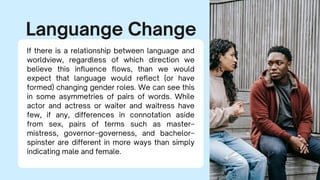
Languange Change
If there is a relationship between language and
worldview, regardless of which direction we
believe this influence flows, than we would
expect that language would reflect (or have
formed) changing gender roles. We can see this
in some asymmetries of pairs of words. While
actor and actress or waiter and waitress have
few, if any, differences in connotation aside
from sex, pairs of terms such as master–
mistress, governor–governess, and bachelor–
spinster are different in more ways than simply
indicating male and female.
Grammatical gender is a
basic part of a noun that
determines which kind of
agreement such as article,
adjective, verb, numeral or
preposition that can follow
the noun.
Lexically, the meaning of
mother and sister represents
femaleness while son and boy
relate to maleness. In other
words, such nouns can be
referred to “gender specific”
(female specific or male
specific).
Categories of Gender
in Language
GRAMMATICAL
GENDER
1. 2. LEXICAL
GENDER
Referential gender can be
understood as the linguistic
expressions that are used to non-
linguistic reality. It means a word can
be changed its basic function
grammatically and lexically to be
feminine, masculine or neuter when
idiomatic expressions are used.
Social gender can be understood as
the social separation between
masculine and feminine roles and
character traits. It means that
personal nouns are formed
specifically socially when there is no
any difference between feminine or
masculine words if it is viewed
grammatically or lexically.
Categories of Gender
in Language
3. REFERENTIAL
GENDER
4. SOCIAL
GENDER
Thanks for listening!
Reach out to us if you have any questions or concerns.

Language and Gender.pdf

  • 1.
    Ifal Sukatri (22202249007) MohRafli (22202289009) Jen Ulitami (222022) Language and Gender
  • 2.
    Defining terms: GENDER, SEXCATEGORY AND SEXUALITY Defining Terms: Gender, Sex Category, and Sexuality 01 Theories about Gender 02 Representation of Gender 03
  • 3.
    Defining terms: GENDER, SEXCATEGORY AND SEXUALITY Sexist Language 04 Grammatical Gender Marking 05 Language Change Categories of Gender in Language 06 07
  • 4.
    The term “gender”is sometimes misunderstood by some certain people by considering it is the same as “sex”. In fact, they have different definitions, “Sex is designation based on biology, whereas gender is socially and psychologically constructed by the process of interactions in the family, social and education settings.” In other words, “gender is not something we have, but something we do, something we perform. Sex is a biological categorization based primarily on reproductive potential, whereas gender is the social elaboration of biological sex.” Gender, Sex Category and Sexuality DEFINITION OF GENDER AND SEX
  • 5.
    Theories about Genderand Spoken Language Talk more than men, talk too much, are more polite, are indecisive/hesitant, complain and nag, ask more questions, support each other, are more co-operative WOMEN Don't talk about emotions, talk about sport more, talk about women and machines in the same way, insult each other frequently, are competitive in conversation, dominate conversation MEN
  • 6.
    Representation of Gender Theadvertisement appears to be just a bottle of FruitWater with a pretty blonde standing next to it to capture interest. The advertisement draws as many connections as it can between this woman and the FruitWater bottle. By describing the woman as "bubbly" and the bottle as "lovely," they subvert expectations by making a clear relationship between the two.
  • 7.
    Representation of Gender Thisis an advertisement for Maxi-Milk, a ready-to-drink protein shake by the company MaxiNutrition. The text on the ad says “Milk for Real Men” which suggests that this climber is a “real man.” This suggestion comes with the implication that a “real man” is extremely muscular, chiseled and enjoys extreme sports.
  • 8.
    Penelope (1988) discusseshow such usages exclude women and create the mentality that men are the default and the norm, and women are the exception. Another of the issues involved in answering this question has to do with words that encode sex categories, most commonly sex category–marked names of people in specific occupations, for example, fireman, stewardess, and waitress. Sexist Language
  • 9.
    Grammatical gender marking Grammatical gendermarking is more extensive in some languages than it is in English, and presents different problems in attempts to make language more gender neutral. As Mills (2008) notes, the word for ‘minister’ in French is masculine (le minister), so it is difficult to refer to a female minister. Further, the norm in languages such as French and Spanish is to use the masculine plural for groups containing both men and women.
  • 10.
    Languange Change If thereis a relationship between language and worldview, regardless of which direction we believe this influence flows, than we would expect that language would reflect (or have formed) changing gender roles. We can see this in some asymmetries of pairs of words. While actor and actress or waiter and waitress have few, if any, differences in connotation aside from sex, pairs of terms such as master– mistress, governor–governess, and bachelor– spinster are different in more ways than simply indicating male and female.
  • 11.
    Grammatical gender isa basic part of a noun that determines which kind of agreement such as article, adjective, verb, numeral or preposition that can follow the noun. Lexically, the meaning of mother and sister represents femaleness while son and boy relate to maleness. In other words, such nouns can be referred to “gender specific” (female specific or male specific). Categories of Gender in Language GRAMMATICAL GENDER 1. 2. LEXICAL GENDER
  • 12.
    Referential gender canbe understood as the linguistic expressions that are used to non- linguistic reality. It means a word can be changed its basic function grammatically and lexically to be feminine, masculine or neuter when idiomatic expressions are used. Social gender can be understood as the social separation between masculine and feminine roles and character traits. It means that personal nouns are formed specifically socially when there is no any difference between feminine or masculine words if it is viewed grammatically or lexically. Categories of Gender in Language 3. REFERENTIAL GENDER 4. SOCIAL GENDER
  • 13.
    Thanks for listening! Reachout to us if you have any questions or concerns.