- Non-Uniformed Personnel presently assigned at RLDDD (R8) as Training
Specialist 1.
- Married with 4 children.
Bachelor of Arts (AB) major in Development Communication (DevCom) at
Ateneo de Cagayan (Xavier University).
Xavier University and Capitol University
Liceo de Cagayan University - Higher English, Philosophy, others
Capitol University - English, Psychology, others (BSN,
Marine, Nautical, Eng’g.)
RTC 10 - Police Media Relations, Correspondence (PSBRC)
- Human Relations, Police Correspondence, Power and Leadership (PSJLC)
- Human Resource Management, Research and Managing Problem Emphasis, Intro to
CSW (PSSLC)
- Research, Concepts and Principles of Teaching (PSOCC)
- Crisis Incident Management, Oplan Sambayan (Tourist Police)
RHQ - Police Correspondence, Records Management (CIC)
- Managing Media Relations; Building Communications Proficiency (IOBC)
- Instructors Development Course - ICITAP
- Supervisory Development Course (Tracks 1, 2 & 3) – DHRDD
- Training of Trainers – Davao City
- Ethics and Human Dignity Course – ICITAP
- Police Media Relations – RPCRD
- Rescue Training Program – Rotary Club of Metro Cagayan
- others
The goal of this lesson is designed for PNP personnel to
enhance self-awareness on the gender concerns on
issues affecting relationships at various levels within
family, workplace and community.
LESSON GOAL
• Enlighten participants on the difference between sex
and gender;
• Define of Gender Bias, Gender Equality and GAD;
• Cite examples on manifestation of Gender Bias; and
• Identify GAD Projects.
LESSON OBJECTIVES
What is the difference
between sex and gender?
SEX – is a natural distinguished
variable based on biological attributes
between males and females, such as
genitalia.
SEX – is constant across time, across different societies
and cultures
SEX - A biological term, a natural attribute that person is
born with, which meant to signify that one is either a
female or a male
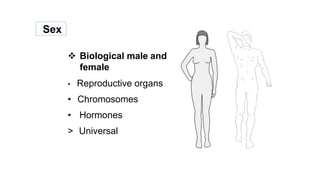
Sex
 Biological male and
female
• Reproductive organs
• Chromosomes
• Hormones
> Universal
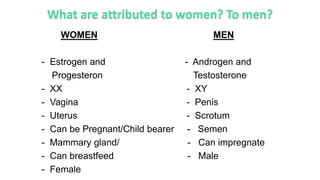
WOMEN MEN
- Estrogen and - Androgen and
Progesteron Testosterone
- XX - XY
- Vagina - Penis
- Uterus - Scrotum
- Can be Pregnant/Child bearer - Semen
- Mammary gland/ - Can impregnate
- Can breastfeed - Male
- Female
Genderdefined
Gender refers to a set of socially ascribed characteristics,
norms, roles, attitudes, values and expectations identifying
the social behavior of men and women, and the relations
between them (RA 11313, Safe Spaces Act)
GENDER – refers to the differentiated
social roles, behaviors, capacities,
intellectual, emotional and social
characteristics attributed by a given
culture to women and men. It is what
makes one masculine or feminine.
GENDER - is socially determine and a
learned behavior.
- changes across time, places,
and cultures.
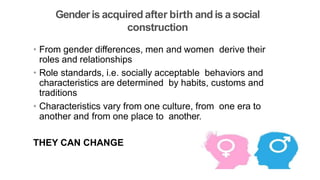
Gender is acquired after birth and is asocial
construction
• From gender differences, men and women derive their
roles and relationships
• Role standards, i.e. socially acceptable behaviors and
characteristics are determined by habits, customs and
traditions
• Characteristics vary from one culture, from one era to
another and from one place to another.
THEY CAN CHANGE
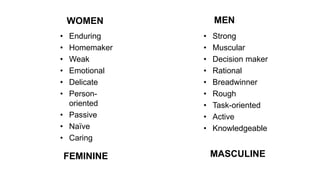
WOMEN MEN
• Enduring
• Homemaker
• Weak
• Emotional
• Delicate
• Person-
oriented
• Passive
• Naïve
• Caring
• Strong
• Muscular
• Decision maker
• Rational
• Breadwinner
• Rough
• Task-oriented
• Active
• Knowledgeable
FEMININE MASCULINE
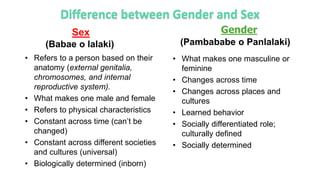
Sex
(Babae o lalaki)
Gender
(Pambababe o Panlalaki)
• Refers to a person based on their
anatomy (external genitalia,
chromosomes, and internal
reproductive system).
• What makes one male and female
• Refers to physical characteristics
• Constant across time (can’t be
changed)
• Constant across different societies
and cultures (universal)
• Biologically determined (inborn)
• What makes one masculine or
feminine
• Changes across time
• Changes across places and
cultures
• Learned behavior
• Socially differentiated role;
culturally defined
• Socially determined
Let’s Have a
Test
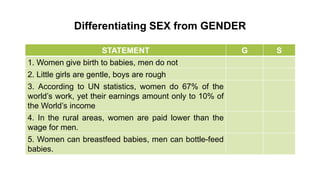
Differentiating SEX from GENDER
STATEMENT G S
1. Women give birth to babies, men do not
2. Little girls are gentle, boys are rough
3. According to UN statistics, women do 67% of the
world’s work, yet their earnings amount only to 10% of
the World’s income
4. In the rural areas, women are paid lower than the
wage for men.
5. Women can breastfeed babies, men can bottle-feed
babies.
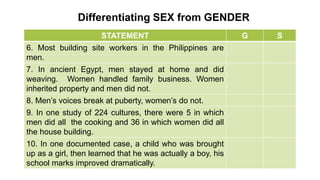
Differentiating SEX from GENDER
STATEMENT G S
6. Most building site workers in the Philippines are
men.
7. In ancient Egypt, men stayed at home and did
weaving. Women handled family business. Women
inherited property and men did not.
8. Men’s voices break at puberty, women’s do not.
9. In one study of 224 cultures, there were 5 in which
men did all the cooking and 36 in which women did all
the house building.
10. In one documented case, a child who was brought
up as a girl, then learned that he was actually a boy, his
school marks improved dramatically.
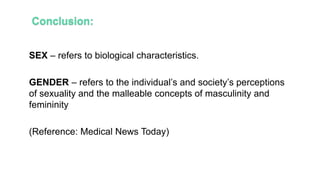
SEX – refers to biological characteristics.
GENDER – refers to the individual’s and society’s perceptions
of sexuality and the malleable concepts of masculinity and
femininity
(Reference: Medical News Today)
GENDER - is socially determine and a learned behavior.
- changes across time, places, and cultures.
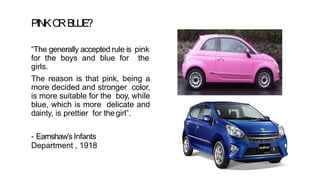
PINKO
RBLUE?
“The generally accepted rule is pink
for the boys and blue for the
girls.
The reason is that pink, being a
more decided and stronger color,
is more suitable for the boy, while
blue, which is more delicate and
dainty, is prettier for the girl”.
- Earnshaw’s Infants
Department , 1918
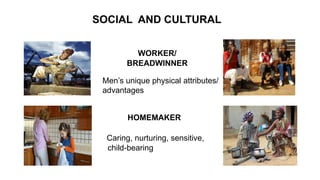
WORKER/
BREADWINNER
Men’s unique physical attributes/
advantages
HOMEMAKER
Caring, nurturing, sensitive,
child-bearing
SOCIAL AND CULTURAL
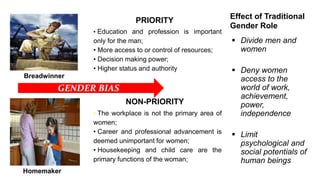
Breadwinner
Homemaker
GENDER BIAS
PRIORITY
• Education and profession is important
only for the man;
• More access to or control of resources;
• Decision making power;
• Higher status and authority
NON-PRIORITY
• The workplace is not the primary area of
women;
• Career and professional advancement is
deemed unimportant for women;
• Housekeeping and child care are the
primary functions of the woman;
Effect of Traditional
Gender Role
 Divide men and
women
 Deny women
access to the
world of work,
achievement,
power,
independence
 Limit
psychological and
social potentials of
human beings
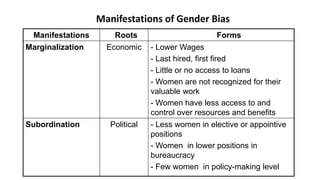
Manifestations of Gender Bias
Manifestations Roots Forms
Marginalization Economic - Lower Wages
- Last hired, first fired
- Little or no access to loans
- Women are not recognized for their
valuable work
- Women have less access to and
control over resources and benefits
Subordination Political - Less women in elective or appointive
positions
- Women in lower positions in
bureaucracy
- Few women in policy-making level
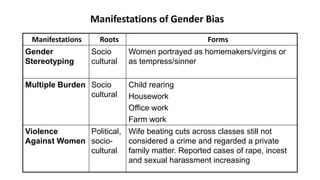
Manifestations of Gender Bias
Manifestations Roots Forms
Gender
Stereotyping
Socio
cultural
Women portrayed as homemakers/virgins or
as tempress/sinner
Multiple Burden Socio
cultural
Child rearing
Housework
Office work
Farm work
Violence
Against Women
Political,
socio-
cultural
Wife beating cuts across classes still not
considered a crime and regarded a private
family matter. Reported cases of rape, incest
and sexual harassment increasing
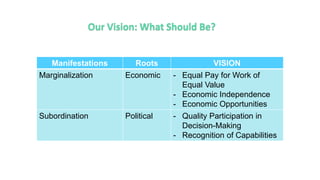
Manifestations Roots VISION
Marginalization Economic - Equal Pay for Work of
Equal Value
- Economic Independence
- Economic Opportunities
Subordination Political - Quality Participation in
Decision-Making
- Recognition of Capabilities
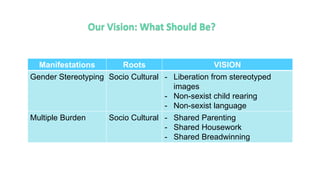
Manifestations Roots VISION
Gender Stereotyping Socio Cultural - Liberation from stereotyped
images
- Non-sexist child rearing
- Non-sexist language
Multiple Burden Socio Cultural - Shared Parenting
- Shared Housework
- Shared Breadwinning
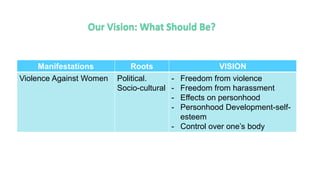
Manifestations Roots VISION
Violence Against Women Political.
Socio-cultural
- Freedom from violence
- Freedom from harassment
- Effects on personhood
- Personhood Development-self-
esteem
- Control over one’s body
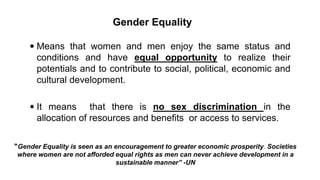
Gender Equality
 Means that women and men enjoy the same status and
conditions and have equal opportunity to realize their
potentials and to contribute to social, political, economic and
cultural development.
 It means that there is no sex discrimination in the
allocation of resources and benefits or access to services.
“Gender Equality is seen as an encouragement to greater economic prosperity. Societies
where women are not afforded equal rights as men can never achieve development in a
sustainable manner” -UN
Gender Mainstreaming
 Means raising people's GAD awareness and building GAD-related
capabilities; putting in place policies, structures, systems, and
mechanisms that would facilitate and institutionalize the pursuit of
gender equality and women’s empowerment.
Entry Points of GAD Mainstreaming
• People
• Policy
• Programs and Projects
• Enabling Mechanisms
(ensuring the institutional compliance to the minimum 5% utilization
of the GAD budgets of government agencies and local government
units.)
Movement for Gender Equality resulted in the following:
 Women Suffrage
 Woman Property Rights in Marriage
 Sex Discrimination Laws
 Equal Pay for Equal Work
 Women in Business and Politics
 Women in Police, Fire and Armed Forces
WHAT is GENDER and
DEVELOPMENT (GAD) ?
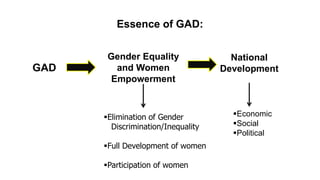
Essence of GAD:
GAD
Gender Equality
and Women
Empowerment
National
Development
Elimination of Gender
Discrimination/Inequality
Full Development of women
Participation of women
Economic
Social
Political
What is Gender and Development?
 GAD is a human rights based development framework that
recognizes the legitimacy of gender equality as a fundamental
value that should be reflected in every development program.
 Both men and women must equally contribute to and benefit
from development.
GAD is about being faithful to the principle that…
Fairness and equity demands that everyone in society whether
male or female has the right to the same opportunities to
achieve a full and satisfying life.
In the processes of developing, budgeting, implementing,
monitoring and evaluating programs, projects and services,
particularly in GOVERNMENT AGENCIES
A gender-responsive development is crucial in attaining
GROWTH with EQUITY
GROWTH, because GAD empowers women to be effective
as half of the national producers of goods and services.
EQUITY, because it aims to provide more to those who
have less according to needs.
GAD Through The Years
Article II, Sec 14, Philippine Constitution:
“The State recognizes the role of women in nation building and
shall ensure the fundamental equality before the law of women
and men”.
1988
Proclamation No. 224, “Declaring the First Week of March of
Every Year as Women’s Week and March 8, 1988 and Every
Year Thereafter as Women’s Rights and International Peace
day.” Signed by former President Corazon C. Aquino on March
1, 1988.
1992
NAPOLCOM issued memorandum circular 92-010
establishing the child and youth relations section.
1993
Pres. Ramos issued Presidential Memorandum creating the
Women’s Desk in police stations.
1997
The PNP issued Memorandum Circular No. 97-001 re:
Activation of the Women and Children Concerns Division
(WCCD) under the DPCR.
The Women’s Desk and the CYRS were merged to
strengthen PNP response to violence against women
and children. The unit was renamed Women and
Children’s Desk.
1998
RA 8551, otherwise known as PNP reform and
reorganization act, was enacted Sec. 57 of the law paved the
way to the institutionalization of the women and children’s
desk.
DPCR initiated a data monitoring system on gender-based
crimes against children/ children in conflict with the law.
2001
The PNP Women’s Crisis and Child
Protection Center based in Camp Crame
was established.
The WCD was renamed to Women and
Children Protection Desk.
2002 - 2003
The investigate functions of WCCD were transferred under
DIDM.
2005 - 2006
Several programs, projects and activities to advance the
cause of women and children were adopted and
implemented.
These included among others, the construction of women
quarters and establishment of day care centers.
2009
RA 9710 - An act providing for the Magna Carta of Women.
Within the next five (5) years incremental increase in the
recruitment and training of women in the police force until
fifty percent (50%) of the personnel, thereof shall be women.
(Section 9)
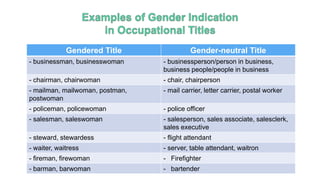
Gendered Title Gender-neutral Title
- businessman, businesswoman - businessperson/person in business,
business people/people in business
- chairman, chairwoman - chair, chairperson
- mailman, mailwoman, postman,
postwoman
- mail carrier, letter carrier, postal worker
- policeman, policewoman - police officer
- salesman, saleswoman - salesperson, sales associate, salesclerk,
sales executive
- steward, stewardess - flight attendant
- waiter, waitress - server, table attendant, waitron
- fireman, firewoman - Firefighter
- barman, barwoman - bartender
GAD Projects
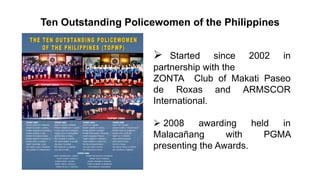
Ten Outstanding Policewomen of the Philippines
 Started since 2002 in
partnership with the
ZONTA Club of Makati Paseo
de Roxas and ARMSCOR
International.
 2008 awarding held in
Malacañang with PGMA
presenting the Awards.
TOPWP 2002
PSSUPT ANGELES Z ABINOJA
PCINSP ELEANOR V LAMPA
PCINSP ADELENE M FLORENDO
PCINSP SALOME R JOSE
PCINSP FELICIDAD R GIDO
PSINSP MARILYN B SAMARITA
PSINSP JEAN S FAJARDO
PINSP CHRISTINE S TAN
PO2 MARIA LUISA J PEDROZA
PO2 JOANNE B TORREFRANCA
TOPWP 2003
PSUPT JUANITA S NEBRAN
PSINSP CARMENCITA C SALIBA
PSINSP CRISTINA B NOBLEZA
PSINSP ALETA F ASTRONOMO
SPO2 SESIMA V SISMA
PO2 TEJANNE Z ZARZOSO
P02 ANNIE MARIE A ANUARY
P02 EMILY M TECON
PO2 MARICON U LABSANG
PO2 ANA M PARAL
TOPWP 2004
PSUPT FE P QUIBOL
PSINSP NORMA B FUNDAR
PSINSP ROYINA M GARMA
PSINSP JEANURADA J MACARIO
PINSP VIRGINIA P TEJUCO
PINSP CORAZON P VERGARA
PINSP KIMBERLY E MOLITAS
P02 MA CECINIA B RAGAY
PO2 LIZA JANE C ALTEZA
PO1 ANNALIZA R REYES
TOPWP 2005
PSUPT FE P QUIBOL
PCINSP SOTERA P MACATANGAY
PSINSP MARILOU G ABOLOC
PSINSP LINA L AVELINO
PINSP JOY E TOMBOC
PINSP RHEA E SANTOS
SPO2 ERMA B JABAL
PO3 FE S POLAS
PO3 MAYLA PERLA G GAVINA
PO2 YOLANDA A MABERIT
TOPWP 2006
PSUPT EVANGELINE L CANDIA PSINSP MA CECILIA R DETABLAN
PSUPT LILIAN P CASTILLO PSINSP FLOR E MIRASOL
PCINSP EMMA I GALERO PSINSP JHOANNA P ROSALES
PSINSP ANITA L ARAULLO PSINSP RUBENIE B GRANDEZA
PSINSP MA IVY P CASTILLO PO3 ROSALIE G AGLANANG
TOPWP 2002 TOPWP 2003
TOPWP 2004 TOPWP 2005
Organization-focus (PNP)
 Orientation Seminars on RA 7877/ 9710/ 9262 and 8353
and other VAW related laws for police personnel.
 Quarters/Dressing Rooms for Women.
 PNP Day Care Center and/or Child Minding Facilities.
 PNP Reproductive Health and Women’s Diseases
Awareness Program.
 Continuing Gender Training Program.
 Responsible Parenting Seminars.
 PNP Women Representation in the Third level Position.
 PNP Summit for Policemen in relation to Men
Opposed to Violence Against Women Everywhere
(MOVE).
Client Focus (Community)
 Production of Information and Communication (IEC)
Materials on GAD and women and children protection.
 Assessment on the implementation of WCPD programs.
 Equipping the Women and Children Protection Desks
 School Visitation for imparting knowledge on the Right
of the Children and Law concerning Women and
Children.
 Established a system for receiving complaints and calls
to assist trafficked persons and conduct of rescue
operations.
You respect every person/individual, regardless of age, ability
(physical or mental), belief/religion, educational attainment,
race, ethnic group, status in society, marital status, region of
origin, color, sexual orientation, gender identity and
expression.
Maraming
Salamat
Po!

Gender and Development Lecture (new) (2 hrs).pptx

  • 2.
    - Non-Uniformed Personnelpresently assigned at RLDDD (R8) as Training Specialist 1. - Married with 4 children. Bachelor of Arts (AB) major in Development Communication (DevCom) at Ateneo de Cagayan (Xavier University). Xavier University and Capitol University Liceo de Cagayan University - Higher English, Philosophy, others Capitol University - English, Psychology, others (BSN, Marine, Nautical, Eng’g.)
  • 3.
    RTC 10 -Police Media Relations, Correspondence (PSBRC) - Human Relations, Police Correspondence, Power and Leadership (PSJLC) - Human Resource Management, Research and Managing Problem Emphasis, Intro to CSW (PSSLC) - Research, Concepts and Principles of Teaching (PSOCC) - Crisis Incident Management, Oplan Sambayan (Tourist Police) RHQ - Police Correspondence, Records Management (CIC) - Managing Media Relations; Building Communications Proficiency (IOBC) - Instructors Development Course - ICITAP - Supervisory Development Course (Tracks 1, 2 & 3) – DHRDD - Training of Trainers – Davao City - Ethics and Human Dignity Course – ICITAP - Police Media Relations – RPCRD - Rescue Training Program – Rotary Club of Metro Cagayan - others
  • 4.
    The goal ofthis lesson is designed for PNP personnel to enhance self-awareness on the gender concerns on issues affecting relationships at various levels within family, workplace and community. LESSON GOAL
  • 5.
    • Enlighten participantson the difference between sex and gender; • Define of Gender Bias, Gender Equality and GAD; • Cite examples on manifestation of Gender Bias; and • Identify GAD Projects. LESSON OBJECTIVES
  • 6.
    What is thedifference between sex and gender?
  • 7.
    SEX – isa natural distinguished variable based on biological attributes between males and females, such as genitalia.
  • 8.
    SEX – isconstant across time, across different societies and cultures SEX - A biological term, a natural attribute that person is born with, which meant to signify that one is either a female or a male
  • 9.
    Sex  Biological maleand female • Reproductive organs • Chromosomes • Hormones > Universal
  • 10.
    WOMEN MEN - Estrogenand - Androgen and Progesteron Testosterone - XX - XY - Vagina - Penis - Uterus - Scrotum - Can be Pregnant/Child bearer - Semen - Mammary gland/ - Can impregnate - Can breastfeed - Male - Female
  • 11.
    Genderdefined Gender refers toa set of socially ascribed characteristics, norms, roles, attitudes, values and expectations identifying the social behavior of men and women, and the relations between them (RA 11313, Safe Spaces Act)
  • 12.
    GENDER – refersto the differentiated social roles, behaviors, capacities, intellectual, emotional and social characteristics attributed by a given culture to women and men. It is what makes one masculine or feminine.
  • 13.
    GENDER - issocially determine and a learned behavior. - changes across time, places, and cultures.
  • 14.
    Gender is acquiredafter birth and is asocial construction • From gender differences, men and women derive their roles and relationships • Role standards, i.e. socially acceptable behaviors and characteristics are determined by habits, customs and traditions • Characteristics vary from one culture, from one era to another and from one place to another. THEY CAN CHANGE
  • 15.
    WOMEN MEN • Enduring •Homemaker • Weak • Emotional • Delicate • Person- oriented • Passive • Naïve • Caring • Strong • Muscular • Decision maker • Rational • Breadwinner • Rough • Task-oriented • Active • Knowledgeable FEMININE MASCULINE
  • 16.
    Sex (Babae o lalaki) Gender (Pambababeo Panlalaki) • Refers to a person based on their anatomy (external genitalia, chromosomes, and internal reproductive system). • What makes one male and female • Refers to physical characteristics • Constant across time (can’t be changed) • Constant across different societies and cultures (universal) • Biologically determined (inborn) • What makes one masculine or feminine • Changes across time • Changes across places and cultures • Learned behavior • Socially differentiated role; culturally defined • Socially determined
  • 17.
  • 18.
    Differentiating SEX fromGENDER STATEMENT G S 1. Women give birth to babies, men do not 2. Little girls are gentle, boys are rough 3. According to UN statistics, women do 67% of the world’s work, yet their earnings amount only to 10% of the World’s income 4. In the rural areas, women are paid lower than the wage for men. 5. Women can breastfeed babies, men can bottle-feed babies.
  • 19.
    Differentiating SEX fromGENDER STATEMENT G S 6. Most building site workers in the Philippines are men. 7. In ancient Egypt, men stayed at home and did weaving. Women handled family business. Women inherited property and men did not. 8. Men’s voices break at puberty, women’s do not. 9. In one study of 224 cultures, there were 5 in which men did all the cooking and 36 in which women did all the house building. 10. In one documented case, a child who was brought up as a girl, then learned that he was actually a boy, his school marks improved dramatically.
  • 20.
    SEX – refersto biological characteristics. GENDER – refers to the individual’s and society’s perceptions of sexuality and the malleable concepts of masculinity and femininity (Reference: Medical News Today)
  • 21.
    GENDER - issocially determine and a learned behavior. - changes across time, places, and cultures.
  • 22.
    PINKO RBLUE? “The generally acceptedrule is pink for the boys and blue for the girls. The reason is that pink, being a more decided and stronger color, is more suitable for the boy, while blue, which is more delicate and dainty, is prettier for the girl”. - Earnshaw’s Infants Department , 1918
  • 27.
    WORKER/ BREADWINNER Men’s unique physicalattributes/ advantages HOMEMAKER Caring, nurturing, sensitive, child-bearing SOCIAL AND CULTURAL
  • 28.
    Breadwinner Homemaker GENDER BIAS PRIORITY • Educationand profession is important only for the man; • More access to or control of resources; • Decision making power; • Higher status and authority NON-PRIORITY • The workplace is not the primary area of women; • Career and professional advancement is deemed unimportant for women; • Housekeeping and child care are the primary functions of the woman; Effect of Traditional Gender Role  Divide men and women  Deny women access to the world of work, achievement, power, independence  Limit psychological and social potentials of human beings
  • 29.
    Manifestations of GenderBias Manifestations Roots Forms Marginalization Economic - Lower Wages - Last hired, first fired - Little or no access to loans - Women are not recognized for their valuable work - Women have less access to and control over resources and benefits Subordination Political - Less women in elective or appointive positions - Women in lower positions in bureaucracy - Few women in policy-making level
  • 30.
    Manifestations of GenderBias Manifestations Roots Forms Gender Stereotyping Socio cultural Women portrayed as homemakers/virgins or as tempress/sinner Multiple Burden Socio cultural Child rearing Housework Office work Farm work Violence Against Women Political, socio- cultural Wife beating cuts across classes still not considered a crime and regarded a private family matter. Reported cases of rape, incest and sexual harassment increasing
  • 31.
    Manifestations Roots VISION MarginalizationEconomic - Equal Pay for Work of Equal Value - Economic Independence - Economic Opportunities Subordination Political - Quality Participation in Decision-Making - Recognition of Capabilities
  • 32.
    Manifestations Roots VISION GenderStereotyping Socio Cultural - Liberation from stereotyped images - Non-sexist child rearing - Non-sexist language Multiple Burden Socio Cultural - Shared Parenting - Shared Housework - Shared Breadwinning
  • 33.
    Manifestations Roots VISION ViolenceAgainst Women Political. Socio-cultural - Freedom from violence - Freedom from harassment - Effects on personhood - Personhood Development-self- esteem - Control over one’s body
  • 34.
    Gender Equality  Meansthat women and men enjoy the same status and conditions and have equal opportunity to realize their potentials and to contribute to social, political, economic and cultural development.  It means that there is no sex discrimination in the allocation of resources and benefits or access to services. “Gender Equality is seen as an encouragement to greater economic prosperity. Societies where women are not afforded equal rights as men can never achieve development in a sustainable manner” -UN
  • 35.
    Gender Mainstreaming  Meansraising people's GAD awareness and building GAD-related capabilities; putting in place policies, structures, systems, and mechanisms that would facilitate and institutionalize the pursuit of gender equality and women’s empowerment. Entry Points of GAD Mainstreaming • People • Policy • Programs and Projects • Enabling Mechanisms (ensuring the institutional compliance to the minimum 5% utilization of the GAD budgets of government agencies and local government units.)
  • 36.
    Movement for GenderEquality resulted in the following:  Women Suffrage  Woman Property Rights in Marriage  Sex Discrimination Laws  Equal Pay for Equal Work  Women in Business and Politics  Women in Police, Fire and Armed Forces
  • 37.
    WHAT is GENDERand DEVELOPMENT (GAD) ?
  • 38.
    Essence of GAD: GAD GenderEquality and Women Empowerment National Development Elimination of Gender Discrimination/Inequality Full Development of women Participation of women Economic Social Political
  • 39.
    What is Genderand Development?  GAD is a human rights based development framework that recognizes the legitimacy of gender equality as a fundamental value that should be reflected in every development program.  Both men and women must equally contribute to and benefit from development.
  • 40.
    GAD is aboutbeing faithful to the principle that… Fairness and equity demands that everyone in society whether male or female has the right to the same opportunities to achieve a full and satisfying life.
  • 41.
    In the processesof developing, budgeting, implementing, monitoring and evaluating programs, projects and services, particularly in GOVERNMENT AGENCIES
  • 42.
    A gender-responsive developmentis crucial in attaining GROWTH with EQUITY GROWTH, because GAD empowers women to be effective as half of the national producers of goods and services. EQUITY, because it aims to provide more to those who have less according to needs.
  • 43.
    GAD Through TheYears Article II, Sec 14, Philippine Constitution: “The State recognizes the role of women in nation building and shall ensure the fundamental equality before the law of women and men”. 1988 Proclamation No. 224, “Declaring the First Week of March of Every Year as Women’s Week and March 8, 1988 and Every Year Thereafter as Women’s Rights and International Peace day.” Signed by former President Corazon C. Aquino on March 1, 1988.
  • 44.
    1992 NAPOLCOM issued memorandumcircular 92-010 establishing the child and youth relations section. 1993 Pres. Ramos issued Presidential Memorandum creating the Women’s Desk in police stations.
  • 45.
    1997 The PNP issuedMemorandum Circular No. 97-001 re: Activation of the Women and Children Concerns Division (WCCD) under the DPCR. The Women’s Desk and the CYRS were merged to strengthen PNP response to violence against women and children. The unit was renamed Women and Children’s Desk.
  • 46.
    1998 RA 8551, otherwiseknown as PNP reform and reorganization act, was enacted Sec. 57 of the law paved the way to the institutionalization of the women and children’s desk. DPCR initiated a data monitoring system on gender-based crimes against children/ children in conflict with the law.
  • 47.
    2001 The PNP Women’sCrisis and Child Protection Center based in Camp Crame was established. The WCD was renamed to Women and Children Protection Desk.
  • 48.
    2002 - 2003 Theinvestigate functions of WCCD were transferred under DIDM. 2005 - 2006 Several programs, projects and activities to advance the cause of women and children were adopted and implemented. These included among others, the construction of women quarters and establishment of day care centers.
  • 49.
    2009 RA 9710 -An act providing for the Magna Carta of Women. Within the next five (5) years incremental increase in the recruitment and training of women in the police force until fifty percent (50%) of the personnel, thereof shall be women. (Section 9)
  • 50.
    Gendered Title Gender-neutralTitle - businessman, businesswoman - businessperson/person in business, business people/people in business - chairman, chairwoman - chair, chairperson - mailman, mailwoman, postman, postwoman - mail carrier, letter carrier, postal worker - policeman, policewoman - police officer - salesman, saleswoman - salesperson, sales associate, salesclerk, sales executive - steward, stewardess - flight attendant - waiter, waitress - server, table attendant, waitron - fireman, firewoman - Firefighter - barman, barwoman - bartender
  • 51.
  • 52.
    Ten Outstanding Policewomenof the Philippines  Started since 2002 in partnership with the ZONTA Club of Makati Paseo de Roxas and ARMSCOR International.  2008 awarding held in Malacañang with PGMA presenting the Awards. TOPWP 2002 PSSUPT ANGELES Z ABINOJA PCINSP ELEANOR V LAMPA PCINSP ADELENE M FLORENDO PCINSP SALOME R JOSE PCINSP FELICIDAD R GIDO PSINSP MARILYN B SAMARITA PSINSP JEAN S FAJARDO PINSP CHRISTINE S TAN PO2 MARIA LUISA J PEDROZA PO2 JOANNE B TORREFRANCA TOPWP 2003 PSUPT JUANITA S NEBRAN PSINSP CARMENCITA C SALIBA PSINSP CRISTINA B NOBLEZA PSINSP ALETA F ASTRONOMO SPO2 SESIMA V SISMA PO2 TEJANNE Z ZARZOSO P02 ANNIE MARIE A ANUARY P02 EMILY M TECON PO2 MARICON U LABSANG PO2 ANA M PARAL TOPWP 2004 PSUPT FE P QUIBOL PSINSP NORMA B FUNDAR PSINSP ROYINA M GARMA PSINSP JEANURADA J MACARIO PINSP VIRGINIA P TEJUCO PINSP CORAZON P VERGARA PINSP KIMBERLY E MOLITAS P02 MA CECINIA B RAGAY PO2 LIZA JANE C ALTEZA PO1 ANNALIZA R REYES TOPWP 2005 PSUPT FE P QUIBOL PCINSP SOTERA P MACATANGAY PSINSP MARILOU G ABOLOC PSINSP LINA L AVELINO PINSP JOY E TOMBOC PINSP RHEA E SANTOS SPO2 ERMA B JABAL PO3 FE S POLAS PO3 MAYLA PERLA G GAVINA PO2 YOLANDA A MABERIT TOPWP 2006 PSUPT EVANGELINE L CANDIA PSINSP MA CECILIA R DETABLAN PSUPT LILIAN P CASTILLO PSINSP FLOR E MIRASOL PCINSP EMMA I GALERO PSINSP JHOANNA P ROSALES PSINSP ANITA L ARAULLO PSINSP RUBENIE B GRANDEZA PSINSP MA IVY P CASTILLO PO3 ROSALIE G AGLANANG TOPWP 2002 TOPWP 2003 TOPWP 2004 TOPWP 2005
  • 53.
    Organization-focus (PNP)  OrientationSeminars on RA 7877/ 9710/ 9262 and 8353 and other VAW related laws for police personnel.  Quarters/Dressing Rooms for Women.  PNP Day Care Center and/or Child Minding Facilities.
  • 54.
     PNP ReproductiveHealth and Women’s Diseases Awareness Program.  Continuing Gender Training Program.  Responsible Parenting Seminars.
  • 55.
     PNP WomenRepresentation in the Third level Position.  PNP Summit for Policemen in relation to Men Opposed to Violence Against Women Everywhere (MOVE).
  • 56.
    Client Focus (Community) Production of Information and Communication (IEC) Materials on GAD and women and children protection.  Assessment on the implementation of WCPD programs.
  • 57.
     Equipping theWomen and Children Protection Desks  School Visitation for imparting knowledge on the Right of the Children and Law concerning Women and Children.  Established a system for receiving complaints and calls to assist trafficked persons and conduct of rescue operations.
  • 58.
    You respect everyperson/individual, regardless of age, ability (physical or mental), belief/religion, educational attainment, race, ethnic group, status in society, marital status, region of origin, color, sexual orientation, gender identity and expression.
  • 59.