Teaching the
Elements of
Language
A. SOUNDS
(Phonology)

Aileen Pacayra
Page 1
Page 2
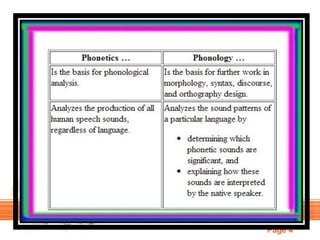
is "the study of sound pertaining
to the system of language”.
is "the study of sound pertaining
to the act of speech." (Nikolai Trubetzkoy
 in Grundzüge der Phonologie )
 The ways in which languages use sounds
or signs to construct meaning are studied
in phonology.
 The study of how humans produce and
perceive vocal sounds is called phonetics.
(Wikipedia)
Page 3
Page 4
Page 5
Page 6
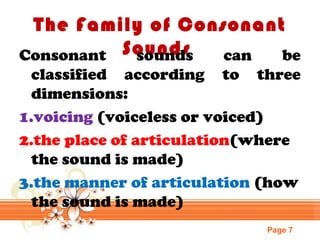
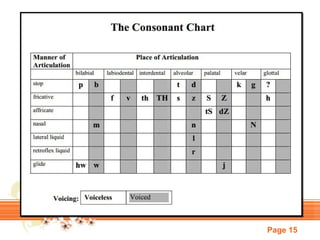
The Family of Consonant
Consonant Sounds
sounds
can
be
classified according to three
dimensions:
1.voicing (voiceless or voiced)
2.the place of articulation(where
the sound is made)
3.the manner of articulation (how
the sound is made)
Page 7
Voicing
A sound is voiced if the
vocal chords vibrate, whereas
a sound is voiceless if the vocal
cords are not vibrating upon
the production of sounds.
Page 8
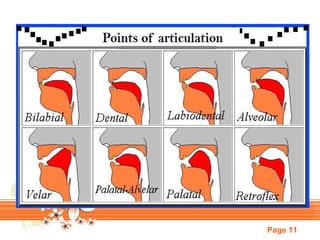
Place or Point of
1. BilaBial- two lips touching
Articulation
each other
2. laBio dental- lower lip
touches the upper teeth
3. dental- tip of the tongue and
the inner edge of the upper teeth
4. alveolar- tip of the tongue and
hard palate
Page 9
5. Palatal- the tongue
and hard palate
6. velar- dorsal tongue
and soft palate
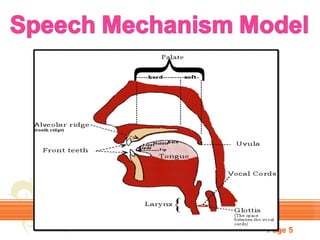
7. Glottal- throat passage

Page 10
Page 11
Manner of
Articulation

1. StoPS/PloSiveS- These are the sounds
produced when the air stream is blocked
completely before it is abruptly released.
The sounds P,T,K,B,D,G, are the
members of this family.
2. FricativeS- These are the sounds
produced when the air stream is
compressed and passes through a small
opening creating friction. The sounds
Page 12
F,V,S,Z,TH (voiced) and
(voiceless), SH, ZH are members of
this group.
3. aFFricateS- These are the
sounds produced when a plosive is
followed by a fricative. CH and J are
the members of this group
4. naSalS- These are the sounds
produced when the oral cavity is
blocked, and so the air passes
through the nose. N, M and NG are
nasal sounds.

Page 13
5. liquid/lateral- Sounds are
produced when air stream moves
around the tongue in an obstructed
manner. Sounds like L and R are
examples.
6. GlideS- Sounds that are close to
vowel sounds. Sounds like W and Y.

Page 14
Page 15
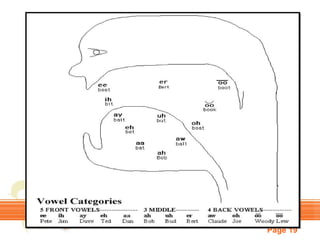
Vowel
Vowel sounds are produced with
one’s mouth open. It is also a fact that
all vowel sounds are voiced sounds.
Vowel sounds can be classified
according to the height of the tongue
and jaw, and the way the mouth
opens.
Page 16
What You Need to Know for
Vowels

• FRONT/CENTRAL/BACK: These three refers
to the position of the tongue from front to
back of the mouth during the production of
the sound.
• HIGH/MID/LOW: This designation refers to
whether the lips are rounded (O shape) or
spread (no rounding) when the sound is
being made.
Page 17
•TENSE VS. LAX: Also important in
describing vowel sounds are the
designations TENSE and LAX, which
refer to the relative tenseness of the
vocal muscles.

Page 18
Page 19
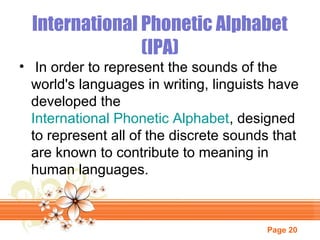
International Phonetic Alphabet
(IPA)

• In order to represent the sounds of the
world's languages in writing, linguists have
developed the
International Phonetic Alphabet, designed
to represent all of the discrete sounds that
are known to contribute to meaning in
human languages.

Page 20
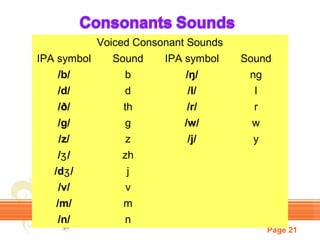
Voiced Consonant Sounds
IPA symbol

Sound

IPA symbol

Sound

/b/

b

/ŋ/

ng

/d/

d

/l/

l

/ð/

th

/r/

r

/g/

g

/w/

w

/z/

z

/j/

y

/ʒ /

zh

/dʒ /

j

/v/

v

/m/

m

/n/

n
Page 21
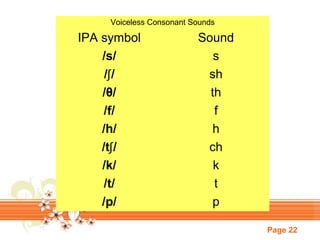
Voiceless Consonant Sounds

IPA symbol
/s/
/ʃ /
/θ/
/f/
/h/
/tʃ /
/k/
/t/
/p/

Sound
s
sh
th
f
h
ch
k
t
p
Page 22
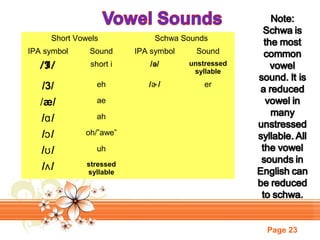
Short Vowels

Schwa Sounds

IPA symbol

Sound

IPA symbol

Sound

/I/

short i

/ə/

unstressed
syllable

/3/

eh

/ɚ /

er

/æ/

ae

/ɑ /

ah

/ɔ /

oh/”awe”

/ʊ /

uh

/ʌ /

stressed
syllable

Page 23
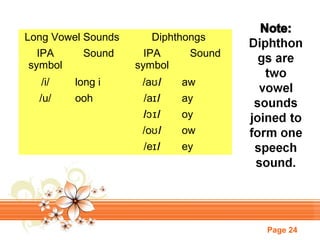
Long Vowel Sounds
IPA
symbol

Sound

Diphthongs
IPA
symbol

Sound

/i/

long i

/aʊ /

aw

/u/

ooh

/aɪ /

ay

/ɔɪ /

oy

/oʊ /

ow

/eɪ /

ey

Page 24
Activities

Page 25
Page 26
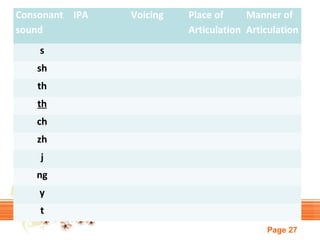
Consonant IPA
sound

Voicing

Place of
Manner of
Articulation Articulation

s
sh
th
th
ch
zh
j
ng
y
t
Page 27
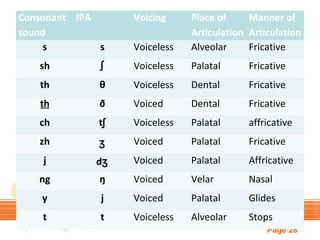
Consonant IPA
sound
s
s

Voicing
Voiceless

Place of
Manner of
Articulation Articulation
Alveolar
Fricative

sh

ʃ

Voiceless

Palatal

Fricative

th

θ

Voiceless

Dental

Fricative

th

ð

Voiced

Dental

Fricative

ch

tʃ

Voiceless

Palatal

affricative

zh

ʒ

Voiced

Palatal

Fricative

j

dʒ

Voiced

Palatal

Affricative

ng

ŋ

Voiced

Velar

Nasal

y

j

Voiced

Palatal

Glides

t

t

Voiceless

Alveolar

Stops
Page 28
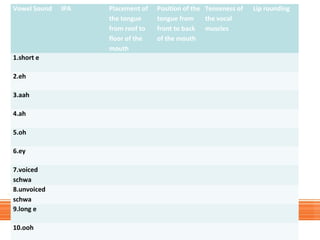
Vowel Sound

IPA

Placement of
the tongue
from roof to
floor of the
mouth

Position of the Tenseness of
tongue from
the vocal
front to back muscles
of the mouth

Lip rounding

1.short e
2.eh
3.aah
4.ah
5.oh
6.ey
7.voiced
schwa
8.unvoiced
schwa
9.long e
10.ooh

Page 29
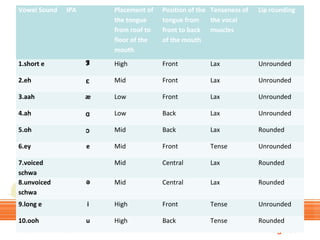
Vowel Sound

IPA

Placement of
the tongue
from roof to
floor of the
mouth

Position of the Tenseness of
tongue from
the vocal
front to back muscles
of the mouth

Lip rounding

1.short e

I

High

Front

Lax

Unrounded

2.eh

ɛ

Mid

Front

Lax

Unrounded

3.aah

æ

Low

Front

Lax

Unrounded

4.ah

ɑ

Low

Back

Lax

Unrounded

5.oh

ɔ

Mid

Back

Lax

Rounded

6.ey

e

Mid

Front

Tense

Unrounded

Mid

Central

Lax

Rounded

ə

Mid

Central

Lax

Rounded

9.long e

i

High

Front

Tense

Unrounded

10.ooh

u

High

Back

Tense

Rounded

7.voiced
schwa
8.unvoiced
schwa

Page 30
Page 31

Sounds

  • 1.
    Teaching the Elements of Language A.SOUNDS (Phonology) Aileen Pacayra Page 1
  • 2.
  • 3.
    is "the studyof sound pertaining to the system of language”. is "the study of sound pertaining to the act of speech." (Nikolai Trubetzkoy  in Grundzüge der Phonologie )  The ways in which languages use sounds or signs to construct meaning are studied in phonology.  The study of how humans produce and perceive vocal sounds is called phonetics. (Wikipedia) Page 3
  • 4.
  • 5.
  • 6.
  • 7.
    The Family ofConsonant Consonant Sounds sounds can be classified according to three dimensions: 1.voicing (voiceless or voiced) 2.the place of articulation(where the sound is made) 3.the manner of articulation (how the sound is made) Page 7
  • 8.
    Voicing A sound isvoiced if the vocal chords vibrate, whereas a sound is voiceless if the vocal cords are not vibrating upon the production of sounds. Page 8
  • 9.
    Place or Pointof 1. BilaBial- two lips touching Articulation each other 2. laBio dental- lower lip touches the upper teeth 3. dental- tip of the tongue and the inner edge of the upper teeth 4. alveolar- tip of the tongue and hard palate Page 9
  • 10.
    5. Palatal- thetongue and hard palate 6. velar- dorsal tongue and soft palate 7. Glottal- throat passage Page 10
  • 11.
  • 12.
    Manner of Articulation 1. StoPS/PloSiveS-These are the sounds produced when the air stream is blocked completely before it is abruptly released. The sounds P,T,K,B,D,G, are the members of this family. 2. FricativeS- These are the sounds produced when the air stream is compressed and passes through a small opening creating friction. The sounds Page 12
  • 13.
    F,V,S,Z,TH (voiced) and (voiceless),SH, ZH are members of this group. 3. aFFricateS- These are the sounds produced when a plosive is followed by a fricative. CH and J are the members of this group 4. naSalS- These are the sounds produced when the oral cavity is blocked, and so the air passes through the nose. N, M and NG are nasal sounds. Page 13
  • 14.
    5. liquid/lateral- Soundsare produced when air stream moves around the tongue in an obstructed manner. Sounds like L and R are examples. 6. GlideS- Sounds that are close to vowel sounds. Sounds like W and Y. Page 14
  • 15.
  • 16.
    Vowel Vowel sounds areproduced with one’s mouth open. It is also a fact that all vowel sounds are voiced sounds. Vowel sounds can be classified according to the height of the tongue and jaw, and the way the mouth opens. Page 16
  • 17.
    What You Needto Know for Vowels • FRONT/CENTRAL/BACK: These three refers to the position of the tongue from front to back of the mouth during the production of the sound. • HIGH/MID/LOW: This designation refers to whether the lips are rounded (O shape) or spread (no rounding) when the sound is being made. Page 17
  • 18.
    •TENSE VS. LAX:Also important in describing vowel sounds are the designations TENSE and LAX, which refer to the relative tenseness of the vocal muscles. Page 18
  • 19.
  • 20.
    International Phonetic Alphabet (IPA) •In order to represent the sounds of the world's languages in writing, linguists have developed the International Phonetic Alphabet, designed to represent all of the discrete sounds that are known to contribute to meaning in human languages. Page 20
  • 21.
    Voiced Consonant Sounds IPAsymbol Sound IPA symbol Sound /b/ b /ŋ/ ng /d/ d /l/ l /ð/ th /r/ r /g/ g /w/ w /z/ z /j/ y /ʒ / zh /dʒ / j /v/ v /m/ m /n/ n Page 21
  • 22.
    Voiceless Consonant Sounds IPAsymbol /s/ /ʃ / /θ/ /f/ /h/ /tʃ / /k/ /t/ /p/ Sound s sh th f h ch k t p Page 22
  • 23.
    Short Vowels Schwa Sounds IPAsymbol Sound IPA symbol Sound /I/ short i /ə/ unstressed syllable /3/ eh /ɚ / er /æ/ ae /ɑ / ah /ɔ / oh/”awe” /ʊ / uh /ʌ / stressed syllable Page 23
  • 24.
    Long Vowel Sounds IPA symbol Sound Diphthongs IPA symbol Sound /i/ longi /aʊ / aw /u/ ooh /aɪ / ay /ɔɪ / oy /oʊ / ow /eɪ / ey Page 24
  • 25.
  • 26.
  • 27.
    Consonant IPA sound Voicing Place of Mannerof Articulation Articulation s sh th th ch zh j ng y t Page 27
  • 28.
    Consonant IPA sound s s Voicing Voiceless Place of Mannerof Articulation Articulation Alveolar Fricative sh ʃ Voiceless Palatal Fricative th θ Voiceless Dental Fricative th ð Voiced Dental Fricative ch tʃ Voiceless Palatal affricative zh ʒ Voiced Palatal Fricative j dʒ Voiced Palatal Affricative ng ŋ Voiced Velar Nasal y j Voiced Palatal Glides t t Voiceless Alveolar Stops Page 28
  • 29.
    Vowel Sound IPA Placement of thetongue from roof to floor of the mouth Position of the Tenseness of tongue from the vocal front to back muscles of the mouth Lip rounding 1.short e 2.eh 3.aah 4.ah 5.oh 6.ey 7.voiced schwa 8.unvoiced schwa 9.long e 10.ooh Page 29
  • 30.
    Vowel Sound IPA Placement of thetongue from roof to floor of the mouth Position of the Tenseness of tongue from the vocal front to back muscles of the mouth Lip rounding 1.short e I High Front Lax Unrounded 2.eh ɛ Mid Front Lax Unrounded 3.aah æ Low Front Lax Unrounded 4.ah ɑ Low Back Lax Unrounded 5.oh ɔ Mid Back Lax Rounded 6.ey e Mid Front Tense Unrounded Mid Central Lax Rounded ə Mid Central Lax Rounded 9.long e i High Front Tense Unrounded 10.ooh u High Back Tense Rounded 7.voiced schwa 8.unvoiced schwa Page 30
  • 31.