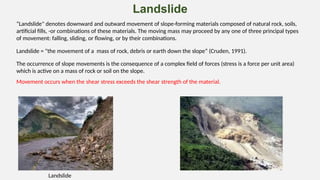
Landslide
“Landslide" denotes downwardand outward movement of slope-forming materials composed of natural rock, soils,
artificial fills, -or combinations of these materials. The moving mass may proceed by any one of three principal types
of movement: falling, sliding, or flowing, or by their combinations.
Landslide = "the movement of a mass of rock, debris or earth down the slope” (Cruden, 1991).
The occurrence of slope movements is the consequence of a complex field of forces (stress is a force per unit area)
which is active on a mass of rock or soil on the slope.
Movement occurs when the shear stress exceeds the shear strength of the material.
Landslide
3.
Causes
The causes oflandslides are usually related to instabilities in slopes. It is usually possible to identify one or more
landslide causes and one landslide trigger. The difference between these two concepts is subtle but important. The
landslide causes are the reasons that a landslide occurred in that location and at that time. Landslide causes are
listed in the following table and include geological factors, morphological factors, physical factors and factors
associated with human activity.
1. Geological causes (Weathered materials, Sheared materials, Jointed or fissured materials, Adversely orientated
discontinuities, Permeability contrasts, Material contrasts, Rainfall and snowfall Earthquakes)
2. Morphological causes (Slope angle, Uplift Rebound, Fluvial erosion, Wave erosion, Glacial erosion, Erosion of
lateral margins, Subterranean erosion, Slope loading, Vegetation change, Erosion)
3. Physical causes (Topography, Tectonic Activity, Physical Weathering[Thawing Freeze-thaw Soil erosion],
Hydrogeological Factors)
4. Human Causes (Deforestation, Excavation Loading, Water management [Groundwater Draw-down and Water
leakage], Land use [e.g. construction of roads, houses etc.], Vibration, Mining and Quarrying)
4.
Types and classification
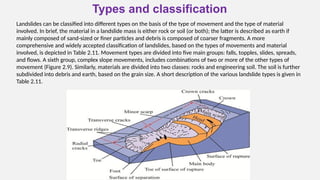
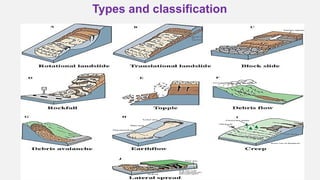
Landslidescan be classified into different types on the basis of the type of movement and the type of material
involved. In brief, the material in a landslide mass is either rock or soil (or both); the latter is described as earth if
mainly composed of sand-sized or finer particles and debris is composed of coarser fragments. A more
comprehensive and widely accepted classification of landslides, based on the types of movements and material
involved, is depicted in Table 2.11. Movement types are divided into five main groups: falls, topples, slides, spreads,
and flows. A sixth group, complex slope movements, includes combinations of two or more of the other types of
movement (Figure 2.9). Similarly, materials are divided into two classes: rocks and engineering soil. The soil is further
subdivided into debris and earth, based on the grain size. A short description of the various landslide types is given in
Table 2.11.
Types and classification
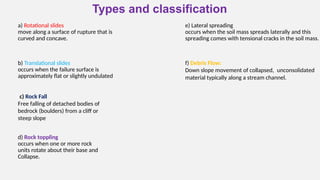
a)Rotational slides
move along a surface of rupture that is
curved and concave.
b) Translational slides
occurs when the failure surface is
approximately flat or slightly undulated
c) Rock Fall
Free falling of detached bodies of
bedrock (boulders) from a cliff or
steep slope
d) Rock toppling
occurs when one or more rock
units rotate about their base and
Collapse.
e) Lateral spreading
occurs when the soil mass spreads laterally and this
spreading comes with tensional cracks in the soil mass.
f) Debris Flow:
Down slope movement of collapsed,7 unconsolidated
material typically along a stream channel.
7.
Impact
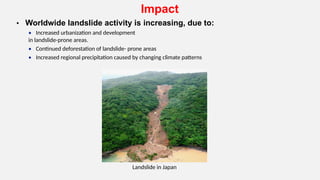
• Worldwide landslideactivity is increasing, due to:
• Increased urbanization and development
in landslide-prone areas.
• Continued deforestation of landslide- prone areas
• Increased regional precipitation caused by changing climate patterns
Landslide in Japan
8.
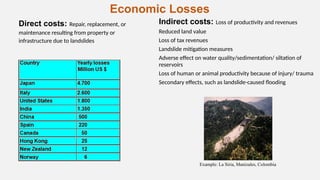
Economic Losses
Direct costs:Repair, replacement, or
maintenance resulting from property or
infrastructure due to landslides
Indirect costs: Loss of productivity and revenues
Reduced land value
Loss of tax revenues
Landslide mitigation measures
Adverse effect on water quality/sedimentation/ siltation of
reservoirs
Loss of human or animal productivity because of injury/ trauma
Secondary effects, such as landslide-caused flooding
Example: La Siria, Manizales, Colombia
9.
PREPAREDNESS AND SAFETYMEASURES
A. Before a landslide:
Find out if landslides have happened in your area in the past.
Look out for landslide warning signs like doors or windows jammed for the first time, new cracks appear in walls,
bricks, foundations, retaining walls, tilt of utility poles or trees.
Consider relocation in case your house is located in an area particularly vulnerable to landslides. While doing so,
remember:
i. Do not build on or at the base of unstable slopes, on or at the base of minor drainage hollows, at the base or
on top of an old fill slope, at the base or top of a steep cut slope.
ii. Do not cut down trees or remove vegetation or avoid slope weakening.
Iii. If the house cannot be relocated, then ensure proper drainage and proper retaining walls
Always stay alert and awake!!! Listen to radio/television for warnings of intense rainfall, storm
and damp weather. These usually trigger landslides/debris or mudflow.
Make an evacuation plan in case of a landslide with all the emergency items.
10.
PREPAREDNESS AND SAFETYMEASURES
Listen to any unusual sounds that might indicate moving debris, such as trees cracking or boulders knocking
together. A trickle of flowing or falling mud or debris may precede larger flows
While you are outdoors during a landslide,
try to get out of the path of the landslide or mudflow by running to the nearest high ground or away from the path.
If you are near a river be alert for any sudden increase or decrease in water flow or for a change from clear to
muddy water. Such changes may indicate landslide upstream. So move quickly to safer areas.
While you are indoors during a landslide,
Stay inside and remain alert. Listen to radio/ television for any update. i.e. if landslide occurs outside.
If your house falls apart due to landslide and if there is no escape, hold on to something strong and protect your
head.
.
B) During a landslide:
11.
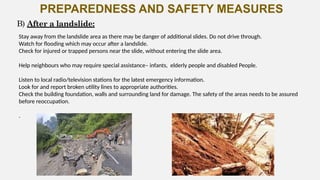
PREPAREDNESS AND SAFETYMEASURES
Stay away from the landslide area as there may be danger of additional slides. Do not drive through.
Watch for flooding which may occur after a landslide.
Check for injured or trapped persons near the slide, without entering the slide area.
Help neighbours who may require special assistance– infants, elderly people and disabled People.
Listen to local radio/television stations for the latest emergency information.
Look for and report broken utility lines to appropriate authorities.
Check the building foundation, walls and surrounding land for damage. The safety of the areas needs to be assured
before reoccupation.
.
B) After a landslide:

![Causes
The causes of landslides are usually related to instabilities in slopes. It is usually possible to identify one or more
landslide causes and one landslide trigger. The difference between these two concepts is subtle but important. The
landslide causes are the reasons that a landslide occurred in that location and at that time. Landslide causes are
listed in the following table and include geological factors, morphological factors, physical factors and factors
associated with human activity.
1. Geological causes (Weathered materials, Sheared materials, Jointed or fissured materials, Adversely orientated
discontinuities, Permeability contrasts, Material contrasts, Rainfall and snowfall Earthquakes)
2. Morphological causes (Slope angle, Uplift Rebound, Fluvial erosion, Wave erosion, Glacial erosion, Erosion of
lateral margins, Subterranean erosion, Slope loading, Vegetation change, Erosion)
3. Physical causes (Topography, Tectonic Activity, Physical Weathering[Thawing Freeze-thaw Soil erosion],
Hydrogeological Factors)
4. Human Causes (Deforestation, Excavation Loading, Water management [Groundwater Draw-down and Water
leakage], Land use [e.g. construction of roads, houses etc.], Vibration, Mining and Quarrying)](https://image.slidesharecdn.com/presentationonlandslide5-250508161836-15b8ed6b/85/Presentation_on_Landslide-5-presentation-3-320.jpg)