Laminitis
• Possible causes of laminitis
• How to recognise the symptoms of acute
  and chronic laminitis
• What to do if your horse has laminitis
• How to recognise and treat Insulin
  Resistance/EMS
• How to recognise and treat PPID/Cushing’s
  “The more you know, the better off you and your horse are going to
  be.” David Ramey DVM
Laminitis is ALWAYS an emergency -
  contact your vet (and farrier)

• Establish that the horse has laminitis

• Identify and remove/treat the cause

• Treat the pain/symptoms

• Support and realign the feet
Possible causes of laminitis
                Endocrine (hormonal)
• Insulin Resistance/Equine Metabolic Syndrome
Probably the most common cause of laminitis. Suspect IR unless there is
  another obvious cause, especially if the horse has been eating grass or cereal,
  is overweight or is an “easy keeper”

• PPID (Cushing’s disease)
First time laminitis in the autumn, particularly in older horses, is often a sign of
   PPID long before coat changes are seen

• Obesity - linked to IR/EMS - adipose fat has been shown to release
  hormones which reduce sensitivity to insulin and cause inflammation

• Cortico-steroids (iatrogenic) e.g. dexamethasone - rule out
  underlying PPID/IR

• Stress - travelling, loss of companion, extreme cold/hot weather - rule out
  underlying PPID/IR
Possible causes of laminitis
                        Inflammatory
• Grain/grass carbohydrate overload
  often following an event such as escaping into long grass or feed room, and
  likely to be accompanied by colic, gas and /or diarrhoea

• Retained placenta following foaling
• Endotoxaemia/acute bacterial infection e.g. colic,
  colitis, salmonella, peritonitis, pneumonia - horse is likely to be seriously ill
  and will often have a raised temperature

• Toxins e.g.black walnut shavings, poisonous plants
Possible causes of laminitis
                    Mechanical

• Excessive weight bearing on one leg (supporting
 limb laminitis) following serious injury to another leg

• Excessive concussion, e.g. galloping on a road, jumping
 on hard ground (rule out underlying IR/PPID)

• Incorrect foot balance (rule out underlying IR/PPID)
Symptoms of acute laminitis
• Reluctance to move leading to total refusal to
  move
• Reluctance to turn
• Lying down more than normal
• Muscle tension in the shoulders, back, quarters
• Digital pulses are strong and pounding
• Laminitic stance - usually standing with weight taken on heels to
   relieve pain on toes, front feet further out in front of body than normal, hind
   feet further under body than normal.

• Paddling - shifting weight from one foot to the other, usually fronts but
   can be hinds too
Symptoms of acute laminitis
• Feet feel hotter than usual
• Pain on sole pressure between frog and toe
• Signs of pain - increased pulse (may exceed 80
  bpm) and respiration (may exceed 60 breaths/min),
  trembling, sweating, depressed, off food

• NB laminitis is often mistaken for hock lameness,
  bruised soles or abscesses - if there is any doubt,
  treat as laminitis until proven otherwise
• don’t overlook hind leg laminitis - laminitis is
  commonly seen in all 4 feet in endocrine cases
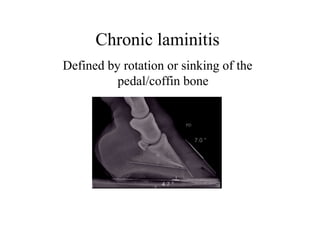
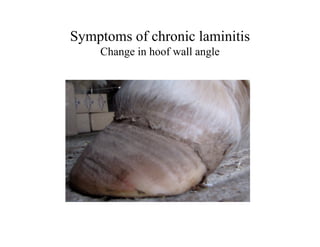
Chronic laminitis
Defined by rotation or sinking of the
          pedal/coffin bone
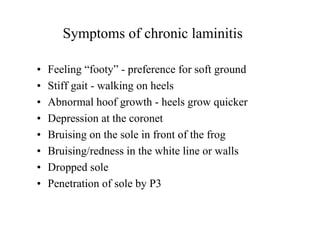
Symptoms of chronic laminitis

•   Feeling “footy” - preference for soft ground
•   Stiff gait - walking on heels
•   Abnormal hoof growth - heels grow quicker
•   Depression at the coronet
•   Bruising on the sole in front of the frog
•   Bruising/redness in the white line or walls
•   Dropped sole
•   Penetration of sole by P3
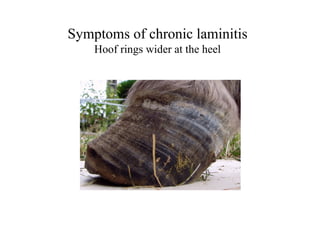
Symptoms of chronic laminitis
    Hoof rings wider at the heel
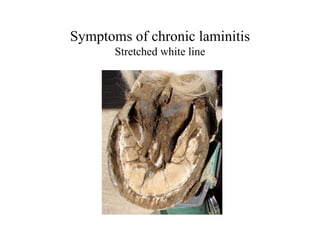
Symptoms of chronic laminitis
       Stretched white line
Symptoms of chronic laminitis
    Change in hoof wall angle
What to do if your horse has laminitis
          Emergency treatment
• call your vet (and farrier/trimmer)
• remove horse from grass (but move horse as little as possible - if
   necessary wait for vet/support feet/use transport)

• confine on deep supportive bedding e.g. sand,
  sawdust, pea gravel
• support the feet if the bedding isn’t sufficient to do
  this, e.g. with styrofoam, boots & pads, dental impression material
• give NSAIDs e.g. Bute, Danilon, Equioxx for the inflammation & pain
   (for as short a time as possible)

• apply cold therapy to the feet to reduce pain and
  inflammation
What to do if your horse has laminitis
• feed a low sugar/starch/fat and high fibre diet - do
  not starve
• diagnose the cause - with blood tests if necessary
  (insulin & glucose for IR/EMS, ACTH for PPID)
• treat the cause - pergolide for PPID, diet and
  possibly Metformin for IR/EMS
• get lateral x-rays taken to assess damage and
  movement of the pedal bone
• get the hooves trimmed as soon as possible with a
  short toe & low heel. Realign any rotation as soon
  as possible
Symptoms of Insulin Resistance/EMS
• history of easy weight gain from adulthood, frequently
  obese, “good doer”
• abnormal fat deposits: cresty neck, fat in the hollows above
  the eyes (supraorbital fat), lumpy fat deposits at the base of
  the tail, a fat sheath (often mistaken for a sheath infection)
  or fat udder
• history of laminitis usually when horse eating grass
• advanced symptoms include increased thirst and urination,
  loss of body condition, especially muscle, weakness, low
  energy levels
• ravenous appetite, rarely stops eating when food available
• poor exercise tolerance
• above normal insulin with normal blood glucose
Treatment of IR/EMS

Insulin Resistance is managed by:
• low sugar/starch/fat and high fibre mineral
balanced diet
• regular exercise when able
• Metformin or Thyro-L may be considered
• (keeping feet well trimmed)
Symptoms of PPID/Cushing’s Disease
• Laminitis often occurring in autumn (see seasonal rise) or
  occurring late in life for the first time
• Insulin resistance
• Weight loss and pot belly appearance are common and may
  be seen with patchy fat deposits developing in the neck and
  around the tail head
• Changes to coat (hirsutism) - long, often curly hair, delayed
  or incomplete shedding
• PU/PD (excessive drinking and urination)
• Muscle wasting, often most noticeable along the topline
• Increased susceptibility to infections, particularly sinusitis,
  abscesses, skin problems, pneumonia.
Symptoms of PPID/Cushing’s
• Poor resistance to internal parasites
• Development of allergies and hypersensitivities (e.g. to
  vaccinations, insect bites)
• Hyperhidrosis - excessive sweating (or sometimes failure
  to sweat at all)
• Lethargy/poor performance
• Loss of fertility
• Unexplained tendon & ligament problems
• Neurological disease, e.g. ataxia, blindness, seizures,
  narcolepsy
PPID Seasonal Rise
• All horses experience a rise in ACTH levels in the autumn
  (usually Aug - Oct but often into Nov/Dec in older/advanced
  PPID horses).

• Autumn unexplained laminitis may be due to the seasonal
  rise and trying pergolide may be warranted (ideally blood
  should be tested for ACTH before starting pergolide).

• Testing ACTH for diagnosis of PPID can be done at any
  time of year if the lab uses a seasonally adjusted normal
  range (e.g. Liphook Equine Hospital) - autumn may be the
  best time to test as the difference between horses with PPID
  and normal horses is greater.
Treatment of PPID/Cushing’s
• Treat with Pergolide – starting dose usually 0.5 – 1.5 mg/day
  rising to 7 mg or more to control symptoms as the disease
  progresses. Ideally introduce slowly to avoid the “pergolide
  veil”.
• Some horses have shown improvements in shedding and attitude
  with Vitex Agnus Castus.
• Monitor dosage according to symptoms/blood tests and be aware
  dosage may need to be increased during the autumn
• Horses with PPID may also be insulin resistant and need
  managing accordingly with diet and exercise
• PPID horses often need careful management e.g. to reduce stress,
  regulate their temperature, control internal parasites, etc.
Conclusion

• Always treat laminitis as an emergency -
  – learn to recognise the slightest symptom
  – identify and remove/treat the cause
  – keep feet well balanced and provide support if
    necessary
And finally,
       prevention is better than cure!
Make your goal no laminitis ever by
  – keeping feet properly balanced
  – feeding a high fibre low sugar/starch/fat mineral
     balanced diet according to your horse’s needs
  – giving your horse regular exercise
  – monitoring weight/body condition score and not
     allowing your horse to become overweight
  – Employing good horse management to minimise stress
     and maintain good health
  – Learning all you can about these conditions

Laminitis IR PPID causes and treatment

  • 1.
    Laminitis • Possible causesof laminitis • How to recognise the symptoms of acute and chronic laminitis • What to do if your horse has laminitis • How to recognise and treat Insulin Resistance/EMS • How to recognise and treat PPID/Cushing’s “The more you know, the better off you and your horse are going to be.” David Ramey DVM
  • 2.
    Laminitis is ALWAYSan emergency - contact your vet (and farrier) • Establish that the horse has laminitis • Identify and remove/treat the cause • Treat the pain/symptoms • Support and realign the feet
  • 3.
    Possible causes oflaminitis Endocrine (hormonal) • Insulin Resistance/Equine Metabolic Syndrome Probably the most common cause of laminitis. Suspect IR unless there is another obvious cause, especially if the horse has been eating grass or cereal, is overweight or is an “easy keeper” • PPID (Cushing’s disease) First time laminitis in the autumn, particularly in older horses, is often a sign of PPID long before coat changes are seen • Obesity - linked to IR/EMS - adipose fat has been shown to release hormones which reduce sensitivity to insulin and cause inflammation • Cortico-steroids (iatrogenic) e.g. dexamethasone - rule out underlying PPID/IR • Stress - travelling, loss of companion, extreme cold/hot weather - rule out underlying PPID/IR
  • 4.
    Possible causes oflaminitis Inflammatory • Grain/grass carbohydrate overload often following an event such as escaping into long grass or feed room, and likely to be accompanied by colic, gas and /or diarrhoea • Retained placenta following foaling • Endotoxaemia/acute bacterial infection e.g. colic, colitis, salmonella, peritonitis, pneumonia - horse is likely to be seriously ill and will often have a raised temperature • Toxins e.g.black walnut shavings, poisonous plants
  • 5.
    Possible causes oflaminitis Mechanical • Excessive weight bearing on one leg (supporting limb laminitis) following serious injury to another leg • Excessive concussion, e.g. galloping on a road, jumping on hard ground (rule out underlying IR/PPID) • Incorrect foot balance (rule out underlying IR/PPID)
  • 6.
    Symptoms of acutelaminitis • Reluctance to move leading to total refusal to move • Reluctance to turn • Lying down more than normal • Muscle tension in the shoulders, back, quarters • Digital pulses are strong and pounding • Laminitic stance - usually standing with weight taken on heels to relieve pain on toes, front feet further out in front of body than normal, hind feet further under body than normal. • Paddling - shifting weight from one foot to the other, usually fronts but can be hinds too
  • 7.
    Symptoms of acutelaminitis • Feet feel hotter than usual • Pain on sole pressure between frog and toe • Signs of pain - increased pulse (may exceed 80 bpm) and respiration (may exceed 60 breaths/min), trembling, sweating, depressed, off food • NB laminitis is often mistaken for hock lameness, bruised soles or abscesses - if there is any doubt, treat as laminitis until proven otherwise • don’t overlook hind leg laminitis - laminitis is commonly seen in all 4 feet in endocrine cases
  • 8.
    Chronic laminitis Defined byrotation or sinking of the pedal/coffin bone
  • 9.
    Symptoms of chroniclaminitis • Feeling “footy” - preference for soft ground • Stiff gait - walking on heels • Abnormal hoof growth - heels grow quicker • Depression at the coronet • Bruising on the sole in front of the frog • Bruising/redness in the white line or walls • Dropped sole • Penetration of sole by P3
  • 10.
    Symptoms of chroniclaminitis Hoof rings wider at the heel
  • 11.
    Symptoms of chroniclaminitis Stretched white line
  • 12.
    Symptoms of chroniclaminitis Change in hoof wall angle
  • 13.
    What to doif your horse has laminitis Emergency treatment • call your vet (and farrier/trimmer) • remove horse from grass (but move horse as little as possible - if necessary wait for vet/support feet/use transport) • confine on deep supportive bedding e.g. sand, sawdust, pea gravel • support the feet if the bedding isn’t sufficient to do this, e.g. with styrofoam, boots & pads, dental impression material • give NSAIDs e.g. Bute, Danilon, Equioxx for the inflammation & pain (for as short a time as possible) • apply cold therapy to the feet to reduce pain and inflammation
  • 14.
    What to doif your horse has laminitis • feed a low sugar/starch/fat and high fibre diet - do not starve • diagnose the cause - with blood tests if necessary (insulin & glucose for IR/EMS, ACTH for PPID) • treat the cause - pergolide for PPID, diet and possibly Metformin for IR/EMS • get lateral x-rays taken to assess damage and movement of the pedal bone • get the hooves trimmed as soon as possible with a short toe & low heel. Realign any rotation as soon as possible
  • 15.
    Symptoms of InsulinResistance/EMS • history of easy weight gain from adulthood, frequently obese, “good doer” • abnormal fat deposits: cresty neck, fat in the hollows above the eyes (supraorbital fat), lumpy fat deposits at the base of the tail, a fat sheath (often mistaken for a sheath infection) or fat udder • history of laminitis usually when horse eating grass • advanced symptoms include increased thirst and urination, loss of body condition, especially muscle, weakness, low energy levels • ravenous appetite, rarely stops eating when food available • poor exercise tolerance • above normal insulin with normal blood glucose
  • 16.
    Treatment of IR/EMS InsulinResistance is managed by: • low sugar/starch/fat and high fibre mineral balanced diet • regular exercise when able • Metformin or Thyro-L may be considered • (keeping feet well trimmed)
  • 17.
    Symptoms of PPID/Cushing’sDisease • Laminitis often occurring in autumn (see seasonal rise) or occurring late in life for the first time • Insulin resistance • Weight loss and pot belly appearance are common and may be seen with patchy fat deposits developing in the neck and around the tail head • Changes to coat (hirsutism) - long, often curly hair, delayed or incomplete shedding • PU/PD (excessive drinking and urination) • Muscle wasting, often most noticeable along the topline • Increased susceptibility to infections, particularly sinusitis, abscesses, skin problems, pneumonia.
  • 18.
    Symptoms of PPID/Cushing’s •Poor resistance to internal parasites • Development of allergies and hypersensitivities (e.g. to vaccinations, insect bites) • Hyperhidrosis - excessive sweating (or sometimes failure to sweat at all) • Lethargy/poor performance • Loss of fertility • Unexplained tendon & ligament problems • Neurological disease, e.g. ataxia, blindness, seizures, narcolepsy
  • 19.
    PPID Seasonal Rise •All horses experience a rise in ACTH levels in the autumn (usually Aug - Oct but often into Nov/Dec in older/advanced PPID horses). • Autumn unexplained laminitis may be due to the seasonal rise and trying pergolide may be warranted (ideally blood should be tested for ACTH before starting pergolide). • Testing ACTH for diagnosis of PPID can be done at any time of year if the lab uses a seasonally adjusted normal range (e.g. Liphook Equine Hospital) - autumn may be the best time to test as the difference between horses with PPID and normal horses is greater.
  • 20.
    Treatment of PPID/Cushing’s •Treat with Pergolide – starting dose usually 0.5 – 1.5 mg/day rising to 7 mg or more to control symptoms as the disease progresses. Ideally introduce slowly to avoid the “pergolide veil”. • Some horses have shown improvements in shedding and attitude with Vitex Agnus Castus. • Monitor dosage according to symptoms/blood tests and be aware dosage may need to be increased during the autumn • Horses with PPID may also be insulin resistant and need managing accordingly with diet and exercise • PPID horses often need careful management e.g. to reduce stress, regulate their temperature, control internal parasites, etc.
  • 21.
    Conclusion • Always treatlaminitis as an emergency - – learn to recognise the slightest symptom – identify and remove/treat the cause – keep feet well balanced and provide support if necessary
  • 22.
    And finally, prevention is better than cure! Make your goal no laminitis ever by – keeping feet properly balanced – feeding a high fibre low sugar/starch/fat mineral balanced diet according to your horse’s needs – giving your horse regular exercise – monitoring weight/body condition score and not allowing your horse to become overweight – Employing good horse management to minimise stress and maintain good health – Learning all you can about these conditions