
WAGES AND SALARY
ADMINISTRATION
INSTITUTE OF BUSINESSMANAGEMENT
C.S.J.M. UNIVERSITY, KANPUR
GUIDED BY:-
dr. vivek singh sachan
(faculty of ibm)
SUBMITED BY:-
ASHISH SHUKLA
ABHISHEK AWASTHI
ABHISHEK GUPTA
AKSHAY PANDEY
PRASHANT GUPTA
RAJAT SINGH
VAIBHAV SAXENA
Group-5
3/13/2017 4:55:11 AM 2
 Wages – paid to blue-collar employees; paid
daily, weekly or monthly; paid to jobs which
can be measured in terms of money’s worth.
 Salary – paid to white-collar employees; paid
in monthly basis; paid to employees whose
contribution cannot be measured easily.
 A group of activities involved in the
development, implementation, and
maintenance of a pay system.
 An ongoing process of managing a wage and
salary structure.
WAGES
Paid to BLUE
Collared
On Daily, weekly,
Monthly
Can be measured in
terms of money
SALARY
Paid to WHITE
collared Employees
Paid at specified
Intervals
Paid to Employees
whose contribution
cannot be measured
Remuneration in comparable
industries
Firm’s ability to pay
Relating to price index
Productivity
Cost of Living
Union Pressures & Strategies
Government Legislations
Minimum
wage
Fair wage
Living
wage
type of wages
3/13/2017 4:55:11 AM 8
MINIMUM WAGES:
Minimum amount of remuneration paid to works.
Under Minimum Wages Act 1948.
FAIR WAGES:
Workers performing work of equal skills, difficulty or
unpleasantness should receive equal or fair wages
Match the prevailing wage rates
LIVING WAGES:
Living wages should enable the male earner to provide for
himself and his family, not only the bare essentials of food,
clothing and shelter, but also a measure of frugal comfort
including:
Education for the children , Protection against ill-health
type of wages
Wage policy in india
Wages policy refers to all
systematic efforts of the
government in relation to national
wage and salary system.
3/13/2017 4:55:11 AM 10
 To obtain for the worker a just share of the
fruits of economic development.
 To set minimum wages for worker’s
whose bargaining position is weak
 To abolish malpractices and abuses in
wages and salary payments.
3/13/2017 4:55:11 AM 11
Wage policy in india
Methods of
wages
payment
3/13/2017 4:55:11 AM 12
TIME RATE/WAGE SYSTEM
Wages = No. of days worked Rate per day
OR
Wages = No. of hours worked Rate per day
3/13/2017 4:55:11 AM 13
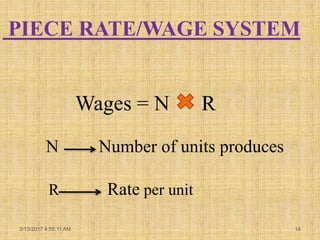
PIECE RATE/WAGE SYSTEM
Wages = N R
N Number of units produces
R Rate per unit
3/13/2017 4:55:11 AM 14
FOR EXAMPLE- If a worker
produces 20 units per day when
the piece rate is Rs 30 Per unit,
the total wages per day will be
20*30 = Rs 600
3/13/2017 4:55:11 AM 15
Time Wage
 Under this system, wages
are paid on the basis of
time spent on the job
irrespective of the amount
of work done. The unit of
time may be a day. A
week, a fortnight or a
month.
 It came to be known as
the ‘Day Wage System’
Piece Wage
 Under this system,
remuneration is based on
the amount of work done
or output of a worker.
One unit of output is
considered as one piece
and a specific rate of
wage is paid per piece
 It is called payment by
results
 ADVANTAGES
o It is the simplest and the oldest method.
o As there is no pressure to speed up production, the quality of work can be kept high.
o It is an objective method.
 DISADVANTAGES
o The method provides no incentive for better performance
o Guaranteed remuneration makes workers indifferent and complacent.
o Calculation of labour cost per unit is difficult
o In the absence of an incentive to hard work, productivity of labor becomes low
 APPLICABILITY
o When quality of work is especially important, e.g., artistic furniture, fine jewelry, etc.
o When supervision is good and supervisors know what constitutes a “fair day’s work”.
o When workers are new and learning the job.
 ADVANTAGES:
o An incentive to increase productivity.
o Opportunity to improve their standard of living and morale.
o The method is just and fair to all
o Increase in productivity results in higher output and lower costs of
production per unit
 DISADVANTAGES:
o It is very difficult to fix piece wage rates.
Trade unions do not like it as it affects their solidarity.
 APPLICABILITY
o When work done by an individual worker can be measured
accurately,.
o When the quantity of output depends directly upon the skill and efforts
of the worker.
This system was devised by F.W. Taylor, the father of
scientific management and was the first systematic attempt in
rationalizing incentive.
It is based on the assumption that the degree of efficiency
varies from worker to worker and hence the workers must be
paid according to their degree of efficiency.
 There shall be two piece work rates,one is lower& the
other is higher.
 If a worker finishes work within standard time he/she
will be given high piece rate.
3/13/2017 4:55:11 AM 19
Taylor differential piece rate system
To illustrate the Taylor’s piece rate system, we take the following:
Standard output = 100 units
Rate per unit = 10 RS
Differentials to be applied:
120 per cent of piece-rate at or above the standard
80 per cent of piece-rate when below the standard
Case (1)
Output =120 units
Earnings = 120*120/100*10
=1440 RS
Case(2)
Output = 90 units
Earnings = 90*80/100*10
= 720 RS
3/13/2017 4:55:11 AM 20
(i) It does not guarantee a minimum wage for the workers.
ii) The system is very harsh to the inefficient workers because
they gentle wages due to lower rate and lower output.
iii) It penalises a worker who just fails to attain the standard by
a narrow margin
It is clear from the above illustration that the workers with
lower efficiency less wages and workers with higher
efficiency get more wages under Taylor differential piece rate
system as compared to ordinary piece rate system.
3/13/2017 4:55:11 AM 21
Disadvantages of taylor’s piece rate system
This system made by Mr. Merrick, is a
modification of Taylor’s differential piece rate
system. Under Taylor’s differential piece rate
system, workers by whom 100% efficiency
cannot be attained or penalized, where as under
Merrick system, there is no imposition of such
punitive lower rate upon them
3/13/2017 4:55:11 AM 22
Merrick Differential piece rate system
Features of Merrick piece rate system
Upto 83% of the standard output workers
are paid at the ordinary piece rate.
83%-100% at 110% of the ordinary piece
rate.
Above 100% at 120% of the ordinary
piece rate.
The Merrick system can be illustrated as follows:
Standard output = 100 units
Piece rate = 10 paise
Case (1)
Output = 80 units
Efficiency = 80/100*100 =
80%
Earnings-
As the efficiency is less than 83 per cent, only the base piece
rate applies
80*0.10= 8.00 rupees
Case (2)
Output = 90 units
Efficiency = 90/100*100 =
90%
Earnings-
3/13/2017 4:55:11 AM 24
salary
A salary is a form of periodic payment
from an employer to an employee, which
may be specified in an employment
contract. It is contrasted with piece
wages, where each job, hour or other
unit is paid separately, rather than on a
periodic basis
3/13/2017 4:55:11 AM 25
While there is no first pay stub for
the first work-for-pay exchange, the
first salaried work would have
required a society advanced enough
to have a barter system which
allowed for the even exchange of
goods or services between tradesmen3/13/2017 4:55:11 AM 26
FIRST PAID SALARY
allowances
An allowance is an amount of money given or
allotted usually at regular intervals for a specific
purpose. In the context of children, parents may
provide an allowance: pocket money to their child
for their miscellaneous personal spending. In the
construction industry it may be an amount
allocated to a specific item of work as part of an
overall contract.
3/13/2017 4:55:11 AM 27
3/13/2017 4:55:11 AM 28
Construction contracting
In construction, an allowance is an amount
specified and included in the
construction contract (or specifications) for
a certain item of work (e.g., appliances,
lighting, etc.) whose details are not yet
determined at the time of contracting.
3/13/2017 4:55:11 AM 29
Allowances for children
Parents often give their children an
allowance (British English: pocket
money) for their miscellaneous
personal spending, and also to teach
them money management at an early
age.
3/13/2017 4:55:11 AM 30
Allowances for adults
In Japan three quarters of men get a
monthly allowance from their wives.
Since 1979 Shinsei Bank has been
researching the amount of spending
money given to husbands by their
wives. In 2011 it is 39,600 Yen or about
$US 500
3/13/2017 4:55:11 AM 31
incentives
An incentive is something that
motivates an individual to perform
an action. The study of incentive
structures is central to the study of
all economic activities
There are (1) Individual incentive schemes.
(2)Group incentives programe.
3/13/2017 4:55:11 AM 33
Categorizing incentives
Class Definition
Remunerative incentives
Are said to exist where an agent can expect some
form of material reward – especially money – in
exchange for acting in a particular way.
Financial incentives
moral incentives
Are said to exist where a particular choice is widely
regarded as the right thing to do, or as particularly
admirable, or where the failure to act in a certain
way is condemned as indecent. A person acting on a
moral incentive can expect a sense of self-esteem,
and approval or even admiration from his
community; a person acting against a moral
incentive can expect a sense of guilt, and
condemnation or even ostracism from the
community.
3/13/2017 4:55:11 AM 34
Coercive incentives
Are said to exist where a person can expect
that the failure to act in a particular way will
result in physical force being used against
them (or their loved ones) by others in the
community – for example, by inflicting pain
in punishment, or by imprisonment, or by
confiscating or destroying their possessions.
Natural Incentives
such as curiosity, mental or physical exercise,
admiration, fear, anger, pain, joy, or the
pursuit of truth, or the control over things in
the world or people or oneself.
3/13/2017 4:55:11 AM 35
Halsey plan
A wage incentive program established as
the first in the US industry.
The incentive program was created by
Frederick A. Halsey as a method for
improving the straight piece-rate system in
an effort to reduce wage rate cutting
by management.
3/13/2017 4:55:11 AM 36
The following examples illustrate the scheme :
Standard time = 10 hrs
Rate per hour = Re 1
Case (i)
Time taken = 10 hrs
Earnings =10*1 = 10 Ru
Case (ii)
Time taken = 12 hrs
Earnings =12*1 = 12 Ru
Case (iii)
Time taken = 8hrs
Earnings
Time wages = 8*1 = 8.00
Bonus = ½ *2 *1 = 1.00
= 9.00 Ru
3/13/2017 4:55:11 AM 37
Rowan plan
It is widely used in England. It was introduced by
James Rowan of David Rowan & Sons, Glass go in
1901. It is modification in the Halsey's Plan. The
premium is calculated on a percentage of wages for
the time worked and not for the time saved. This
gives more bonus to the workers.
3/13/2017 4:55:11 AM 38
The following examples illustrate the scheme :
Standard time = 10 hrs
Rate per hour = Ru 1
Case (i)
Time taken = 10 hrs
Earnings =10*1 = 10 Ru
Case (ii)
Time taken = 12 hrs
Earnings =12*1 = 12 Ru
Case (iii)
Time taken = 8hrs
Earnings =8*1 =8.00
Bonus =2/10 *8 = 1.60
= 9.60 Ru
3/13/2017 4:55:11 AM 39
Advantages of Rowan Plan
(i) Checks over-speeding, overstrain by worker.
(ii) Assured minimum base-wage
(iii) Efficiency is rewarded
Disadvantages of Rowan Plan
(i) Discourages workers to over-achieve.
(ii) Difficulty in ascertaining wages as it requires large data
processing
(iii) Sharing of profit for over-achievement may not be liked by
workers.
3/13/2017 4:55:11 AM 40
Some Comparisons
The piece-rate with minimum guaranteed
wage, Rowan plan and Halsey plan are
compared below. All plans guarantee an
assured minimum wage. For over-
achievers, i.e., those, who perform more
than standard output, will get different
wages in these plans.
3/13/2017 4:55:11 AM 41
EMERSON EFFICIENCY PLAN
In this, a minimum time wage is
guaranteed. Working condition and
standard output are fixed on the
basis of time-study.
3/13/2017 4:55:11 AM 42
The following example illustrates the method:
Standard output in 10 hrs = 100 units
Rate per hour = 1 rupees
Case (1)
Output in 10 hr = 50 units
Earnings:
Efficiency = 50 per cent
As the efficiency is below 67 per cent the worker is entitled to
time wages only.
10*1 = 10.00
Case (2)
Output in 10 hrs = 100 units
Efficiency = 100 per cent
3/13/2017 4:55:11 AM 43
The worker is entitled to time wages plus 20 per cent of time wages as
bonus.
Time = 10*1 = 10.00
Bonus = 20/100*10 = 2.00
Earnings = 12.00
Case (3)
Output in 10 hrs = 130 units
Efficiency = 130 per cent
At the rate of 20 per cent at 100 per cent efficiency and one per cent
increase for every one per cent increase in efficiency, the worker is
eligible for 50 per cent of the time wage as bonus.
Time wages = 10*1 = 10.00
Bonus = 50/100*10 = 5.00
= 15.00
3/13/2017 4:55:11 AM 44
Advantages of Emerson Efficiency Plan
(i) Guarantees minimum wage till 66.67% of standard output.
(ii)Efficient worker is rewarded handsomely.
Disadvantages of Emerson Efficiency Plan
(i) Disproportionate rate of bonus below standard output
(ii)Chances of over-speeding and compromise of quality
3/13/2017 4:55:11 AM 45
Social pressure
It's also worth noting that these
categories are not
necessarily exclusive; one and the same
situation may, in its different aspects,
carry incentives that come under any or
all of these categories. In
modern American society
3/13/2017 4:55:11 AM 46
economics
The study of economics in modern societies is
mostly concerned with remunerative incentives
rather than moral or coercive incentives – not
because the latter two are unimportant, but
rather because remunerative incentives are the
main form of incentives employed in the world
of business, whereas moral and coercive
incentives are more characteristic of the sorts of
decisions studied by political
science and sociology.3/13/2017 4:55:11 AM 47
standard hour plan
A standard hour plan is an incentive
pay plan which establishes a fixed unit
of time for completion of a task or job.
An employee receives the wage for the
standard unit of time for completion of
the task without regard to the actual
time needed…………….
3/13/2017 4:55:11 AM 48
For example, assume that in an automobile
repair shop the standard time for replacing
a muffler is one hour. Under a standard
hour plan an employee would receive one
hour's wage for replacing a muffler,
regardless of the actual time required. Such
a plan requires accurate measurement of
time necessary for each job or task
3/13/2017 4:55:11 AM 49
3/13/2017 4:55:11 AM 50

Hrm

  • 1.
  • 2.
    INSTITUTE OF BUSINESSMANAGEMENT C.S.J.M.UNIVERSITY, KANPUR GUIDED BY:- dr. vivek singh sachan (faculty of ibm) SUBMITED BY:- ASHISH SHUKLA ABHISHEK AWASTHI ABHISHEK GUPTA AKSHAY PANDEY PRASHANT GUPTA RAJAT SINGH VAIBHAV SAXENA Group-5 3/13/2017 4:55:11 AM 2
  • 5.
     Wages –paid to blue-collar employees; paid daily, weekly or monthly; paid to jobs which can be measured in terms of money’s worth.  Salary – paid to white-collar employees; paid in monthly basis; paid to employees whose contribution cannot be measured easily.  A group of activities involved in the development, implementation, and maintenance of a pay system.  An ongoing process of managing a wage and salary structure.
  • 6.
    WAGES Paid to BLUE Collared OnDaily, weekly, Monthly Can be measured in terms of money SALARY Paid to WHITE collared Employees Paid at specified Intervals Paid to Employees whose contribution cannot be measured
  • 7.
    Remuneration in comparable industries Firm’sability to pay Relating to price index Productivity Cost of Living Union Pressures & Strategies Government Legislations
  • 8.
    Minimum wage Fair wage Living wage type ofwages 3/13/2017 4:55:11 AM 8
  • 9.
    MINIMUM WAGES: Minimum amountof remuneration paid to works. Under Minimum Wages Act 1948. FAIR WAGES: Workers performing work of equal skills, difficulty or unpleasantness should receive equal or fair wages Match the prevailing wage rates LIVING WAGES: Living wages should enable the male earner to provide for himself and his family, not only the bare essentials of food, clothing and shelter, but also a measure of frugal comfort including: Education for the children , Protection against ill-health type of wages
  • 10.
    Wage policy inindia Wages policy refers to all systematic efforts of the government in relation to national wage and salary system. 3/13/2017 4:55:11 AM 10
  • 11.
     To obtainfor the worker a just share of the fruits of economic development.  To set minimum wages for worker’s whose bargaining position is weak  To abolish malpractices and abuses in wages and salary payments. 3/13/2017 4:55:11 AM 11 Wage policy in india
  • 12.
  • 13.
    TIME RATE/WAGE SYSTEM Wages= No. of days worked Rate per day OR Wages = No. of hours worked Rate per day 3/13/2017 4:55:11 AM 13
  • 14.
    PIECE RATE/WAGE SYSTEM Wages= N R N Number of units produces R Rate per unit 3/13/2017 4:55:11 AM 14
  • 15.
    FOR EXAMPLE- Ifa worker produces 20 units per day when the piece rate is Rs 30 Per unit, the total wages per day will be 20*30 = Rs 600 3/13/2017 4:55:11 AM 15
  • 16.
    Time Wage  Underthis system, wages are paid on the basis of time spent on the job irrespective of the amount of work done. The unit of time may be a day. A week, a fortnight or a month.  It came to be known as the ‘Day Wage System’ Piece Wage  Under this system, remuneration is based on the amount of work done or output of a worker. One unit of output is considered as one piece and a specific rate of wage is paid per piece  It is called payment by results
  • 17.
     ADVANTAGES o Itis the simplest and the oldest method. o As there is no pressure to speed up production, the quality of work can be kept high. o It is an objective method.  DISADVANTAGES o The method provides no incentive for better performance o Guaranteed remuneration makes workers indifferent and complacent. o Calculation of labour cost per unit is difficult o In the absence of an incentive to hard work, productivity of labor becomes low  APPLICABILITY o When quality of work is especially important, e.g., artistic furniture, fine jewelry, etc. o When supervision is good and supervisors know what constitutes a “fair day’s work”. o When workers are new and learning the job.
  • 18.
     ADVANTAGES: o Anincentive to increase productivity. o Opportunity to improve their standard of living and morale. o The method is just and fair to all o Increase in productivity results in higher output and lower costs of production per unit  DISADVANTAGES: o It is very difficult to fix piece wage rates. Trade unions do not like it as it affects their solidarity.  APPLICABILITY o When work done by an individual worker can be measured accurately,. o When the quantity of output depends directly upon the skill and efforts of the worker.
  • 19.
    This system wasdevised by F.W. Taylor, the father of scientific management and was the first systematic attempt in rationalizing incentive. It is based on the assumption that the degree of efficiency varies from worker to worker and hence the workers must be paid according to their degree of efficiency.  There shall be two piece work rates,one is lower& the other is higher.  If a worker finishes work within standard time he/she will be given high piece rate. 3/13/2017 4:55:11 AM 19 Taylor differential piece rate system
  • 20.
    To illustrate theTaylor’s piece rate system, we take the following: Standard output = 100 units Rate per unit = 10 RS Differentials to be applied: 120 per cent of piece-rate at or above the standard 80 per cent of piece-rate when below the standard Case (1) Output =120 units Earnings = 120*120/100*10 =1440 RS Case(2) Output = 90 units Earnings = 90*80/100*10 = 720 RS 3/13/2017 4:55:11 AM 20
  • 21.
    (i) It doesnot guarantee a minimum wage for the workers. ii) The system is very harsh to the inefficient workers because they gentle wages due to lower rate and lower output. iii) It penalises a worker who just fails to attain the standard by a narrow margin It is clear from the above illustration that the workers with lower efficiency less wages and workers with higher efficiency get more wages under Taylor differential piece rate system as compared to ordinary piece rate system. 3/13/2017 4:55:11 AM 21 Disadvantages of taylor’s piece rate system
  • 22.
    This system madeby Mr. Merrick, is a modification of Taylor’s differential piece rate system. Under Taylor’s differential piece rate system, workers by whom 100% efficiency cannot be attained or penalized, where as under Merrick system, there is no imposition of such punitive lower rate upon them 3/13/2017 4:55:11 AM 22 Merrick Differential piece rate system
  • 23.
    Features of Merrickpiece rate system Upto 83% of the standard output workers are paid at the ordinary piece rate. 83%-100% at 110% of the ordinary piece rate. Above 100% at 120% of the ordinary piece rate.
  • 24.
    The Merrick systemcan be illustrated as follows: Standard output = 100 units Piece rate = 10 paise Case (1) Output = 80 units Efficiency = 80/100*100 = 80% Earnings- As the efficiency is less than 83 per cent, only the base piece rate applies 80*0.10= 8.00 rupees Case (2) Output = 90 units Efficiency = 90/100*100 = 90% Earnings- 3/13/2017 4:55:11 AM 24
  • 25.
    salary A salary isa form of periodic payment from an employer to an employee, which may be specified in an employment contract. It is contrasted with piece wages, where each job, hour or other unit is paid separately, rather than on a periodic basis 3/13/2017 4:55:11 AM 25
  • 26.
    While there isno first pay stub for the first work-for-pay exchange, the first salaried work would have required a society advanced enough to have a barter system which allowed for the even exchange of goods or services between tradesmen3/13/2017 4:55:11 AM 26 FIRST PAID SALARY
  • 27.
    allowances An allowance isan amount of money given or allotted usually at regular intervals for a specific purpose. In the context of children, parents may provide an allowance: pocket money to their child for their miscellaneous personal spending. In the construction industry it may be an amount allocated to a specific item of work as part of an overall contract. 3/13/2017 4:55:11 AM 27
  • 28.
  • 29.
    Construction contracting In construction,an allowance is an amount specified and included in the construction contract (or specifications) for a certain item of work (e.g., appliances, lighting, etc.) whose details are not yet determined at the time of contracting. 3/13/2017 4:55:11 AM 29
  • 30.
    Allowances for children Parentsoften give their children an allowance (British English: pocket money) for their miscellaneous personal spending, and also to teach them money management at an early age. 3/13/2017 4:55:11 AM 30
  • 31.
    Allowances for adults InJapan three quarters of men get a monthly allowance from their wives. Since 1979 Shinsei Bank has been researching the amount of spending money given to husbands by their wives. In 2011 it is 39,600 Yen or about $US 500 3/13/2017 4:55:11 AM 31
  • 33.
    incentives An incentive issomething that motivates an individual to perform an action. The study of incentive structures is central to the study of all economic activities There are (1) Individual incentive schemes. (2)Group incentives programe. 3/13/2017 4:55:11 AM 33
  • 34.
    Categorizing incentives Class Definition Remunerativeincentives Are said to exist where an agent can expect some form of material reward – especially money – in exchange for acting in a particular way. Financial incentives moral incentives Are said to exist where a particular choice is widely regarded as the right thing to do, or as particularly admirable, or where the failure to act in a certain way is condemned as indecent. A person acting on a moral incentive can expect a sense of self-esteem, and approval or even admiration from his community; a person acting against a moral incentive can expect a sense of guilt, and condemnation or even ostracism from the community. 3/13/2017 4:55:11 AM 34
  • 35.
    Coercive incentives Are saidto exist where a person can expect that the failure to act in a particular way will result in physical force being used against them (or their loved ones) by others in the community – for example, by inflicting pain in punishment, or by imprisonment, or by confiscating or destroying their possessions. Natural Incentives such as curiosity, mental or physical exercise, admiration, fear, anger, pain, joy, or the pursuit of truth, or the control over things in the world or people or oneself. 3/13/2017 4:55:11 AM 35
  • 36.
    Halsey plan A wageincentive program established as the first in the US industry. The incentive program was created by Frederick A. Halsey as a method for improving the straight piece-rate system in an effort to reduce wage rate cutting by management. 3/13/2017 4:55:11 AM 36
  • 37.
    The following examplesillustrate the scheme : Standard time = 10 hrs Rate per hour = Re 1 Case (i) Time taken = 10 hrs Earnings =10*1 = 10 Ru Case (ii) Time taken = 12 hrs Earnings =12*1 = 12 Ru Case (iii) Time taken = 8hrs Earnings Time wages = 8*1 = 8.00 Bonus = ½ *2 *1 = 1.00 = 9.00 Ru 3/13/2017 4:55:11 AM 37
  • 38.
    Rowan plan It iswidely used in England. It was introduced by James Rowan of David Rowan & Sons, Glass go in 1901. It is modification in the Halsey's Plan. The premium is calculated on a percentage of wages for the time worked and not for the time saved. This gives more bonus to the workers. 3/13/2017 4:55:11 AM 38
  • 39.
    The following examplesillustrate the scheme : Standard time = 10 hrs Rate per hour = Ru 1 Case (i) Time taken = 10 hrs Earnings =10*1 = 10 Ru Case (ii) Time taken = 12 hrs Earnings =12*1 = 12 Ru Case (iii) Time taken = 8hrs Earnings =8*1 =8.00 Bonus =2/10 *8 = 1.60 = 9.60 Ru 3/13/2017 4:55:11 AM 39
  • 40.
    Advantages of RowanPlan (i) Checks over-speeding, overstrain by worker. (ii) Assured minimum base-wage (iii) Efficiency is rewarded Disadvantages of Rowan Plan (i) Discourages workers to over-achieve. (ii) Difficulty in ascertaining wages as it requires large data processing (iii) Sharing of profit for over-achievement may not be liked by workers. 3/13/2017 4:55:11 AM 40
  • 41.
    Some Comparisons The piece-ratewith minimum guaranteed wage, Rowan plan and Halsey plan are compared below. All plans guarantee an assured minimum wage. For over- achievers, i.e., those, who perform more than standard output, will get different wages in these plans. 3/13/2017 4:55:11 AM 41
  • 42.
    EMERSON EFFICIENCY PLAN Inthis, a minimum time wage is guaranteed. Working condition and standard output are fixed on the basis of time-study. 3/13/2017 4:55:11 AM 42
  • 43.
    The following exampleillustrates the method: Standard output in 10 hrs = 100 units Rate per hour = 1 rupees Case (1) Output in 10 hr = 50 units Earnings: Efficiency = 50 per cent As the efficiency is below 67 per cent the worker is entitled to time wages only. 10*1 = 10.00 Case (2) Output in 10 hrs = 100 units Efficiency = 100 per cent 3/13/2017 4:55:11 AM 43
  • 44.
    The worker isentitled to time wages plus 20 per cent of time wages as bonus. Time = 10*1 = 10.00 Bonus = 20/100*10 = 2.00 Earnings = 12.00 Case (3) Output in 10 hrs = 130 units Efficiency = 130 per cent At the rate of 20 per cent at 100 per cent efficiency and one per cent increase for every one per cent increase in efficiency, the worker is eligible for 50 per cent of the time wage as bonus. Time wages = 10*1 = 10.00 Bonus = 50/100*10 = 5.00 = 15.00 3/13/2017 4:55:11 AM 44
  • 45.
    Advantages of EmersonEfficiency Plan (i) Guarantees minimum wage till 66.67% of standard output. (ii)Efficient worker is rewarded handsomely. Disadvantages of Emerson Efficiency Plan (i) Disproportionate rate of bonus below standard output (ii)Chances of over-speeding and compromise of quality 3/13/2017 4:55:11 AM 45
  • 46.
    Social pressure It's alsoworth noting that these categories are not necessarily exclusive; one and the same situation may, in its different aspects, carry incentives that come under any or all of these categories. In modern American society 3/13/2017 4:55:11 AM 46
  • 47.
    economics The study ofeconomics in modern societies is mostly concerned with remunerative incentives rather than moral or coercive incentives – not because the latter two are unimportant, but rather because remunerative incentives are the main form of incentives employed in the world of business, whereas moral and coercive incentives are more characteristic of the sorts of decisions studied by political science and sociology.3/13/2017 4:55:11 AM 47
  • 48.
    standard hour plan Astandard hour plan is an incentive pay plan which establishes a fixed unit of time for completion of a task or job. An employee receives the wage for the standard unit of time for completion of the task without regard to the actual time needed……………. 3/13/2017 4:55:11 AM 48
  • 49.
    For example, assumethat in an automobile repair shop the standard time for replacing a muffler is one hour. Under a standard hour plan an employee would receive one hour's wage for replacing a muffler, regardless of the actual time required. Such a plan requires accurate measurement of time necessary for each job or task 3/13/2017 4:55:11 AM 49
  • 50.