ICH Q7
(Step 4 version, dated 10 November 2000 )
By Agung Sumantri, 2016
 <11.1> General
 <11.2> Testing and <11.3> Method
Validation
 <11.4> CoA
 <11.5> Stability Monitoring
 <11.6> Expiry/ Retest Date
 <11.7> Retention Samples
*Specifications should include:
◦ Impurity Control (Organic, Inorganic, Residual Solvent)
◦ Microbial Limit and/ or Endotoxin (if any)
**Specifications in addition to those in the registration/filing is permitted.
<11.1> General
Required Document Approved Scientifical
ly Sound
Aligned
with
registratio
n filing
Aligned
with
accepted
standard
Disposition
Procedures
Yes
Data recording and
storage Procedures
Yes
Sampling Procedures
(including sampling
plan)
Yes (by Quality Unit) Yes
Test procedures Yes (by Quality Unit) Yes Yes
Specifications* Yes (by Quality Unit) Yes Yes** Yes
Documentation
 OOS Handling Procedure:
◦ Investigation and Documentation
◦ Analysis of the data
◦ Assessment of impact
◦ Allocation of the tasks for corrective actions
◦ Conclusions
◦ Resampling and/or retesting
<11.1> General
Out-of-Specification (OOS) Handling
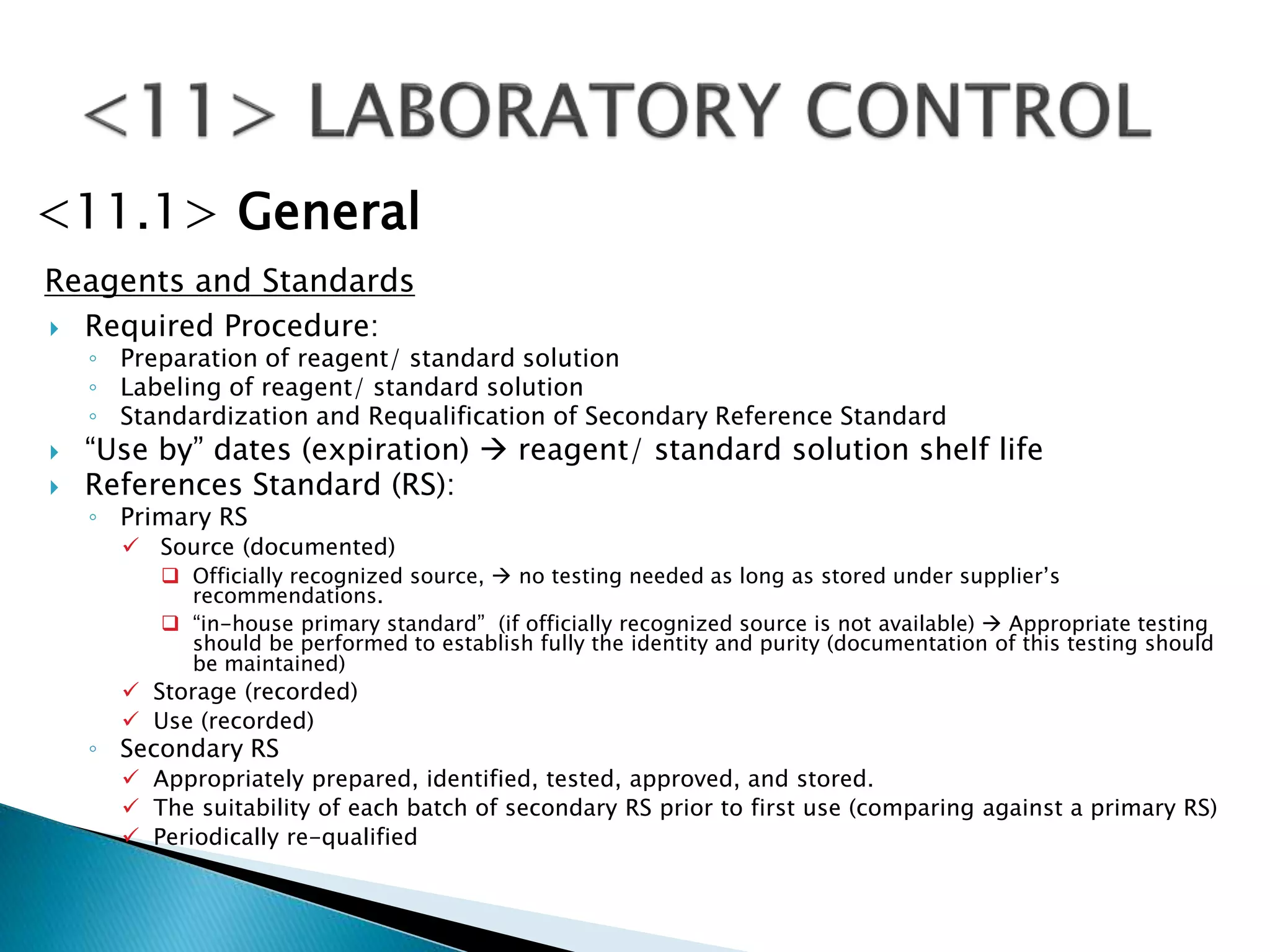
 Required Procedure:
◦ Preparation of reagent/ standard solution
◦ Labeling of reagent/ standard solution
◦ Standardization and Requalification of Secondary Reference Standard
 “Use by” dates (expiration)  reagent/ standard solution shelf life
 References Standard (RS):
◦ Primary RS
 Source (documented)
 Officially recognized source,  no testing needed as long as stored under supplier’s
recommendations.
 “in-house primary standard” (if officially recognized source is not available)  Appropriate testing
should be performed to establish fully the identity and purity (documentation of this testing should
be maintained)
 Storage (recorded)
 Use (recorded)
◦ Secondary RS
 Appropriately prepared, identified, tested, approved, and stored.
 The suitability of each batch of secondary RS prior to first use (comparing against a primary RS)
 Periodically re-qualified
<11.1> General
Reagents and Standards
 Each batch should be tested against its specification
 Impurity Profile (note: not necessary for APIs from herbal
or animal tissue origin):
◦ Identified and Unidentified impurities
◦ identity or some qualitative analytical designation (e.g. retention
time)
◦ the range of each impurity observed
◦ classification of each identified impurity (e.g. inorganic, organic,
solvent)
 The impurity profile should be compared against the
impurity profile in the regulatory submission or historical
 to detect changes in raw materials, equipment, or the
production process
 <11.3> Analytical Method/ Procedures should be
validated/ verified
<11.2> Testing
 Issued for each batch
 Information included:
◦ Name API (including its grade, if any)
◦ Batch number
◦ Release date
◦ Retest/ Expiry Date
Expiry date indicated on the label and Certificate of Analysis
Retest date  indicated on the label and/or Certificate of Analysis
◦ List of each test (including limits, and [numerical] results)
◦ Sign and date of authorized personnel of the quality unit
◦ Name, address and telephone number of the original
manufacturer *
<11.4> Certificates of Analysis
*If analysis is carried out by a re-packer/re-processor  the CoA should show the name, address and telephone
number of the re-packer/re-processor and reference to the name of the original manufacturer
* If new Certificates are issued by or on behalf of re-packer/re-processor , agents or brokers  Certificates
should show the name, address and telephone number of the laboratory that performed the analysis and
reference to original certificate and name and address of the original manufacturer (copy of original should be
attached)
 Types:
◦ On-going at least 1 batch/ year
 Frequency:
 For stable API (2 years or more)  Annually
 For short shelf life APOI More frequent (e.g. tested monthly for the first
three months, and at three month intervals after that)
◦ Study (shelf life determination)  Normally first three
commercial batches (If previous studies show stable at least for
two years, fewer than three batches can be used)
 Should have stability testing program
 The test procedures should be stability indicating and
validated
 Stability samples should be stored in containers that
simulate the market container (same or smaller-scale
drums with identical composition)
 Stability storage conditions  ICH guidelines on stability.
<11.5> Stability Monitoring
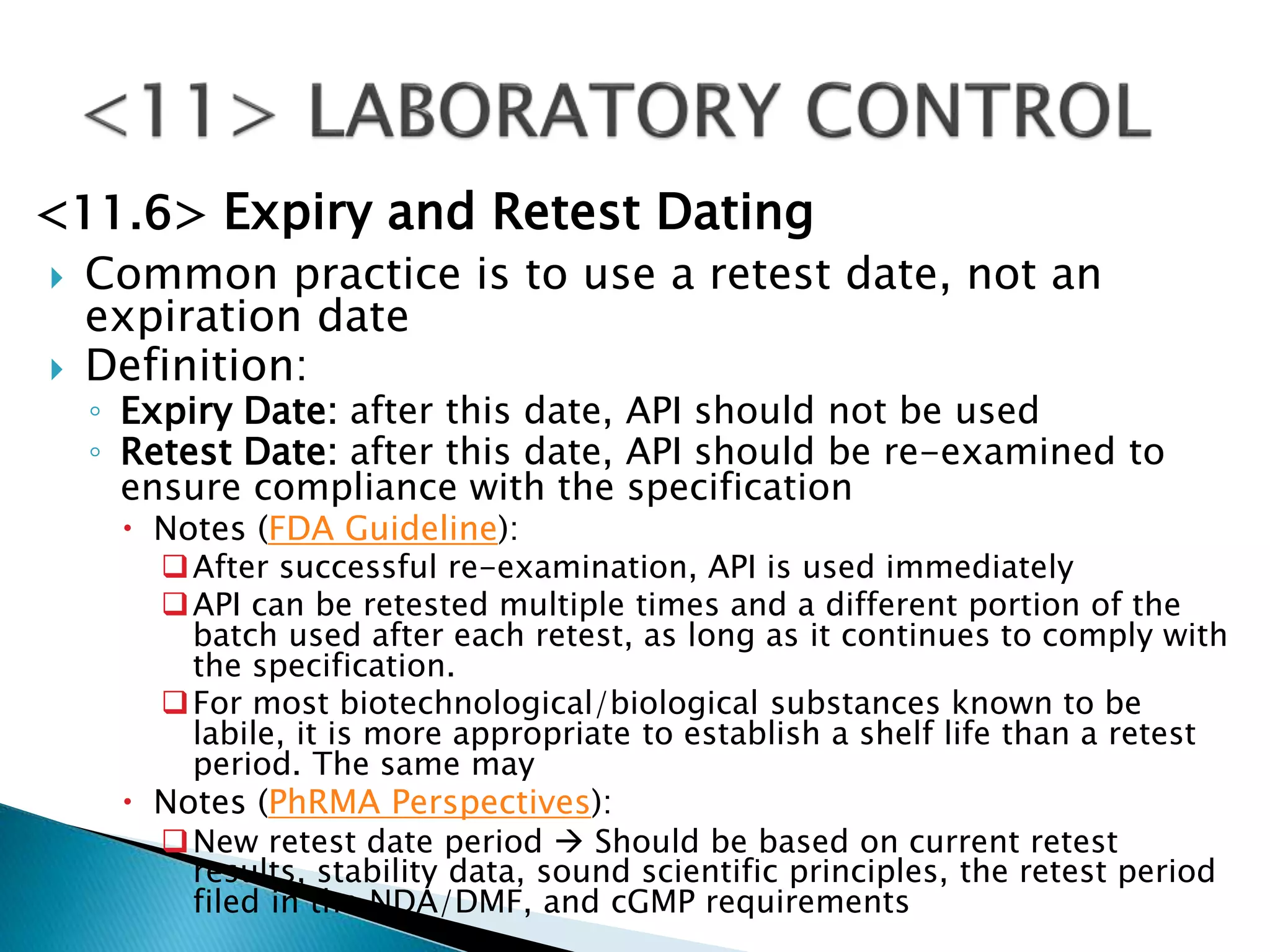
 Common practice is to use a retest date, not an
expiration date
 Definition:
◦ Expiry Date: after this date, API should not be used
◦ Retest Date: after this date, API should be re-examined to
ensure compliance with the specification
 Notes (FDA Guideline):
After successful re-examination, API is used immediately
API can be retested multiple times and a different portion of the
batch used after each retest, as long as it continues to comply with
the specification.
For most biotechnological/biological substances known to be
labile, it is more appropriate to establish a shelf life than a retest
period. The same may
 Notes (PhRMA Perspectives):
New retest date period  Should be based on current retest
results, stability data, sound scientific principles, the retest period
filed in the NDA/DMF, and cGMP requirements
<11.6> Expiry and Retest Dating
 Purpose:
◦ For future evaluation of the quality of batches of API
◦ not for future stability testing purposes
 Retention Period:
◦ 1 year after the expiry date or 3 years after distribution,
whichever is the longer.
◦ For APIs with retest dates  3 years after distribution
 Storage condition:
◦ The same packaging system or equivalent or more protective
than the marketed packaging system
 Quantity:
◦ At least two full compendia analyses
◦ At least two full specification analyses (if not compendia)
<11.7> Reserve/Retention Samples

Laboratory control gmp api (q7 ich guide)

  • 1.
    ICH Q7 (Step 4version, dated 10 November 2000 ) By Agung Sumantri, 2016
  • 2.
     <11.1> General <11.2> Testing and <11.3> Method Validation  <11.4> CoA  <11.5> Stability Monitoring  <11.6> Expiry/ Retest Date  <11.7> Retention Samples
  • 3.
    *Specifications should include: ◦Impurity Control (Organic, Inorganic, Residual Solvent) ◦ Microbial Limit and/ or Endotoxin (if any) **Specifications in addition to those in the registration/filing is permitted. <11.1> General Required Document Approved Scientifical ly Sound Aligned with registratio n filing Aligned with accepted standard Disposition Procedures Yes Data recording and storage Procedures Yes Sampling Procedures (including sampling plan) Yes (by Quality Unit) Yes Test procedures Yes (by Quality Unit) Yes Yes Specifications* Yes (by Quality Unit) Yes Yes** Yes Documentation
  • 4.
     OOS HandlingProcedure: ◦ Investigation and Documentation ◦ Analysis of the data ◦ Assessment of impact ◦ Allocation of the tasks for corrective actions ◦ Conclusions ◦ Resampling and/or retesting <11.1> General Out-of-Specification (OOS) Handling
  • 5.
     Required Procedure: ◦Preparation of reagent/ standard solution ◦ Labeling of reagent/ standard solution ◦ Standardization and Requalification of Secondary Reference Standard  “Use by” dates (expiration)  reagent/ standard solution shelf life  References Standard (RS): ◦ Primary RS  Source (documented)  Officially recognized source,  no testing needed as long as stored under supplier’s recommendations.  “in-house primary standard” (if officially recognized source is not available)  Appropriate testing should be performed to establish fully the identity and purity (documentation of this testing should be maintained)  Storage (recorded)  Use (recorded) ◦ Secondary RS  Appropriately prepared, identified, tested, approved, and stored.  The suitability of each batch of secondary RS prior to first use (comparing against a primary RS)  Periodically re-qualified <11.1> General Reagents and Standards
  • 6.
     Each batchshould be tested against its specification  Impurity Profile (note: not necessary for APIs from herbal or animal tissue origin): ◦ Identified and Unidentified impurities ◦ identity or some qualitative analytical designation (e.g. retention time) ◦ the range of each impurity observed ◦ classification of each identified impurity (e.g. inorganic, organic, solvent)  The impurity profile should be compared against the impurity profile in the regulatory submission or historical  to detect changes in raw materials, equipment, or the production process  <11.3> Analytical Method/ Procedures should be validated/ verified <11.2> Testing
  • 7.
     Issued foreach batch  Information included: ◦ Name API (including its grade, if any) ◦ Batch number ◦ Release date ◦ Retest/ Expiry Date Expiry date indicated on the label and Certificate of Analysis Retest date  indicated on the label and/or Certificate of Analysis ◦ List of each test (including limits, and [numerical] results) ◦ Sign and date of authorized personnel of the quality unit ◦ Name, address and telephone number of the original manufacturer * <11.4> Certificates of Analysis *If analysis is carried out by a re-packer/re-processor  the CoA should show the name, address and telephone number of the re-packer/re-processor and reference to the name of the original manufacturer * If new Certificates are issued by or on behalf of re-packer/re-processor , agents or brokers  Certificates should show the name, address and telephone number of the laboratory that performed the analysis and reference to original certificate and name and address of the original manufacturer (copy of original should be attached)
  • 8.
     Types: ◦ On-goingat least 1 batch/ year  Frequency:  For stable API (2 years or more)  Annually  For short shelf life APOI More frequent (e.g. tested monthly for the first three months, and at three month intervals after that) ◦ Study (shelf life determination)  Normally first three commercial batches (If previous studies show stable at least for two years, fewer than three batches can be used)  Should have stability testing program  The test procedures should be stability indicating and validated  Stability samples should be stored in containers that simulate the market container (same or smaller-scale drums with identical composition)  Stability storage conditions  ICH guidelines on stability. <11.5> Stability Monitoring
  • 9.
     Common practiceis to use a retest date, not an expiration date  Definition: ◦ Expiry Date: after this date, API should not be used ◦ Retest Date: after this date, API should be re-examined to ensure compliance with the specification  Notes (FDA Guideline): After successful re-examination, API is used immediately API can be retested multiple times and a different portion of the batch used after each retest, as long as it continues to comply with the specification. For most biotechnological/biological substances known to be labile, it is more appropriate to establish a shelf life than a retest period. The same may  Notes (PhRMA Perspectives): New retest date period  Should be based on current retest results, stability data, sound scientific principles, the retest period filed in the NDA/DMF, and cGMP requirements <11.6> Expiry and Retest Dating
  • 10.
     Purpose: ◦ Forfuture evaluation of the quality of batches of API ◦ not for future stability testing purposes  Retention Period: ◦ 1 year after the expiry date or 3 years after distribution, whichever is the longer. ◦ For APIs with retest dates  3 years after distribution  Storage condition: ◦ The same packaging system or equivalent or more protective than the marketed packaging system  Quantity: ◦ At least two full compendia analyses ◦ At least two full specification analyses (if not compendia) <11.7> Reserve/Retention Samples