Field/Lab Assignment By Marco Sandoval
Field/Lab Assignment Part I
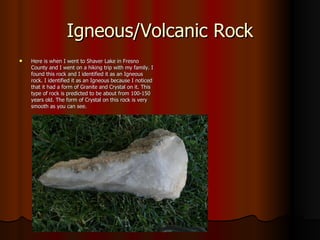
Igneous/Volcanic Rock Here is when I went to Shaver Lake in Fresno County and I went on a hiking trip with my family. I found this rock and I identified it as an Igneous rock. I identified it as an Igneous because I noticed that it had a form of Granite and Crystal on it. This type of rock is predicted to be about from 100-150 years old. The form of Crystal on this rock is very smooth as you can see.
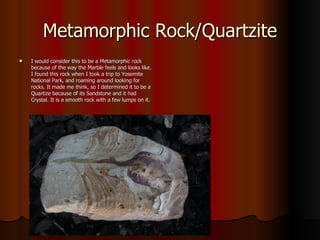
Metamorphic Rock/Quartzite I would consider this to be a Metamorphic rock because of the way the Marble feels and looks like. I found this rock when I took a trip to Yosemite National Park, and roaming around looking for rocks. It made me think, so I determined it to be a Quartize because of its Sandstone and it had Crystal. It is a smooth rock with a few lumps on it.
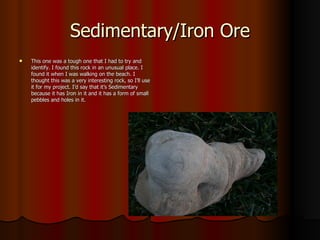
Sedimentary/Iron Ore This one was a tough one that I had to try and identify. I found this rock in an unusual place. I found it when I was walking on the beach. I thought this was a very interesting rock, so I’ll use it for my project. I’d say that it’s Sedimentary because it has Iron in it and it has a form of small pebbles and holes in it.
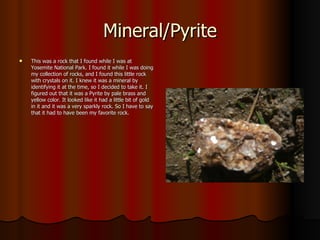
Mineral/Pyrite This was a rock that I found while I was at Yosemite National Park. I found it while I was doing my collection of rocks, and I found this little rock with crystals on it. I knew it was a mineral by identifying it at the time, so I decided to take it. I figured out that it was a Pyrite by pale brass and yellow color. It looked like it had a little bit of gold in it and it was a very sparkly rock. So I have to say that it had to have been my favorite rock.
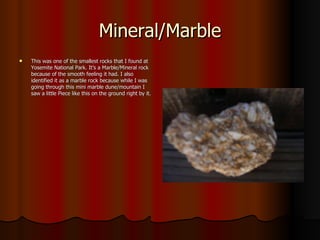
Mineral/Marble This was one of the smallest rocks that I found at Yosemite National Park. It’s a Marble/Mineral rock because of the smooth feeling it had. I also identified it as a marble rock because while I was going through this mini marble dune/mountain I saw a little Piece like this on the ground right by it.
What is a Mineral? A mineral is a Crystalline solid with Chemical Composition and Geometric shapes of atoms known as Crystal faces.  There are different types of Mineral types such as: Quartz, Feldspar, mica, and Hornblende.
How to Identify types of Rocks Here are ways you can Identify the way different types of Rocks are.
Igneous Rocks Igneous Rocks are known for having a tough layering, with a feeling of Granite.
Sedimentary Rocks Sedimentary Rocks have hard sediment layers of stone. They can even have fossils inside of them.
Metamorphic Rocks Metamorphic rocks are hard rocks with layers of minerals that are mostly curved.
Field/Lad Assignment Part II Here is Part Two of this assignment.
A Fault A Fault is a line that is caused by the volume of rocks. Earthquakes are what causes Faults to be made.  A perfect example of where a Fault is located is in San Andreas, CA.
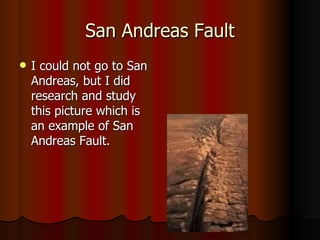
San Andreas Fault I could not go to San Andreas, but I did research and study this picture which is an example of San Andreas Fault.
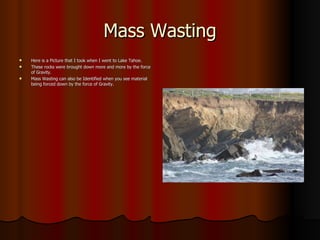
Mass Wasting Here is a Picture that I took when I went to Lake Tahoe. These rocks were brought down more and more by the force of Gravity. Mass Wasting can also be Identified when you see material being forced down by the force of Gravity.
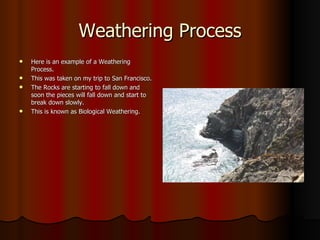
Weathering Process Here is an example of a Weathering Process.  This was taken on my trip to San Francisco. The Rocks are starting to fall down and soon the pieces will fall down and start to break down slowly. This is known as Biological Weathering.
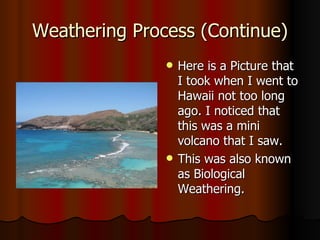
Weathering Process (Continue) Here is a Picture that I took when I went to Hawaii not too long ago. I noticed that this was a mini volcano that I saw. This was also known as Biological Weathering.
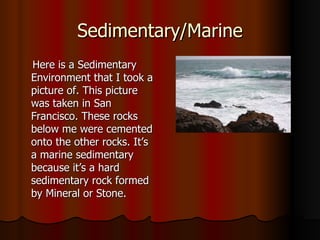
Sedimentary/Marine Here is a Sedimentary Environment that I took a picture of. This picture was taken in San Francisco. These rocks below me were cemented onto the other rocks. It’s a marine sedimentary because it’s a hard sedimentary rock formed by Mineral or Stone.
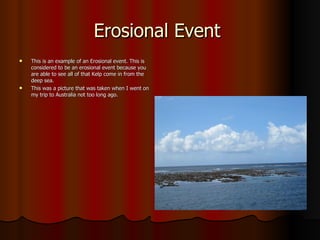
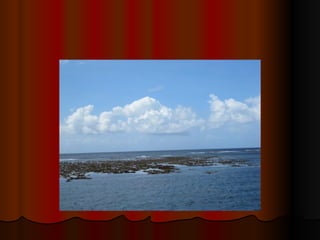
Erosional Event  This is an example of an Erosional event. This is considered to be an erosional event because you are able to see all of that Kelp come in from the deep sea. This was a picture that was taken when I went on my trip to Australia not too long ago.
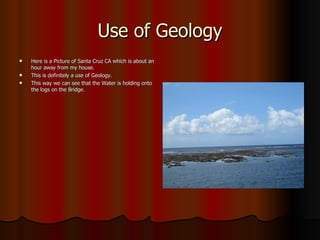
Use of Geology Here is a Picture of Santa Cruz CA which is about an hour away from my house.  This is definitely a use of Geology. This way we can see that the Water is holding onto the logs on the Bridge.
 

Lab field assignment

  • 1.
  • 2.
  • 3.
    Igneous/Volcanic Rock Hereis when I went to Shaver Lake in Fresno County and I went on a hiking trip with my family. I found this rock and I identified it as an Igneous rock. I identified it as an Igneous because I noticed that it had a form of Granite and Crystal on it. This type of rock is predicted to be about from 100-150 years old. The form of Crystal on this rock is very smooth as you can see.
  • 4.
    Metamorphic Rock/Quartzite Iwould consider this to be a Metamorphic rock because of the way the Marble feels and looks like. I found this rock when I took a trip to Yosemite National Park, and roaming around looking for rocks. It made me think, so I determined it to be a Quartize because of its Sandstone and it had Crystal. It is a smooth rock with a few lumps on it.
  • 5.
    Sedimentary/Iron Ore Thisone was a tough one that I had to try and identify. I found this rock in an unusual place. I found it when I was walking on the beach. I thought this was a very interesting rock, so I’ll use it for my project. I’d say that it’s Sedimentary because it has Iron in it and it has a form of small pebbles and holes in it.
  • 6.
    Mineral/Pyrite This wasa rock that I found while I was at Yosemite National Park. I found it while I was doing my collection of rocks, and I found this little rock with crystals on it. I knew it was a mineral by identifying it at the time, so I decided to take it. I figured out that it was a Pyrite by pale brass and yellow color. It looked like it had a little bit of gold in it and it was a very sparkly rock. So I have to say that it had to have been my favorite rock.
  • 7.
    Mineral/Marble This wasone of the smallest rocks that I found at Yosemite National Park. It’s a Marble/Mineral rock because of the smooth feeling it had. I also identified it as a marble rock because while I was going through this mini marble dune/mountain I saw a little Piece like this on the ground right by it.
  • 8.
    What is aMineral? A mineral is a Crystalline solid with Chemical Composition and Geometric shapes of atoms known as Crystal faces. There are different types of Mineral types such as: Quartz, Feldspar, mica, and Hornblende.
  • 9.
    How to Identifytypes of Rocks Here are ways you can Identify the way different types of Rocks are.
  • 10.
    Igneous Rocks IgneousRocks are known for having a tough layering, with a feeling of Granite.
  • 11.
    Sedimentary Rocks SedimentaryRocks have hard sediment layers of stone. They can even have fossils inside of them.
  • 12.
    Metamorphic Rocks Metamorphicrocks are hard rocks with layers of minerals that are mostly curved.
  • 13.
    Field/Lad Assignment PartII Here is Part Two of this assignment.
  • 14.
    A Fault AFault is a line that is caused by the volume of rocks. Earthquakes are what causes Faults to be made. A perfect example of where a Fault is located is in San Andreas, CA.
  • 15.
    San Andreas FaultI could not go to San Andreas, but I did research and study this picture which is an example of San Andreas Fault.
  • 16.
    Mass Wasting Hereis a Picture that I took when I went to Lake Tahoe. These rocks were brought down more and more by the force of Gravity. Mass Wasting can also be Identified when you see material being forced down by the force of Gravity.
  • 17.
    Weathering Process Hereis an example of a Weathering Process. This was taken on my trip to San Francisco. The Rocks are starting to fall down and soon the pieces will fall down and start to break down slowly. This is known as Biological Weathering.
  • 18.
    Weathering Process (Continue)Here is a Picture that I took when I went to Hawaii not too long ago. I noticed that this was a mini volcano that I saw. This was also known as Biological Weathering.
  • 19.
    Sedimentary/Marine Here isa Sedimentary Environment that I took a picture of. This picture was taken in San Francisco. These rocks below me were cemented onto the other rocks. It’s a marine sedimentary because it’s a hard sedimentary rock formed by Mineral or Stone.
  • 20.
    Erosional Event This is an example of an Erosional event. This is considered to be an erosional event because you are able to see all of that Kelp come in from the deep sea. This was a picture that was taken when I went on my trip to Australia not too long ago.
  • 21.
    Use of GeologyHere is a Picture of Santa Cruz CA which is about an hour away from my house. This is definitely a use of Geology. This way we can see that the Water is holding onto the logs on the Bridge.
  • 22.