Field/Lab ProjectFall 2010By: Brisa Ramirez
Field/Lab Assignment Pt. 1
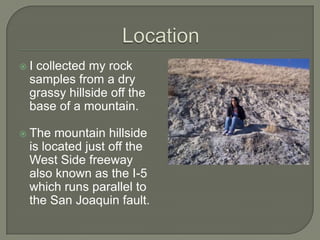
LocationI collected my rock samples from a dry grassy hillside off the base of a mountain.The mountain hillside is located just off the West Side freeway also known as the I-5 which runs parallel to the San Joaquin fault.
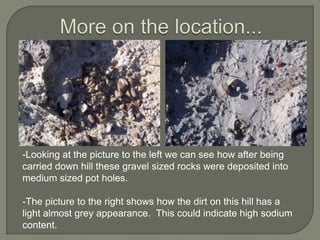
More on the location...-Looking at the picture to the left we can see how after being carried down hill these gravel sized rocks were deposited into medium sized pot holes.-The picture to the right shows how the dirt on this hill has a light almost grey appearance.  This could indicate high sodium content.
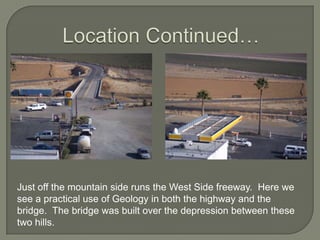
Location Continued…Just off the mountain side runs the West Side freeway.  Here we see a practical use of Geology in both the highway and the bridge.  The bridge was built over the depression between these two hills.
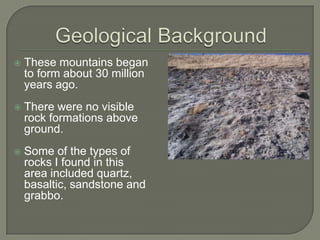
Geological BackgroundThese mountains began to form about 30 million years ago.There were no visible rock formations above ground.Some of the types of rocks I found in this area included quartz, basaltic, sandstone and grabbo.
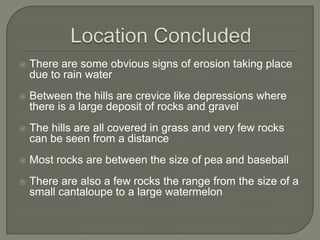
Location ConcludedThere are some obvious signs of erosion taking place due to rain waterBetween the hills are crevice like depressions where there is a large deposit of rocks and gravelThe hills are all covered in grass and very few rocks can be seen from a distanceMost rocks are between the size of pea and baseballThere are also a few rocks the range from the size of a small cantaloupe to a large watermelon
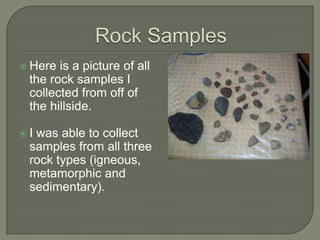
Rock SamplesHere is a picture of all the rock samples I collected from off of the hillside.I was able to collect samples from all three rock types (igneous, metamorphic and sedimentary).
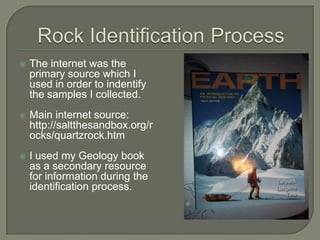
Rock Identification ProcessThe internet was the primary source which I used in order to indentify the samples I collected. Main internet source: http://saltthesandbox.org/rocks/quartzrock.htmI used my Geology book as a secondary resource for information during the identification process.
Rock Identification Process Cont…During the identification process I used vinegar and a nail in order to help classify my samples.Vinegar produces a chemical reaction with certain minerals found in some rocks.I used the nail in order to test my samples by scratching them.
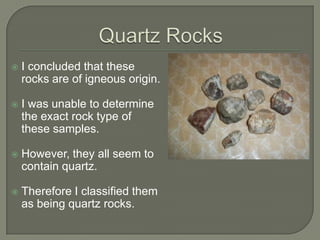
Quartz RocksI concluded that these rocks are of igneous origin.I was unable to determine the exact rock type of these samples.However, they all seem to contain quartz.Therefore I classified them as being quartz rocks.
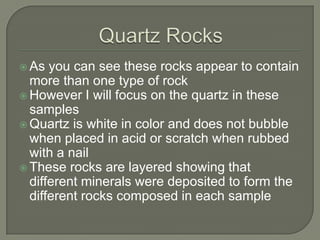
Quartz RocksAs you can see these rocks appear to contain more than one type of rockHowever I will focus on the quartz in these samplesQuartz is white in color and does not bubble when placed in acid or scratch when rubbed with a nailThese rocks are layered showing that different minerals were deposited to form the different rocks composed in each sample
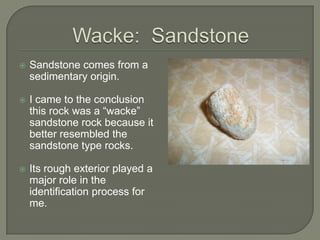
Wacke:  SandstoneSandstone comes from a sedimentary origin.I came to the conclusion this rock was a “wacke” sandstone rock because it better resembled the sandstone type rocks.Its rough exterior played a major role in the identification process for me.
Wacke:  SandstoneSand stone has a rough textureIt has a light brownish color with dark grey specksOn the bottom there is a faded orange or rust like colorSandstone is quite durable
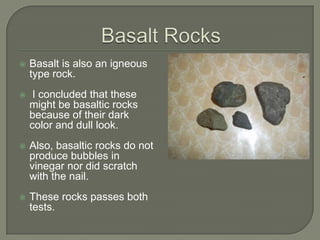
Basalt RocksBasalt is also an igneous type rock. I concluded that these might be basaltic rocks because of their dark color and dull look. Also, basaltic rocks do not produce bubbles in vinegar nor did scratch with the nail.  These rocks passes both tests.
Basalt RocksThese rocks all have a dark grayish colorThe surface of these rocks is smooth until broken When broken the edges are jagged and semi sharpThese rocks appear to have small cracks in them
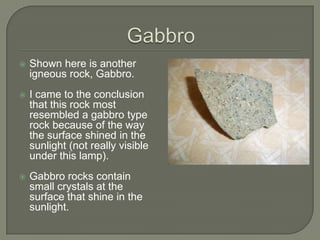
GabbroShown here is another igneous rock, Gabbro.I came to the conclusion that this rock most resembled a gabbro type rock because of the way the surface shined in the sunlight (not really visible under this lamp).Gabbro rocks contain small crystals at the surface that shine in the sunlight.
GabbroThis rock is grey and has black, brownish and off white speckles in itRough to the touchDoes not scratch when rubbed with a nail
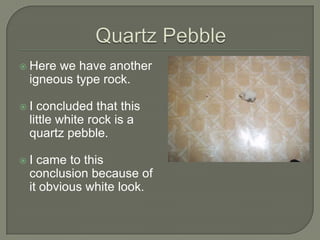
Quartz PebbleHere we have another igneous type rock.I concluded that this little white rock is a quartz pebble.I came to this conclusion because of it obvious white look.
Quartz PebbleThis pebble is white with a little brownish and black color at two endsDoes not bubble when placed in acidWill not scratch when rubbed with a nailThis pebble is only about three eights in diameter
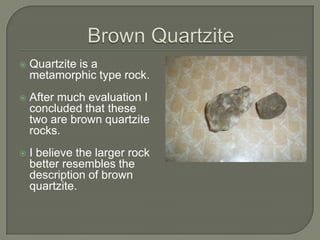
Brown QuartziteQuartzite is a metamorphic type rock.After much evaluation I concluded that these two are brown quartzite rocks.  I believe the larger rock better resembles the description of brown  quartzite.
Brown QuartziteBoth of these rocks have a light brownish color to themSmooth to the touchThe larger rock has some quartz still imbedded  in itHave a little shine to them like a glassy finish
Field/Lab Assignment Pt. 2
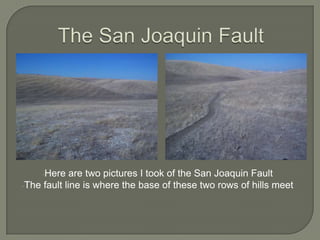
The San Joaquin FaultHere are two pictures I took of the San Joaquin Fault
The fault line is where the base of these two rows of hills meetSan Joaquin Fault Cont…The San Joaquin fault is located in the San Joaquin valley west of the I-5 freeway.The fault runs parallel to the I-5.In order to get to the fault location I had to park off the freeway and walk several miles over the hills in order to find it and take pictures.This fault is a transform fault.The San Joaquin Fault is said to be a seismically active.
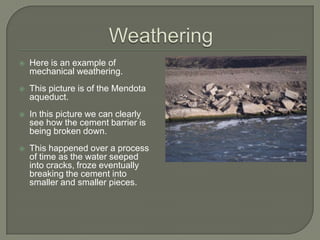
WeatheringHere is an example of mechanical weathering.This picture is of the Mendota aqueduct.  In this picture we can clearly see how the cement barrier is being broken down.This happened over a process of time as the water seeped into cracks, froze eventually breaking the cement into smaller and smaller pieces.
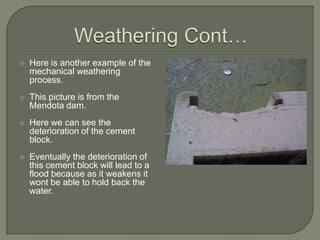
Weathering Cont…Here is another example of the mechanical weathering process.This picture is from the Mendota dam.Here we can see the deterioration of the cement block.Eventually the deterioration of this cement block will lead to a flood because as it weakens it wont be able to hold back the water.
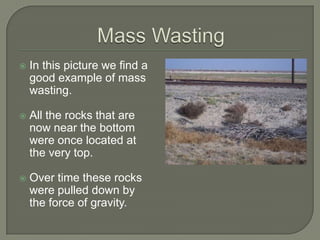
Mass WastingIn this picture we find a good example of mass wasting.All the rocks that are now near the bottom were once located at the very top.Over time these rocks were pulled down by the force of gravity.
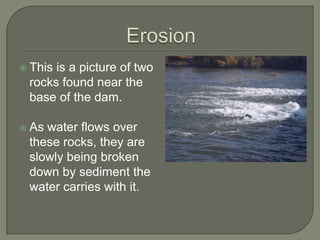
ErosionThis is a picture of two rocks found near the base of the dam.As water flows over these rocks, they are slowly being broken down by sediment the water carries with it.
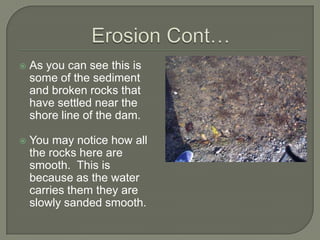
Erosion Cont…As you can see this is some of the sediment and broken rocks that have settled near the shore line of the dam.You may notice how all the rocks here are smooth.  This is because as the water carries them they are slowly sanded smooth.
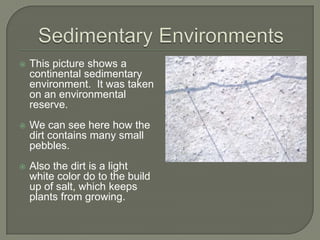
Sedimentary EnvironmentsThis picture shows a continental sedimentary environment.  It was taken on an environmental reserve.We can see here how the dirt contains many small pebbles.Also the dirt is a light white color do to the build up of salt, which keeps plants from growing.
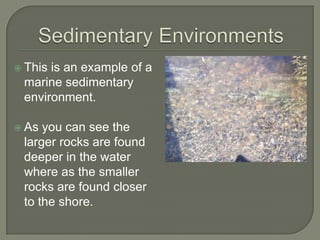
Sedimentary EnvironmentsThis is an example of a marine sedimentary environment.As you can see the larger rocks are found deeper in the water where as the smaller rocks are found closer to the shore.
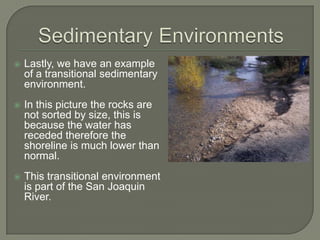
Sedimentary EnvironmentsLastly, we have an example of a transitional sedimentary environment. In this picture the rocks are not sorted by size, this is because the water has receded therefore the shoreline is much lower than normal.This transitional environment is part of the San Joaquin River.
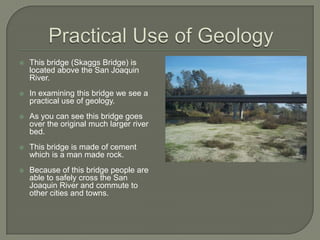
Practical Use of GeologyThis bridge (Skaggs Bridge) is located above the San Joaquin River.In examining this bridge we see a practical use of geology.As you can see this bridge goes over the original much larger river bed.This bridge is made of cement which is a man made rock.Because of this bridge people are able to safely cross the San Joaquin River and commute to other cities and towns.
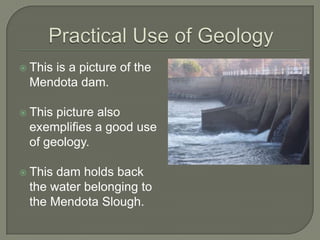
Practical Use of GeologyThis is a picture of the Mendota dam.This picture also exemplifies a good use of geology.This dam holds back the water belonging to the Mendota Slough.

Project 1

  • 1.
  • 2.
  • 3.
    LocationI collected myrock samples from a dry grassy hillside off the base of a mountain.The mountain hillside is located just off the West Side freeway also known as the I-5 which runs parallel to the San Joaquin fault.
  • 4.
    More on thelocation...-Looking at the picture to the left we can see how after being carried down hill these gravel sized rocks were deposited into medium sized pot holes.-The picture to the right shows how the dirt on this hill has a light almost grey appearance. This could indicate high sodium content.
  • 5.
    Location Continued…Just offthe mountain side runs the West Side freeway. Here we see a practical use of Geology in both the highway and the bridge. The bridge was built over the depression between these two hills.
  • 6.
    Geological BackgroundThese mountainsbegan to form about 30 million years ago.There were no visible rock formations above ground.Some of the types of rocks I found in this area included quartz, basaltic, sandstone and grabbo.
  • 7.
    Location ConcludedThere aresome obvious signs of erosion taking place due to rain waterBetween the hills are crevice like depressions where there is a large deposit of rocks and gravelThe hills are all covered in grass and very few rocks can be seen from a distanceMost rocks are between the size of pea and baseballThere are also a few rocks the range from the size of a small cantaloupe to a large watermelon
  • 8.
    Rock SamplesHere isa picture of all the rock samples I collected from off of the hillside.I was able to collect samples from all three rock types (igneous, metamorphic and sedimentary).
  • 9.
    Rock Identification ProcessTheinternet was the primary source which I used in order to indentify the samples I collected. Main internet source: http://saltthesandbox.org/rocks/quartzrock.htmI used my Geology book as a secondary resource for information during the identification process.
  • 10.
    Rock Identification ProcessCont…During the identification process I used vinegar and a nail in order to help classify my samples.Vinegar produces a chemical reaction with certain minerals found in some rocks.I used the nail in order to test my samples by scratching them.
  • 11.
    Quartz RocksI concludedthat these rocks are of igneous origin.I was unable to determine the exact rock type of these samples.However, they all seem to contain quartz.Therefore I classified them as being quartz rocks.
  • 12.
    Quartz RocksAs youcan see these rocks appear to contain more than one type of rockHowever I will focus on the quartz in these samplesQuartz is white in color and does not bubble when placed in acid or scratch when rubbed with a nailThese rocks are layered showing that different minerals were deposited to form the different rocks composed in each sample
  • 13.
    Wacke: SandstoneSandstonecomes from a sedimentary origin.I came to the conclusion this rock was a “wacke” sandstone rock because it better resembled the sandstone type rocks.Its rough exterior played a major role in the identification process for me.
  • 14.
    Wacke: SandstoneSandstone has a rough textureIt has a light brownish color with dark grey specksOn the bottom there is a faded orange or rust like colorSandstone is quite durable
  • 15.
    Basalt RocksBasalt isalso an igneous type rock. I concluded that these might be basaltic rocks because of their dark color and dull look. Also, basaltic rocks do not produce bubbles in vinegar nor did scratch with the nail. These rocks passes both tests.
  • 16.
    Basalt RocksThese rocksall have a dark grayish colorThe surface of these rocks is smooth until broken When broken the edges are jagged and semi sharpThese rocks appear to have small cracks in them
  • 17.
    GabbroShown here isanother igneous rock, Gabbro.I came to the conclusion that this rock most resembled a gabbro type rock because of the way the surface shined in the sunlight (not really visible under this lamp).Gabbro rocks contain small crystals at the surface that shine in the sunlight.
  • 18.
    GabbroThis rock isgrey and has black, brownish and off white speckles in itRough to the touchDoes not scratch when rubbed with a nail
  • 19.
    Quartz PebbleHere wehave another igneous type rock.I concluded that this little white rock is a quartz pebble.I came to this conclusion because of it obvious white look.
  • 20.
    Quartz PebbleThis pebbleis white with a little brownish and black color at two endsDoes not bubble when placed in acidWill not scratch when rubbed with a nailThis pebble is only about three eights in diameter
  • 21.
    Brown QuartziteQuartzite isa metamorphic type rock.After much evaluation I concluded that these two are brown quartzite rocks. I believe the larger rock better resembles the description of brown quartzite.
  • 22.
    Brown QuartziteBoth ofthese rocks have a light brownish color to themSmooth to the touchThe larger rock has some quartz still imbedded in itHave a little shine to them like a glassy finish
  • 23.
  • 24.
    The San JoaquinFaultHere are two pictures I took of the San Joaquin Fault
  • 25.
    The fault lineis where the base of these two rows of hills meetSan Joaquin Fault Cont…The San Joaquin fault is located in the San Joaquin valley west of the I-5 freeway.The fault runs parallel to the I-5.In order to get to the fault location I had to park off the freeway and walk several miles over the hills in order to find it and take pictures.This fault is a transform fault.The San Joaquin Fault is said to be a seismically active.
  • 26.
    WeatheringHere is anexample of mechanical weathering.This picture is of the Mendota aqueduct. In this picture we can clearly see how the cement barrier is being broken down.This happened over a process of time as the water seeped into cracks, froze eventually breaking the cement into smaller and smaller pieces.
  • 27.
    Weathering Cont…Here isanother example of the mechanical weathering process.This picture is from the Mendota dam.Here we can see the deterioration of the cement block.Eventually the deterioration of this cement block will lead to a flood because as it weakens it wont be able to hold back the water.
  • 28.
    Mass WastingIn thispicture we find a good example of mass wasting.All the rocks that are now near the bottom were once located at the very top.Over time these rocks were pulled down by the force of gravity.
  • 29.
    ErosionThis is apicture of two rocks found near the base of the dam.As water flows over these rocks, they are slowly being broken down by sediment the water carries with it.
  • 30.
    Erosion Cont…As youcan see this is some of the sediment and broken rocks that have settled near the shore line of the dam.You may notice how all the rocks here are smooth. This is because as the water carries them they are slowly sanded smooth.
  • 31.
    Sedimentary EnvironmentsThis pictureshows a continental sedimentary environment. It was taken on an environmental reserve.We can see here how the dirt contains many small pebbles.Also the dirt is a light white color do to the build up of salt, which keeps plants from growing.
  • 32.
    Sedimentary EnvironmentsThis isan example of a marine sedimentary environment.As you can see the larger rocks are found deeper in the water where as the smaller rocks are found closer to the shore.
  • 33.
    Sedimentary EnvironmentsLastly, wehave an example of a transitional sedimentary environment. In this picture the rocks are not sorted by size, this is because the water has receded therefore the shoreline is much lower than normal.This transitional environment is part of the San Joaquin River.
  • 34.
    Practical Use ofGeologyThis bridge (Skaggs Bridge) is located above the San Joaquin River.In examining this bridge we see a practical use of geology.As you can see this bridge goes over the original much larger river bed.This bridge is made of cement which is a man made rock.Because of this bridge people are able to safely cross the San Joaquin River and commute to other cities and towns.
  • 35.
    Practical Use ofGeologyThis is a picture of the Mendota dam.This picture also exemplifies a good use of geology.This dam holds back the water belonging to the Mendota Slough.