S
Historical Geology in
Lake Tahoe.
Jake Dawson
Professor Lawler
Geology 103
Introduction
S Throughout this project I researched and learned about
Kokanee Salmon and how they have adapted to Lake Tahoe.
S Also I picked Emerald bay and how it was made from Glaciers,
that made U-Shaped Valleys, lateral moraine.
S I went to fallen leaf rock and cave rock to find 3 different types
of rocks.
S I also found a type of nonconformity.
Part 1 Content
S Animal (Kokanee Salmon)
S Emerald Bay (Glacial Formation)
S Cave Rock ( Geological Formation)
Kokanee Salmon
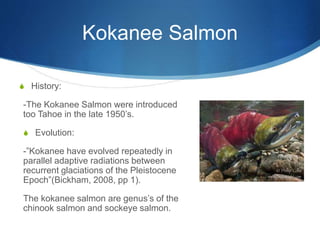
S History:
-The Kokanee Salmon were introduced
too Tahoe in the late 1950’s.
S Evolution:
-”Kokanee have evolved repeatedly in
parallel adaptive radiations between
recurrent glaciations of the Pleistocene
Epoch”(Bickham, 2008, pp 1).
The kokanee salmon are genus’s of the
chinook salmon and sockeye salmon.
Kokanee Salmon Cont.
Evolution-
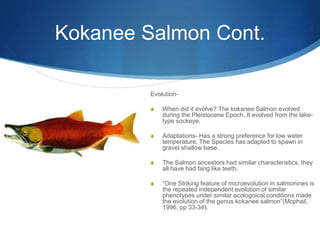
S When did it evolve? The kokanee Salmon evolved
during the Pleistocene Epoch. It evolved from the lake-
type sockeye.
S Adaptations- Has a strong preference for low water
temperature. The Species has adapted to spawn in
gravel shallow base.
S The Salmon ancestors had similar characteristics, they
all have had fang like teeth.
S “One Striking feature of microevolution in salmonines is
the repeated independent evolution of similar
phenotypes under similar ecologoical conditions made
the evolution of the genus kokanee salmon”(Mcphail,
1996, pp 33-34).
Kokanee Salmon cont.
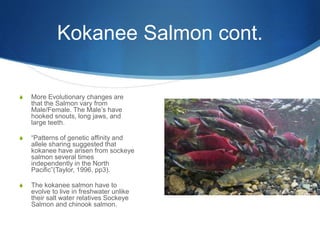
S More Evolutionary changes are
that the Salmon vary from
Male/Female. The Male’s have
hooked snouts, long jaws, and
large teeth.
S “Patterns of genetic affinity and
allele sharing suggested that
kokanee have arisen from sockeye
salmon several times
independently in the North
Pacific”(Taylor, 1996, pp3).
S The kokanee salmon have to
evolve to live in freshwater unlike
their salt water relatives Sockeye
Salmon and chinook salmon.
Emerald Bay
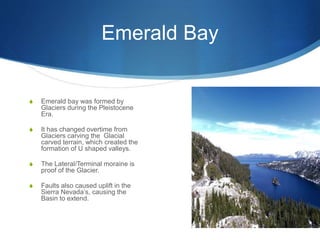
S Emerald bay was formed by
Glaciers during the Pleistocene
Era.
S It has changed overtime from
Glaciers carving the Glacial
carved terrain, which created the
formation of U shaped valleys.
S The Lateral/Terminal moraine is
proof of the Glacier.
S Faults also caused uplift in the
Sierra Nevada’s, causing the
Basin to extend.
Emerald Bay cont.
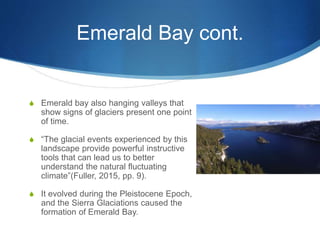
S Emerald bay also hanging valleys that
show signs of glaciers present one point
of time.
S “The glacial events experienced by this
landscape provide powerful instructive
tools that can lead us to better
understand the natural fluctuating
climate”(Fuller, 2015, pp. 9).
S It evolved during the Pleistocene Epoch,
and the Sierra Glaciations caused the
formation of Emerald Bay.
Cave Rock
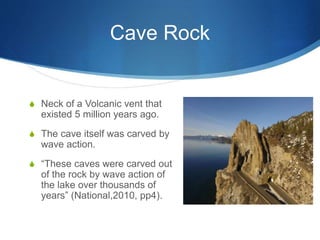
S Neck of a Volcanic vent that
existed 5 million years ago.
S The cave itself was carved by
wave action.
S “These caves were carved out
of the rock by wave action of
the lake over thousands of
years” (National,2010, pp4).
Part 2 Content
S Igneous Granite
S Slate rock
S Tallac Meta-sedimentary rock
Igneous Granite
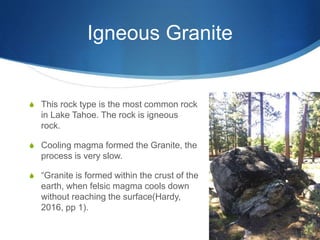
S This rock type is the most common rock
in Lake Tahoe. The rock is igneous
rock.
S Cooling magma formed the Granite, the
process is very slow.
S “Granite is formed within the crust of the
earth, when felsic magma cools down
without reaching the surface(Hardy,
2016, pp 1).
Slate rock
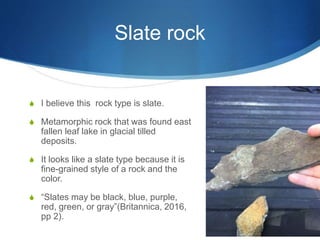
S I believe this rock type is slate.
S Metamorphic rock that was found east
fallen leaf lake in glacial tilled
deposits.
S It looks like a slate type because it is
fine-grained style of a rock and the
color.
S “Slates may be black, blue, purple,
red, green, or gray”(Britannica, 2016,
pp 2).
Tallac Metasedimentary
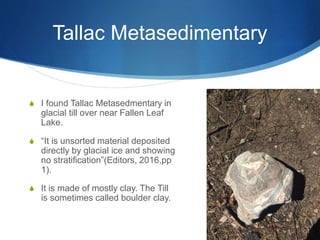
S I found Tallac Metasedmentary in
glacial till over near Fallen Leaf
Lake.
S “It is unsorted material deposited
directly by glacial ice and showing
no stratification”(Editors, 2016,pp
1).
S It is made of mostly clay. The Till
is sometimes called boulder clay.
Part 3 Content
S Steno’s Principle of Original Horizontality.
S Nonconformity.
Steno’s Principle of Original
Horizontality
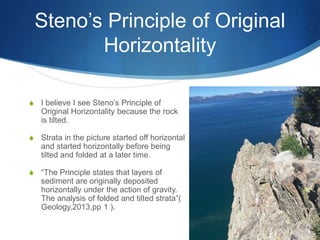
S I believe I see Steno’s Principle of
Original Horizontality because the rock
is tilted.
S Strata in the picture started off horizontal
and started horizontally before being
tilted and folded at a later time.
S “The Principle states that layers of
sediment are originally deposited
horizontally under the action of gravity.
The analysis of folded and tilted strata”(
Geology,2013,pp 1 ).
Nonconformity
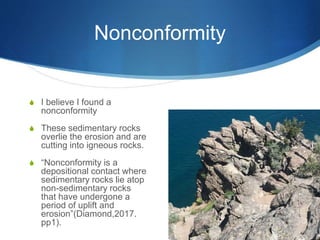
S I believe I found a
nonconformity
S These sedimentary rocks
overlie the erosion and are
cutting into igneous rocks.
S “Nonconformity is a
depositional contact where
sedimentary rocks lie atop
non-sedimentary rocks
that have undergone a
period of uplift and
erosion”(Diamond,2017.
pp1).
Reference
S Wood, C. (2008, May 1). Recurrent evolution of life history ecotypes in sockeye salmon:
implications for conservation and future evolution. Retrieved from
http://www.ncbi.nlm.gov/pmc/articles/PMC3352436/
S National Geographic. (2010, July 21). Cave Rock - Sierra Nevada Geotourism MapGuide.
Retrieved from https://www.sierranevadageotourism.org/content/cave-
rock/sieD297F2DC0D30D2CA8
S Fuller, M. (2015, February 2). Retrieved from
ftp://ftp.consrv.ca.gov/pub/dmg/pubs/sr/SR_230/Notes_LR/CGS_SR230_EmeraldBay_SP
_lr.pdf
S Hardy, L. (2016, March 22). Error 429 (Too Many Requests) - Quora. Retrieved from
https://www.quora.com/Geology-How-is-granite-formed
S Britannica, E. (2016, January 1). till | geology | Britannica.com. Retrieved from
https://www.britannica.com/science/till
References
S Taylor, E. (1996) Molecular Genetic Evidence for Parallel Life-History
Evolution within a Pacific Salmon (Sockeye Salmon and Kokanee,
Oncorhynchus nerka). Evolution, 50(1), 401. doi:10.2307/2410810
S Diamond, D.(2017, January 3). Quora/ Retrieved from
http://www.quora.com/What -are-some-examples-of-non-conformity-in-
geology.
S Geology IN. (2013, March 7). Principle of Original Horizontality/ Geology
IN. Retrieved from http://www.geologyin.com/2014/03/ principle-of-original-
horizontality.html
S Mcphail,M. (1997, February 4). Pacific Salmon and their Ecosystems:
Status and Future Options. Retreieved from
http://books.google.com/books?

Lab field assg geology

  • 1.
    S Historical Geology in LakeTahoe. Jake Dawson Professor Lawler Geology 103
  • 2.
    Introduction S Throughout thisproject I researched and learned about Kokanee Salmon and how they have adapted to Lake Tahoe. S Also I picked Emerald bay and how it was made from Glaciers, that made U-Shaped Valleys, lateral moraine. S I went to fallen leaf rock and cave rock to find 3 different types of rocks. S I also found a type of nonconformity.
  • 3.
    Part 1 Content SAnimal (Kokanee Salmon) S Emerald Bay (Glacial Formation) S Cave Rock ( Geological Formation)
  • 4.
    Kokanee Salmon S History: -TheKokanee Salmon were introduced too Tahoe in the late 1950’s. S Evolution: -”Kokanee have evolved repeatedly in parallel adaptive radiations between recurrent glaciations of the Pleistocene Epoch”(Bickham, 2008, pp 1). The kokanee salmon are genus’s of the chinook salmon and sockeye salmon.
  • 5.
    Kokanee Salmon Cont. Evolution- SWhen did it evolve? The kokanee Salmon evolved during the Pleistocene Epoch. It evolved from the lake- type sockeye. S Adaptations- Has a strong preference for low water temperature. The Species has adapted to spawn in gravel shallow base. S The Salmon ancestors had similar characteristics, they all have had fang like teeth. S “One Striking feature of microevolution in salmonines is the repeated independent evolution of similar phenotypes under similar ecologoical conditions made the evolution of the genus kokanee salmon”(Mcphail, 1996, pp 33-34).
  • 6.
    Kokanee Salmon cont. SMore Evolutionary changes are that the Salmon vary from Male/Female. The Male’s have hooked snouts, long jaws, and large teeth. S “Patterns of genetic affinity and allele sharing suggested that kokanee have arisen from sockeye salmon several times independently in the North Pacific”(Taylor, 1996, pp3). S The kokanee salmon have to evolve to live in freshwater unlike their salt water relatives Sockeye Salmon and chinook salmon.
  • 7.
    Emerald Bay S Emeraldbay was formed by Glaciers during the Pleistocene Era. S It has changed overtime from Glaciers carving the Glacial carved terrain, which created the formation of U shaped valleys. S The Lateral/Terminal moraine is proof of the Glacier. S Faults also caused uplift in the Sierra Nevada’s, causing the Basin to extend.
  • 8.
    Emerald Bay cont. SEmerald bay also hanging valleys that show signs of glaciers present one point of time. S “The glacial events experienced by this landscape provide powerful instructive tools that can lead us to better understand the natural fluctuating climate”(Fuller, 2015, pp. 9). S It evolved during the Pleistocene Epoch, and the Sierra Glaciations caused the formation of Emerald Bay.
  • 9.
    Cave Rock S Neckof a Volcanic vent that existed 5 million years ago. S The cave itself was carved by wave action. S “These caves were carved out of the rock by wave action of the lake over thousands of years” (National,2010, pp4).
  • 10.
    Part 2 Content SIgneous Granite S Slate rock S Tallac Meta-sedimentary rock
  • 11.
    Igneous Granite S Thisrock type is the most common rock in Lake Tahoe. The rock is igneous rock. S Cooling magma formed the Granite, the process is very slow. S “Granite is formed within the crust of the earth, when felsic magma cools down without reaching the surface(Hardy, 2016, pp 1).
  • 12.
    Slate rock S Ibelieve this rock type is slate. S Metamorphic rock that was found east fallen leaf lake in glacial tilled deposits. S It looks like a slate type because it is fine-grained style of a rock and the color. S “Slates may be black, blue, purple, red, green, or gray”(Britannica, 2016, pp 2).
  • 13.
    Tallac Metasedimentary S Ifound Tallac Metasedmentary in glacial till over near Fallen Leaf Lake. S “It is unsorted material deposited directly by glacial ice and showing no stratification”(Editors, 2016,pp 1). S It is made of mostly clay. The Till is sometimes called boulder clay.
  • 14.
    Part 3 Content SSteno’s Principle of Original Horizontality. S Nonconformity.
  • 15.
    Steno’s Principle ofOriginal Horizontality S I believe I see Steno’s Principle of Original Horizontality because the rock is tilted. S Strata in the picture started off horizontal and started horizontally before being tilted and folded at a later time. S “The Principle states that layers of sediment are originally deposited horizontally under the action of gravity. The analysis of folded and tilted strata”( Geology,2013,pp 1 ).
  • 16.
    Nonconformity S I believeI found a nonconformity S These sedimentary rocks overlie the erosion and are cutting into igneous rocks. S “Nonconformity is a depositional contact where sedimentary rocks lie atop non-sedimentary rocks that have undergone a period of uplift and erosion”(Diamond,2017. pp1).
  • 17.
    Reference S Wood, C.(2008, May 1). Recurrent evolution of life history ecotypes in sockeye salmon: implications for conservation and future evolution. Retrieved from http://www.ncbi.nlm.gov/pmc/articles/PMC3352436/ S National Geographic. (2010, July 21). Cave Rock - Sierra Nevada Geotourism MapGuide. Retrieved from https://www.sierranevadageotourism.org/content/cave- rock/sieD297F2DC0D30D2CA8 S Fuller, M. (2015, February 2). Retrieved from ftp://ftp.consrv.ca.gov/pub/dmg/pubs/sr/SR_230/Notes_LR/CGS_SR230_EmeraldBay_SP _lr.pdf S Hardy, L. (2016, March 22). Error 429 (Too Many Requests) - Quora. Retrieved from https://www.quora.com/Geology-How-is-granite-formed S Britannica, E. (2016, January 1). till | geology | Britannica.com. Retrieved from https://www.britannica.com/science/till
  • 18.
    References S Taylor, E.(1996) Molecular Genetic Evidence for Parallel Life-History Evolution within a Pacific Salmon (Sockeye Salmon and Kokanee, Oncorhynchus nerka). Evolution, 50(1), 401. doi:10.2307/2410810 S Diamond, D.(2017, January 3). Quora/ Retrieved from http://www.quora.com/What -are-some-examples-of-non-conformity-in- geology. S Geology IN. (2013, March 7). Principle of Original Horizontality/ Geology IN. Retrieved from http://www.geologyin.com/2014/03/ principle-of-original- horizontality.html S Mcphail,M. (1997, February 4). Pacific Salmon and their Ecosystems: Status and Future Options. Retreieved from http://books.google.com/books?