Sedimentary: Shale/Sandstone


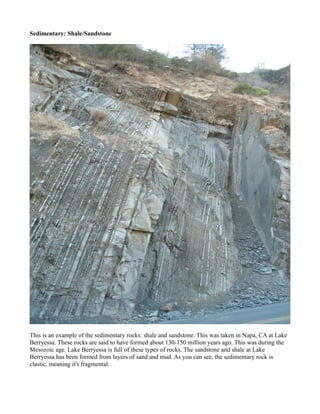
This is an example of the sedimentary rocks: shale and sandstone. This was taken in Napa, CA at Lake
Berryessa. These rocks are said to have formed about 130-150 million years ago. This was during the
Mesozoic age. Lake Berryessa is full of these types of rocks. The sandstone and shale at Lake
Berryessa has been formed from layers of sand and mud. As you can see, the sedimentary rock is
clastic, meaning it's fragmental.
Igneous: Basalt


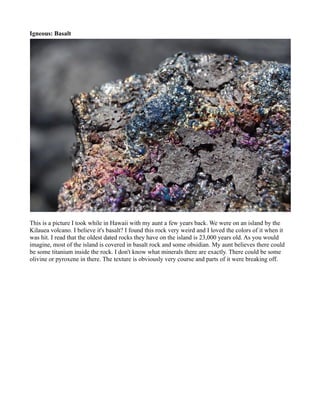
This is a picture I took while in Hawaii with my aunt a few years back. We were on an island by the
Kilauea volcano. I believe it's basalt? I found this rock very weird and I loved the colors of it when it
was hit. I read that the oldest dated rocks they have on the island is 23,000 years old. As you would
imagine, most of the island is covered in basalt rock and some obsidian. My aunt believes there could
be some titanium inside the rock. I don't know what minerals there are exactly. There could be some
olivine or pyroxene in there. The texture is obviously very course and parts of it were breaking off.
Igneous: Granite


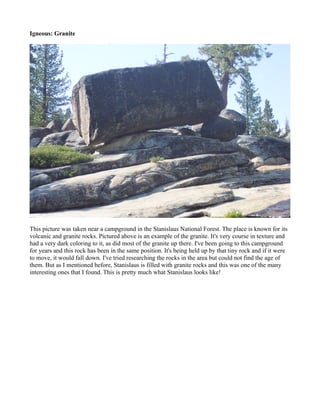
This picture was taken near a campground in the Stanislaus National Forest. The place is known for its
volcanic and granite rocks. Pictured above is an example of the granite. It's very course in texture and
had a very dark coloring to it, as did most of the granite up there. I've been going to this campground
for years and this rock has been in the same position. It's being held up by that tiny rock and if it were
to move, it would fall down. I've tried researching the rocks in the area but could not find the age of
them. But as I mentioned before, Stanislaus is filled with granite rocks and this was one of the many
interesting ones that I found. This is pretty much what Stanislaus looks like!
Metamorphic: Marble


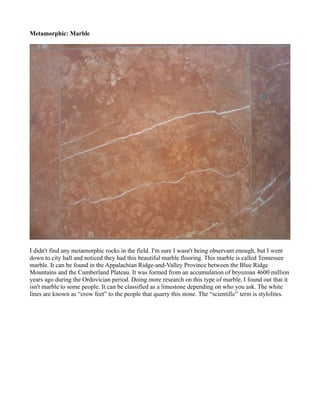
I didn't find any metamorphic rocks in the field. I'm sure I wasn't being observant enough, but I went
down to city hall and noticed they had this beautiful marble flooring. This marble is called Tennessee
marble. It can be found in the Appalachian Ridge-and-Valley Province between the Blue Ridge
Mountains and the Cumberland Plateau. It was formed from an accumulation of bryozoan 4600 million
years ago during the Ordovician period. Doing more research on this type of marble, I found out that it
isn't marble to some people. It can be classified as a limestone depending on who you ask. The white
lines are known as “crow feet” to the people that quarry this stone. The “scientific” term is stylolites.
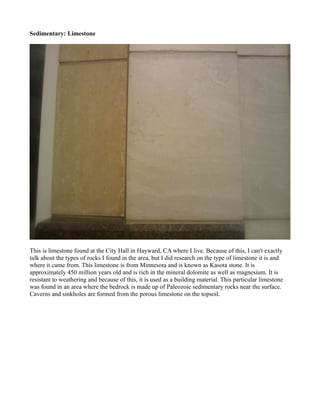
Sedimentary: Limestone


This is limestone found at the City Hall in Hayward, CA where I live. Because of this, I can't exactly
talk about the types of rocks I found in the area, but I did research on the type of limestone it is and
where it came from. This limestone is from Minnesota and is known as Kasota stone. It is
approximately 450 million years old and is rich in the mineral dolomite as well as magnesium. It is
resistant to weathering and because of this, it is used as a building material. This particular limestone
was found in an area where the bedrock is made up of Paleozoic sedimentary rocks near the surface.
Caverns and sinkholes are formed from the porous limestone on the topsoil.

Part 1

  • 1.
    Sedimentary: Shale/Sandstone This isan example of the sedimentary rocks: shale and sandstone. This was taken in Napa, CA at Lake Berryessa. These rocks are said to have formed about 130-150 million years ago. This was during the Mesozoic age. Lake Berryessa is full of these types of rocks. The sandstone and shale at Lake Berryessa has been formed from layers of sand and mud. As you can see, the sedimentary rock is clastic, meaning it's fragmental.
  • 2.
    Igneous: Basalt This isa picture I took while in Hawaii with my aunt a few years back. We were on an island by the Kilauea volcano. I believe it's basalt? I found this rock very weird and I loved the colors of it when it was hit. I read that the oldest dated rocks they have on the island is 23,000 years old. As you would imagine, most of the island is covered in basalt rock and some obsidian. My aunt believes there could be some titanium inside the rock. I don't know what minerals there are exactly. There could be some olivine or pyroxene in there. The texture is obviously very course and parts of it were breaking off.
  • 3.
    Igneous: Granite This picturewas taken near a campground in the Stanislaus National Forest. The place is known for its volcanic and granite rocks. Pictured above is an example of the granite. It's very course in texture and had a very dark coloring to it, as did most of the granite up there. I've been going to this campground for years and this rock has been in the same position. It's being held up by that tiny rock and if it were to move, it would fall down. I've tried researching the rocks in the area but could not find the age of them. But as I mentioned before, Stanislaus is filled with granite rocks and this was one of the many interesting ones that I found. This is pretty much what Stanislaus looks like!
  • 4.
    Metamorphic: Marble I didn'tfind any metamorphic rocks in the field. I'm sure I wasn't being observant enough, but I went down to city hall and noticed they had this beautiful marble flooring. This marble is called Tennessee marble. It can be found in the Appalachian Ridge-and-Valley Province between the Blue Ridge Mountains and the Cumberland Plateau. It was formed from an accumulation of bryozoan 4600 million years ago during the Ordovician period. Doing more research on this type of marble, I found out that it isn't marble to some people. It can be classified as a limestone depending on who you ask. The white lines are known as “crow feet” to the people that quarry this stone. The “scientific” term is stylolites.
  • 5.
    Sedimentary: Limestone This islimestone found at the City Hall in Hayward, CA where I live. Because of this, I can't exactly talk about the types of rocks I found in the area, but I did research on the type of limestone it is and where it came from. This limestone is from Minnesota and is known as Kasota stone. It is approximately 450 million years old and is rich in the mineral dolomite as well as magnesium. It is resistant to weathering and because of this, it is used as a building material. This particular limestone was found in an area where the bedrock is made up of Paleozoic sedimentary rocks near the surface. Caverns and sinkholes are formed from the porous limestone on the topsoil.