Thunder Mountain
Kirkwood, CA
Mary Simpson
Geology 103
Professor Lawler
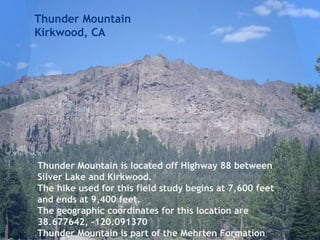
Thunder Mountain
Kirkwood, CA
Thunder Mountain is located off Highway 88 between
Silver Lake and Kirkwood.
The hike used for this field study begins at 7,600 feet
and ends at 9,400 feet.
The geographic coordinates for this location are
38.677642, -120.091370
Thunder Mountain is part of the Mehrten Formation
● 225 million years ago, Farallon plate subducted
beneath the Pacific plate
● Heat caused underlying crust to melt, forming
magma, and then forming a series of granitic plutons
which are the Sierra Nevada batholith
● A chain of volcanoes formed above the magma,
erupting and leaving ash, mud flows, and basaltic
rock behind.
● The entire region underwent uplifting and tilting
● The granite batholith is now exposed around the
Silver Lake area, just below Thunder Mountain
● Thunder Mountain is primarily made up of mud and
ash flow remnants (TUSD.org, n.d.)
A Short Geological History
Part 1
Evidence of
Change Over Time
31
2
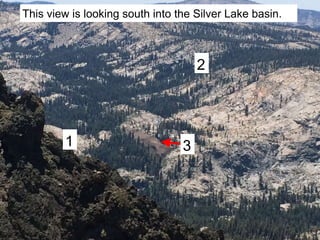
This view is looking south into the Silver Lake basin.
The Mountain
• A granitic batholith sits beneath the mountain,
formed during the Triassic Period
• Uplift, tilting, and volcanic action followed, building
the mountain to its current height of 9,400 feet
• Deposits of volcanic tuff and ash flow are most likely
from the late Miocene (Busby, et. al. 2008)(1)
• The U-shaped valley is indicative of glaciation and
erosion which took place during the Pleistocene(2)
• The massive pile of dirt is also indicative of on-going
erosive forces of snow, wind, and rain as it breaks
down the mountain and flows into the valley(3)
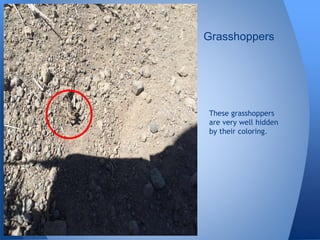
These grasshoppers
are very well hidden
by their coloring.
Grasshoppers
Grasshopper
• Order Orthopera, Suborder Caeliferam Genus
Xanthippus
• They are widely diverse
• Stridulation causes a clicking or singing noise, used
for mating and warning
• They eat plant and animal material
• Their camouflage is an adaptation to hide from
predators - there are many varieties with differing
camouflage for different habitats
• It is thought that they remain in egg formation during
the harsh winters and appear in June after the snow
melts - this makes them well-adapted to the harsh
conditions in the high Sierra
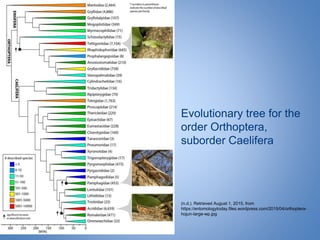
Evolutionary tree for the
order Orthoptera,
suborder Caelifera
(n.d.). Retrieved August 1, 2015, from
https://entomologytoday.files.wordpress.com/2015/04/orthoptera-
hojun-large-wp.jpg
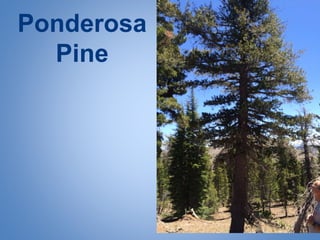
Ponderosa
Pine
• Species: Pinus Ponderosa
• Thick bark protects against fire
• Fires destroy undergrowth allowing the pines to flourish
and survive
• Commonly used species for tree-ring dating
• Large trees can live more than 500 years
• Exact origin is unknown
• Oldest fossil is 600,000 years old, found in West Central
Nevada (Bettancourt, 1990)
• Thrives in basaltic soil
• Evidence of genetic diversity indicates this survived the
glaciation of the Pleistocene Epoch (Meisenbach, 2003)
Part 2
Rocks!
Breccia
This is an example of breccia. At first I thought this was
conglomerate, but the clasts are angular in nature,
indicating they were carried a short distance with
minimal erosion. Conglomerate has rounded clasts.
Breccia is plentiful in the Thunder Mountain area.
During the Nevadan Orogeny, mud and ash flowed
down the mountain collecting country rock as it did,
then hardening into the breccia we see today.
This occurred during the late Jurassic period.
This is a clastic sedimentary rock.
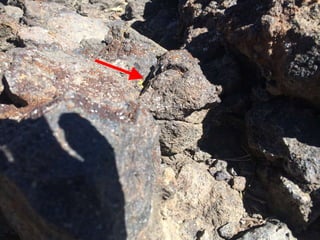
Scoria
This gray rock is an example of Scoria. Scoria forms
when gases are trapped in flowing magma (lava)
during a volcanic eruption. As the magma leaves the
volcano as lava and cools, the gases start to escape
as bubbles some becoming trapped and forming
holes, or vesicles, in the hardening rock. Another
name for this rock is vesicular basalt. One reason I
believe this is Scoria and not pumice is the presence
of basalt in the region, showing a basaltic eruption,
not a rhyolitic eruption.
This is an igneous rock.
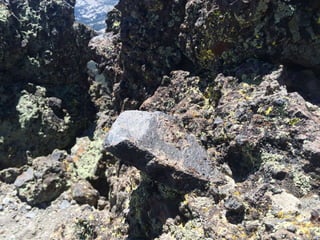
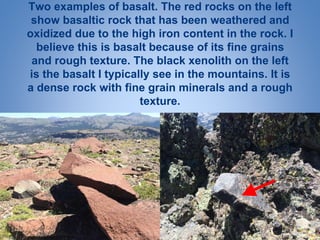
Two examples of basalt. The red rocks on the left
show basaltic rock that has been weathered and
oxidized due to the high iron content in the rock. I
believe this is basalt because of its fine grains
and rough texture. The black xenolith on the left
is the basalt I typically see in the mountains. It is
a dense rock with fine grain minerals and a rough
texture.
Basalt
• Basalt is a fine grained, dark igneous rock formed from
quickly cooling lava flows.
• It contains primarily plagioclase and pyroxene minerals.
• The red rock had me puzzled. In researching, I found
andesite to also be a possibility for this rock, which is still a
basaltic rock, but a rock somewhat between basalt and
granite. (William Rowe, Paul Carpenter)(King,2015)
• This is an igneous rock.
Part 3
Relative Dating
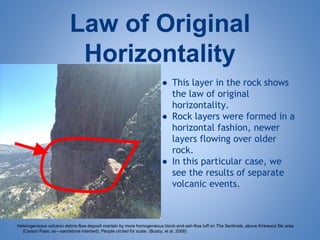
Law of Original
Horizontality
● This layer in the rock shows
the law of original
horizontality.
● Rock layers were formed in a
horizontal fashion, newer
layers flowing over older
rock.
● In this particular case, we
see the results of separate
volcanic events.
Heterogeneous volcanic debris-flow deposit overlain by more homogeneous block-and-ash-flow tuff on The Sentinels, above Kirkwood Ski area
(Carson Pass; ss—sandstone interbed). People circled for scale. (Busby, et al. 2008)
Principle of Inclusions
I also found this example of
an inclusion.
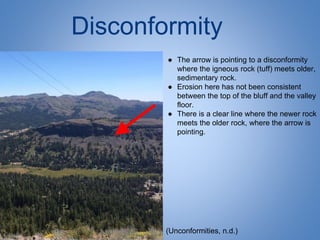
Disconformity
● The arrow is pointing to a disconformity
where the igneous rock (tuff) meets older,
sedimentary rock.
● Erosion here has not been consistent
between the top of the bluff and the valley
floor.
● There is a clear line where the newer rock
meets the older rock, where the arrow is
pointing.
(Unconformities, n.d.)
References
• Basalt. (n.d.). Retrieved July 31, 2015, from http://geology.com/rocks/basalt.shtml
• Betancourt, J.L. 1987. Paleoecology of pinyon-juniper woodlands: U.S. Department of Agriculture, Forest Service,
Intermountain Research Station.
• Busby, C., Hagan, J., Piturka, K., Pluhar, C., Gans, P., Wagner, D., . . . Skilling, I. (2008). Retrieved July 31, 2015.
• Carpenter, Paul. via Gmail
• Evans, A. (2007). National Wildlife Federation field guide to insects and spiders & related species of North America. New
York: Sterling Pub.
• Imai, T., Skilling, I., & Busby, C. (n.d.). Peperite-Fed Andesitic Debris Flows in the Miocene Mehrten Formation, Kirkwood,.
Retrieved July 31, 2015.
• Kershner, B. (2008). National Wildlife Federation field guide to trees of North America. New York: Sterling Pub.
• King, H. (n.d.). Andesite. Retrieved July 31, 2015.
• Klots, A., & Klots, E. (1971). Insects of North America. New York: Doubleday.
• Little, E. (1979). The Audobon Society field guide to North American trees, western region. New York: Knopf.
• Marshall, S. (2008). 500 insects: A visual reference. Richmond Hill, Ont.: Firefly Books.
• Milne, L., & Milne, M. (1995). National Audubon Society field guide to North American insects and spiders (A Chanticleer
Press ed.). New York: Knopf.
• (n.d.). Retrieved August 1, 2015, from http://www.tusd.org/Portals/5/Teachers/.../Chapter 6 Section 4.do
• (n.d.). Retrieved August 1, 2015, from https://entomologytoday.files.wordpress.com/2015/04/orthoptera-hojun-large-wp.jpg
• Petrides, G., & Petrides, O. (1992). Western trees: Western United States and Canada. Boston: Houghton Mifflin.
• Rowe, William. via Gmail
• Scoria. (n.d.). Retrieved July 31, 2015, from http://geology.com/rocks/scoria.shtml
• Unconformities. (n.d.). Retrieved August 1, 2015, from
http://www.indiana.edu/~geol105b/images/gaia_chapter_6/unconformities.htm
• United States. National Park Service. (2015, July 31). Ponderosa Pine. Retrieved July 31, 2015.

Field Assignment Geology 103

  • 1.
    Thunder Mountain Kirkwood, CA MarySimpson Geology 103 Professor Lawler
  • 2.
    Thunder Mountain Kirkwood, CA ThunderMountain is located off Highway 88 between Silver Lake and Kirkwood. The hike used for this field study begins at 7,600 feet and ends at 9,400 feet. The geographic coordinates for this location are 38.677642, -120.091370 Thunder Mountain is part of the Mehrten Formation
  • 3.
    ● 225 millionyears ago, Farallon plate subducted beneath the Pacific plate ● Heat caused underlying crust to melt, forming magma, and then forming a series of granitic plutons which are the Sierra Nevada batholith ● A chain of volcanoes formed above the magma, erupting and leaving ash, mud flows, and basaltic rock behind. ● The entire region underwent uplifting and tilting ● The granite batholith is now exposed around the Silver Lake area, just below Thunder Mountain ● Thunder Mountain is primarily made up of mud and ash flow remnants (TUSD.org, n.d.) A Short Geological History
  • 4.
  • 5.
    31 2 This view islooking south into the Silver Lake basin.
  • 6.
    The Mountain • Agranitic batholith sits beneath the mountain, formed during the Triassic Period • Uplift, tilting, and volcanic action followed, building the mountain to its current height of 9,400 feet • Deposits of volcanic tuff and ash flow are most likely from the late Miocene (Busby, et. al. 2008)(1) • The U-shaped valley is indicative of glaciation and erosion which took place during the Pleistocene(2) • The massive pile of dirt is also indicative of on-going erosive forces of snow, wind, and rain as it breaks down the mountain and flows into the valley(3)
  • 7.
    These grasshoppers are verywell hidden by their coloring. Grasshoppers
  • 8.
    Grasshopper • Order Orthopera,Suborder Caeliferam Genus Xanthippus • They are widely diverse • Stridulation causes a clicking or singing noise, used for mating and warning • They eat plant and animal material • Their camouflage is an adaptation to hide from predators - there are many varieties with differing camouflage for different habitats • It is thought that they remain in egg formation during the harsh winters and appear in June after the snow melts - this makes them well-adapted to the harsh conditions in the high Sierra
  • 9.
    Evolutionary tree forthe order Orthoptera, suborder Caelifera (n.d.). Retrieved August 1, 2015, from https://entomologytoday.files.wordpress.com/2015/04/orthoptera- hojun-large-wp.jpg
  • 10.
  • 11.
    • Species: PinusPonderosa • Thick bark protects against fire • Fires destroy undergrowth allowing the pines to flourish and survive • Commonly used species for tree-ring dating • Large trees can live more than 500 years • Exact origin is unknown • Oldest fossil is 600,000 years old, found in West Central Nevada (Bettancourt, 1990) • Thrives in basaltic soil • Evidence of genetic diversity indicates this survived the glaciation of the Pleistocene Epoch (Meisenbach, 2003)
  • 12.
  • 14.
    Breccia This is anexample of breccia. At first I thought this was conglomerate, but the clasts are angular in nature, indicating they were carried a short distance with minimal erosion. Conglomerate has rounded clasts. Breccia is plentiful in the Thunder Mountain area. During the Nevadan Orogeny, mud and ash flowed down the mountain collecting country rock as it did, then hardening into the breccia we see today. This occurred during the late Jurassic period. This is a clastic sedimentary rock.
  • 16.
    Scoria This gray rockis an example of Scoria. Scoria forms when gases are trapped in flowing magma (lava) during a volcanic eruption. As the magma leaves the volcano as lava and cools, the gases start to escape as bubbles some becoming trapped and forming holes, or vesicles, in the hardening rock. Another name for this rock is vesicular basalt. One reason I believe this is Scoria and not pumice is the presence of basalt in the region, showing a basaltic eruption, not a rhyolitic eruption. This is an igneous rock.
  • 17.
    Two examples ofbasalt. The red rocks on the left show basaltic rock that has been weathered and oxidized due to the high iron content in the rock. I believe this is basalt because of its fine grains and rough texture. The black xenolith on the left is the basalt I typically see in the mountains. It is a dense rock with fine grain minerals and a rough texture.
  • 18.
    Basalt • Basalt isa fine grained, dark igneous rock formed from quickly cooling lava flows. • It contains primarily plagioclase and pyroxene minerals. • The red rock had me puzzled. In researching, I found andesite to also be a possibility for this rock, which is still a basaltic rock, but a rock somewhat between basalt and granite. (William Rowe, Paul Carpenter)(King,2015) • This is an igneous rock.
  • 19.
  • 20.
    Law of Original Horizontality ●This layer in the rock shows the law of original horizontality. ● Rock layers were formed in a horizontal fashion, newer layers flowing over older rock. ● In this particular case, we see the results of separate volcanic events. Heterogeneous volcanic debris-flow deposit overlain by more homogeneous block-and-ash-flow tuff on The Sentinels, above Kirkwood Ski area (Carson Pass; ss—sandstone interbed). People circled for scale. (Busby, et al. 2008)
  • 21.
    Principle of Inclusions Ialso found this example of an inclusion.
  • 22.
    Disconformity ● The arrowis pointing to a disconformity where the igneous rock (tuff) meets older, sedimentary rock. ● Erosion here has not been consistent between the top of the bluff and the valley floor. ● There is a clear line where the newer rock meets the older rock, where the arrow is pointing. (Unconformities, n.d.)
  • 23.
    References • Basalt. (n.d.).Retrieved July 31, 2015, from http://geology.com/rocks/basalt.shtml • Betancourt, J.L. 1987. Paleoecology of pinyon-juniper woodlands: U.S. Department of Agriculture, Forest Service, Intermountain Research Station. • Busby, C., Hagan, J., Piturka, K., Pluhar, C., Gans, P., Wagner, D., . . . Skilling, I. (2008). Retrieved July 31, 2015. • Carpenter, Paul. via Gmail • Evans, A. (2007). National Wildlife Federation field guide to insects and spiders & related species of North America. New York: Sterling Pub. • Imai, T., Skilling, I., & Busby, C. (n.d.). Peperite-Fed Andesitic Debris Flows in the Miocene Mehrten Formation, Kirkwood,. Retrieved July 31, 2015. • Kershner, B. (2008). National Wildlife Federation field guide to trees of North America. New York: Sterling Pub. • King, H. (n.d.). Andesite. Retrieved July 31, 2015. • Klots, A., & Klots, E. (1971). Insects of North America. New York: Doubleday. • Little, E. (1979). The Audobon Society field guide to North American trees, western region. New York: Knopf. • Marshall, S. (2008). 500 insects: A visual reference. Richmond Hill, Ont.: Firefly Books. • Milne, L., & Milne, M. (1995). National Audubon Society field guide to North American insects and spiders (A Chanticleer Press ed.). New York: Knopf. • (n.d.). Retrieved August 1, 2015, from http://www.tusd.org/Portals/5/Teachers/.../Chapter 6 Section 4.do • (n.d.). Retrieved August 1, 2015, from https://entomologytoday.files.wordpress.com/2015/04/orthoptera-hojun-large-wp.jpg • Petrides, G., & Petrides, O. (1992). Western trees: Western United States and Canada. Boston: Houghton Mifflin. • Rowe, William. via Gmail • Scoria. (n.d.). Retrieved July 31, 2015, from http://geology.com/rocks/scoria.shtml • Unconformities. (n.d.). Retrieved August 1, 2015, from http://www.indiana.edu/~geol105b/images/gaia_chapter_6/unconformities.htm • United States. National Park Service. (2015, July 31). Ponderosa Pine. Retrieved July 31, 2015.