Getting started with LaTeX and BibTeX 
Installing, compiling and generating a document 
Paolo Pareti 
https://w3id.org/people/paolo
1. Installation 
2. First Document 
3. Compiling the documents 
4. Basic commands 
5. Structure of the BibTeX file 
6. Summary
1. Installation 
The standard LaTeX installation will require to install: 
1. TeX distribution 
2. LaTeX editor * 
* Follow the installation instructions of your LaTeX editor, in 
some cases you will have to configure it to use the TeX 
distribution you have installed
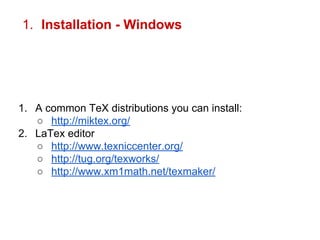
1. Installation - Windows 
1. A common TeX distributions you can install: 
○ http://miktex.org/ 
2. LaTex editor 
○ http://www.texniccenter.org/ 
○ http://tug.org/texworks/ 
○ http://www.xm1math.net/texmaker/
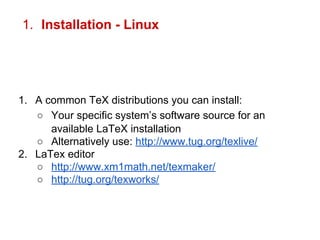
1. Installation - Linux 
1. A common TeX distributions you can install: 
○ Your specific system’s software source for an 
available LaTeX installation 
○ Alternatively use: http://www.tug.org/texlive/ 
2. LaTex editor 
○ http://www.xm1math.net/texmaker/ 
○ http://tug.org/texworks/
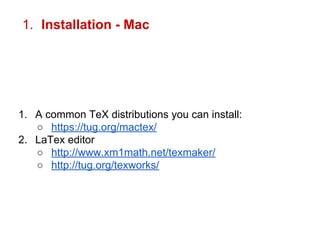
1. Installation - Mac 
1. A common TeX distributions you can install: 
○ https://tug.org/mactex/ 
2. LaTex editor 
○ http://www.xm1math.net/texmaker/ 
○ http://tug.org/texworks/
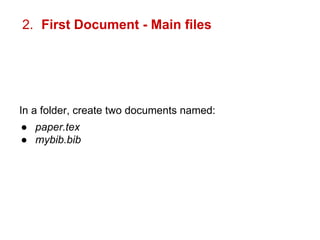
2. First Document - Main files 
In a folder, create two documents named: 
● paper.tex 
● mybib.bib
2. First Document - Document file 
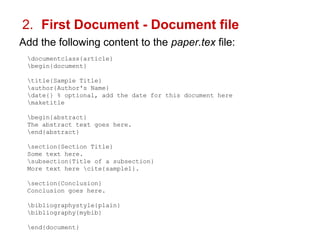
Add the following content to the paper.tex file: 
documentclass{article} 
begin{document} 
title{Sample Title} 
author{Author's Name} 
date{} % optional, add the date for this document here 
maketitle 
begin{abstract} 
The abstract text goes here. 
end{abstract} 
section{Section Title} 
Some text here. 
subsection{Title of a subsection} 
More text here cite{sample1}. 
section{Conclusion} 
Conclusion goes here. 
bibliographystyle{plain} 
bibliography{mybib} 
end{document}
2. First Document - Bibliography file 
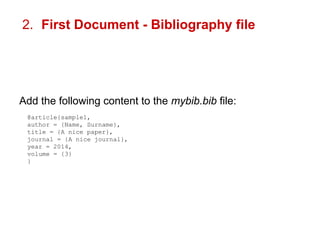
Add the following content to the mybib.bib file: 
@article{sample1, 
author = {Name, Surname}, 
title = {A nice paper}, 
journal = {A nice journal}, 
year = 2014, 
volume = {3} 
}
3. Compiling the documents 
1. Open the file paper.tex with your LaTeX editor 
2. Use the editor build commands to generate the PDF 
○ build once 
○ then build the BibTeX index 
○ build a second time 
○ build a third time 
3. Alternatively you can directly use the following commands: 
○ pdflatex paper.tex 
○ bibtex paper 
○ pdflatex paper.tex 
* It is necessary to build documents this way to make sure 
that the bibliography and the paper are properly 
synchronized. If this is not done properly, you will end up with 
undefined citations [?]
3. Compiling the documents - the output 
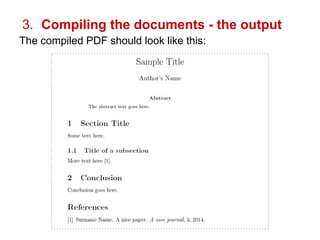
The compiled PDF should look like this:
4. Basic commands - document structure 
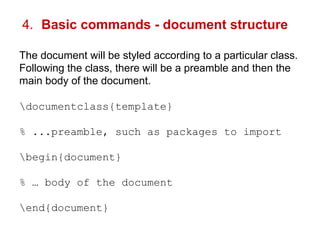
The document will be styled according to a particular class. 
Following the class, there will be a preamble and then the 
main body of the document. 
documentclass{template} 
% ...preamble, such as packages to import 
begin{document} 
% … body of the document 
end{document}
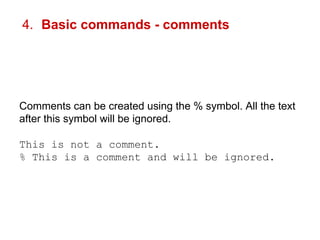
4. Basic commands - comments 
Comments can be created using the % symbol. All the text 
after this symbol will be ignored. 
This is not a comment. 
% This is a comment and will be ignored.
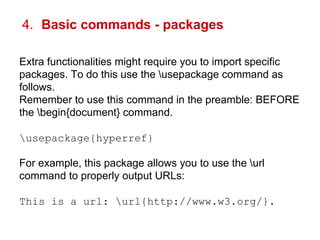
4. Basic commands - packages 
Extra functionalities might require you to import specific 
packages. To do this use the usepackage command as 
follows. 
Remember to use this command in the preamble: BEFORE 
the begin{document} command. 
usepackage{hyperref} 
For example, this package allows you to use the url 
command to properly output URLs: 
This is a url: url{http://www.w3.org/}.
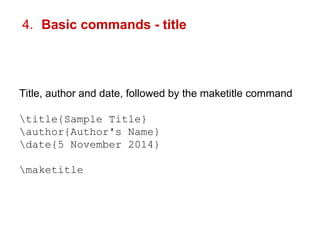
4. Basic commands - title 
Title, author and date, followed by the maketitle command 
title{Sample Title} 
author{Author's Name} 
date{5 November 2014} 
maketitle
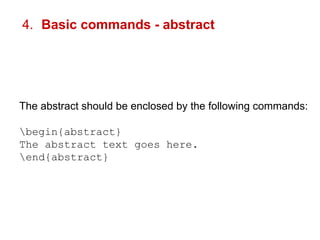
4. Basic commands - abstract 
The abstract should be enclosed by the following commands: 
begin{abstract} 
The abstract text goes here. 
end{abstract}
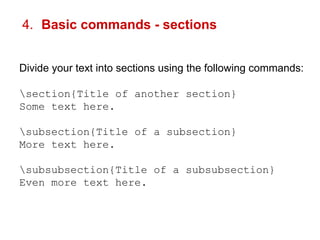
4. Basic commands - sections 
Divide your text into sections using the following commands: 
section{Title of another section} 
Some text here. 
subsection{Title of a subsection} 
More text here. 
subsubsection{Title of a subsubsection} 
Even more text here.
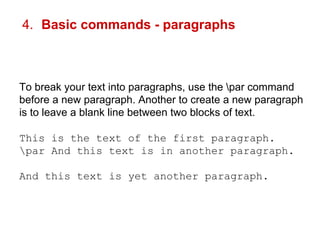
4. Basic commands - paragraphs 
To break your text into paragraphs, use the par command 
before a new paragraph. Another to create a new paragraph 
is to leave a blank line between two blocks of text. 
This is the text of the first paragraph. 
par And this text is in another paragraph. 
And this text is yet another paragraph.
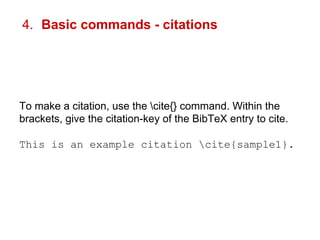
4. Basic commands - citations 
To make a citation, use the cite{} command. Within the 
brackets, give the citation-key of the BibTeX entry to cite. 
This is an example citation cite{sample1}.
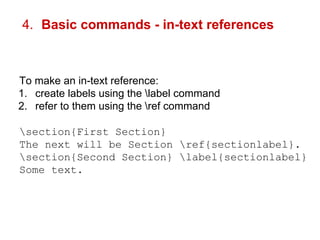
4. Basic commands - in-text references 
To make an in-text reference: 
1. create labels using the label command 
2. refer to them using the ref command 
section{First Section} 
The next will be Section ref{sectionlabel}. 
section{Second Section} label{sectionlabel} 
Some text.
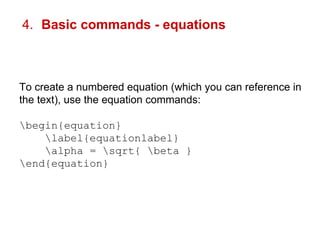
4. Basic commands - equations 
To create a numbered equation (which you can reference in 
the text), use the equation commands: 
begin{equation} 
label{equationlabel} 
alpha = sqrt{ beta } 
end{equation}
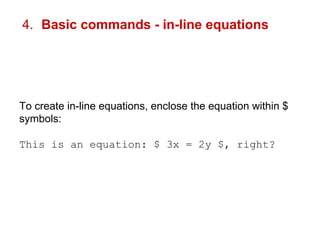
4. Basic commands - in-line equations 
To create in-line equations, enclose the equation within $ 
symbols: 
This is an equation: $ 3x = 2y $, right?
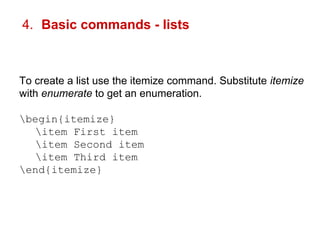
4. Basic commands - lists 
To create a list use the itemize command. Substitute itemize 
with enumerate to get an enumeration. 
begin{itemize} 
item First item 
item Second item 
item Third item 
end{itemize}
4. Basic commands - tables 
Separate lines using the newline command  
Create horizontal lines using hline before the row to overline. 
Create vertical lines using the | symbol before the column 
definition (in this case the letter ‘l’ stands for ‘left aligned’) 
begin{table}[tp] centering 
begin{tabular}{ | l | l l } 
hline 
A & B & C  hline 
a & b & c  
end{tabular} 
caption{Table caption here} 
label{sampletable} 
end{table}
4. Basic commands - figures 
Figures (in this case Image.jpg) can be added using the 
following command. Images are one of many LaTeX objects 
which can have labels. 
begin{figure}[tb] centering 
includegraphics[width=1.00textwidth]{Image.jpg} 
label{figurelabel} 
caption{This is a figure} 
end{figure}
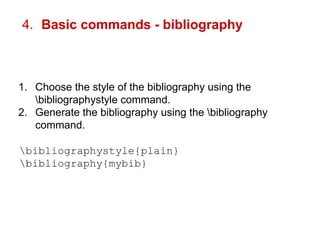
4. Basic commands - bibliography 
1. Choose the style of the bibliography using the 
bibliographystyle command. 
2. Generate the bibliography using the bibliography 
command. 
bibliographystyle{plain} 
bibliography{mybib}
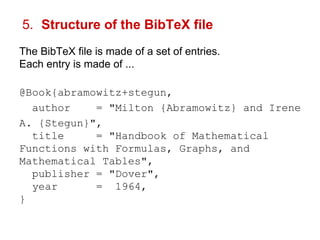
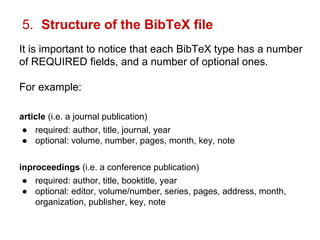
5. Structure of the BibTeX file 
The BibTeX file is made of a set of entries. 
Each entry is made of ... 
@Book{abramowitz+stegun, 
author = "Milton {Abramowitz} and Irene 
A. {Stegun}", 
title = "Handbook of Mathematical 
Functions with Formulas, Graphs, and 
Mathematical Tables", 
publisher = "Dover", 
year = 1964, 
}
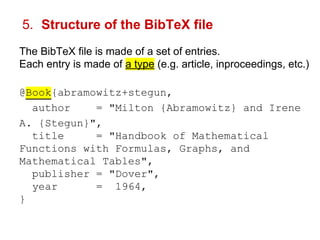
5. Structure of the BibTeX file 
The BibTeX file is made of a set of entries. 
Each entry is made of a type (e.g. article, inproceedings, etc.) 
@Book{abramowitz+stegun, 
author = "Milton {Abramowitz} and Irene 
A. {Stegun}", 
title = "Handbook of Mathematical 
Functions with Formulas, Graphs, and 
Mathematical Tables", 
publisher = "Dover", 
year = 1964, 
}
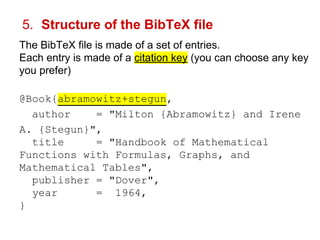
5. Structure of the BibTeX file 
The BibTeX file is made of a set of entries. 
Each entry is made of a citation key (you can choose any key 
you prefer) 
@Book{abramowitz+stegun, 
author = "Milton {Abramowitz} and Irene 
A. {Stegun}", 
title = "Handbook of Mathematical 
Functions with Formulas, Graphs, and 
Mathematical Tables", 
publisher = "Dover", 
year = 1964, 
}
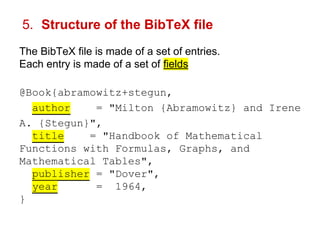
5. Structure of the BibTeX file 
The BibTeX file is made of a set of entries. 
Each entry is made of a set of fields 
@Book{abramowitz+stegun, 
author = "Milton {Abramowitz} and Irene 
A. {Stegun}", 
title = "Handbook of Mathematical 
Functions with Formulas, Graphs, and 
Mathematical Tables", 
publisher = "Dover", 
year = 1964, 
}
5. Structure of the BibTeX file 
It is important to notice that each BibTeX type has a number 
of REQUIRED fields, and a number of optional ones. 
For example: 
article (i.e. a journal publication) 
● required: author, title, journal, year 
● optional: volume, number, pages, month, key, note 
inproceedings (i.e. a conference publication) 
● required: author, title, booktitle, year 
● optional: editor, volume/number, series, pages, address, month, 
organization, publisher, key, note
6. Summary 
This short tutorial should have helped you getting started with 
LaTeX and BibTeX. 
For any problems you might encounter, and to use more 
advanced features, look at the vast amount of online 
resources, such as: 
http://en.wikibooks.org/wiki/LaTeX

How to Start Using LaTeX and BibTeX

  • 1.
    Getting started withLaTeX and BibTeX Installing, compiling and generating a document Paolo Pareti https://w3id.org/people/paolo
  • 2.
    1. Installation 2.First Document 3. Compiling the documents 4. Basic commands 5. Structure of the BibTeX file 6. Summary
  • 3.
    1. Installation Thestandard LaTeX installation will require to install: 1. TeX distribution 2. LaTeX editor * * Follow the installation instructions of your LaTeX editor, in some cases you will have to configure it to use the TeX distribution you have installed
  • 4.
    1. Installation -Windows 1. A common TeX distributions you can install: ○ http://miktex.org/ 2. LaTex editor ○ http://www.texniccenter.org/ ○ http://tug.org/texworks/ ○ http://www.xm1math.net/texmaker/
  • 5.
    1. Installation -Linux 1. A common TeX distributions you can install: ○ Your specific system’s software source for an available LaTeX installation ○ Alternatively use: http://www.tug.org/texlive/ 2. LaTex editor ○ http://www.xm1math.net/texmaker/ ○ http://tug.org/texworks/
  • 6.
    1. Installation -Mac 1. A common TeX distributions you can install: ○ https://tug.org/mactex/ 2. LaTex editor ○ http://www.xm1math.net/texmaker/ ○ http://tug.org/texworks/
  • 7.
    2. First Document- Main files In a folder, create two documents named: ● paper.tex ● mybib.bib
  • 8.
    2. First Document- Document file Add the following content to the paper.tex file: documentclass{article} begin{document} title{Sample Title} author{Author's Name} date{} % optional, add the date for this document here maketitle begin{abstract} The abstract text goes here. end{abstract} section{Section Title} Some text here. subsection{Title of a subsection} More text here cite{sample1}. section{Conclusion} Conclusion goes here. bibliographystyle{plain} bibliography{mybib} end{document}
  • 9.
    2. First Document- Bibliography file Add the following content to the mybib.bib file: @article{sample1, author = {Name, Surname}, title = {A nice paper}, journal = {A nice journal}, year = 2014, volume = {3} }
  • 10.
    3. Compiling thedocuments 1. Open the file paper.tex with your LaTeX editor 2. Use the editor build commands to generate the PDF ○ build once ○ then build the BibTeX index ○ build a second time ○ build a third time 3. Alternatively you can directly use the following commands: ○ pdflatex paper.tex ○ bibtex paper ○ pdflatex paper.tex ○ pdflatex paper.tex * It is necessary to build documents this way to make sure that the bibliography and the paper are properly synchronized. If this is not done properly, you will end up with undefined citations [?]
  • 11.
    3. Compiling thedocuments - the output The compiled PDF should look like this:
  • 12.
    4. Basic commands- document structure The document will be styled according to a particular class. Following the class, there will be a preamble and then the main body of the document. documentclass{template} % ...preamble, such as packages to import begin{document} % … body of the document end{document}
  • 13.
    4. Basic commands- comments Comments can be created using the % symbol. All the text after this symbol will be ignored. This is not a comment. % This is a comment and will be ignored.
  • 14.
    4. Basic commands- packages Extra functionalities might require you to import specific packages. To do this use the usepackage command as follows. Remember to use this command in the preamble: BEFORE the begin{document} command. usepackage{hyperref} For example, this package allows you to use the url command to properly output URLs: This is a url: url{http://www.w3.org/}.
  • 15.
    4. Basic commands- title Title, author and date, followed by the maketitle command title{Sample Title} author{Author's Name} date{5 November 2014} maketitle
  • 16.
    4. Basic commands- abstract The abstract should be enclosed by the following commands: begin{abstract} The abstract text goes here. end{abstract}
  • 17.
    4. Basic commands- sections Divide your text into sections using the following commands: section{Title of another section} Some text here. subsection{Title of a subsection} More text here. subsubsection{Title of a subsubsection} Even more text here.
  • 18.
    4. Basic commands- paragraphs To break your text into paragraphs, use the par command before a new paragraph. Another to create a new paragraph is to leave a blank line between two blocks of text. This is the text of the first paragraph. par And this text is in another paragraph. And this text is yet another paragraph.
  • 19.
    4. Basic commands- citations To make a citation, use the cite{} command. Within the brackets, give the citation-key of the BibTeX entry to cite. This is an example citation cite{sample1}.
  • 20.
    4. Basic commands- in-text references To make an in-text reference: 1. create labels using the label command 2. refer to them using the ref command section{First Section} The next will be Section ref{sectionlabel}. section{Second Section} label{sectionlabel} Some text.
  • 21.
    4. Basic commands- equations To create a numbered equation (which you can reference in the text), use the equation commands: begin{equation} label{equationlabel} alpha = sqrt{ beta } end{equation}
  • 22.
    4. Basic commands- in-line equations To create in-line equations, enclose the equation within $ symbols: This is an equation: $ 3x = 2y $, right?
  • 23.
    4. Basic commands- lists To create a list use the itemize command. Substitute itemize with enumerate to get an enumeration. begin{itemize} item First item item Second item item Third item end{itemize}
  • 24.
    4. Basic commands- tables Separate lines using the newline command Create horizontal lines using hline before the row to overline. Create vertical lines using the | symbol before the column definition (in this case the letter ‘l’ stands for ‘left aligned’) begin{table}[tp] centering begin{tabular}{ | l | l l } hline A & B & C hline a & b & c end{tabular} caption{Table caption here} label{sampletable} end{table}
  • 25.
    4. Basic commands- figures Figures (in this case Image.jpg) can be added using the following command. Images are one of many LaTeX objects which can have labels. begin{figure}[tb] centering includegraphics[width=1.00textwidth]{Image.jpg} label{figurelabel} caption{This is a figure} end{figure}
  • 26.
    4. Basic commands- bibliography 1. Choose the style of the bibliography using the bibliographystyle command. 2. Generate the bibliography using the bibliography command. bibliographystyle{plain} bibliography{mybib}
  • 27.
    5. Structure ofthe BibTeX file The BibTeX file is made of a set of entries. Each entry is made of ... @Book{abramowitz+stegun, author = "Milton {Abramowitz} and Irene A. {Stegun}", title = "Handbook of Mathematical Functions with Formulas, Graphs, and Mathematical Tables", publisher = "Dover", year = 1964, }
  • 28.
    5. Structure ofthe BibTeX file The BibTeX file is made of a set of entries. Each entry is made of a type (e.g. article, inproceedings, etc.) @Book{abramowitz+stegun, author = "Milton {Abramowitz} and Irene A. {Stegun}", title = "Handbook of Mathematical Functions with Formulas, Graphs, and Mathematical Tables", publisher = "Dover", year = 1964, }
  • 29.
    5. Structure ofthe BibTeX file The BibTeX file is made of a set of entries. Each entry is made of a citation key (you can choose any key you prefer) @Book{abramowitz+stegun, author = "Milton {Abramowitz} and Irene A. {Stegun}", title = "Handbook of Mathematical Functions with Formulas, Graphs, and Mathematical Tables", publisher = "Dover", year = 1964, }
  • 30.
    5. Structure ofthe BibTeX file The BibTeX file is made of a set of entries. Each entry is made of a set of fields @Book{abramowitz+stegun, author = "Milton {Abramowitz} and Irene A. {Stegun}", title = "Handbook of Mathematical Functions with Formulas, Graphs, and Mathematical Tables", publisher = "Dover", year = 1964, }
  • 31.
    5. Structure ofthe BibTeX file It is important to notice that each BibTeX type has a number of REQUIRED fields, and a number of optional ones. For example: article (i.e. a journal publication) ● required: author, title, journal, year ● optional: volume, number, pages, month, key, note inproceedings (i.e. a conference publication) ● required: author, title, booktitle, year ● optional: editor, volume/number, series, pages, address, month, organization, publisher, key, note
  • 32.
    6. Summary Thisshort tutorial should have helped you getting started with LaTeX and BibTeX. For any problems you might encounter, and to use more advanced features, look at the vast amount of online resources, such as: http://en.wikibooks.org/wiki/LaTeX