Hydrology
CEN 363
Credit : 3.00
Md. Mehedi Hassan Masum
Lecturer
Department of Civil Engineering
Port City International University
Infiltration rate
Calculation
Department of CEN, PCIU
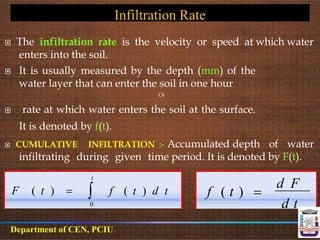
 The infiltration rate is the velocity or speed at which water
enters into the soil.
 It is usually measured by the depth (mm) of the
water layer that can enter the soil in one hour
Or
 rate at which water enters the soil at the surface.
It is denoted by f(t).
 CUMULATIVE INFILTRATION :- Accumulated depth of water
infiltrating during given time period. It is denoted by F(t).
t

0
F ( t )  f ( t ) d t
d t
d F
f ( t ) 
Infiltration Rate
Department of CEN, PCIU
 INFILTRATION CAPACITY RATE CURVE
as obtained from infiltrometer is essentially
observed to be decaying curve (max to min)
 Some mathematical expressions to describe the
shape of curve, given by various investigators
are :-
a) Horton’s equation
Phillips equation
kostiakov equation
holtans equation
b)
c)
d)
Infiltration Equations
Department of CEN, PCIU
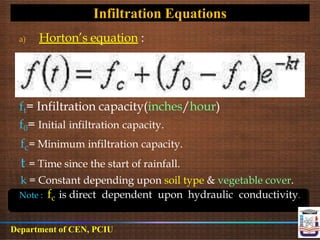
a) Horton’s equation :
ft= Infiltration capacity(inches/hour)
f0= Initial infiltration capacity.
fc= Minimum infiltration capacity.
t = Time since the start of rainfall.
k = Constant depending upon soil type & vegetable cover.
Note : fc is direct dependent upon hydraulic conductivity.
Infiltration Equations
Department of CEN, PCIU
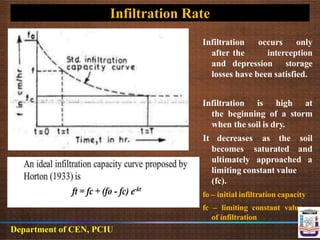
Infiltration occurs only
after the interception
and depression storage
losses have been satisfied.
Infiltration is high at
the beginning of a storm
when the soil is dry.
It decreases as the soil
andbecomes saturated
ultimately approached a
limiting constant value
(fc).
fo – initial infiltration capacity
fc – limiting constant value
of infiltration
Infiltration Rate
Department of CEN, PCIU
b) Phillips equation :
Here a = Minimum infiltration capacity.
s = Initial infiltration capacity.
c) kostiakov equation:
c) holtans equation :
 Here in above methods a & n are constants
depends on soil moisture & vegetable cover
F=[ A+(s/2) x t-0.5 ]
F= (a x t n)
F = ( afn
p + fc )
Infiltration Equations
Department of CEN, PCIU
 For consistency in hydrological calculations, a
constant value of infiltration rate for the entire
storm duration is adopted. The average
infiltration rate is called the INFILTRATION INDEX.
 The two commonly used infiltration indices are
the following:
o φ – index
o W – index
There are extremely used for the analysis of major
floods when the soil is wet and the infiltration
rate becomes constant.
Infiltration Indices
Department of CEN, PCIU
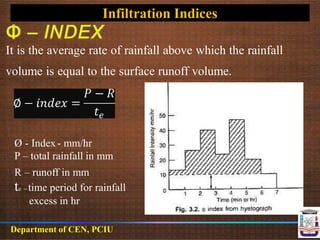
It is the average rate of rainfall above which the rainfall
volume is equal to the surface runoff volume.
Ø - Index- mm/hr
P – total rainfall in mm
R – runoff in mm
te = time period for rainfall
excess in hr
Infiltration Indices
Department of CEN, PCIU
 Φ – INDEX for a catchment, during a storm depends on
 Soil type
 vegetation cover
 Initial moisture condition
 Application – Estimation of flood magnitudes
due to critical storms.
Infiltration Indices
Department of CEN, PCIU
Application of Ø - Index
It can be used to estimate surface runoff from a given
hyetograph.
It is specially useful for predicting the infiltration from a storm
occurring over a very large basin.
It is also useful for the unit hydrograph analysis to
determine the pattern of rainfall excess.
Infiltration Indices
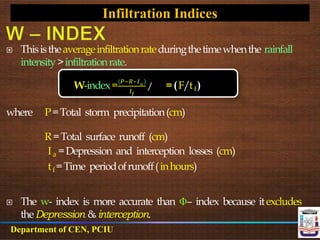
 Thisistheaverageinfiltrationrateduringthetimewhenthe rainfall
intensity>infiltrationrate.
W-index=(𝑃–𝑅–𝐼 𝑎)
𝑡𝒇
/ =(F/tf)
where P=Total storm precipitation(cm)
R=Total surface runoff (cm)
Ia =Depression and interception losses (cm)
tf=Time periodofrunoff(inhours)
 The w- index is more accurate than Φ– index because itexcludes
theDepression & interception.
Infiltration Indices
Department of CEN, PCIU
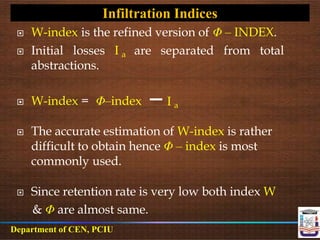
 W-index is the refined version of Φ – INDEX.
 Initial losses
abstractions.
I a are separated from total
 W-index = Φ–index I a
 The accurate estimation of W-index is rather
difficult to obtain hence Φ – index is most
commonly used.
 Since retention rate is very low both index W
& Φ are almost same.
Infiltration Indices
Department of CEN, PCIU
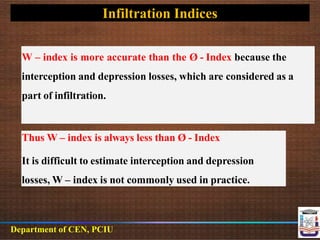
W – index is more accurate than the Ø - Index because the
interception and depression losses, which are considered as a
part of infiltration.
Thus W – index is always less than Ø - Index
It is difficult to estimate interception and depression
losses, W – index is not commonly used in practice.
Infiltration Indices
Department of CEN, PCIU
Infiltration Indices
Department of CEN, PCIU
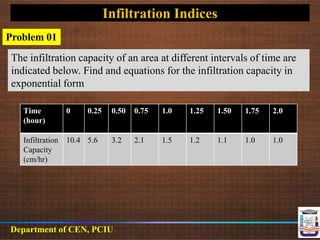
Problem 01
The infiltration capacity of an area at different intervals of time are
indicated below. Find and equations for the infiltration capacity in
exponential form
Time
(hour)
0 0.25 0.50 0.75 1.0 1.25 1.50 1.75 2.0
Infiltration
Capacity
(cm/hr)
10.4 5.6 3.2 2.1 1.5 1.2 1.1 1.0 1.0
Infiltration Indices
Department of CEN, PCIU
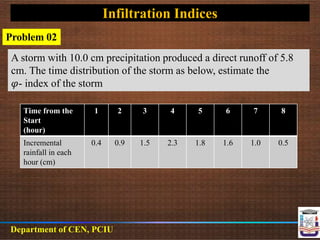
Problem 02
A storm with 10.0 cm precipitation produced a direct runoff of 5.8
cm. The time distribution of the storm as below, estimate the
𝜑- index of the storm
Time from the
Start
(hour)
1 2 3 4 5 6 7 8
Incremental
rainfall in each
hour (cm)
0.4 0.9 1.5 2.3 1.8 1.6 1.0 0.5
Infiltration Indices
Department of CEN, PCIU
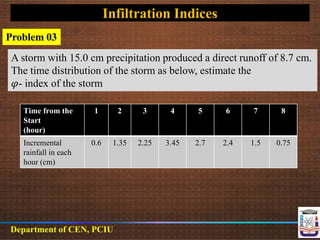
Problem 03
A storm with 15.0 cm precipitation produced a direct runoff of 8.7 cm.
The time distribution of the storm as below, estimate the
𝜑- index of the storm
Time from the
Start
(hour)
1 2 3 4 5 6 7 8
Incremental
rainfall in each
hour (cm)
0.6 1.35 2.25 3.45 2.7 2.4 1.5 0.75
Infiltration Indices
Department of CEN, PCIU
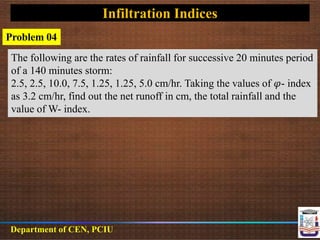
Problem 04
The following are the rates of rainfall for successive 20 minutes period
of a 140 minutes storm:
2.5, 2.5, 10.0, 7.5, 1.25, 1.25, 5.0 cm/hr. Taking the values of 𝜑- index
as 3.2 cm/hr, find out the net runoff in cm, the total rainfall and the
value of W- index.
Infiltration Indices
Department of CEN, PCIU
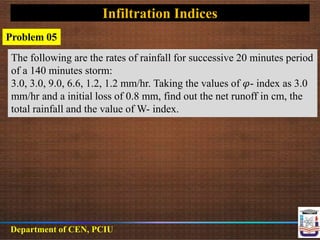
Problem 05
The following are the rates of rainfall for successive 20 minutes period
of a 140 minutes storm:
3.0, 3.0, 9.0, 6.6, 1.2, 1.2 mm/hr. Taking the values of 𝜑- index as 3.0
mm/hr and a initial loss of 0.8 mm, find out the net runoff in cm, the
total rainfall and the value of W- index.
Department of CEN, PCIU
researchgate.net/profile/Mehedi_Masum
For further query feel free to contact:
mehedi.ce.cuet@gmail.com
Department of CEN, PCIU

L6 infiltrationr rate calculation

  • 1.
    Hydrology CEN 363 Credit :3.00 Md. Mehedi Hassan Masum Lecturer Department of Civil Engineering Port City International University Infiltration rate Calculation Department of CEN, PCIU
  • 2.
     The infiltrationrate is the velocity or speed at which water enters into the soil.  It is usually measured by the depth (mm) of the water layer that can enter the soil in one hour Or  rate at which water enters the soil at the surface. It is denoted by f(t).  CUMULATIVE INFILTRATION :- Accumulated depth of water infiltrating during given time period. It is denoted by F(t). t  0 F ( t )  f ( t ) d t d t d F f ( t )  Infiltration Rate Department of CEN, PCIU
  • 3.
     INFILTRATION CAPACITYRATE CURVE as obtained from infiltrometer is essentially observed to be decaying curve (max to min)  Some mathematical expressions to describe the shape of curve, given by various investigators are :- a) Horton’s equation Phillips equation kostiakov equation holtans equation b) c) d) Infiltration Equations Department of CEN, PCIU
  • 4.
    a) Horton’s equation: ft= Infiltration capacity(inches/hour) f0= Initial infiltration capacity. fc= Minimum infiltration capacity. t = Time since the start of rainfall. k = Constant depending upon soil type & vegetable cover. Note : fc is direct dependent upon hydraulic conductivity. Infiltration Equations Department of CEN, PCIU
  • 5.
    Infiltration occurs only afterthe interception and depression storage losses have been satisfied. Infiltration is high at the beginning of a storm when the soil is dry. It decreases as the soil andbecomes saturated ultimately approached a limiting constant value (fc). fo – initial infiltration capacity fc – limiting constant value of infiltration Infiltration Rate Department of CEN, PCIU
  • 6.
    b) Phillips equation: Here a = Minimum infiltration capacity. s = Initial infiltration capacity. c) kostiakov equation: c) holtans equation :  Here in above methods a & n are constants depends on soil moisture & vegetable cover F=[ A+(s/2) x t-0.5 ] F= (a x t n) F = ( afn p + fc ) Infiltration Equations Department of CEN, PCIU
  • 7.
     For consistencyin hydrological calculations, a constant value of infiltration rate for the entire storm duration is adopted. The average infiltration rate is called the INFILTRATION INDEX.  The two commonly used infiltration indices are the following: o φ – index o W – index There are extremely used for the analysis of major floods when the soil is wet and the infiltration rate becomes constant. Infiltration Indices Department of CEN, PCIU
  • 8.
    It is theaverage rate of rainfall above which the rainfall volume is equal to the surface runoff volume. Ø - Index- mm/hr P – total rainfall in mm R – runoff in mm te = time period for rainfall excess in hr Infiltration Indices Department of CEN, PCIU
  • 9.
     Φ –INDEX for a catchment, during a storm depends on  Soil type  vegetation cover  Initial moisture condition  Application – Estimation of flood magnitudes due to critical storms. Infiltration Indices Department of CEN, PCIU
  • 10.
    Application of Ø- Index It can be used to estimate surface runoff from a given hyetograph. It is specially useful for predicting the infiltration from a storm occurring over a very large basin. It is also useful for the unit hydrograph analysis to determine the pattern of rainfall excess. Infiltration Indices
  • 11.
     Thisistheaverageinfiltrationrateduringthetimewhenthe rainfall intensity>infiltrationrate. W-index=(𝑃–𝑅–𝐼𝑎) 𝑡𝒇 / =(F/tf) where P=Total storm precipitation(cm) R=Total surface runoff (cm) Ia =Depression and interception losses (cm) tf=Time periodofrunoff(inhours)  The w- index is more accurate than Φ– index because itexcludes theDepression & interception. Infiltration Indices Department of CEN, PCIU
  • 12.
     W-index isthe refined version of Φ – INDEX.  Initial losses abstractions. I a are separated from total  W-index = Φ–index I a  The accurate estimation of W-index is rather difficult to obtain hence Φ – index is most commonly used.  Since retention rate is very low both index W & Φ are almost same. Infiltration Indices Department of CEN, PCIU
  • 13.
    W – indexis more accurate than the Ø - Index because the interception and depression losses, which are considered as a part of infiltration. Thus W – index is always less than Ø - Index It is difficult to estimate interception and depression losses, W – index is not commonly used in practice. Infiltration Indices Department of CEN, PCIU
  • 14.
    Infiltration Indices Department ofCEN, PCIU Problem 01 The infiltration capacity of an area at different intervals of time are indicated below. Find and equations for the infiltration capacity in exponential form Time (hour) 0 0.25 0.50 0.75 1.0 1.25 1.50 1.75 2.0 Infiltration Capacity (cm/hr) 10.4 5.6 3.2 2.1 1.5 1.2 1.1 1.0 1.0
  • 15.
    Infiltration Indices Department ofCEN, PCIU Problem 02 A storm with 10.0 cm precipitation produced a direct runoff of 5.8 cm. The time distribution of the storm as below, estimate the 𝜑- index of the storm Time from the Start (hour) 1 2 3 4 5 6 7 8 Incremental rainfall in each hour (cm) 0.4 0.9 1.5 2.3 1.8 1.6 1.0 0.5
  • 16.
    Infiltration Indices Department ofCEN, PCIU Problem 03 A storm with 15.0 cm precipitation produced a direct runoff of 8.7 cm. The time distribution of the storm as below, estimate the 𝜑- index of the storm Time from the Start (hour) 1 2 3 4 5 6 7 8 Incremental rainfall in each hour (cm) 0.6 1.35 2.25 3.45 2.7 2.4 1.5 0.75
  • 17.
    Infiltration Indices Department ofCEN, PCIU Problem 04 The following are the rates of rainfall for successive 20 minutes period of a 140 minutes storm: 2.5, 2.5, 10.0, 7.5, 1.25, 1.25, 5.0 cm/hr. Taking the values of 𝜑- index as 3.2 cm/hr, find out the net runoff in cm, the total rainfall and the value of W- index.
  • 18.
    Infiltration Indices Department ofCEN, PCIU Problem 05 The following are the rates of rainfall for successive 20 minutes period of a 140 minutes storm: 3.0, 3.0, 9.0, 6.6, 1.2, 1.2 mm/hr. Taking the values of 𝜑- index as 3.0 mm/hr and a initial loss of 0.8 mm, find out the net runoff in cm, the total rainfall and the value of W- index.
  • 19.
    Department of CEN,PCIU researchgate.net/profile/Mehedi_Masum For further query feel free to contact: mehedi.ce.cuet@gmail.com
  • 20.