Presented by,
Amruta C. Patil
Computer Science Dept
CONTENTS
• Introduction
• What is Cyber Crime?
• Categories of Cyber Crime
• Types of Cyber Crime
• Precautions to prevent cyber crime/ Cyber Hygiene
• Cyber Security
• Steps for reporting of financial cyber frauds
• Conclusion
INTRODUCTION
 The virtual world has taken over the real one, E-business and E-
commerce, which are the new mantras and electronic transactions
dominate the overall business paradigm.
 In this rapidly evolving e-world that depends on free flowing
information, security is the major problem to be considered.
 The first recorded cyber crime took place in the year 1820.
CYBER CRIME
 "Offences that are committed against individuals or groups of
individuals with a criminal motive to intentionally harm the
reputation of the victim or cause physical or mental harm, or loss, to
the victim directly or indirectly, using modern telecommunication
networks such as Internet (networks including chatrooms, emails,
noticeboards and groups) and mobile phones (SMS/MMS)“
 Cybercrimes can be committed single handedly and does not require
any physical presence of the criminals.
 The same systems that have made it easier for people to conduct e-
commerce & online transactions are now being exploited by cyber
criminals.
CATEGORIES CYBER CRIMES
 Cyber crimes can be basically divided into 3 major categories:
1. Cyber crimes against person.
2. Cyber crimes against property.
3. Cyber crimes against government.
 Each category can use a variety of methods and the variety used
can vary from one criminal to another.
AGAINST PERSON
 Cyber crimes committed against persons include cyber-
stalking, dissemination of obscene material like child
pornography, defamation through hacking, and using
technology to threaten or harass individuals.
AGAINST PROPERTY
 The second category of cybercrime is that of cybercrimes against
all forms of property.
These crimes involve intellectual property violations like-
 software piracy (unauthorized use, copying or distribution of
copyrighted software)
 cybersquatting (claiming similar domain names)
 cyber vandalism (destroying data or disrupting network services)
 hacking computer systems
 transmitting viruses
 cyber trespassing (unauthorized access to computers).
AGAINST GOVERNMENT
 It includes-
 cyber terrorism (threatening national security through internet
attacks),
 cyber warfare (politically motivated hacking and spying),
 distribution of pirated software, and possession of unauthorized
information.
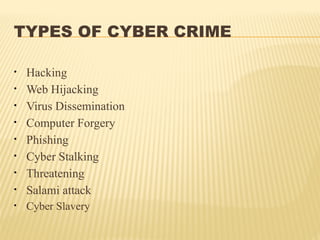
TYPES OF CYBER CRIME
• Hacking
• Web Hijacking
• Virus Dissemination
• Computer Forgery
• Phishing
• Cyber Stalking
• Threatening
• Salami attack
• Cyber Slavery
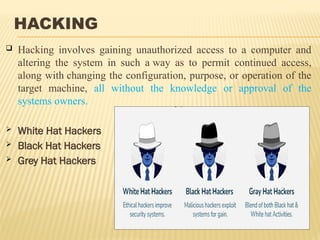
HACKING
 Hacking involves gaining unauthorized access to a computer and
altering the system in such a way as to permit continued access,
along with changing the configuration, purpose, or operation of the
target machine, all without the knowledge or approval of the
systems owners.
 White Hat Hackers
 Black Hat Hackers
 Grey Hat Hackers
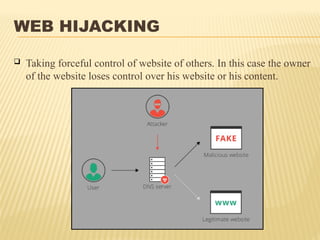
WEB HIJACKING
 Taking forceful control of website of others. In this case the owner
of the website loses control over his website or his content.
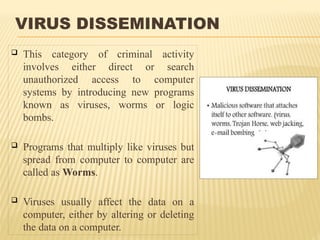
VIRUS DISSEMINATION
 This category of criminal activity
involves either direct or search
unauthorized access to computer
systems by introducing new programs
known as viruses, worms or logic
bombs.
 Programs that multiply like viruses but
spread from computer to computer are
called as Worms.
 Viruses usually affect the data on a
computer, either by altering or deleting
the data on a computer.
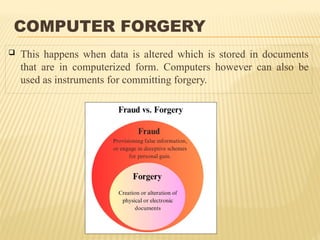
COMPUTER FORGERY
 This happens when data is altered which is stored in documents
that are in computerized form. Computers however can also be
used as instruments for committing forgery.
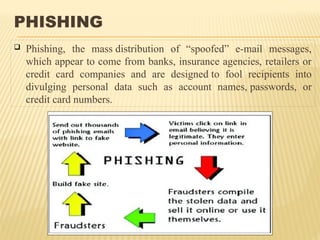
PHISHING
 Phishing, the mass distribution of “spoofed” e-mail messages,
which appear to come from banks, insurance agencies, retailers or
credit card companies and are designed to fool recipients into
divulging personal data such as account names, passwords, or
credit card numbers.
CYBER STALKING
 Cyber stalking is a new form of internet crime in our society when
a person is pursued or followed online. A cyber stalker doesn’t
physically follow his victim.
 He does it virtually by following his online activity to harvest
information about the stalk and harass him or her and make threats
using verbal intimidation.
Ex-
1. Sending unwanted, frightening, or obscene emails, or text
messages.
2. Harassing or threatening you on social media.
3. Tracking your computer and internet use.
4. Using technology such as GPS to track where you are.
THREATENING
 The criminal sends threatening email or comes in contact in chat
rooms with victim.
CYBER SLAVERY
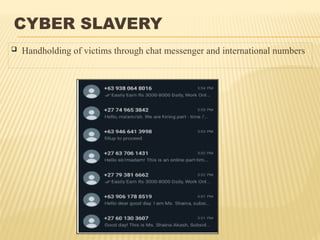
 Handholding of victims through chat messenger and international numbers
SALAMI ATTACK
 In such crime criminal makes insignificant changes in such a
manner that such changes would go unnoticed.
 Criminal makes such program that deducts small amount like
Rs.2.50 per month from the account of all the customer of the
Bank and deposit the same in his account.
 In this case no account holder will approach the bank for such
small amount but criminal gains huge amount.
WHY IS INDIA VULNERABLE TO CYBERCRIME?
 Rapid Digitalization
 Large Internet User Base
 Lack of Awareness
 Inadequate Cyber security Infrastructure
 Weak Legal Framework
 Technological Advancements
 Insider Threats
 Payment Systems Vulnerability
 Cross-Border Challenges
PREVENTION OF CYBER CRIME /
CYBER HYGIENE
 Easy Ways to Stay Safe Online-
1. Use Strong Passwords, use Password manager & Change passwords
frequently.
2. Turn on Multifactor Authentication (Code sent, security key,
fingerprints, facial recognition).
3. Recognize and Report Phishing attacks.
4. Update Your Software.
5. Avoid disclosing your identity to any strangers.
6. Always use latest antivirus software to guard against virus attacks.
7. Uninstall unnecessary software.
8. We should not download any executable files from unknown sources,
information from any sources without checking for virus.
9. We have to use licensed anti-virus software.
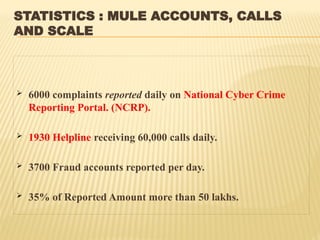
STATISTICS : MULE ACCOUNTS, CALLS
AND SCALE
 6000 complaints reported daily on National Cyber Crime
Reporting Portal. (NCRP).
 1930 Helpline receiving 60,000 calls daily.
 3700 Fraud accounts reported per day.
 35% of Reported Amount more than 50 lakhs.
WHAT IS CYBER SECURITY?
 Defined as "the protection of computer systems and networks
from attacks by malicious actors that may result in unauthorized
information disclosure, theft of, or damage to hardware, software,
or data..."
 Wherever there is technology, there needs to be Cyber security.
 It is important for individuals as well as organizations of all sizes
to protect personal, financial and sensitive information.
STEPS FOR REPORTING OF FINANCIAL CYBER
FRAUDS:
 Any victim of financial cyber fraud can dial helpline number 1930 or report
the incident on National Cybercrime Reporting Portal
(www.cybercrime.gov.in).
 A Bank or financial intermediary or payment wallet can also report financial
cyber fraud through above-mentioned modes.
 The complainant must provide the following information in case incident is
reported on helpline number:
• Mobile Number of the complainant.
• Name of Bank/ Account no/Wallet id/Merchant id from which amount has been
debited .
• Transaction Id, date.
• Debit card/Credit card number in case of fraud made using card.
• Screen shot of transaction or any other image related to fraud, if available.
 After reporting of complaint, the complainant will get a system generated
Log-in Id/acknowledgement number through SMS/Mail.
 Using the above Log-in Id/acknowledgement number, the complainant
must complete registration of complaint on National Cybercrime
Reporting Portal (www.cybercrime.gov.in) within 24 hours. This is
mandatory.
 On receipt of complaint, the designated Police Officer will quickly
examine the matter and after verification report to concerned
Bank/financial intermediary or payment wallet, etc., for blocking the
money involved in the financial cyber fraud.
 Thereafter, due action as per law will be taken in each case by
Police/Bank/Payment wallet/Financial Intermediary.
 Use of this facility will help a victim of financial cyber fraud in retrieving
the money and help Police in identifying the cyber criminal and take
legal action as per law.
CLOSING THOUGHT
 The key to protecting yourself is being aware.
 Not all hackers are cyber criminals.
 There is a whole other world that exists in cyberspace…
make sure that your information travels safely.
 Stay Secure, Stay Happy..
THANK YOU..

Cyber Crime, types and Cyber Security.pptx

  • 1.
    Presented by, Amruta C.Patil Computer Science Dept
  • 2.
    CONTENTS • Introduction • Whatis Cyber Crime? • Categories of Cyber Crime • Types of Cyber Crime • Precautions to prevent cyber crime/ Cyber Hygiene • Cyber Security • Steps for reporting of financial cyber frauds • Conclusion
  • 3.
    INTRODUCTION  The virtualworld has taken over the real one, E-business and E- commerce, which are the new mantras and electronic transactions dominate the overall business paradigm.  In this rapidly evolving e-world that depends on free flowing information, security is the major problem to be considered.  The first recorded cyber crime took place in the year 1820.
  • 4.
    CYBER CRIME  "Offencesthat are committed against individuals or groups of individuals with a criminal motive to intentionally harm the reputation of the victim or cause physical or mental harm, or loss, to the victim directly or indirectly, using modern telecommunication networks such as Internet (networks including chatrooms, emails, noticeboards and groups) and mobile phones (SMS/MMS)“  Cybercrimes can be committed single handedly and does not require any physical presence of the criminals.  The same systems that have made it easier for people to conduct e- commerce & online transactions are now being exploited by cyber criminals.
  • 5.
    CATEGORIES CYBER CRIMES Cyber crimes can be basically divided into 3 major categories: 1. Cyber crimes against person. 2. Cyber crimes against property. 3. Cyber crimes against government.  Each category can use a variety of methods and the variety used can vary from one criminal to another.
  • 6.
    AGAINST PERSON  Cybercrimes committed against persons include cyber- stalking, dissemination of obscene material like child pornography, defamation through hacking, and using technology to threaten or harass individuals.
  • 7.
    AGAINST PROPERTY  Thesecond category of cybercrime is that of cybercrimes against all forms of property. These crimes involve intellectual property violations like-  software piracy (unauthorized use, copying or distribution of copyrighted software)  cybersquatting (claiming similar domain names)  cyber vandalism (destroying data or disrupting network services)  hacking computer systems  transmitting viruses  cyber trespassing (unauthorized access to computers).
  • 8.
    AGAINST GOVERNMENT  Itincludes-  cyber terrorism (threatening national security through internet attacks),  cyber warfare (politically motivated hacking and spying),  distribution of pirated software, and possession of unauthorized information.
  • 9.
    TYPES OF CYBERCRIME • Hacking • Web Hijacking • Virus Dissemination • Computer Forgery • Phishing • Cyber Stalking • Threatening • Salami attack • Cyber Slavery
  • 10.
    HACKING  Hacking involvesgaining unauthorized access to a computer and altering the system in such a way as to permit continued access, along with changing the configuration, purpose, or operation of the target machine, all without the knowledge or approval of the systems owners.  White Hat Hackers  Black Hat Hackers  Grey Hat Hackers
  • 11.
    WEB HIJACKING  Takingforceful control of website of others. In this case the owner of the website loses control over his website or his content.
  • 12.
    VIRUS DISSEMINATION  Thiscategory of criminal activity involves either direct or search unauthorized access to computer systems by introducing new programs known as viruses, worms or logic bombs.  Programs that multiply like viruses but spread from computer to computer are called as Worms.  Viruses usually affect the data on a computer, either by altering or deleting the data on a computer.
  • 13.
    COMPUTER FORGERY  Thishappens when data is altered which is stored in documents that are in computerized form. Computers however can also be used as instruments for committing forgery.
  • 14.
    PHISHING  Phishing, themass distribution of “spoofed” e-mail messages, which appear to come from banks, insurance agencies, retailers or credit card companies and are designed to fool recipients into divulging personal data such as account names, passwords, or credit card numbers.
  • 15.
    CYBER STALKING  Cyberstalking is a new form of internet crime in our society when a person is pursued or followed online. A cyber stalker doesn’t physically follow his victim.  He does it virtually by following his online activity to harvest information about the stalk and harass him or her and make threats using verbal intimidation. Ex- 1. Sending unwanted, frightening, or obscene emails, or text messages. 2. Harassing or threatening you on social media. 3. Tracking your computer and internet use. 4. Using technology such as GPS to track where you are.
  • 16.
    THREATENING  The criminalsends threatening email or comes in contact in chat rooms with victim.
  • 17.
    CYBER SLAVERY  Handholdingof victims through chat messenger and international numbers
  • 18.
    SALAMI ATTACK  Insuch crime criminal makes insignificant changes in such a manner that such changes would go unnoticed.  Criminal makes such program that deducts small amount like Rs.2.50 per month from the account of all the customer of the Bank and deposit the same in his account.  In this case no account holder will approach the bank for such small amount but criminal gains huge amount.
  • 19.
    WHY IS INDIAVULNERABLE TO CYBERCRIME?  Rapid Digitalization  Large Internet User Base  Lack of Awareness  Inadequate Cyber security Infrastructure  Weak Legal Framework  Technological Advancements  Insider Threats  Payment Systems Vulnerability  Cross-Border Challenges
  • 20.
    PREVENTION OF CYBERCRIME / CYBER HYGIENE  Easy Ways to Stay Safe Online- 1. Use Strong Passwords, use Password manager & Change passwords frequently. 2. Turn on Multifactor Authentication (Code sent, security key, fingerprints, facial recognition). 3. Recognize and Report Phishing attacks. 4. Update Your Software. 5. Avoid disclosing your identity to any strangers. 6. Always use latest antivirus software to guard against virus attacks. 7. Uninstall unnecessary software. 8. We should not download any executable files from unknown sources, information from any sources without checking for virus. 9. We have to use licensed anti-virus software.
  • 21.
    STATISTICS : MULEACCOUNTS, CALLS AND SCALE  6000 complaints reported daily on National Cyber Crime Reporting Portal. (NCRP).  1930 Helpline receiving 60,000 calls daily.  3700 Fraud accounts reported per day.  35% of Reported Amount more than 50 lakhs.
  • 22.
    WHAT IS CYBERSECURITY?  Defined as "the protection of computer systems and networks from attacks by malicious actors that may result in unauthorized information disclosure, theft of, or damage to hardware, software, or data..."  Wherever there is technology, there needs to be Cyber security.  It is important for individuals as well as organizations of all sizes to protect personal, financial and sensitive information.
  • 23.
    STEPS FOR REPORTINGOF FINANCIAL CYBER FRAUDS:  Any victim of financial cyber fraud can dial helpline number 1930 or report the incident on National Cybercrime Reporting Portal (www.cybercrime.gov.in).  A Bank or financial intermediary or payment wallet can also report financial cyber fraud through above-mentioned modes.  The complainant must provide the following information in case incident is reported on helpline number: • Mobile Number of the complainant. • Name of Bank/ Account no/Wallet id/Merchant id from which amount has been debited . • Transaction Id, date. • Debit card/Credit card number in case of fraud made using card. • Screen shot of transaction or any other image related to fraud, if available.
  • 24.
     After reportingof complaint, the complainant will get a system generated Log-in Id/acknowledgement number through SMS/Mail.  Using the above Log-in Id/acknowledgement number, the complainant must complete registration of complaint on National Cybercrime Reporting Portal (www.cybercrime.gov.in) within 24 hours. This is mandatory.  On receipt of complaint, the designated Police Officer will quickly examine the matter and after verification report to concerned Bank/financial intermediary or payment wallet, etc., for blocking the money involved in the financial cyber fraud.  Thereafter, due action as per law will be taken in each case by Police/Bank/Payment wallet/Financial Intermediary.  Use of this facility will help a victim of financial cyber fraud in retrieving the money and help Police in identifying the cyber criminal and take legal action as per law.
  • 25.
    CLOSING THOUGHT  Thekey to protecting yourself is being aware.  Not all hackers are cyber criminals.  There is a whole other world that exists in cyberspace… make sure that your information travels safely.  Stay Secure, Stay Happy..
  • 26.