Lumbar disc herniation Management of free fragments Part 2 Vinod Naneria Consultant orthopaedic surgeon Choithram Hospital & Research Centre Indore, India
Reduction in size More than 50% reduction in size on follow-up MRI is clinically significant. Bigger the size, better the chances of reduction and better clinical outcome.
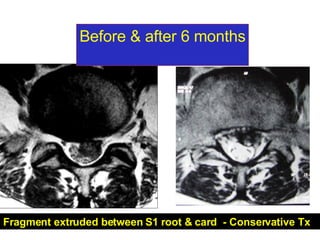
Fragment extruded between S1 root & card  - Conservative Tx Case report Mrs. W. Before & after 6 months
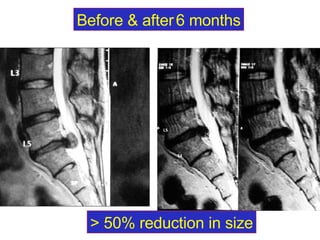
Before & after   6 months > 50% reduction in size
Patient when reported late It is usually for a second opinion. For persisting pain No improvement in neurological deficit. It is stable neurology. May be a case for surgical intervention. Some times Epidural steroids works.
Reduction in size More than 50% reduction in size on follow-up MRI is clinically significant. Bigger the size, better the chances of reduction and better clinical outcome.
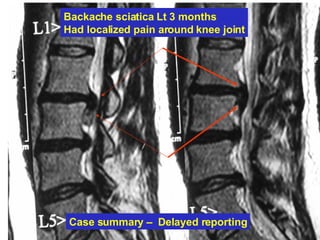
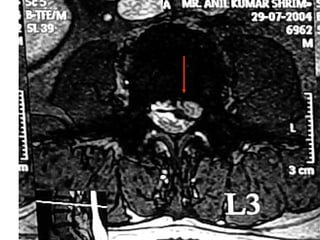
Case summary –  Delayed reporting Backache sciatica Lt 3 months Had localized pain around knee joint
 
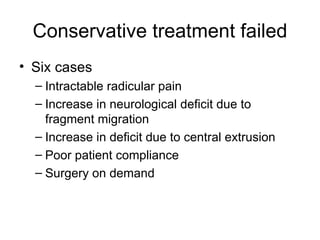
Conservative treatment failed Six cases Intractable radicular pain Increase in neurological deficit due to fragment migration Increase in deficit due to central extrusion Poor patient compliance Surgery on demand
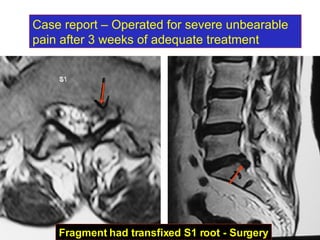
Case report – Operated for severe unbearable pain after 3 weeks of adequate treatment Fragment had transfixed S1 root - Surgery
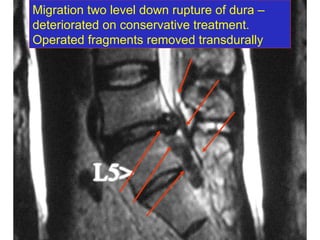
Migration two level down rupture of dura –  deteriorated on conservative treatment. Operated fragments removed transdurally
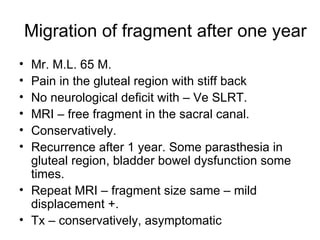
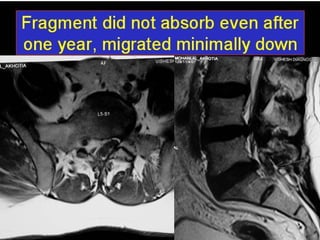
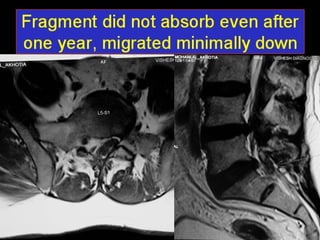
Migration of fragment after one year Mr. M.L. 65 M. Pain in the gluteal region with stiff back No neurological deficit with – Ve SLRT. MRI – free fragment in the sacral canal. Conservatively. Recurrence after 1 year. Some parasthesia in gluteal region, bladder bowel dysfunction some times. Repeat MRI – fragment size same – mild displacement +. Tx – conservatively, asymptomatic
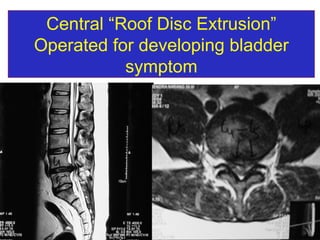
Central “Roof Disc Extrusion” Operated for developing bladder symptom
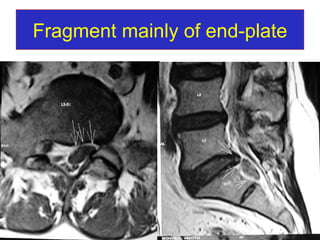
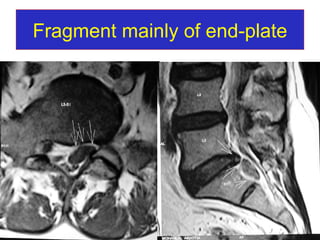
Fragment mainly of end-plate
Management - Protocol All Tx conservative initially Strict Bed Rest in position of comfort No pelvic / limb traction Sitting strictly prohibited Supportive drugs Tx – steroids sos. Frequent neurological examination Bed rest cont… till SLRT become -ve
Management - Protocol Gradual Mobilization in the house Exercises programme  Straight leg raising Knee bending to chest Forward bending in sitting postion Forward bending in standing  Back care ( jerk, weight lifting, bending, sitting at work etc. Strict instructions regarding reporting of neurological deterioration
Follow-up MRI At 3 months At 6 months At 12 months Fragment mainly consist of NP will absorbed in 3 months Fragment mainly consisting of NP+AF will take 6 months – one year Fragment consist of end plate cartilage take longer time – more than 2 years.
Favorable signs negative crossed straight-leg-raising test absence of leg pain with spinal extension absence of stenosis on imaging studies favorable response to steroids normal psychological profile a motivated physically fit patient more than twelve years of education no Workers’ Compensation claim
Initial rest Extruded disc – acute onset Fragment is free in the canal and migrate any where. It is more likely to cause neurological deficit when it get trapped at narrow parts of spinal canal. It take roughly two weeks for the fragment to get fixed by the granulation tissue.
Traction Traction immobilize the patient is a fixed posture. Muscle spasm is basically protective and keep the patient in a posture which protect the compressed nerve root. An alteration in posture by forceful traction increases the chances of damage to nerve root. Traction should be avoided for acute pain.
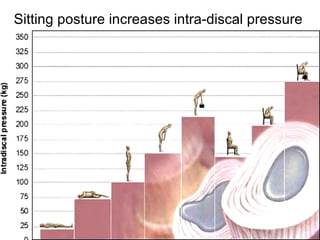
Sitting posture to be avoided Maximum pressure on the damaged disc occur in sitting posture specially with forward bending. It increases the chances of further displacement or migration of the fragment.
Sitting posture increases intra-discal pressure
 
Management - Protocol All Tx conservative initially Strict Bed Rest in position of comfort No pelvic / limb traction Sitting strictly prohibited Supportive drugs Tx – steroids sos. Frequent neurological examination Bed rest cont… till SLRT become -ve
Fragment mainly of end-plate
 
Types of Lumbar Herniated Disc and Clinical Course  SPINE Volume 26, Number 6, pp 648–651 ©2001, Lippincott Williams & Wilkins, Inc.   Takui Ito, MD,* Yuichi Takano, MD,† and Nobuhiro Yuasa, MD†   Conclusions. The authors believe that patients with noncontained lumbar disc herniation can be treated with­out surgery, if these patients can tolerate the symptoms for the first 2 months.
Primary and revision lumbar discectomy  A 16-YEAR REVIEW FROM ONE CENTRE  C. V. J. Morgan-Hough et al, England   primary protrusions are almost three times as likely to require revision surgery as primary extrusions or sequestrations.  We suggest that protrusion represents the beginning of a process of serial fragmentation of disc material, whereas extrusion and sequestration are an end-stage of this process
Saal JA, Saal JS, Herzog RJ: The natural history of lumbar intervertebral disc extrusions treated non-operatively. Spine 15: 683–686, 1990 Patients with large compressive lesions are also generally believed to be more ideally suited to surgical intervention. These same patients, however, are those most likely to experience spontaneous regression of their lesions and they have a high rate of clinical improvement with noninvasive treatments.
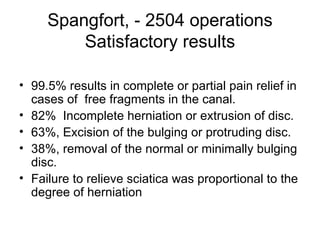
Spangfort, - 2504 operations Satisfactory results 99.5% results in complete or partial pain relief in cases of  free fragments in the canal.  82%  Incomplete herniation or extrusion of disc.  63%, Excision of the bulging or protruding disc. 38%, removal of the normal or minimally bulging disc. Failure to relieve sciatica was proportional to the degree of herniation
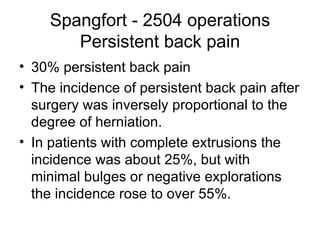
Spangfort - 2504 operations Persistent back pain 30% persistent back pain The incidence of persistent back pain after surgery was inversely proportional to the degree of herniation.  In patients with complete extrusions the incidence was about 25%, but with minimal bulges or negative explorations the incidence rose to over 55%.
Natural history Protrusion – degenerated disc – decreased height – facetal joint degeneration – ligamentum flavum infolding – segmental canal stenosis Degenerative dynamic instability Osteoarthritis – osteophytes in an attempt to stabilize the spine. Surgery only relieve leg pain temporarily.
Radiculopathy and the Herniated Lumbar Disc. Controversies Regarding Pathophysiology and Management J. Bone Joint Surg. Am. John M. Rhee, Michael Schaufele and William A. Abdu, 88:2070-2080, 2006. This information is current as of January 21, 2007
Both the surgeon and the patient must realize that disc surgery is not a cure but may provide symptomatic relief. It neither stops the pathological processes that allowed the herniation to occur nor restores the back to a normal state
Recommendations Presence of Free fragment in the canal indicates auto-decompression of the nerve roots (SLRT –ve, Pain  ↓ as nerve fired/ decompressed). Usually stable mono-radiculopathy – recovery is almost complete. Patients with gross / ↑ neurological deficit should be operated .
Think over it ??? ? Conservative   Thank  U

Lumbar Disc Herniation Naneria Part 2

  • 1.
    Lumbar disc herniationManagement of free fragments Part 2 Vinod Naneria Consultant orthopaedic surgeon Choithram Hospital & Research Centre Indore, India
  • 2.
    Reduction in sizeMore than 50% reduction in size on follow-up MRI is clinically significant. Bigger the size, better the chances of reduction and better clinical outcome.
  • 3.
    Fragment extruded betweenS1 root & card - Conservative Tx Case report Mrs. W. Before & after 6 months
  • 4.
    Before & after 6 months > 50% reduction in size
  • 5.
    Patient when reportedlate It is usually for a second opinion. For persisting pain No improvement in neurological deficit. It is stable neurology. May be a case for surgical intervention. Some times Epidural steroids works.
  • 6.
    Reduction in sizeMore than 50% reduction in size on follow-up MRI is clinically significant. Bigger the size, better the chances of reduction and better clinical outcome.
  • 7.
    Case summary – Delayed reporting Backache sciatica Lt 3 months Had localized pain around knee joint
  • 8.
  • 9.
    Conservative treatment failedSix cases Intractable radicular pain Increase in neurological deficit due to fragment migration Increase in deficit due to central extrusion Poor patient compliance Surgery on demand
  • 10.
    Case report –Operated for severe unbearable pain after 3 weeks of adequate treatment Fragment had transfixed S1 root - Surgery
  • 11.
    Migration two leveldown rupture of dura – deteriorated on conservative treatment. Operated fragments removed transdurally
  • 12.
    Migration of fragmentafter one year Mr. M.L. 65 M. Pain in the gluteal region with stiff back No neurological deficit with – Ve SLRT. MRI – free fragment in the sacral canal. Conservatively. Recurrence after 1 year. Some parasthesia in gluteal region, bladder bowel dysfunction some times. Repeat MRI – fragment size same – mild displacement +. Tx – conservatively, asymptomatic
  • 13.
    Central “Roof DiscExtrusion” Operated for developing bladder symptom
  • 14.
  • 15.
    Management - ProtocolAll Tx conservative initially Strict Bed Rest in position of comfort No pelvic / limb traction Sitting strictly prohibited Supportive drugs Tx – steroids sos. Frequent neurological examination Bed rest cont… till SLRT become -ve
  • 16.
    Management - ProtocolGradual Mobilization in the house Exercises programme Straight leg raising Knee bending to chest Forward bending in sitting postion Forward bending in standing Back care ( jerk, weight lifting, bending, sitting at work etc. Strict instructions regarding reporting of neurological deterioration
  • 17.
    Follow-up MRI At3 months At 6 months At 12 months Fragment mainly consist of NP will absorbed in 3 months Fragment mainly consisting of NP+AF will take 6 months – one year Fragment consist of end plate cartilage take longer time – more than 2 years.
  • 18.
    Favorable signs negativecrossed straight-leg-raising test absence of leg pain with spinal extension absence of stenosis on imaging studies favorable response to steroids normal psychological profile a motivated physically fit patient more than twelve years of education no Workers’ Compensation claim
  • 19.
    Initial rest Extrudeddisc – acute onset Fragment is free in the canal and migrate any where. It is more likely to cause neurological deficit when it get trapped at narrow parts of spinal canal. It take roughly two weeks for the fragment to get fixed by the granulation tissue.
  • 20.
    Traction Traction immobilizethe patient is a fixed posture. Muscle spasm is basically protective and keep the patient in a posture which protect the compressed nerve root. An alteration in posture by forceful traction increases the chances of damage to nerve root. Traction should be avoided for acute pain.
  • 21.
    Sitting posture tobe avoided Maximum pressure on the damaged disc occur in sitting posture specially with forward bending. It increases the chances of further displacement or migration of the fragment.
  • 22.
    Sitting posture increasesintra-discal pressure
  • 23.
  • 24.
    Management - ProtocolAll Tx conservative initially Strict Bed Rest in position of comfort No pelvic / limb traction Sitting strictly prohibited Supportive drugs Tx – steroids sos. Frequent neurological examination Bed rest cont… till SLRT become -ve
  • 25.
  • 26.
  • 27.
    Types of LumbarHerniated Disc and Clinical Course SPINE Volume 26, Number 6, pp 648–651 ©2001, Lippincott Williams & Wilkins, Inc. Takui Ito, MD,* Yuichi Takano, MD,† and Nobuhiro Yuasa, MD† Conclusions. The authors believe that patients with noncontained lumbar disc herniation can be treated with­out surgery, if these patients can tolerate the symptoms for the first 2 months.
  • 28.
    Primary and revisionlumbar discectomy A 16-YEAR REVIEW FROM ONE CENTRE C. V. J. Morgan-Hough et al, England primary protrusions are almost three times as likely to require revision surgery as primary extrusions or sequestrations. We suggest that protrusion represents the beginning of a process of serial fragmentation of disc material, whereas extrusion and sequestration are an end-stage of this process

  • 29.
    Saal JA, SaalJS, Herzog RJ: The natural history of lumbar intervertebral disc extrusions treated non-operatively. Spine 15: 683–686, 1990 Patients with large compressive lesions are also generally believed to be more ideally suited to surgical intervention. These same patients, however, are those most likely to experience spontaneous regression of their lesions and they have a high rate of clinical improvement with noninvasive treatments.
  • 30.
    Spangfort, - 2504operations Satisfactory results 99.5% results in complete or partial pain relief in cases of free fragments in the canal. 82% Incomplete herniation or extrusion of disc. 63%, Excision of the bulging or protruding disc. 38%, removal of the normal or minimally bulging disc. Failure to relieve sciatica was proportional to the degree of herniation
  • 31.
    Spangfort - 2504operations Persistent back pain 30% persistent back pain The incidence of persistent back pain after surgery was inversely proportional to the degree of herniation. In patients with complete extrusions the incidence was about 25%, but with minimal bulges or negative explorations the incidence rose to over 55%.
  • 32.
    Natural history Protrusion– degenerated disc – decreased height – facetal joint degeneration – ligamentum flavum infolding – segmental canal stenosis Degenerative dynamic instability Osteoarthritis – osteophytes in an attempt to stabilize the spine. Surgery only relieve leg pain temporarily.
  • 33.
    Radiculopathy and theHerniated Lumbar Disc. Controversies Regarding Pathophysiology and Management J. Bone Joint Surg. Am. John M. Rhee, Michael Schaufele and William A. Abdu, 88:2070-2080, 2006. This information is current as of January 21, 2007
  • 34.
    Both the surgeonand the patient must realize that disc surgery is not a cure but may provide symptomatic relief. It neither stops the pathological processes that allowed the herniation to occur nor restores the back to a normal state
  • 35.
    Recommendations Presence ofFree fragment in the canal indicates auto-decompression of the nerve roots (SLRT –ve, Pain ↓ as nerve fired/ decompressed). Usually stable mono-radiculopathy – recovery is almost complete. Patients with gross / ↑ neurological deficit should be operated .
  • 36.
    Think over it??? ? Conservative Thank U