M.KARTHIKEYAN
ASSISTANT PROFESSOR
DEPARTMENT OF MECHANICAL ENGINEERING
AAA COLLEGE OF ENGINEERING & TECHNOLOGY, SIVAKASI
karthikeyan@aaacet.ac.in
OML751 TESTING OF MATERIALS
UNIT III NON DESTRUCTIVE TESTING
1. Visual inspection
2. Liquid penetrant test
3. Magnetic particle test
4. Thermography test
5. Radiographic test
6. Eddy current test
7. Ultrasonic test
8. Acoustic emission
Principles, Techniques, Methods, Advantages and Limitations,
Applications.
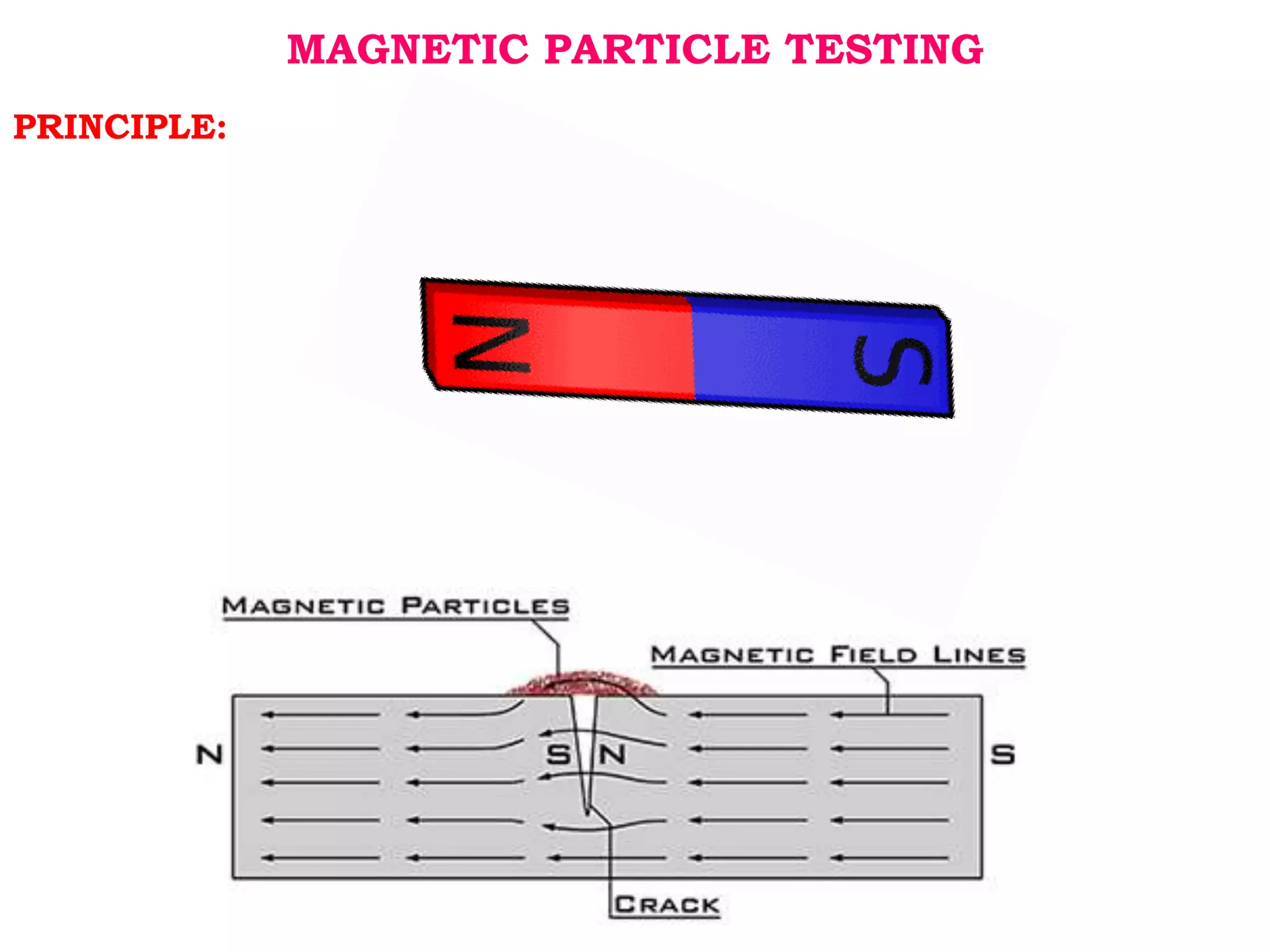
MAGNETIC PARTICLE TESTING
PRINCIPLE:
INSPECTION PROCEDURE:
 Magnetize the component
 Leakage field will be formed at the surface defects area
 Iron particles either in a dry or wet suspended form are
applied to the surface of the component.
 Now the iron particles will be attracted and cluster at the flux
leakage fields.
 Finally the inspector will easily identify the crack.
ADVANTAGES:
 High sensitivity
 Indication are produced directly on the surface of the
component
 Minimal surface preparation
 Portable
 It is quick and relatively uncomplicated
 The method can be adapted for site or workshop use
 It is inexpensive compared to radiography
 Large or small objects can be examined
 Less training requirements.
LIMITATIONS:
 Only surface and near surface defects can be detected
 Only non-porous surface can be inspected
 Only applicable to ferromagnetic materials.
 Need a supply of electricity
 Parts must be demagnetized and cleaned after inspection.
INSPECTION MATERIALS
MAGNETIZATION EQUIPMENT [or METHODS OF MAGNETIZATION]
1. Permanent magnet
2. Electromagnetic yokes
3. Prods
4. Stationary magnetic particle inspection equipment]
EQUIPMENT USED IN DETERMINATION OF MAGNETIC FIELD
STRENGTH AND DIRECTION
1. Hall effect or gauss meter
2. Pie gauge
3. Quantitative quality indicator [QQI]
MAGNETIC PARTICLES
1. Wet magnetic particles
2. Dry magnetic particles
MAGNETISATION METHODS
1. Magnetization using permanent magnet
2. Magnetization using electromagnet
3. Magnetization using prods
4. Magnetization using circular magnetic field [stationary
magnetic particle inspection equipment]
MAGNETIZATION USING PERMANENT MAGNET
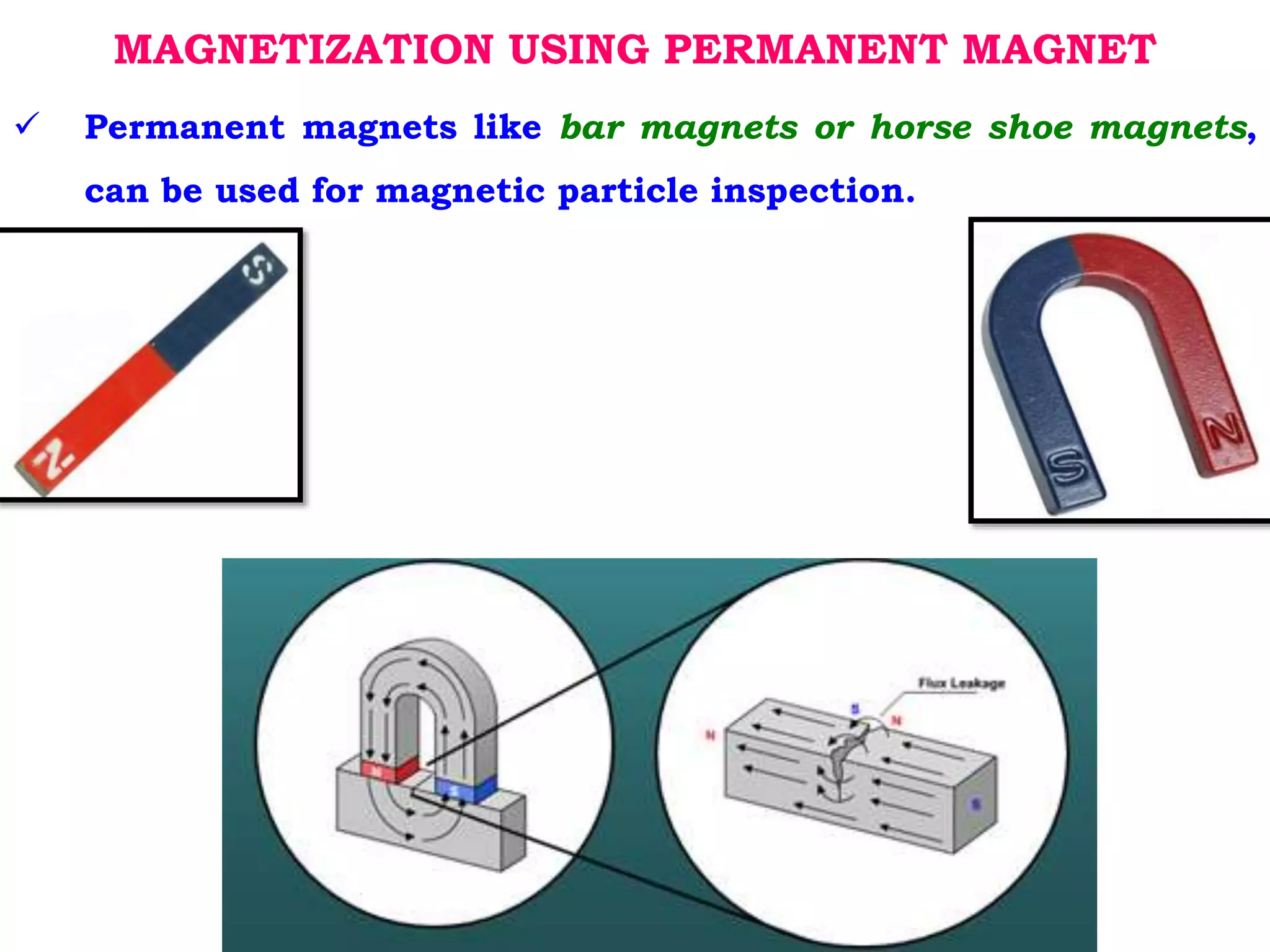
 Permanent magnets like bar magnets or horse shoe magnets,
can be used for magnetic particle inspection.
MAGNETIZATION USING ELECTROMAGNET
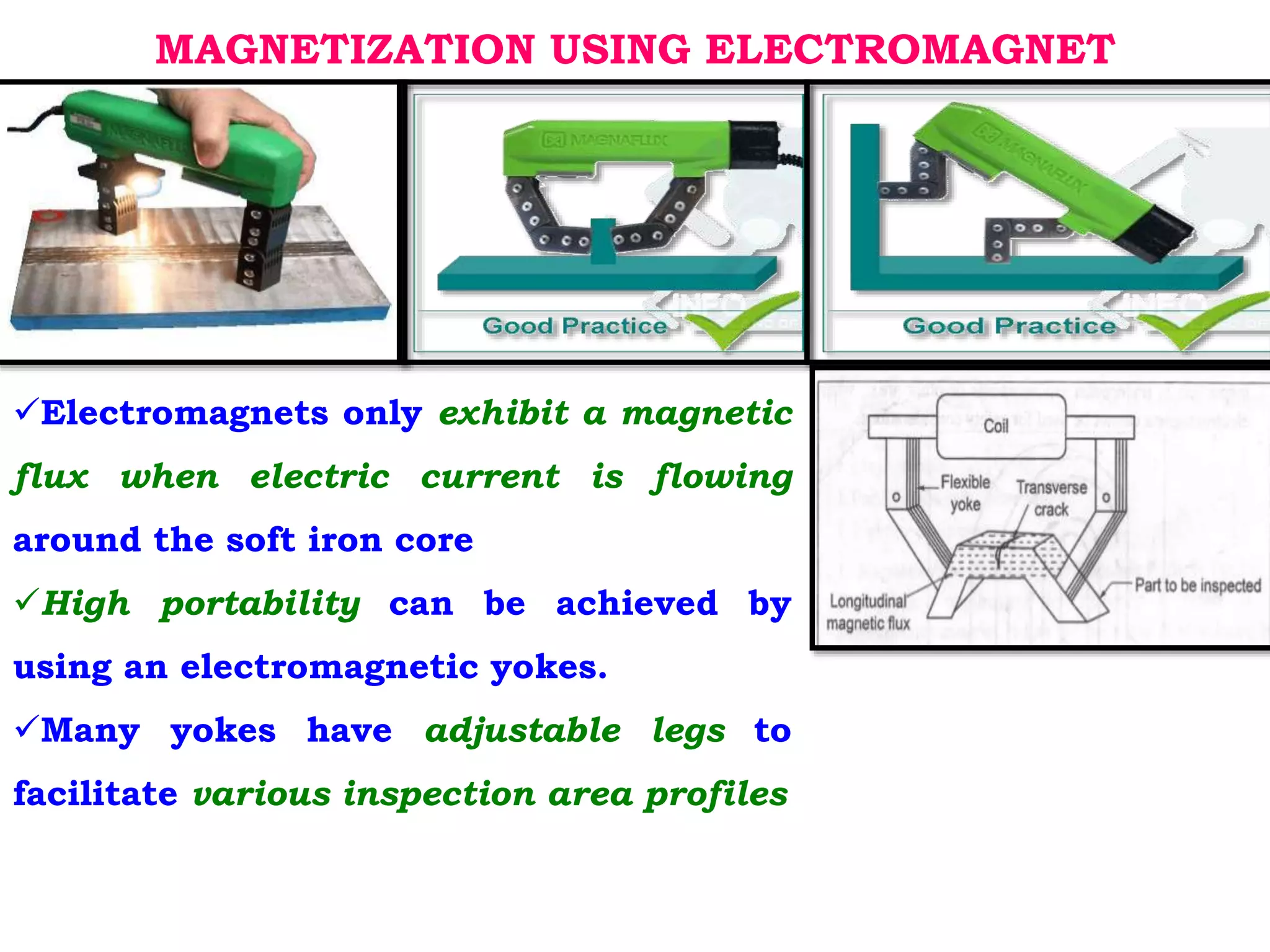
Electromagnets only exhibit a magnetic
flux when electric current is flowing
around the soft iron core
High portability can be achieved by
using an electromagnetic yokes.
Many yokes have adjustable legs to
facilitate various inspection area profiles
MAGNETIZATION USING PRODS
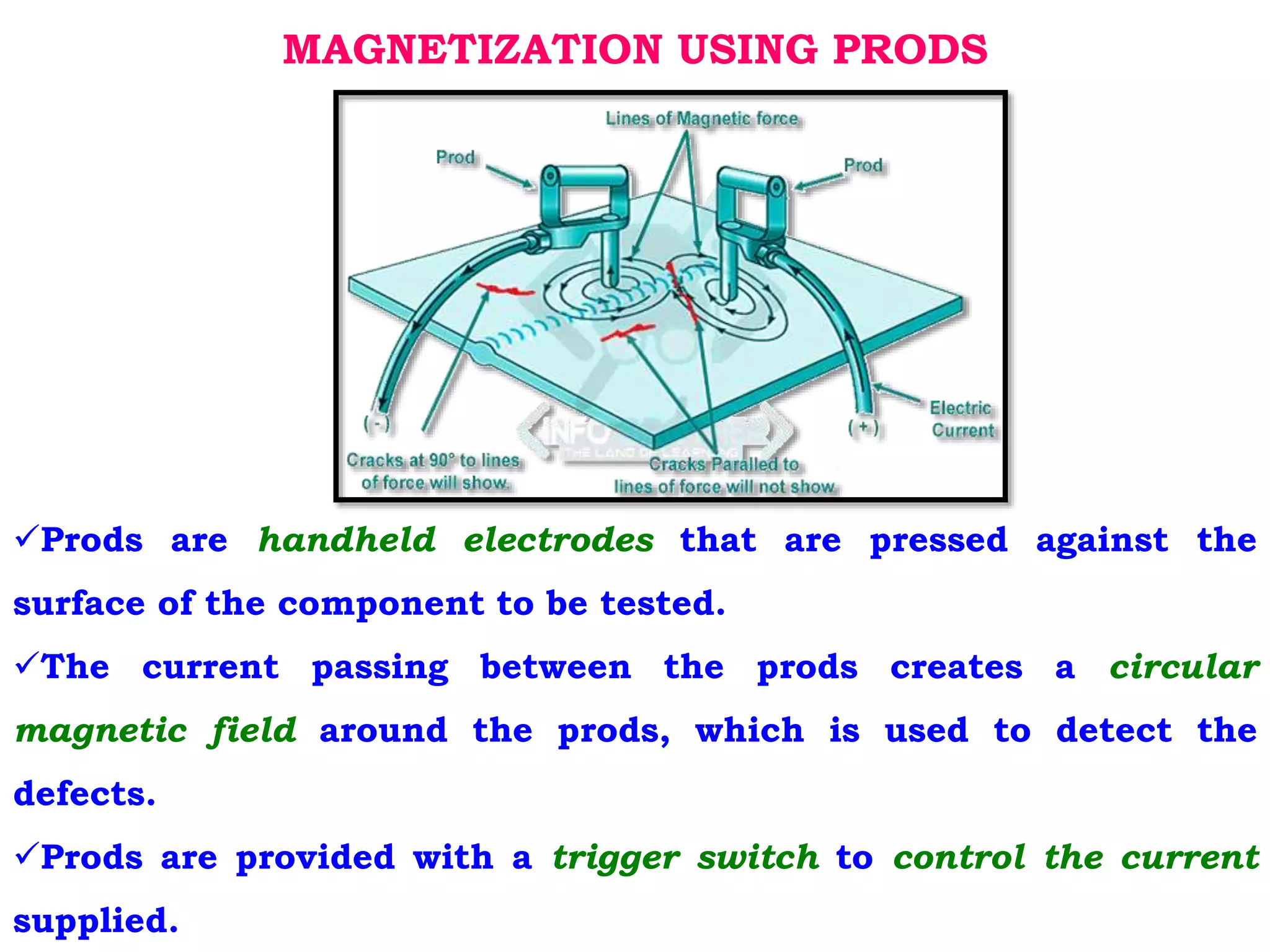
Prods are handheld electrodes that are pressed against the
surface of the component to be tested.
The current passing between the prods creates a circular
magnetic field around the prods, which is used to detect the
defects.
Prods are provided with a trigger switch to control the current
supplied.
MAGNETIZATION USING CIRCULAR MAGNETIC FIELD
[stationary magnetic particle inspection equipment]
In this type, a circular magnetic field can be produced in a
cylindrical components.
The part is placed between the headstock and tailstock and
gripped by pneumatic chuck to permit current to flow, thereby
producing a circular magnetic field.
INSPECTION MATERIALS
MAGNETIZATION EQUIPMENT [or METHODS OF MAGNETIZATION]
1. Permanent magnet
2. Electromagnetic yokes
3. Prods
4. Stationary magnetic particle inspection equipment]
EQUIPMENT USED IN DETERMINATION OF MAGNETIC FIELD
STRENGTH AND DIRECTION
1. Hall effect or gauss meter
2. Pie gauge
3. Quantitative quality indicator [QQI]
MAGNETIC PARTICLES
1. Wet magnetic particles
2. Dry magnetic particles
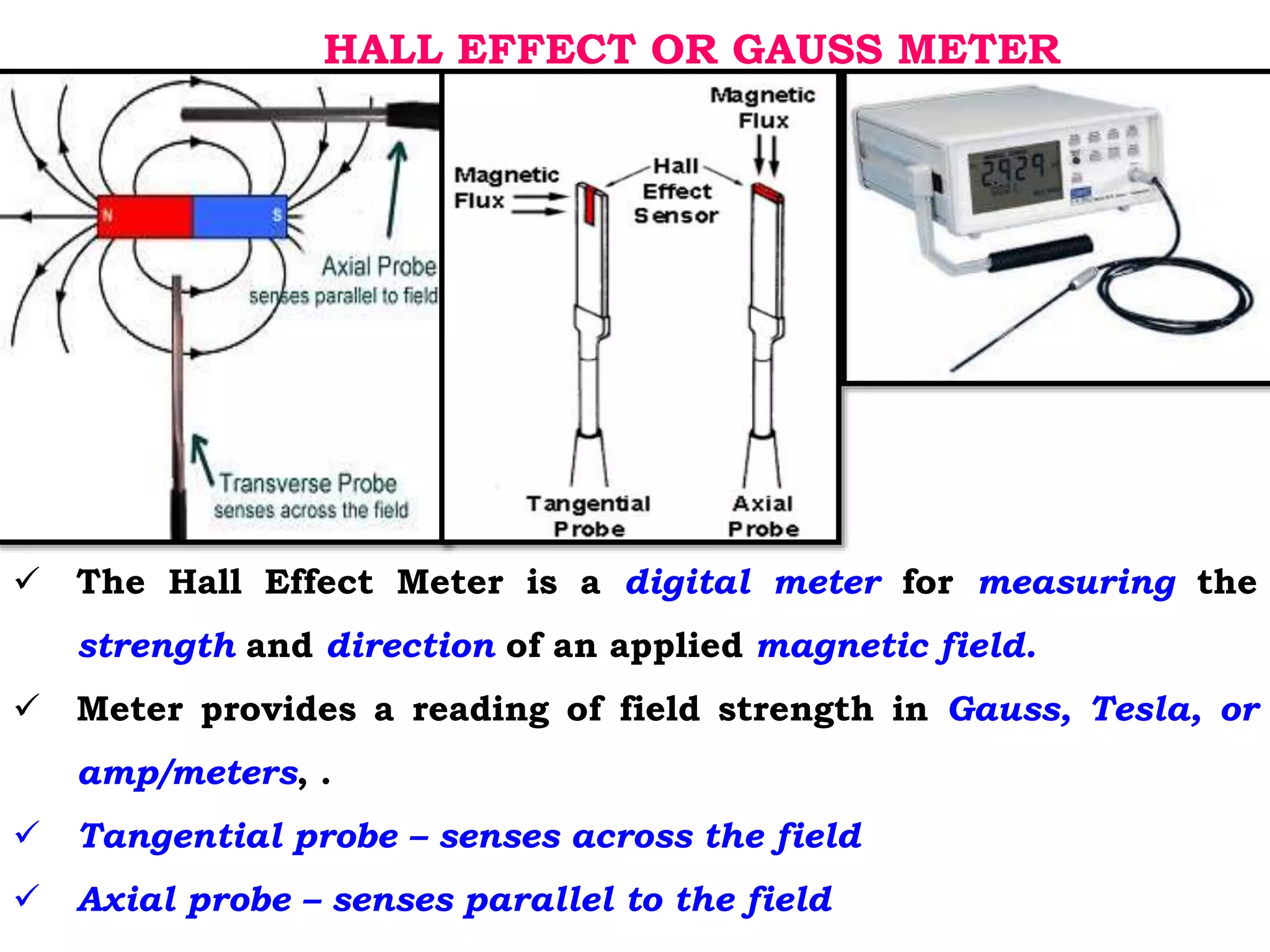
HALL EFFECT OR GAUSS METER
 The Hall Effect Meter is a digital meter for measuring the
strength and direction of an applied magnetic field.
 Meter provides a reading of field strength in Gauss, Tesla, or
amp/meters, .
 Tangential probe – senses across the field
 Axial probe – senses parallel to the field
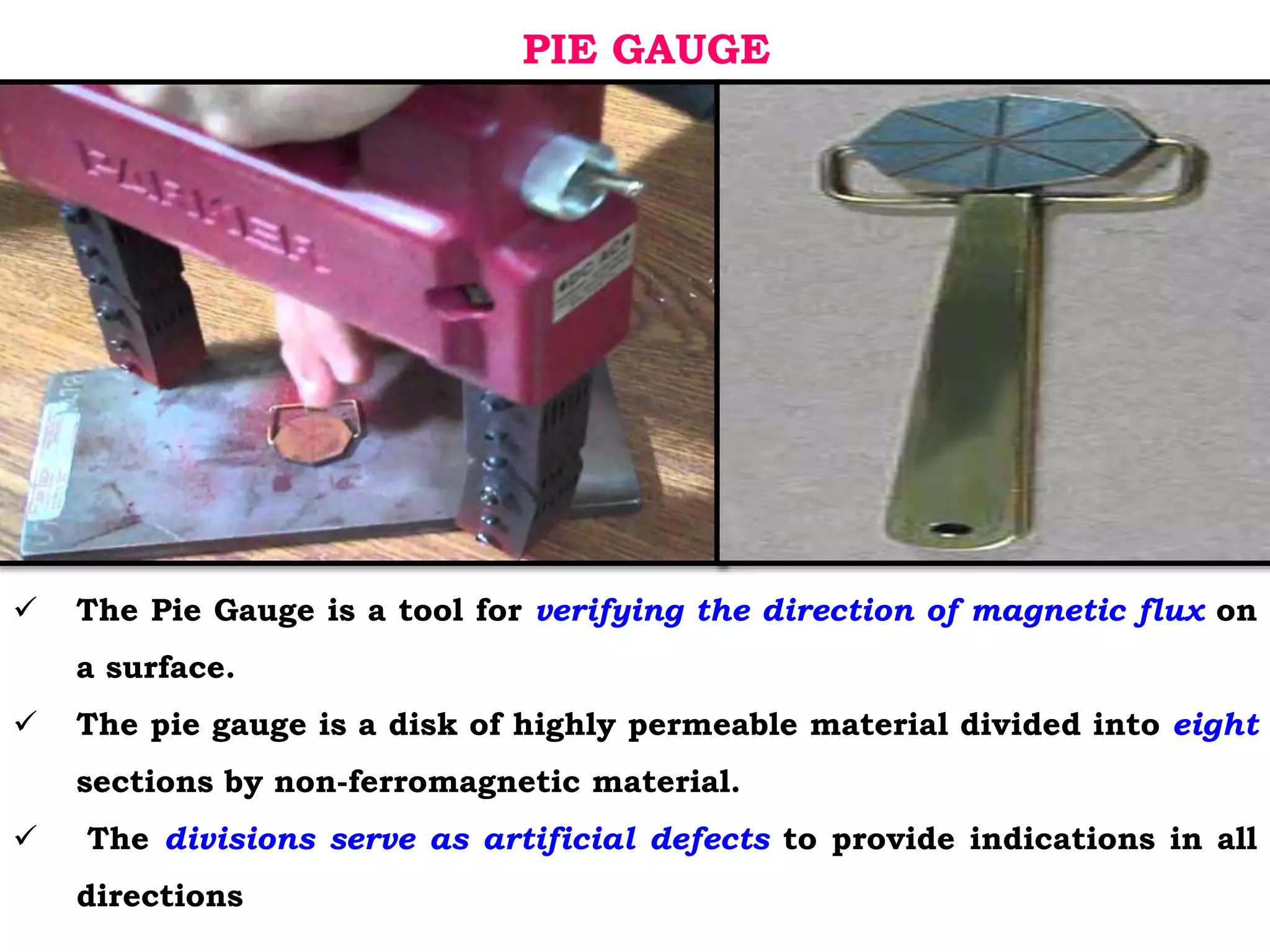
PIE GAUGE
 The Pie Gauge is a tool for verifying the direction of magnetic flux on
a surface.
 The pie gauge is a disk of highly permeable material divided into eight
sections by non-ferromagnetic material.
 The divisions serve as artificial defects to provide indications in all
directions
QUANTITATIVE QUALITY INDICATOR [QQI]
 Quantitative Quality Indicators (QQI) are magnetic particle test
pieces with artificial defects used to verify field direction
INSPECTION MATERIALS
MAGNETIZATION EQUIPMENT [or METHODS OF MAGNETIZATION]
1. Permanent magnet
2. Electromagnetic yokes
3. Prods
4. Stationary magnetic particle inspection equipment]
EQUIPMENT USED IN DETERMINATION OF MAGNETIC FIELD
STRENGTH AND DIRECTION
1. Hall effect or gauss meter
2. Pie gauge
3. Quantitative quality indicator [QQI]
MAGNETIC PARTICLES
1. Wet magnetic particles
2. Dry magnetic particles
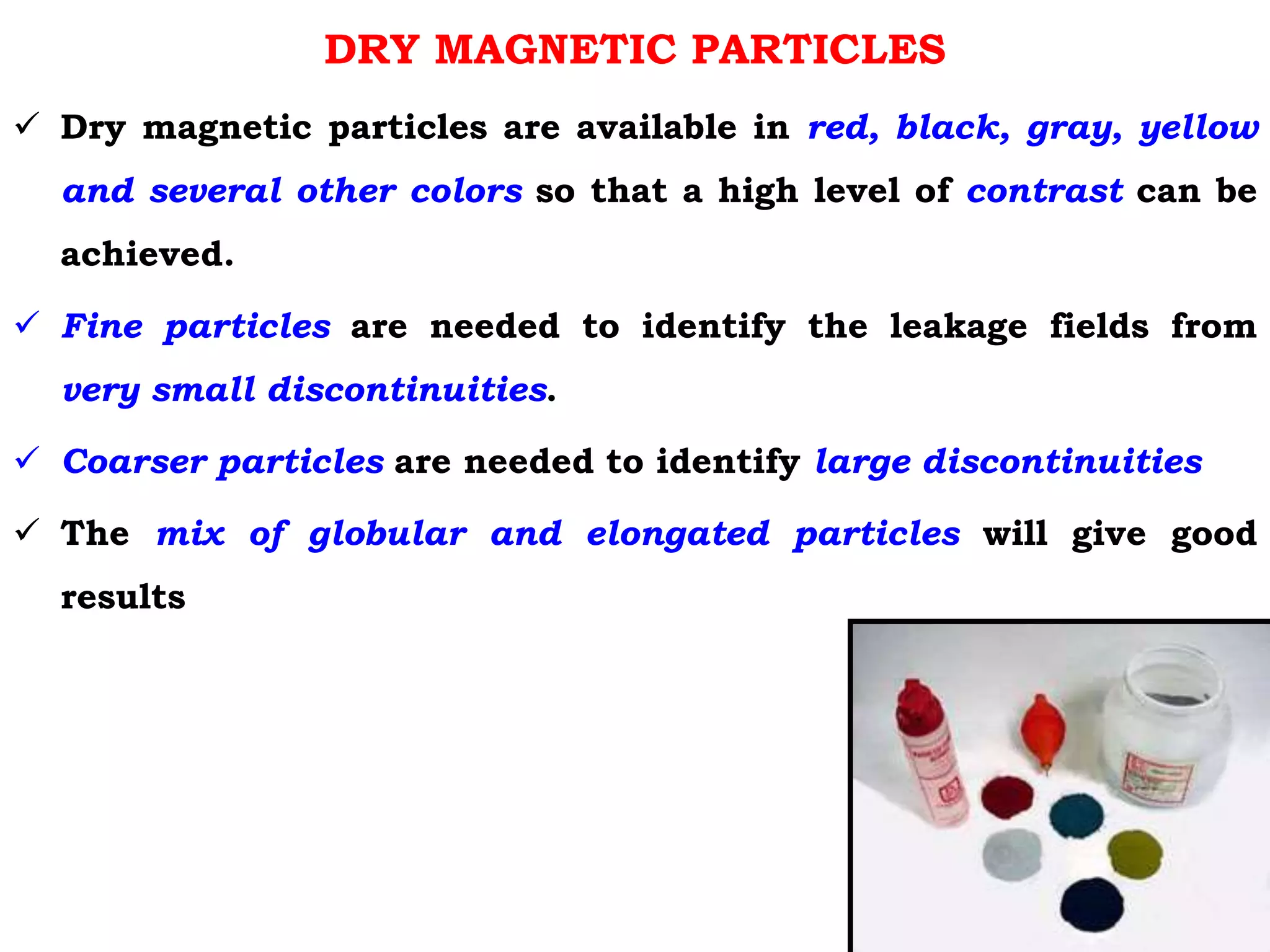
DRY MAGNETIC PARTICLES
 Dry magnetic particles are available in red, black, gray, yellow
and several other colors so that a high level of contrast can be
achieved.
 Fine particles are needed to identify the leakage fields from
very small discontinuities.
 Coarser particles are needed to identify large discontinuities
 The mix of globular and elongated particles will give good
results
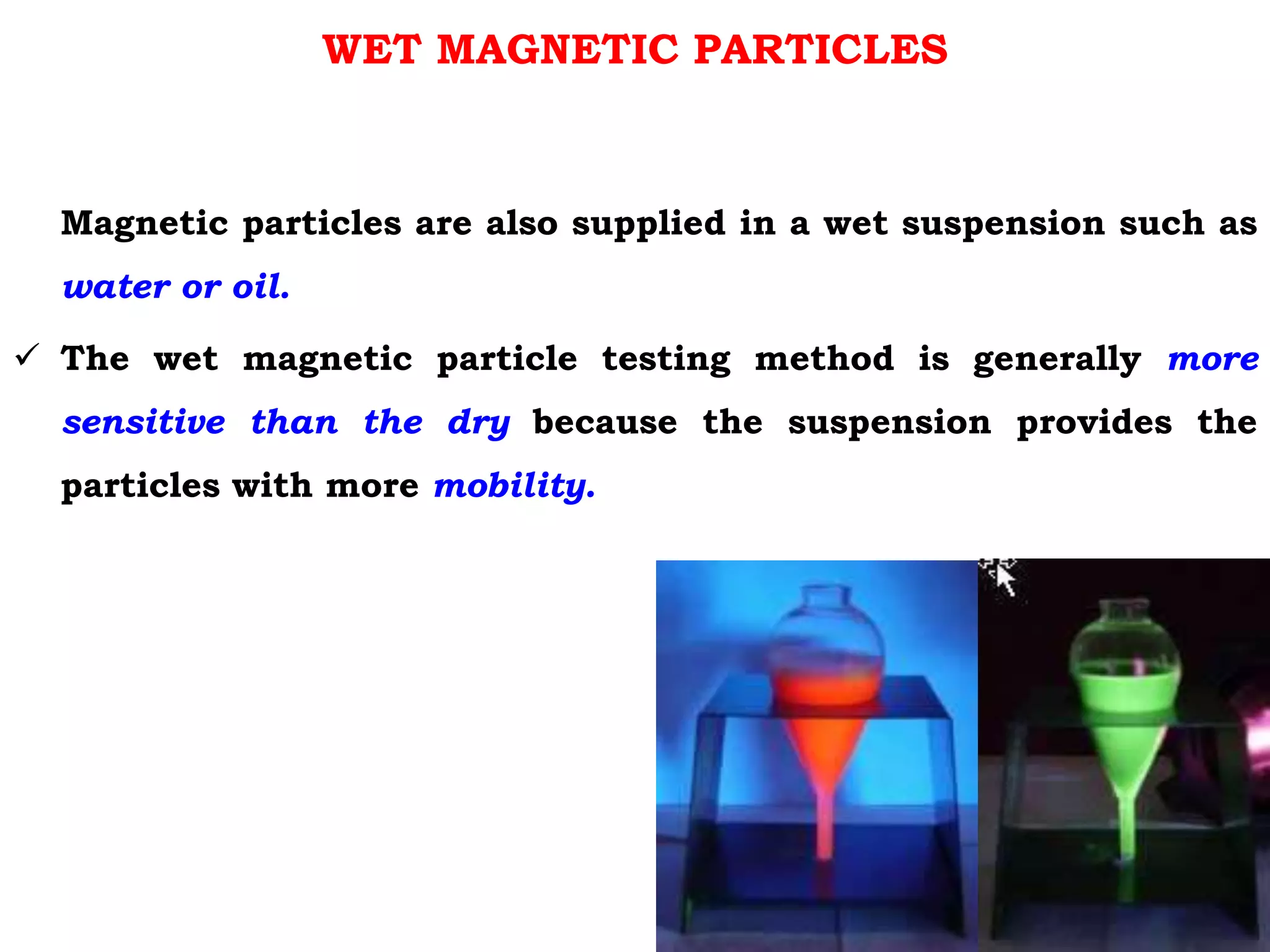
WET MAGNETIC PARTICLES
Magnetic particles are also supplied in a wet suspension such as
water or oil.
 The wet magnetic particle testing method is generally more
sensitive than the dry because the suspension provides the
particles with more mobility.
INSPECTION MATERIALS
MAGNETIZATION EQUIPMENT [or METHODS OF MAGNETIZATION]
1. Permanent magnet
2. Electromagnetic yokes
3. Prods
4. Stationary magnetic particle inspection equipment]
EQUIPMENT USED IN DETERMINATION OF MAGNETIC FIELD
STRENGTH AND DIRECTION
1. Hall effect or gauss meter
2. Pie gauge
3. Quantitative quality indicator [QQI]
MAGNETIC PARTICLES
1. Wet magnetic particles
2. Dry magnetic particles
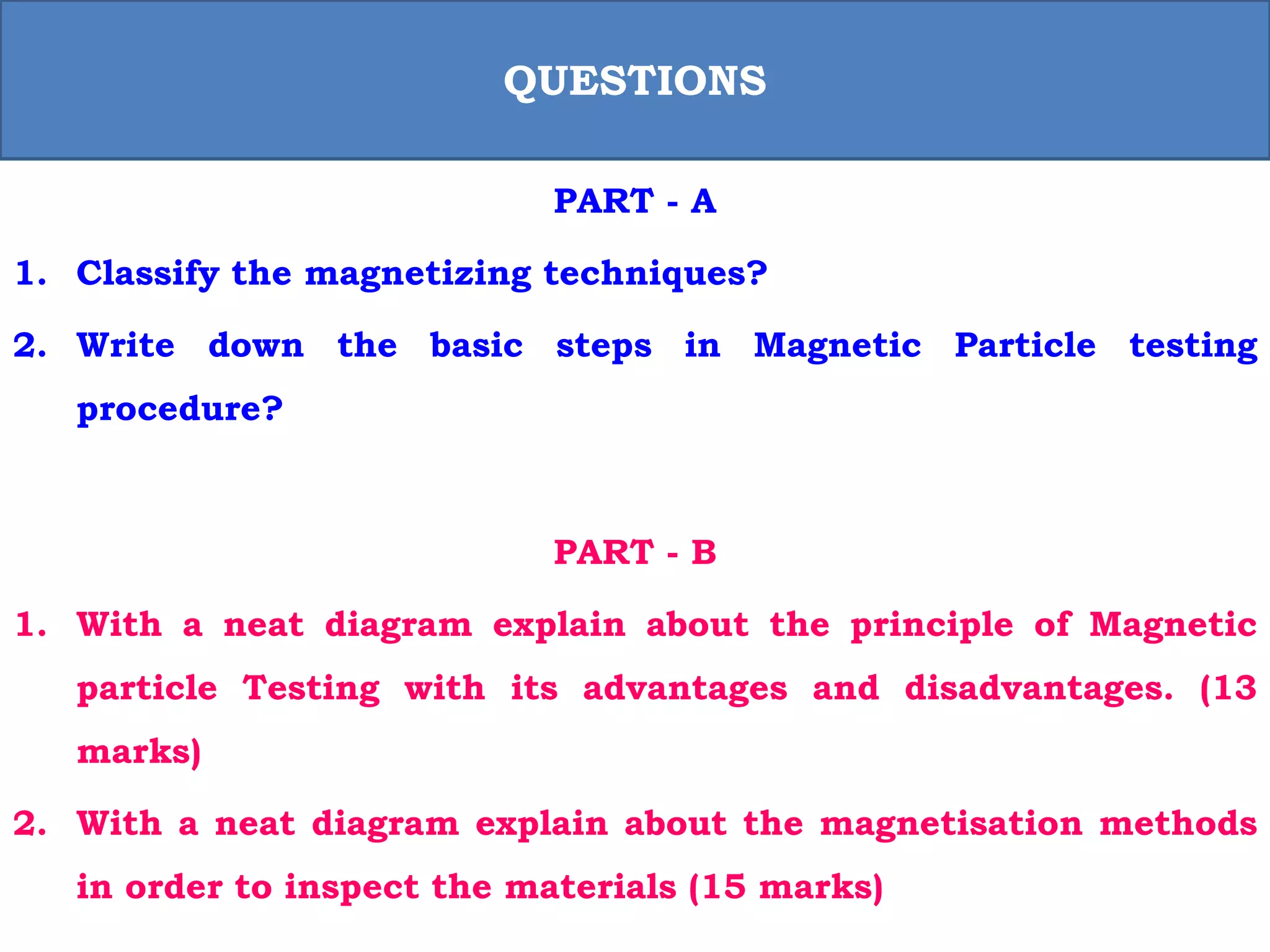
PART - A
1. Classify the magnetizing techniques?
2. Write down the basic steps in Magnetic Particle testing
procedure?
PART - B
1. With a neat diagram explain about the principle of Magnetic
particle Testing with its advantages and disadvantages. (13
marks)
2. With a neat diagram explain about the magnetisation methods
in order to inspect the materials (15 marks)
QUESTIONS

L22 magnetic particle test

  • 1.
    M.KARTHIKEYAN ASSISTANT PROFESSOR DEPARTMENT OFMECHANICAL ENGINEERING AAA COLLEGE OF ENGINEERING & TECHNOLOGY, SIVAKASI karthikeyan@aaacet.ac.in OML751 TESTING OF MATERIALS
  • 2.
    UNIT III NONDESTRUCTIVE TESTING 1. Visual inspection 2. Liquid penetrant test 3. Magnetic particle test 4. Thermography test 5. Radiographic test 6. Eddy current test 7. Ultrasonic test 8. Acoustic emission Principles, Techniques, Methods, Advantages and Limitations, Applications.
  • 3.
  • 4.
    INSPECTION PROCEDURE:  Magnetizethe component  Leakage field will be formed at the surface defects area  Iron particles either in a dry or wet suspended form are applied to the surface of the component.  Now the iron particles will be attracted and cluster at the flux leakage fields.  Finally the inspector will easily identify the crack.
  • 5.
    ADVANTAGES:  High sensitivity Indication are produced directly on the surface of the component  Minimal surface preparation  Portable  It is quick and relatively uncomplicated  The method can be adapted for site or workshop use  It is inexpensive compared to radiography  Large or small objects can be examined  Less training requirements.
  • 6.
    LIMITATIONS:  Only surfaceand near surface defects can be detected  Only non-porous surface can be inspected  Only applicable to ferromagnetic materials.  Need a supply of electricity  Parts must be demagnetized and cleaned after inspection.
  • 7.
    INSPECTION MATERIALS MAGNETIZATION EQUIPMENT[or METHODS OF MAGNETIZATION] 1. Permanent magnet 2. Electromagnetic yokes 3. Prods 4. Stationary magnetic particle inspection equipment] EQUIPMENT USED IN DETERMINATION OF MAGNETIC FIELD STRENGTH AND DIRECTION 1. Hall effect or gauss meter 2. Pie gauge 3. Quantitative quality indicator [QQI] MAGNETIC PARTICLES 1. Wet magnetic particles 2. Dry magnetic particles
  • 8.
    MAGNETISATION METHODS 1. Magnetizationusing permanent magnet 2. Magnetization using electromagnet 3. Magnetization using prods 4. Magnetization using circular magnetic field [stationary magnetic particle inspection equipment]
  • 9.
    MAGNETIZATION USING PERMANENTMAGNET  Permanent magnets like bar magnets or horse shoe magnets, can be used for magnetic particle inspection.
  • 10.
    MAGNETIZATION USING ELECTROMAGNET Electromagnetsonly exhibit a magnetic flux when electric current is flowing around the soft iron core High portability can be achieved by using an electromagnetic yokes. Many yokes have adjustable legs to facilitate various inspection area profiles
  • 11.
    MAGNETIZATION USING PRODS Prodsare handheld electrodes that are pressed against the surface of the component to be tested. The current passing between the prods creates a circular magnetic field around the prods, which is used to detect the defects. Prods are provided with a trigger switch to control the current supplied.
  • 12.
    MAGNETIZATION USING CIRCULARMAGNETIC FIELD [stationary magnetic particle inspection equipment] In this type, a circular magnetic field can be produced in a cylindrical components. The part is placed between the headstock and tailstock and gripped by pneumatic chuck to permit current to flow, thereby producing a circular magnetic field.
  • 13.
    INSPECTION MATERIALS MAGNETIZATION EQUIPMENT[or METHODS OF MAGNETIZATION] 1. Permanent magnet 2. Electromagnetic yokes 3. Prods 4. Stationary magnetic particle inspection equipment] EQUIPMENT USED IN DETERMINATION OF MAGNETIC FIELD STRENGTH AND DIRECTION 1. Hall effect or gauss meter 2. Pie gauge 3. Quantitative quality indicator [QQI] MAGNETIC PARTICLES 1. Wet magnetic particles 2. Dry magnetic particles
  • 14.
    HALL EFFECT ORGAUSS METER  The Hall Effect Meter is a digital meter for measuring the strength and direction of an applied magnetic field.  Meter provides a reading of field strength in Gauss, Tesla, or amp/meters, .  Tangential probe – senses across the field  Axial probe – senses parallel to the field
  • 15.
    PIE GAUGE  ThePie Gauge is a tool for verifying the direction of magnetic flux on a surface.  The pie gauge is a disk of highly permeable material divided into eight sections by non-ferromagnetic material.  The divisions serve as artificial defects to provide indications in all directions
  • 16.
    QUANTITATIVE QUALITY INDICATOR[QQI]  Quantitative Quality Indicators (QQI) are magnetic particle test pieces with artificial defects used to verify field direction
  • 17.
    INSPECTION MATERIALS MAGNETIZATION EQUIPMENT[or METHODS OF MAGNETIZATION] 1. Permanent magnet 2. Electromagnetic yokes 3. Prods 4. Stationary magnetic particle inspection equipment] EQUIPMENT USED IN DETERMINATION OF MAGNETIC FIELD STRENGTH AND DIRECTION 1. Hall effect or gauss meter 2. Pie gauge 3. Quantitative quality indicator [QQI] MAGNETIC PARTICLES 1. Wet magnetic particles 2. Dry magnetic particles
  • 18.
    DRY MAGNETIC PARTICLES Dry magnetic particles are available in red, black, gray, yellow and several other colors so that a high level of contrast can be achieved.  Fine particles are needed to identify the leakage fields from very small discontinuities.  Coarser particles are needed to identify large discontinuities  The mix of globular and elongated particles will give good results
  • 19.
    WET MAGNETIC PARTICLES Magneticparticles are also supplied in a wet suspension such as water or oil.  The wet magnetic particle testing method is generally more sensitive than the dry because the suspension provides the particles with more mobility.
  • 20.
    INSPECTION MATERIALS MAGNETIZATION EQUIPMENT[or METHODS OF MAGNETIZATION] 1. Permanent magnet 2. Electromagnetic yokes 3. Prods 4. Stationary magnetic particle inspection equipment] EQUIPMENT USED IN DETERMINATION OF MAGNETIC FIELD STRENGTH AND DIRECTION 1. Hall effect or gauss meter 2. Pie gauge 3. Quantitative quality indicator [QQI] MAGNETIC PARTICLES 1. Wet magnetic particles 2. Dry magnetic particles
  • 21.
    PART - A 1.Classify the magnetizing techniques? 2. Write down the basic steps in Magnetic Particle testing procedure? PART - B 1. With a neat diagram explain about the principle of Magnetic particle Testing with its advantages and disadvantages. (13 marks) 2. With a neat diagram explain about the magnetisation methods in order to inspect the materials (15 marks) QUESTIONS