B.Sreedher Int. Journal of Engineering Research and Applications www.ijera.com 
ISSN : 2248-9622, Vol. 4, Issue 11(Version - 4), November 2014, pp.80-83 
www.ijera.com 80 | P a g e 
Stress Analysis and Optimization of a Piaggio Ape Clutch Plate with different Friction Materials B.Sreedher*, N.Amaranageswararao** 
*PG student, Department of mechanical engineering, Nimra institute of science & technology, Ibrahimpattanam. **Guide(Assoc.Prof), Department of mechanical engineering, Nimra institute of science & technology, Ibrahimpattanam 
Abstract— clutch plate is one of the important part in the power transmission systems. Good design of clutch provides better engine performance. Clutch is device which is used to engage or disengage of gears and it transfers the rotary motion of one shaft to the other shaft when desired. In automobiles friction clutches are widely used in power transmission applications. To transmit maximum torque in friction clutches selection of the friction material is one of the important tasks. In this thesis a model of Piaggio Ape clutch plate has been generated in Pro-E Cre0-5 and then imported in ANSYS for power transmission applications. We have conducted structural analysis by varying the friction surfaces material and keeping base material aluminium same. By seeing the results, Comparison is done for both materials to validate better lining material for Piaggio Ape clutch plate by doing analysis on clutch with help of ANSYS software for find out which material is best for the lining of friction surfaces. 
Keywords— cork, cr2m, cre0-5 , Kevlar, Piaggio ape , sa80, sa92….. 
I. INTRODUCTION 
Clutches are designed to transfer maximum torque with minimum heat generation. During engagement and disengagement the two clutch discs has the sliding motion between them. Due to rubbing of the two discs the large amount heat is generated during engagement and disengagement. The default state of the clutch is engaged that is the connection between engine and gearbox is always "on" unless the driver presses the pedal and disengages it. If the engine is running with clutch engaged and the transmission in neutral, the engine spins the input shaft of the transmission, but no power is transmitted to the wheels. There are two types of clutch positive contact clutch and friction clutch. Positive clutch transmits large amount of torque without slip but they have certain disadvantages such asthey cannot be engaged at high speeds, max 60 rpm for jaw clutches, and 300 rpm for toothed clutches. Shock develops during engagement at any speed. Require some relative motion in order to engage when both driving and driven shafts are at rest. These drawbacks are overcome in friction clutch hence friction clutch is most widely used in automotive applications. Generally there are two types of clutches based on the type of contact: 
 Positive clutch 
 Friction clutch 
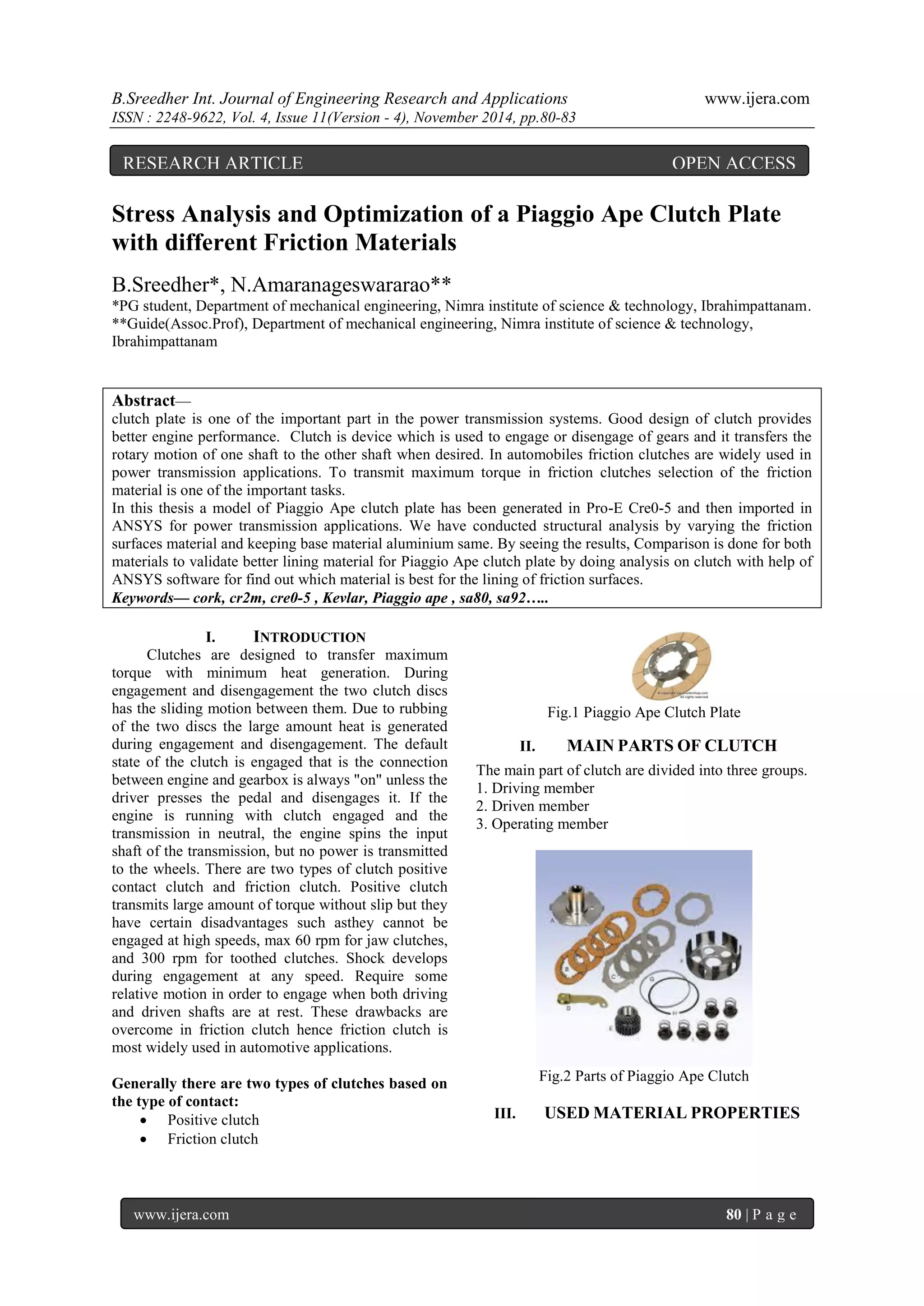
Fig.1 Piaggio Ape Clutch Plate 
II. MAIN PARTS OF CLUTCH 
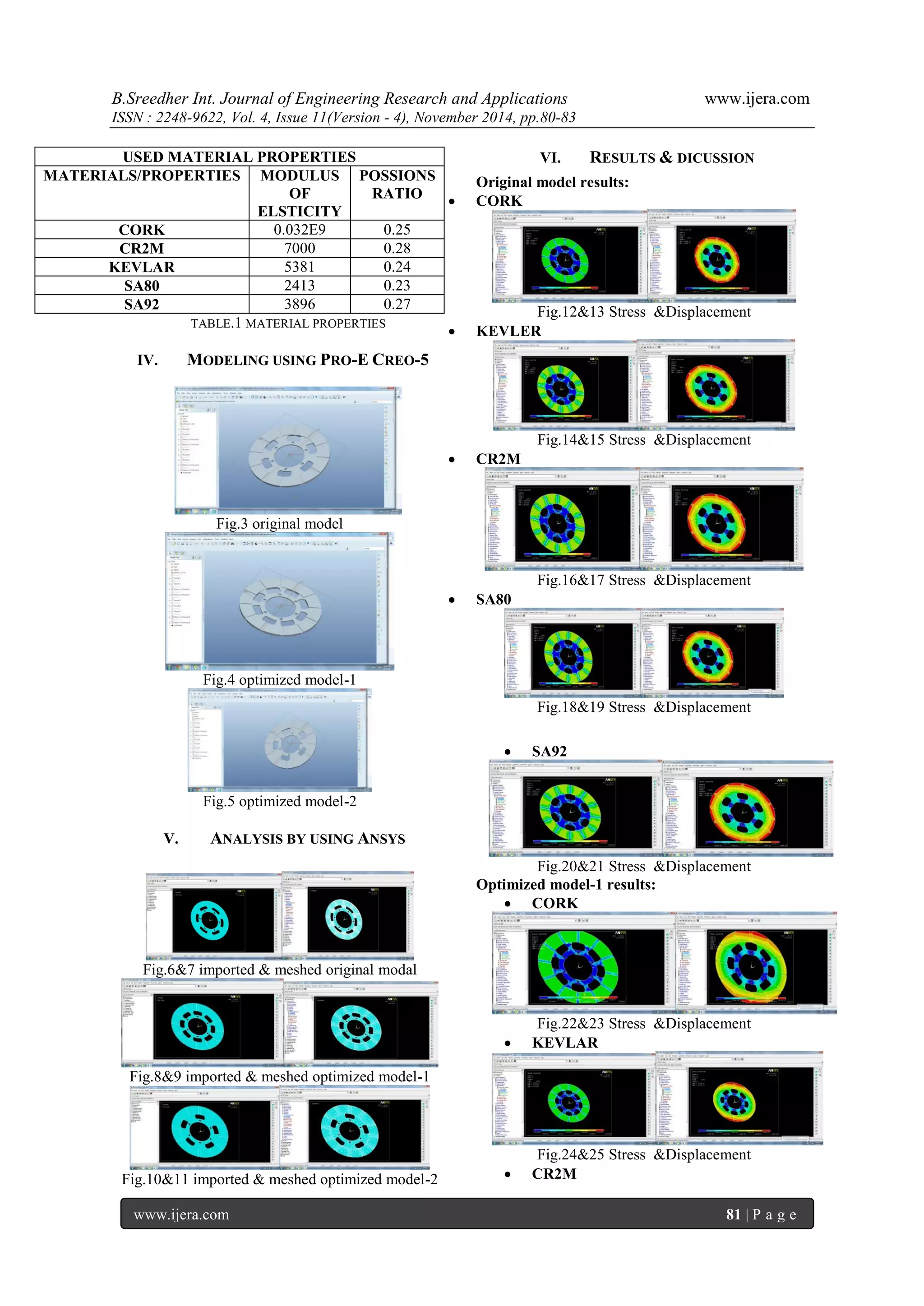
The main part of clutch are divided into three groups. 1. Driving member 2. Driven member 3. Operating member Fig.2 Parts of Piaggio Ape Clutch 
III. USED MATERIAL PROPERTIES 
RESEARCH ARTICLE OPEN ACCESS
B.Sreedher Int. Journal of Engineering Research and Applications www.ijera.com 
ISSN : 2248-9622, Vol. 4, Issue 11(Version - 4), November 2014, pp.80-83 
www.ijera.com 81 | P a g e 
USED MATERIAL PROPERTIES 
MATERIALS/PROPERTIES 
MODULUS OF ELSTICITY 
POSSIONS RATIO 
CORK 
0.032E9 
0.25 
CR2M 
7000 
0.28 
KEVLAR 
5381 
0.24 
SA80 
2413 
0.23 
SA92 
3896 
0.27 
TABLE.1 MATERIAL PROPERTIES 
IV. MODELING USING PRO-E CREO-5 
Fig.3 original model Fig.4 optimized model-1 Fig.5 optimized model-2 
V. ANALYSIS BY USING ANSYS 
Fig.6&7 imported & meshed original modal Fig.8&9 imported & meshed optimized model-1 Fig.10&11 imported & meshed optimized model-2 
VI. RESULTS & DICUSSION 
Original model results: 
 CORK Fig.12&13 Stress &Displacement 
 KEVLER Fig.14&15 Stress &Displacement 
 CR2M Fig.16&17 Stress &Displacement 
 SA80 Fig.18&19 Stress &Displacement 
 SA92 Fig.20&21 Stress &Displacement Optimized model-1 results: 
 CORK Fig.22&23 Stress &Displacement 
 KEVLAR Fig.24&25 Stress &Displacement 
 CR2M
B.Sreedher Int. Journal of Engineering Research and Applications www.ijera.com 
ISSN : 2248-9622, Vol. 4, Issue 11(Version - 4), November 2014, pp.80-83 
www.ijera.com 82 | P a g e 
Fig.26&27 Stress &Displacement 
 SA80 Fig.28&29 Stress &Displacement 
 SA92 Fig.30&31 Stress &Displacement Optimized model-2 results: 
 CORK Fig.32&33 Stress &Displacement 
 KEVLAR Fig.34&35 Stress &Displacement 
 CR2M Fig.36&37 Stress &Displacement 
 SA80 Fig.38&39 Stress &Displacement 
 SA92 Fig.40&41 Stress &Displacement 
VII. TABULATION OF RESULTS 
ORIGINAL MODEL 
OPTIMIZED MODEL-1 
OPTIMIZED MODEL-2 
STRESS 
DISPLACEMENT 
STRESS 
DISPLACEMENT 
STRESS 
DISPLACEMENT 
CORK 
235963 
268E7 
236509 
312E7 
232157 
255E7 
KEVLER 
225178 
136E3 
239808 
159E3 
235194 
130E3 
CR2M 
222216 
154E3 
235365 
178E3 
231103 
146E3 
SA80 
221574 
331E3 
234204 
382E3 
230031 
313E3 
SA92 
224295 
238E3 
238724 
275E3 
234204 
255E3 
VIII. CONCLUSION 
In our project we have designed a Piaggio Ape clutch plate using theoretical calculations. 2-D drawings are drafted from the calculations. 3-D model of the Piaggio Ape clutch plate are done in Pro-E Creo-5 software. Structural analysis is done on the friction plates to verify the strength. Friction materials used are CORK, KEVLER, CR2M, SA80 and SA92. By observing the analysis results, the maximum stress and total deformation values for hybrid SA80 are less than All other materials respective values. So we expected that for Piaggio Ape clutch plate using as hybrid SA80 friction material is advantageous than using cork or other friction materials. And if we compare the results of the model reference optimized model-2 have nearest values than the optimized model-1 so optimized model-2 advantageous than using optimized model-1 & original model. References: 
[1]. Timoshenko S., Element of Strength of Materials, Part I and II, Van Nastrond , NewJersey, 1956. 
[2]. Robert Cook, ―Finite Element Modeling for Stress Analysis‖, John Wiley & Sons, (1995). 
[3]. Timoshenho S. and J.N.Goodier, Theory of Elasticity, Mc Graw-Hill, New York,1970. 
[4]. Richards, T H, Energy Methods in Structural Analysis with an Introduction to Finite Element Techniques, Ellis Harwood Ltd., Chichester,1977. 
[5]. H. Blok, ―Fundamental Mechanical Aspects in Boundary Lubrication‖, SAE Trans. 46, pp. 54–68 (1940). 
[6]. M El-sherbiny, T P Newcomb, ―Temperature distributions in automotive dry clutches‖, Proceedings of the Institution of Mechanical Engineers 1847-1996, 1976, Vol. 190, pp. 359-365. 
[7]. Reddy J N , An Introduction to the finite element Method , Mc Graw Hill Book Co, Singapore, International student edition,1985.
B.Sreedher Int. Journal of Engineering Research and Applications www.ijera.com 
ISSN : 2248-9622, Vol. 4, Issue 11(Version - 4), November 2014, pp.80-83 
www.ijera.com 83 | P a g e 
[8]. F. F. Ling, ―A Quasi-Iterative Method for Computing Interface Temperature Distributions‖, Zeitschrift für angewandte Mathematik und Physik (ZAMP) 10, pp. 461–474 (1959). 
[9]. Desai C S and J F Abel, Introduction to the Finite Element method, Affiliated East-West press pvt. Ltd., New Delhi, East West student Edition, 1977. 
[10]. Argyris J H and S Kelsey, Energy Theorom and Structural analysis, Butlerworth, London, 1960. (Reprinted from Aaircraft Engg, 1954-55) 
[11]. Zeinkiewicz O C and K.Morgan, Finite element and approximation, John Wiley and Son, Inc., New York.1983.

Stress Analysis and Optimization of a Piaggio Ape Clutch Plate with different Friction Materials

  • 1.
    B.Sreedher Int. Journalof Engineering Research and Applications www.ijera.com ISSN : 2248-9622, Vol. 4, Issue 11(Version - 4), November 2014, pp.80-83 www.ijera.com 80 | P a g e Stress Analysis and Optimization of a Piaggio Ape Clutch Plate with different Friction Materials B.Sreedher*, N.Amaranageswararao** *PG student, Department of mechanical engineering, Nimra institute of science & technology, Ibrahimpattanam. **Guide(Assoc.Prof), Department of mechanical engineering, Nimra institute of science & technology, Ibrahimpattanam Abstract— clutch plate is one of the important part in the power transmission systems. Good design of clutch provides better engine performance. Clutch is device which is used to engage or disengage of gears and it transfers the rotary motion of one shaft to the other shaft when desired. In automobiles friction clutches are widely used in power transmission applications. To transmit maximum torque in friction clutches selection of the friction material is one of the important tasks. In this thesis a model of Piaggio Ape clutch plate has been generated in Pro-E Cre0-5 and then imported in ANSYS for power transmission applications. We have conducted structural analysis by varying the friction surfaces material and keeping base material aluminium same. By seeing the results, Comparison is done for both materials to validate better lining material for Piaggio Ape clutch plate by doing analysis on clutch with help of ANSYS software for find out which material is best for the lining of friction surfaces. Keywords— cork, cr2m, cre0-5 , Kevlar, Piaggio ape , sa80, sa92….. I. INTRODUCTION Clutches are designed to transfer maximum torque with minimum heat generation. During engagement and disengagement the two clutch discs has the sliding motion between them. Due to rubbing of the two discs the large amount heat is generated during engagement and disengagement. The default state of the clutch is engaged that is the connection between engine and gearbox is always "on" unless the driver presses the pedal and disengages it. If the engine is running with clutch engaged and the transmission in neutral, the engine spins the input shaft of the transmission, but no power is transmitted to the wheels. There are two types of clutch positive contact clutch and friction clutch. Positive clutch transmits large amount of torque without slip but they have certain disadvantages such asthey cannot be engaged at high speeds, max 60 rpm for jaw clutches, and 300 rpm for toothed clutches. Shock develops during engagement at any speed. Require some relative motion in order to engage when both driving and driven shafts are at rest. These drawbacks are overcome in friction clutch hence friction clutch is most widely used in automotive applications. Generally there are two types of clutches based on the type of contact:  Positive clutch  Friction clutch Fig.1 Piaggio Ape Clutch Plate II. MAIN PARTS OF CLUTCH The main part of clutch are divided into three groups. 1. Driving member 2. Driven member 3. Operating member Fig.2 Parts of Piaggio Ape Clutch III. USED MATERIAL PROPERTIES RESEARCH ARTICLE OPEN ACCESS
  • 2.
    B.Sreedher Int. Journalof Engineering Research and Applications www.ijera.com ISSN : 2248-9622, Vol. 4, Issue 11(Version - 4), November 2014, pp.80-83 www.ijera.com 81 | P a g e USED MATERIAL PROPERTIES MATERIALS/PROPERTIES MODULUS OF ELSTICITY POSSIONS RATIO CORK 0.032E9 0.25 CR2M 7000 0.28 KEVLAR 5381 0.24 SA80 2413 0.23 SA92 3896 0.27 TABLE.1 MATERIAL PROPERTIES IV. MODELING USING PRO-E CREO-5 Fig.3 original model Fig.4 optimized model-1 Fig.5 optimized model-2 V. ANALYSIS BY USING ANSYS Fig.6&7 imported & meshed original modal Fig.8&9 imported & meshed optimized model-1 Fig.10&11 imported & meshed optimized model-2 VI. RESULTS & DICUSSION Original model results:  CORK Fig.12&13 Stress &Displacement  KEVLER Fig.14&15 Stress &Displacement  CR2M Fig.16&17 Stress &Displacement  SA80 Fig.18&19 Stress &Displacement  SA92 Fig.20&21 Stress &Displacement Optimized model-1 results:  CORK Fig.22&23 Stress &Displacement  KEVLAR Fig.24&25 Stress &Displacement  CR2M
  • 3.
    B.Sreedher Int. Journalof Engineering Research and Applications www.ijera.com ISSN : 2248-9622, Vol. 4, Issue 11(Version - 4), November 2014, pp.80-83 www.ijera.com 82 | P a g e Fig.26&27 Stress &Displacement  SA80 Fig.28&29 Stress &Displacement  SA92 Fig.30&31 Stress &Displacement Optimized model-2 results:  CORK Fig.32&33 Stress &Displacement  KEVLAR Fig.34&35 Stress &Displacement  CR2M Fig.36&37 Stress &Displacement  SA80 Fig.38&39 Stress &Displacement  SA92 Fig.40&41 Stress &Displacement VII. TABULATION OF RESULTS ORIGINAL MODEL OPTIMIZED MODEL-1 OPTIMIZED MODEL-2 STRESS DISPLACEMENT STRESS DISPLACEMENT STRESS DISPLACEMENT CORK 235963 268E7 236509 312E7 232157 255E7 KEVLER 225178 136E3 239808 159E3 235194 130E3 CR2M 222216 154E3 235365 178E3 231103 146E3 SA80 221574 331E3 234204 382E3 230031 313E3 SA92 224295 238E3 238724 275E3 234204 255E3 VIII. CONCLUSION In our project we have designed a Piaggio Ape clutch plate using theoretical calculations. 2-D drawings are drafted from the calculations. 3-D model of the Piaggio Ape clutch plate are done in Pro-E Creo-5 software. Structural analysis is done on the friction plates to verify the strength. Friction materials used are CORK, KEVLER, CR2M, SA80 and SA92. By observing the analysis results, the maximum stress and total deformation values for hybrid SA80 are less than All other materials respective values. So we expected that for Piaggio Ape clutch plate using as hybrid SA80 friction material is advantageous than using cork or other friction materials. And if we compare the results of the model reference optimized model-2 have nearest values than the optimized model-1 so optimized model-2 advantageous than using optimized model-1 & original model. References: [1]. Timoshenko S., Element of Strength of Materials, Part I and II, Van Nastrond , NewJersey, 1956. [2]. Robert Cook, ―Finite Element Modeling for Stress Analysis‖, John Wiley & Sons, (1995). [3]. Timoshenho S. and J.N.Goodier, Theory of Elasticity, Mc Graw-Hill, New York,1970. [4]. Richards, T H, Energy Methods in Structural Analysis with an Introduction to Finite Element Techniques, Ellis Harwood Ltd., Chichester,1977. [5]. H. Blok, ―Fundamental Mechanical Aspects in Boundary Lubrication‖, SAE Trans. 46, pp. 54–68 (1940). [6]. M El-sherbiny, T P Newcomb, ―Temperature distributions in automotive dry clutches‖, Proceedings of the Institution of Mechanical Engineers 1847-1996, 1976, Vol. 190, pp. 359-365. [7]. Reddy J N , An Introduction to the finite element Method , Mc Graw Hill Book Co, Singapore, International student edition,1985.
  • 4.
    B.Sreedher Int. Journalof Engineering Research and Applications www.ijera.com ISSN : 2248-9622, Vol. 4, Issue 11(Version - 4), November 2014, pp.80-83 www.ijera.com 83 | P a g e [8]. F. F. Ling, ―A Quasi-Iterative Method for Computing Interface Temperature Distributions‖, Zeitschrift für angewandte Mathematik und Physik (ZAMP) 10, pp. 461–474 (1959). [9]. Desai C S and J F Abel, Introduction to the Finite Element method, Affiliated East-West press pvt. Ltd., New Delhi, East West student Edition, 1977. [10]. Argyris J H and S Kelsey, Energy Theorom and Structural analysis, Butlerworth, London, 1960. (Reprinted from Aaircraft Engg, 1954-55) [11]. Zeinkiewicz O C and K.Morgan, Finite element and approximation, John Wiley and Son, Inc., New York.1983.