ADAMA SCIENCE AND TECHNOLOGY UNIVERSITY
SCHOOL OF MECHANICAL, CHEMICALAND MATERIAL ENGINEERING
DEPARTMENT OF MECHANICAL ENGINEERING
Design of Machine Element II ; MEng 4207
CHAPTER-2
CLUTCHES
Prepared by: Dr GM Sayeed Ahmed
Reviewed by: Mulugeta Hagos
Date, 10-11-2023
03/01/2024
Contents
1. Introduction.
2. Types of Clutches.
3. Positive Clutches.
4. Friction Clutches.
5. Material for Friction Surfaces.
6. Considerations in Designing a Friction Clutch.
7. Types of Friction Clutches.
8. Single Disc or Plate Clutch.
9. Design of a Disc or Plate Clutch. 10. Multiple Disc Clutch.
10. Reference
Chapter 2 : COUPLINGS AND CLUTCH
LEARNING OUTCOMES/ Note:- Don’t forget to use measurable words based on the
bloom taxonomy and consider use higher order words according to the students level.
After our discussions students expected to:
 Explain the difference Coupling & Clutches.
 Describe in Types of Coupling such as Rigid coupling and flexible coupling and induced stress.
 Discuss the strength, stress in Rigid coupling and flexible coupling.
 Describe Clutches: Positive clutches and Analyzing friction clutches with respect to Heat dissipation.
CLUTCHES
Introduction
 A clutch is a machine member used to connect a driving shaft to a driven shaft so that the driven shaft
may be started or stopped at will, without stopping the driving shaft.
 The use of a clutch is mostly found in automobiles. A little consideration will show that in order to
change gears or to stop the vehicle, it is required that the driven shaft should stop, but the engine
should continue to run.
 It is, therefore, necessary that the driven shaft should be disengaged from the driving shaft.
 The engagement and disengagement of the shafts is obtained by means of a clutch which is operated by
a lever.
 Types of Clutches Following are the two main types of clutches commonly used in engineering practice
1. Positive clutches and 2. Friction clutches
Positive Clutches:
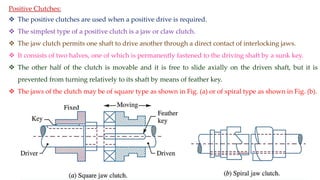
 The positive clutches are used when a positive drive is required.
 The simplest type of a positive clutch is a jaw or claw clutch.
 The jaw clutch permits one shaft to drive another through a direct contact of interlocking jaws.
 It consists of two halves, one of which is permanently fastened to the driving shaft by a sunk key.
 The other half of the clutch is movable and it is free to slide axially on the driven shaft, but it is
prevented from turning relatively to its shaft by means of feather key.
 The jaws of the clutch may be of square type as shown in Fig. (a) or of spiral type as shown in Fig. (b).
A square jaw type is used where engagement and disengagement in motion and under
load is not necessary.
This type of clutch will transmit power in either direction of rotation.
The spiral jaws may be left-hand or right-hand, because power transmitted by them is
in one direction only.
This type of clutch is occasionally used where the clutch must be engaged and
disengaged while in motion.
The use of jaw clutches are frequently applied to sprocket wheels, gears and pulleys.
In such a case, the non-sliding part is made integral with the hub.
Friction Clutches
 A friction clutch has its principal application in the transmission of power of shafts and machines which
must be started and stopped frequently. Its application is also found in cases in which power is to be
delivered to machines partially or fully loaded.
 The force of friction is used to start the driven shaft from rest and gradually brings it up to the proper
speed without excessive slipping of the friction surfaces. In automobiles, friction clutch is used to
connect the engine to the drive shaft.
 In operating such a clutch, care should be taken so that the friction surfaces engage easily and gradually
bring the driven shaft up to proper speed.
 The proper alignment of the bearing must be maintained and it should be located as close to the clutch
as possible.
 1. The contact surfaces should develop a frictional force that may pick up and hold the load with
reasonably low pressure between the contact surfaces.
 2. The heat of friction should be rapidly *dissipated and tendency to grab should be at a minimum.
 3. The surfaces should be backed by a material stiff enough to ensure a reasonably uniform distribution
of pressure.
Material for Friction Surfaces The material used for lining of friction surfaces of a clutch
should have the following characteristics
During operation of a clutch, most of the work done against frictional forces opposing
the motion is liberated as heat at the interface. It has been found that at the actual point
of contact, the temperature as high as 1000°C is reached for a very short duration (i.e. for
0.0001 second). Due to this, the temperature of the contact surfaces will increase and may
destroy the clutch.
1. It should have a high and uniform coefficient of friction.
2. It should not be affected by moisture and oil.
3. It should have the ability to withstand high temperatures caused by slippage.
4. It should have high heat conductivity.
5. It should have high resistance to wear and scoring. The materials commonly used for
lining of friction surfaces .
Properties of materials commonly used for lining of friction surfaces
Considerations in Designing a Friction Clutch
The following considerations must be kept in mind while designing a friction clutch.
1. The suitable material forming the contact surfaces should be selected.
2. The moving parts of the clutch should have low weight in order to minimize the
inertia load, especially in high speed service.
3. The clutch should not require any external force to maintain contact of the friction
surfaces.
4. The provision for taking up wear of the contact surfaces must be provided.
5. The clutch should have provision for facilitating repairs.
6. The clutch should have provision for carrying away the heat generated at the contact
surfaces.
7. The projecting parts of the clutch should be covered by guard.
Types of Friction Clutches
Though there are many types of friction clutches, yet the following are important from
the subject point of view :
1. Disc or plate clutches (single disc or multiple disc clutch),
2. Cone clutches, and
3. Centrifugal clutches.
We shall now discuss these clutches, in detail, in the following pages.
Note : The disc and cone clutches are known as axial friction clutches, while centrifugal
clutch is called radial friction clutch
Single Disc or Plate Clutch
 A single disc or plate clutch, as shown in Fig,
consists of a clutch plate whose both sides are
faced with a frictional material (usually of
Ferrodo).
 It is mounted on the hub which is free to move
axially along the splines of the driven shaft.
 The pressure plate is mounted inside the clutch
body which is bolted to the flywheel.
 Both the pressure plate and the flywheel rotate
with the engine crankshaft or the driving shaft.
 The pressure plate pushes the clutch plate
towards the flywheel by a set of strong springs
which are arranged radially inside the body.
 The three levers (also known as release levers
or fingers) are carried on pivots suspended
from the case of the body.
 These are arranged in such a manner so that the pressure plate
moves away from the flywheel by the inward movement of a
thrust bearing.
 The bearing is mounted upon a forked shaft and moves
forward when the clutch pedal is pressed
 When the clutch pedal is pressed down, its linkage forces the thrust release bearing to
move in towards the flywheel and pressing the longer ends of the levers inward.
 The levers are forced to turn on their suspended pivot and the pressure plate moves
away from the flywheel by the knife edges, thereby compressing the clutch springs.
This action removes the pressure from the clutch plate and thus moves back from the
flywheel and the driven shaft becomes stationary.
 On the other hand, when the foot is taken off from the clutch pedal, the thrust bearing
moves back by the levers. This allows the springs to extend and thus the pressure
plate pushes the clutch plate back towards the flywheel.
 The axial pressure exerted by the spring provides a frictional force in the
circumferential direction when the relative motion between the driving and driven
members tends to take place.
 If the torque due to this frictional force exceeds the torque to be transmitted, then no
slipping takes place and the power is transmitted from the driving shaft to the driven
Design of a Disc or Plate Clutch
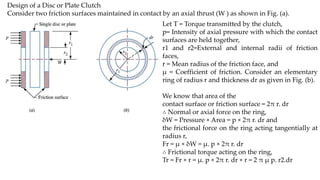
Consider two friction surfaces maintained in contact by an axial thrust (W ) as shown in Fig. (a).
Let T = Torque transmitted by the clutch,
p= Intensity of axial pressure with which the contact
surfaces are held together,
r1 and r2=External and internal radii of friction
faces,
r = Mean radius of the friction face, and
μ = Coefficient of friction. Consider an elementary
ring of radius r and thickness dr as given in Fig. (b).
We know that area of the
contact surface or friction surface = 2π r. dr
∴ Normal or axial force on the ring,
δW = Pressure × Area = p × 2π r. dr and
the frictional force on the ring acting tangentially at
radius r,
Fr = μ × δW = μ. p × 2π r. dr
∴ Frictional torque acting on the ring,
Tr = Fr × r = μ. p × 2π r. dr × r = 2 π μ p. r2.dr
We shall now consider the following two cases :
When there is a uniform pressure, and 2. When there is a uniform axial wear.
Considering uniform pressure.
When the pressure is uniformly distributed over the entire area of the friction face as shown in Fig. (a),
then the intensity of pressure.
2. Considering uniform axial wear.
The basic principle in designing machine parts that are subjected to wear due to sliding friction is that the
normal wear is proportional to the work of friction. The work of friction is proportional to the product of
normal pressure ( p) and the sliding velocity (V). Therefore, Normal wear ∝ Work of friction ∝ p.V or p.V
= K (a constant) or p = K/V ...(i)
It may be noted that when the friction surface is new, there is a uniform pressure distribution over the
entire contact surface. This pressure will wear most rapidly where the sliding velocity is maximum and
this will reduce the pressure between the friction surfaces.
This wearing-in process continues until the product p.V is constant over the entire surface. After this, the
wear will be uniform as shown in Fig. Let p be the normal intensity of pressure at a distance r from the
axis of the clutch. Since the intensity of pressure varies inversely with the distance, therefore
Reference / Check whether the reference books are available in the university
library/eLibrary or not.
Overall Best: Shigley’s Mechanical Engineering Design by J. Keith Nisbeth and Richard G. Budynas
Second Overall Best: Machine Design – An Integrated Approach by Robert L. Norton
Best For Beginners: A Textbook of Machine Design by R.S. Khurami and J.K. Gupta
Best For Practice Problem: Fundamentals of Machine Component Design by Robert Juvinall and Kurt
Marshek

Chapter 2-CLUTCHES-Lecture pptx.pptx

  • 1.
    ADAMA SCIENCE ANDTECHNOLOGY UNIVERSITY SCHOOL OF MECHANICAL, CHEMICALAND MATERIAL ENGINEERING DEPARTMENT OF MECHANICAL ENGINEERING Design of Machine Element II ; MEng 4207 CHAPTER-2 CLUTCHES Prepared by: Dr GM Sayeed Ahmed Reviewed by: Mulugeta Hagos Date, 10-11-2023 03/01/2024
  • 2.
    Contents 1. Introduction. 2. Typesof Clutches. 3. Positive Clutches. 4. Friction Clutches. 5. Material for Friction Surfaces. 6. Considerations in Designing a Friction Clutch. 7. Types of Friction Clutches. 8. Single Disc or Plate Clutch. 9. Design of a Disc or Plate Clutch. 10. Multiple Disc Clutch. 10. Reference
  • 3.
    Chapter 2 :COUPLINGS AND CLUTCH LEARNING OUTCOMES/ Note:- Don’t forget to use measurable words based on the bloom taxonomy and consider use higher order words according to the students level. After our discussions students expected to:  Explain the difference Coupling & Clutches.  Describe in Types of Coupling such as Rigid coupling and flexible coupling and induced stress.  Discuss the strength, stress in Rigid coupling and flexible coupling.  Describe Clutches: Positive clutches and Analyzing friction clutches with respect to Heat dissipation.
  • 4.
    CLUTCHES Introduction  A clutchis a machine member used to connect a driving shaft to a driven shaft so that the driven shaft may be started or stopped at will, without stopping the driving shaft.  The use of a clutch is mostly found in automobiles. A little consideration will show that in order to change gears or to stop the vehicle, it is required that the driven shaft should stop, but the engine should continue to run.  It is, therefore, necessary that the driven shaft should be disengaged from the driving shaft.  The engagement and disengagement of the shafts is obtained by means of a clutch which is operated by a lever.  Types of Clutches Following are the two main types of clutches commonly used in engineering practice 1. Positive clutches and 2. Friction clutches
  • 5.
    Positive Clutches:  Thepositive clutches are used when a positive drive is required.  The simplest type of a positive clutch is a jaw or claw clutch.  The jaw clutch permits one shaft to drive another through a direct contact of interlocking jaws.  It consists of two halves, one of which is permanently fastened to the driving shaft by a sunk key.  The other half of the clutch is movable and it is free to slide axially on the driven shaft, but it is prevented from turning relatively to its shaft by means of feather key.  The jaws of the clutch may be of square type as shown in Fig. (a) or of spiral type as shown in Fig. (b).
  • 6.
    A square jawtype is used where engagement and disengagement in motion and under load is not necessary. This type of clutch will transmit power in either direction of rotation. The spiral jaws may be left-hand or right-hand, because power transmitted by them is in one direction only. This type of clutch is occasionally used where the clutch must be engaged and disengaged while in motion. The use of jaw clutches are frequently applied to sprocket wheels, gears and pulleys. In such a case, the non-sliding part is made integral with the hub.
  • 7.
    Friction Clutches  Afriction clutch has its principal application in the transmission of power of shafts and machines which must be started and stopped frequently. Its application is also found in cases in which power is to be delivered to machines partially or fully loaded.  The force of friction is used to start the driven shaft from rest and gradually brings it up to the proper speed without excessive slipping of the friction surfaces. In automobiles, friction clutch is used to connect the engine to the drive shaft.  In operating such a clutch, care should be taken so that the friction surfaces engage easily and gradually bring the driven shaft up to proper speed.  The proper alignment of the bearing must be maintained and it should be located as close to the clutch as possible.  1. The contact surfaces should develop a frictional force that may pick up and hold the load with reasonably low pressure between the contact surfaces.  2. The heat of friction should be rapidly *dissipated and tendency to grab should be at a minimum.  3. The surfaces should be backed by a material stiff enough to ensure a reasonably uniform distribution of pressure.
  • 8.
    Material for FrictionSurfaces The material used for lining of friction surfaces of a clutch should have the following characteristics During operation of a clutch, most of the work done against frictional forces opposing the motion is liberated as heat at the interface. It has been found that at the actual point of contact, the temperature as high as 1000°C is reached for a very short duration (i.e. for 0.0001 second). Due to this, the temperature of the contact surfaces will increase and may destroy the clutch. 1. It should have a high and uniform coefficient of friction. 2. It should not be affected by moisture and oil. 3. It should have the ability to withstand high temperatures caused by slippage. 4. It should have high heat conductivity. 5. It should have high resistance to wear and scoring. The materials commonly used for lining of friction surfaces .
  • 9.
    Properties of materialscommonly used for lining of friction surfaces
  • 10.
    Considerations in Designinga Friction Clutch The following considerations must be kept in mind while designing a friction clutch. 1. The suitable material forming the contact surfaces should be selected. 2. The moving parts of the clutch should have low weight in order to minimize the inertia load, especially in high speed service. 3. The clutch should not require any external force to maintain contact of the friction surfaces. 4. The provision for taking up wear of the contact surfaces must be provided. 5. The clutch should have provision for facilitating repairs. 6. The clutch should have provision for carrying away the heat generated at the contact surfaces. 7. The projecting parts of the clutch should be covered by guard.
  • 11.
    Types of FrictionClutches Though there are many types of friction clutches, yet the following are important from the subject point of view : 1. Disc or plate clutches (single disc or multiple disc clutch), 2. Cone clutches, and 3. Centrifugal clutches. We shall now discuss these clutches, in detail, in the following pages. Note : The disc and cone clutches are known as axial friction clutches, while centrifugal clutch is called radial friction clutch
  • 12.
    Single Disc orPlate Clutch  A single disc or plate clutch, as shown in Fig, consists of a clutch plate whose both sides are faced with a frictional material (usually of Ferrodo).  It is mounted on the hub which is free to move axially along the splines of the driven shaft.  The pressure plate is mounted inside the clutch body which is bolted to the flywheel.  Both the pressure plate and the flywheel rotate with the engine crankshaft or the driving shaft.  The pressure plate pushes the clutch plate towards the flywheel by a set of strong springs which are arranged radially inside the body.  The three levers (also known as release levers or fingers) are carried on pivots suspended from the case of the body.  These are arranged in such a manner so that the pressure plate moves away from the flywheel by the inward movement of a thrust bearing.  The bearing is mounted upon a forked shaft and moves forward when the clutch pedal is pressed
  • 13.
     When theclutch pedal is pressed down, its linkage forces the thrust release bearing to move in towards the flywheel and pressing the longer ends of the levers inward.  The levers are forced to turn on their suspended pivot and the pressure plate moves away from the flywheel by the knife edges, thereby compressing the clutch springs. This action removes the pressure from the clutch plate and thus moves back from the flywheel and the driven shaft becomes stationary.  On the other hand, when the foot is taken off from the clutch pedal, the thrust bearing moves back by the levers. This allows the springs to extend and thus the pressure plate pushes the clutch plate back towards the flywheel.  The axial pressure exerted by the spring provides a frictional force in the circumferential direction when the relative motion between the driving and driven members tends to take place.  If the torque due to this frictional force exceeds the torque to be transmitted, then no slipping takes place and the power is transmitted from the driving shaft to the driven
  • 14.
    Design of aDisc or Plate Clutch Consider two friction surfaces maintained in contact by an axial thrust (W ) as shown in Fig. (a). Let T = Torque transmitted by the clutch, p= Intensity of axial pressure with which the contact surfaces are held together, r1 and r2=External and internal radii of friction faces, r = Mean radius of the friction face, and μ = Coefficient of friction. Consider an elementary ring of radius r and thickness dr as given in Fig. (b). We know that area of the contact surface or friction surface = 2π r. dr ∴ Normal or axial force on the ring, δW = Pressure × Area = p × 2π r. dr and the frictional force on the ring acting tangentially at radius r, Fr = μ × δW = μ. p × 2π r. dr ∴ Frictional torque acting on the ring, Tr = Fr × r = μ. p × 2π r. dr × r = 2 π μ p. r2.dr
  • 15.
    We shall nowconsider the following two cases : When there is a uniform pressure, and 2. When there is a uniform axial wear. Considering uniform pressure. When the pressure is uniformly distributed over the entire area of the friction face as shown in Fig. (a), then the intensity of pressure.
  • 16.
    2. Considering uniformaxial wear. The basic principle in designing machine parts that are subjected to wear due to sliding friction is that the normal wear is proportional to the work of friction. The work of friction is proportional to the product of normal pressure ( p) and the sliding velocity (V). Therefore, Normal wear ∝ Work of friction ∝ p.V or p.V = K (a constant) or p = K/V ...(i) It may be noted that when the friction surface is new, there is a uniform pressure distribution over the entire contact surface. This pressure will wear most rapidly where the sliding velocity is maximum and this will reduce the pressure between the friction surfaces. This wearing-in process continues until the product p.V is constant over the entire surface. After this, the wear will be uniform as shown in Fig. Let p be the normal intensity of pressure at a distance r from the axis of the clutch. Since the intensity of pressure varies inversely with the distance, therefore
  • 19.
    Reference / Checkwhether the reference books are available in the university library/eLibrary or not. Overall Best: Shigley’s Mechanical Engineering Design by J. Keith Nisbeth and Richard G. Budynas Second Overall Best: Machine Design – An Integrated Approach by Robert L. Norton Best For Beginners: A Textbook of Machine Design by R.S. Khurami and J.K. Gupta Best For Practice Problem: Fundamentals of Machine Component Design by Robert Juvinall and Kurt Marshek