LEXICAL
STYLISTIC DEVICES
General overview of some frequently used SD
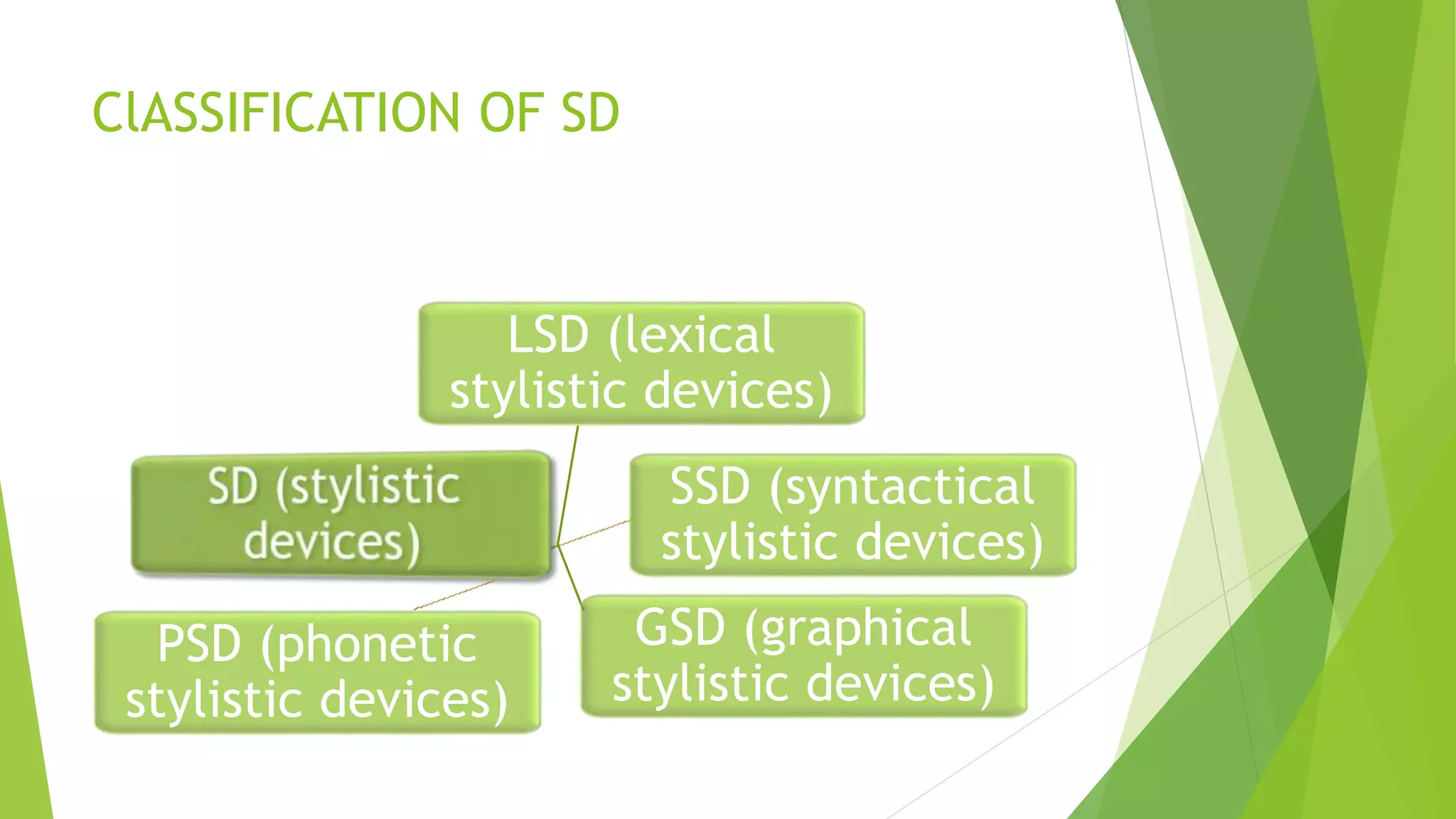
ClASSIFICATION OF SD
LSD (lexical
stylistic devices)
SSD (syntactical
stylistic devices)
GSD (graphical
stylistic devices)
PSD (phonetic
stylistic devices)
Lexical Stylistic Devices based on the
interaction of different types of meanings
zeugma/pun/metonomy/irony
oxymoron/antonomasia
metaphor/epithet/personification
Zeugma
 Zeugma is a figure of speech where one word applies to
multiple parts of the sentence causing the comic effect, e.g.:
1) She opened her door and her heart (sematic contrast, different
categories are united by one verb i.e. OPENED)
2) He lost his coat and his temper (funny juxtaposition);
3) Шел дождь и отряд красноармейцев
Pun (каламбур)
 Pun (or paranomasia) is basically a play of words, e.g.:
1) What is the difference between a schoolmaster and an engine-
driver? - One trains the mind and the other minds the train.
Play of words: train/mind & minds train.
2) “Have you been seeing any spirits?” - “Or taking any?”
The word ‘Spirit’ has multiple meanings: ghost & алкогольный
напиток.
Metonomy (symbolic presentation of
smth)
 A metonymy is a word or phrase that is used to stand in for
another word, e.g.:
1) They were the favorites of the king’s court:
The word «court» is reffered to all those who surrounded the
ruler.
2) The White House will be announcing the decision around noon
today:
White House symbolizes the head of USA institutional power.
Antonomasia (the type of metonomy used to
characterise the person/character)
1) They are dedicated soldiers of the British Crown.
Crown is used instead of the proper name i.e. Elizabeth II.
2) «I adore The Fab Four, so I can listen to their magnificent music
for hours...»
The Fab Four = The Beatles (легендарная/великолепная
четверка)
Irony
 Irony is a figure of speech in which words are used in a way
that their intended meaning is different (or they make a
contrast with system of values the person posesses), e.g.:
«Donald Trumps is aware of what does it mean to be a true
American! His wife, his dog and his ex wife are indigenous
americans as well!»
(in reality, Melania Tramp is an immigrant. The irony is used to
challenge Tramp’s ideas of ‘ethnic purity’ as a part of his political
image).
Oxymoron (combination of contradictive
meanings)
 - a combination of words that have opposite or very different
meanings, e.g.:
1) "the same difference.«
This phrase qualifies is an oxymoron because the words "same" and
"difference" have completely opposite meanings. Therefore, bringing
them together into one phrase produces a verbally puzzling, yet funny
effect.
2) Random order
- juxtaposition of contrasting meanings
3) "I can resist everything, except temptation." - Oscar Wilde
4) "I am a deeply superficial person." - Andy Warhol
Metaphor
 A metaphor is a figure of speech that refers to one thing by mentioning another thing, putting
together the words from different semantic categories, e.g.:
1) a mirror of peaceful lake:
+ = Mirror of the Lake
2) I am so excited. My pulse is a race car!
+ = Pulse is a race car
Epithet
 Epithet describes a place/thing/person in such a way that it
makes the characteristics of a person/thing/place more
prominent than they actually are. Also, it is known as a
‘descriptive title’, e.g.:
1) She gave him a knowing smile;
2) A scornful eye;
3) Snowy white pillow;
4) True Midnight Blues etc.
Personification
 Personification = giving human qualities to an object or
animal, e.g.:
The stars danced playfully in the moonlit sky;
She did not realize that opportunity was knocking at her door;
The ocean danced in the moonlight etc.
Lexical Stylistic Devices based on the
intensification of a feature of a
thing/phenomenon:
Simile/ hyperbole/ periphrasis
Simile
 Colorful comparison used for the stylistic purposes, e.g.:
As busy as a bee;
You were as brave as a lion;
Watching the show was like watching grass grow (i.e. boring);
As sure as death and taxes etc.
Commonly accompanied by particles: ‘as/as’ & ‘just like
(smth/someone)’ etc.
Hyperbole
 is an exaggeration which may be used for emphasis and humor, e.g.:
I am so hungry I could eat a horse;
Her brain is the size of a pea;
He was skinny enough to jump through a keyhole (замочная скважина);
Everybody knows that etc.
Periphrasis
 Periphrasis is basically the symbolic renaming of an object for
some rhetorical reasons, e.g.:
My lips are closed upon the past from this hour = Meaning: I won’t
say a word about the past);
This show is intended for the fair sex audience = Meaning: This
show is created for women.
Lexical Stylistic Devices: Peculiar Use of Set
Expressions
Cliche/proverb/allusion/quotation.
Cliche
 A cliche is generally defined as an expression that has become
hackneyed and trite. It has lost its precise meaning by constant
reiteration: in other words it has become stereotyped, e.g.:
Rosy dreams of youth;
Growing awareness;
Commonly known;
Needless to say;
It is not a secret that etc.
Proverb
 Proverbs are short, well-known, supposedly wise sayings, usually in
simple language, e.g.:
Never say never;
You can't get blood of a stone;
Absence makes the heart grow
fonder etc.
PROVERB
Absence makes the heart
grow fonder
MEANING
Being away from someone or
something for a period of
time makes you appreciate
that person or thing more
when you see them or it
again
EXAMPLE
“I used to hate going to my
aunt’s house, but now I kind
of miss it. Absence makes the
heart grow fonder.”
Allusion
 a figure of speech that makes a reference to a place/ person/event of
historical, cultural, literary or political significance, etc.:
1) “You are a Solomon when it comes to making decisions.” This refers to
King Solomon, who was very wise.
2) “It is raining so hard, I hope it doesn’t rain for 40 days and 40 nights.”
This makes a reference to the biblical story of Noah and the ark he built.
He was told by God that it would rain for 40 days and 40 nights and flood
the land.
3) Andy Warhol commented on the explosion of media coverage by saying,
"In the future, everyone will be world-famous for 15 minutes." Today,
when someone receives a great deal of media attention for something
fairly trivial, and he or she is said to be experiencing his or her "15
minutes of fame", the allusion is to Andy Warhol's famous remark.
Quotation
 The repetition of one’s expression for stylistic/rhetorical reasons,
e.g.:
1) "Success is most often achieved by those who don't know that failure
is inevitable." -- Coco Chanel
2) "Success is walking from failure to failure with no loss of
enthusiasm."
- Winston Churchill
3) "Try not to become a person of success, but rather try to become a
person of value." -- Albert Einstein
4) "If you can't explain it simply, you don't understand it well enough."
- Albert Einstein

L Stylistic devices.pptx

  • 1.
  • 2.
    ClASSIFICATION OF SD LSD(lexical stylistic devices) SSD (syntactical stylistic devices) GSD (graphical stylistic devices) PSD (phonetic stylistic devices)
  • 3.
    Lexical Stylistic Devicesbased on the interaction of different types of meanings zeugma/pun/metonomy/irony oxymoron/antonomasia metaphor/epithet/personification
  • 4.
    Zeugma  Zeugma isa figure of speech where one word applies to multiple parts of the sentence causing the comic effect, e.g.: 1) She opened her door and her heart (sematic contrast, different categories are united by one verb i.e. OPENED) 2) He lost his coat and his temper (funny juxtaposition); 3) Шел дождь и отряд красноармейцев
  • 5.
    Pun (каламбур)  Pun(or paranomasia) is basically a play of words, e.g.: 1) What is the difference between a schoolmaster and an engine- driver? - One trains the mind and the other minds the train. Play of words: train/mind & minds train. 2) “Have you been seeing any spirits?” - “Or taking any?” The word ‘Spirit’ has multiple meanings: ghost & алкогольный напиток.
  • 6.
    Metonomy (symbolic presentationof smth)  A metonymy is a word or phrase that is used to stand in for another word, e.g.: 1) They were the favorites of the king’s court: The word «court» is reffered to all those who surrounded the ruler. 2) The White House will be announcing the decision around noon today: White House symbolizes the head of USA institutional power.
  • 7.
    Antonomasia (the typeof metonomy used to characterise the person/character) 1) They are dedicated soldiers of the British Crown. Crown is used instead of the proper name i.e. Elizabeth II. 2) «I adore The Fab Four, so I can listen to their magnificent music for hours...» The Fab Four = The Beatles (легендарная/великолепная четверка)
  • 8.
    Irony  Irony isa figure of speech in which words are used in a way that their intended meaning is different (or they make a contrast with system of values the person posesses), e.g.: «Donald Trumps is aware of what does it mean to be a true American! His wife, his dog and his ex wife are indigenous americans as well!» (in reality, Melania Tramp is an immigrant. The irony is used to challenge Tramp’s ideas of ‘ethnic purity’ as a part of his political image).
  • 9.
    Oxymoron (combination ofcontradictive meanings)  - a combination of words that have opposite or very different meanings, e.g.: 1) "the same difference.« This phrase qualifies is an oxymoron because the words "same" and "difference" have completely opposite meanings. Therefore, bringing them together into one phrase produces a verbally puzzling, yet funny effect. 2) Random order - juxtaposition of contrasting meanings 3) "I can resist everything, except temptation." - Oscar Wilde 4) "I am a deeply superficial person." - Andy Warhol
  • 10.
    Metaphor  A metaphoris a figure of speech that refers to one thing by mentioning another thing, putting together the words from different semantic categories, e.g.: 1) a mirror of peaceful lake: + = Mirror of the Lake 2) I am so excited. My pulse is a race car! + = Pulse is a race car
  • 11.
    Epithet  Epithet describesa place/thing/person in such a way that it makes the characteristics of a person/thing/place more prominent than they actually are. Also, it is known as a ‘descriptive title’, e.g.: 1) She gave him a knowing smile; 2) A scornful eye; 3) Snowy white pillow; 4) True Midnight Blues etc.
  • 12.
    Personification  Personification =giving human qualities to an object or animal, e.g.: The stars danced playfully in the moonlit sky; She did not realize that opportunity was knocking at her door; The ocean danced in the moonlight etc.
  • 13.
    Lexical Stylistic Devicesbased on the intensification of a feature of a thing/phenomenon: Simile/ hyperbole/ periphrasis
  • 14.
    Simile  Colorful comparisonused for the stylistic purposes, e.g.: As busy as a bee; You were as brave as a lion; Watching the show was like watching grass grow (i.e. boring); As sure as death and taxes etc. Commonly accompanied by particles: ‘as/as’ & ‘just like (smth/someone)’ etc.
  • 15.
    Hyperbole  is anexaggeration which may be used for emphasis and humor, e.g.: I am so hungry I could eat a horse; Her brain is the size of a pea; He was skinny enough to jump through a keyhole (замочная скважина); Everybody knows that etc.
  • 16.
    Periphrasis  Periphrasis isbasically the symbolic renaming of an object for some rhetorical reasons, e.g.: My lips are closed upon the past from this hour = Meaning: I won’t say a word about the past); This show is intended for the fair sex audience = Meaning: This show is created for women.
  • 17.
    Lexical Stylistic Devices:Peculiar Use of Set Expressions Cliche/proverb/allusion/quotation.
  • 18.
    Cliche  A clicheis generally defined as an expression that has become hackneyed and trite. It has lost its precise meaning by constant reiteration: in other words it has become stereotyped, e.g.: Rosy dreams of youth; Growing awareness; Commonly known; Needless to say; It is not a secret that etc.
  • 19.
    Proverb  Proverbs areshort, well-known, supposedly wise sayings, usually in simple language, e.g.: Never say never; You can't get blood of a stone; Absence makes the heart grow fonder etc. PROVERB Absence makes the heart grow fonder MEANING Being away from someone or something for a period of time makes you appreciate that person or thing more when you see them or it again EXAMPLE “I used to hate going to my aunt’s house, but now I kind of miss it. Absence makes the heart grow fonder.”
  • 20.
    Allusion  a figureof speech that makes a reference to a place/ person/event of historical, cultural, literary or political significance, etc.: 1) “You are a Solomon when it comes to making decisions.” This refers to King Solomon, who was very wise. 2) “It is raining so hard, I hope it doesn’t rain for 40 days and 40 nights.” This makes a reference to the biblical story of Noah and the ark he built. He was told by God that it would rain for 40 days and 40 nights and flood the land. 3) Andy Warhol commented on the explosion of media coverage by saying, "In the future, everyone will be world-famous for 15 minutes." Today, when someone receives a great deal of media attention for something fairly trivial, and he or she is said to be experiencing his or her "15 minutes of fame", the allusion is to Andy Warhol's famous remark.
  • 21.
    Quotation  The repetitionof one’s expression for stylistic/rhetorical reasons, e.g.: 1) "Success is most often achieved by those who don't know that failure is inevitable." -- Coco Chanel 2) "Success is walking from failure to failure with no loss of enthusiasm." - Winston Churchill 3) "Try not to become a person of success, but rather try to become a person of value." -- Albert Einstein 4) "If you can't explain it simply, you don't understand it well enough." - Albert Einstein