Literary Techniques
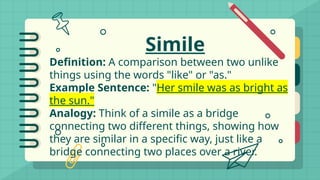
Simile
Definition: A comparison between two unlike
things using the words "like" or "as."
Example Sentence: "Her smile was as bright as
the sun."
Analogy: Think of a simile as a bridge
connecting two different things, showing how
they are similar in a specific way, just like a
bridge connecting two places over a river.
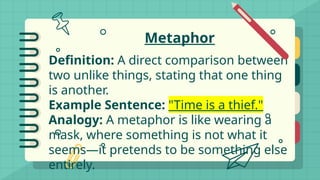
Metaphor
Definition: A direct comparison between
two unlike things, stating that one thing
is another.
Example Sentence: "Time is a thief."
Analogy: A metaphor is like wearing a
mask, where something is not what it
seems—it pretends to be something else
entirely.
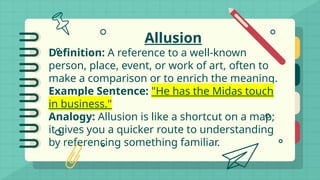
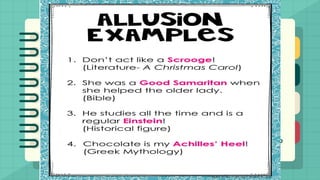
Allusion
Definition: A reference to a well-known
person, place, event, or work of art, often to
make a comparison or to enrich the meaning.
Example Sentence: "He has the Midas touch
in business."
Analogy: Allusion is like a shortcut on a map;
it gives you a quicker route to understanding
by referencing something familiar.
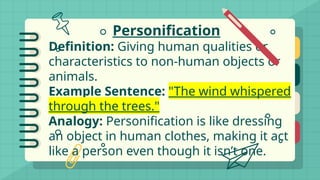
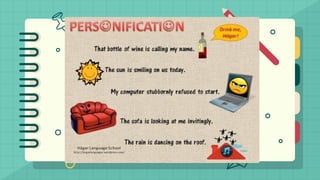
Personification
Definition: Giving human qualities or
characteristics to non-human objects or
animals.
Example Sentence: "The wind whispered
through the trees."
Analogy: Personification is like dressing
an object in human clothes, making it act
like a person even though it isn’t one.
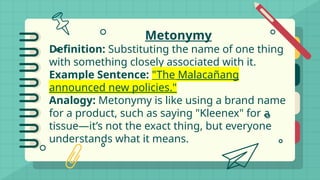
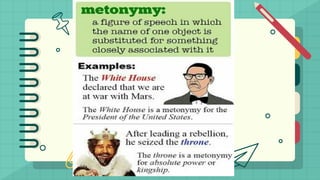
Metonymy
Definition: Substituting the name of one thing
with something closely associated with it.
Example Sentence: "The Malacañang
announced new policies."
Analogy: Metonymy is like using a brand name
for a product, such as saying "Kleenex" for a
tissue—it’s not the exact thing, but everyone
understands what it means.
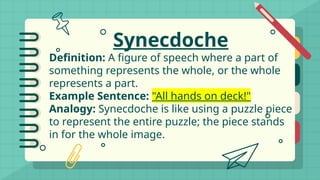
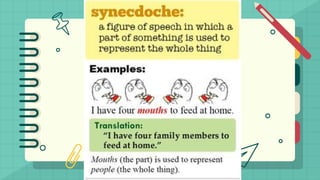
Synecdoche
Definition: A figure of speech where a part of
something represents the whole, or the whole
represents a part.
Example Sentence: "All hands on deck!"
Analogy: Synecdoche is like using a puzzle piece
to represent the entire puzzle; the piece stands
in for the whole image.
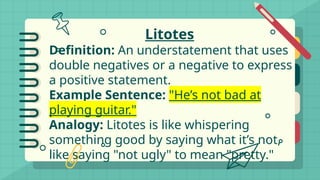
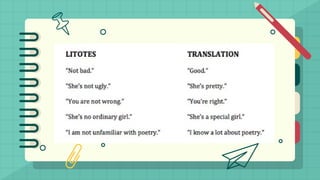
Litotes
Definition: An understatement that uses
double negatives or a negative to express
a positive statement.
Example Sentence: "He’s not bad at
playing guitar."
Analogy: Litotes is like whispering
something good by saying what it’s not,
like saying "not ugly" to mean "pretty."
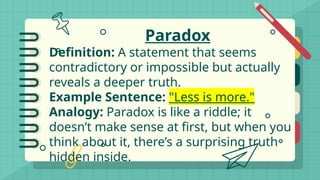
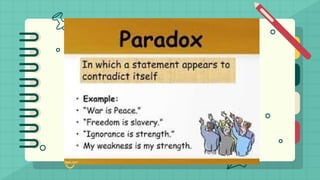
Paradox
Definition: A statement that seems
contradictory or impossible but actually
reveals a deeper truth.
Example Sentence: "Less is more."
Analogy: Paradox is like a riddle; it
doesn’t make sense at first, but when you
think about it, there’s a surprising truth
hidden inside.
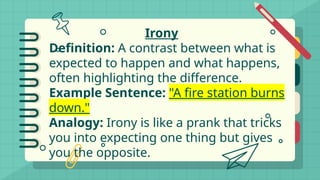
Irony
Definition: A contrast between what is
expected to happen and what happens,
often highlighting the difference.
Example Sentence: "A fire station burns
down."
Analogy: Irony is like a prank that tricks
you into expecting one thing but gives
you the opposite.
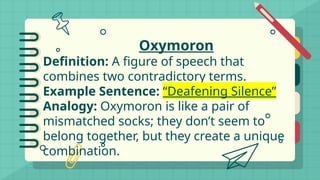
Oxymoron
Definition: A figure of speech that
combines two contradictory terms.
Example Sentence: “Deafening Silence”
Analogy: Oxymoron is like a pair of
mismatched socks; they don’t seem to
belong together, but they create a unique
combination.
Literary Techniques and Definitions.pptx

Literary Techniques and Definitions.pptx

  • 1.
  • 2.
    Simile Definition: A comparisonbetween two unlike things using the words "like" or "as." Example Sentence: "Her smile was as bright as the sun." Analogy: Think of a simile as a bridge connecting two different things, showing how they are similar in a specific way, just like a bridge connecting two places over a river.
  • 3.
    Metaphor Definition: A directcomparison between two unlike things, stating that one thing is another. Example Sentence: "Time is a thief." Analogy: A metaphor is like wearing a mask, where something is not what it seems—it pretends to be something else entirely.
  • 4.
    Allusion Definition: A referenceto a well-known person, place, event, or work of art, often to make a comparison or to enrich the meaning. Example Sentence: "He has the Midas touch in business." Analogy: Allusion is like a shortcut on a map; it gives you a quicker route to understanding by referencing something familiar.
  • 6.
    Personification Definition: Giving humanqualities or characteristics to non-human objects or animals. Example Sentence: "The wind whispered through the trees." Analogy: Personification is like dressing an object in human clothes, making it act like a person even though it isn’t one.
  • 8.
    Metonymy Definition: Substituting thename of one thing with something closely associated with it. Example Sentence: "The Malacañang announced new policies." Analogy: Metonymy is like using a brand name for a product, such as saying "Kleenex" for a tissue—it’s not the exact thing, but everyone understands what it means.
  • 10.
    Synecdoche Definition: A figureof speech where a part of something represents the whole, or the whole represents a part. Example Sentence: "All hands on deck!" Analogy: Synecdoche is like using a puzzle piece to represent the entire puzzle; the piece stands in for the whole image.
  • 12.
    Litotes Definition: An understatementthat uses double negatives or a negative to express a positive statement. Example Sentence: "He’s not bad at playing guitar." Analogy: Litotes is like whispering something good by saying what it’s not, like saying "not ugly" to mean "pretty."
  • 14.
    Paradox Definition: A statementthat seems contradictory or impossible but actually reveals a deeper truth. Example Sentence: "Less is more." Analogy: Paradox is like a riddle; it doesn’t make sense at first, but when you think about it, there’s a surprising truth hidden inside.
  • 16.
    Irony Definition: A contrastbetween what is expected to happen and what happens, often highlighting the difference. Example Sentence: "A fire station burns down." Analogy: Irony is like a prank that tricks you into expecting one thing but gives you the opposite.
  • 17.
    Oxymoron Definition: A figureof speech that combines two contradictory terms. Example Sentence: “Deafening Silence” Analogy: Oxymoron is like a pair of mismatched socks; they don’t seem to belong together, but they create a unique combination.