Investments Chapter 14: Bonds: Analysis and Management
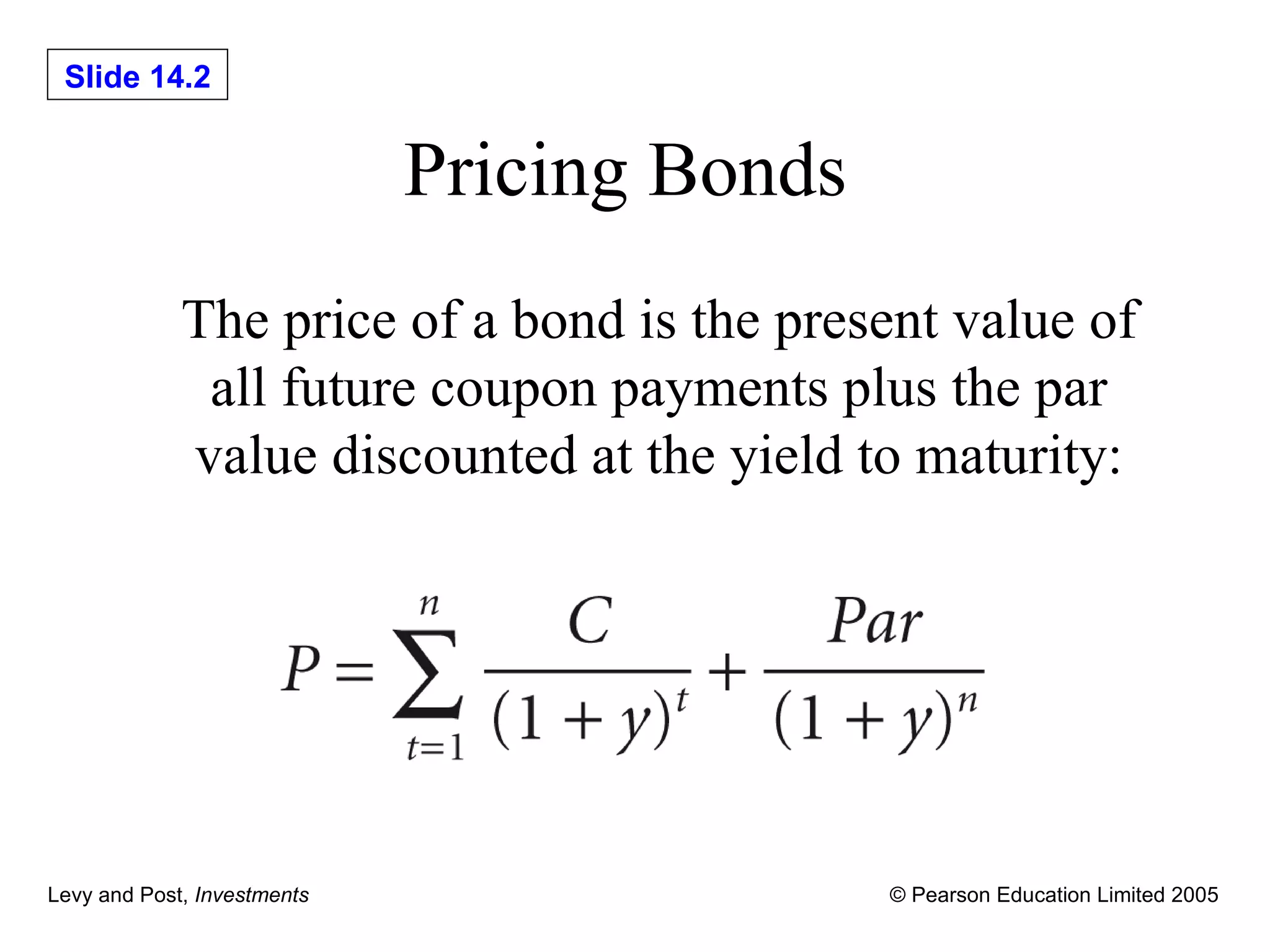
Pricing Bonds  The price of a bond is the present value of all future coupon payments plus the par value discounted at the yield to maturity:
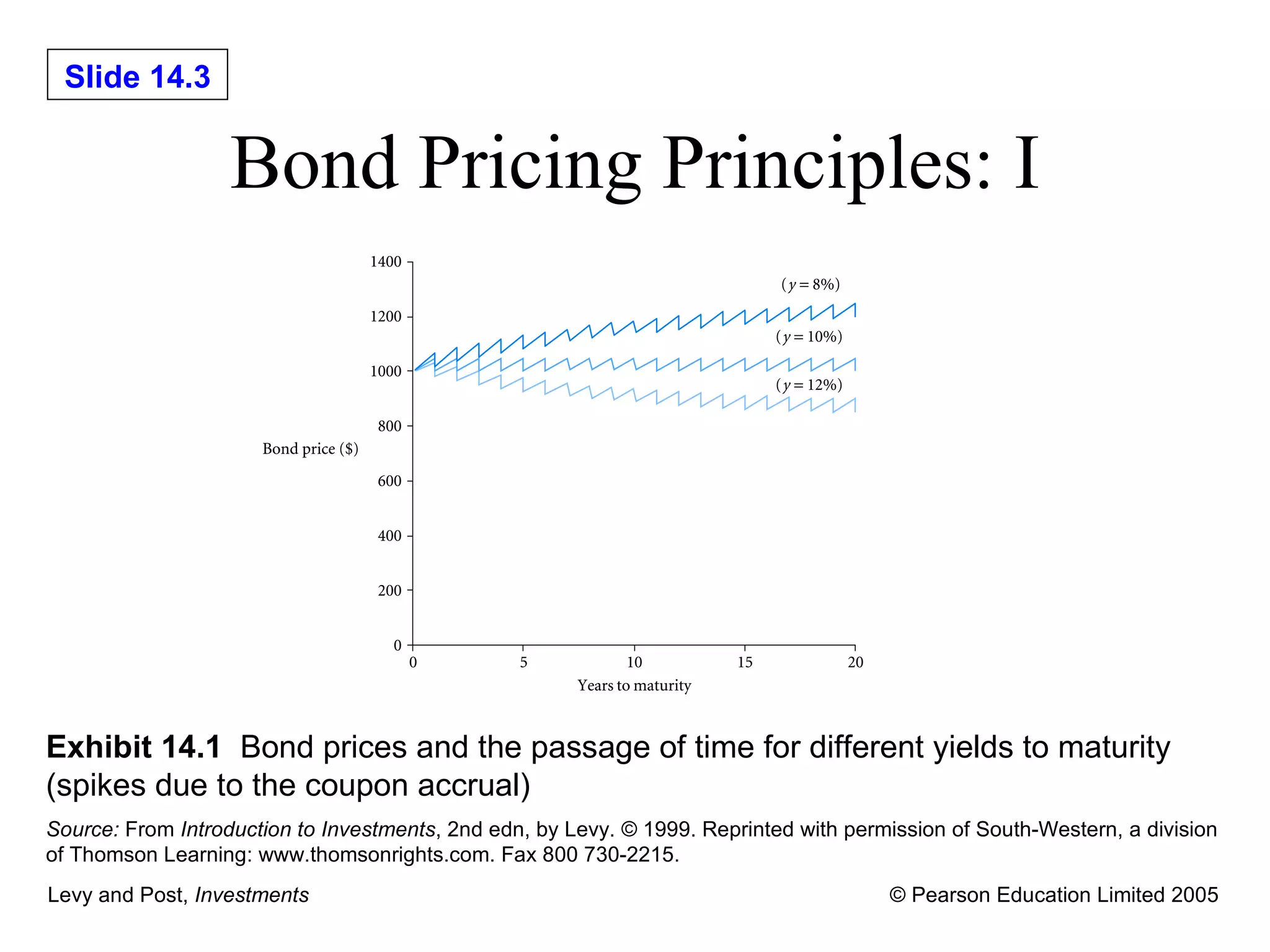
Bond Pricing Principles: I Exhibit 14.1   Bond prices and the passage of time for different yields to maturity (spikes due to the coupon accrual) Source:  From  Introduction to Investments , 2nd edn, by Levy.  © 1999. Reprinted with permission of South-Western, a division of Thomson Learning: www.thomsonrights.com. Fax 800 730-2215.
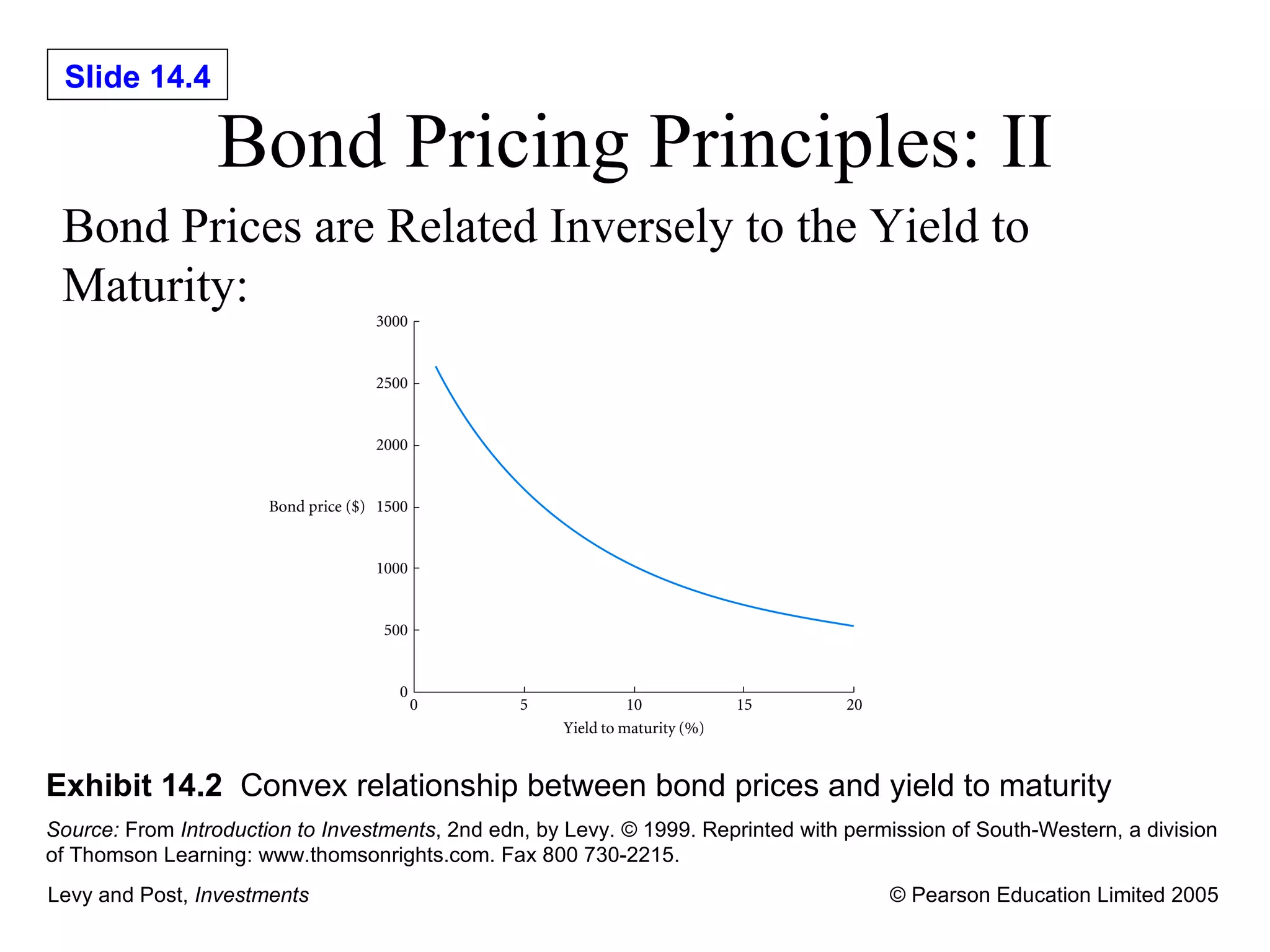
Bond Pricing Principles: II Bond Prices are Related Inversely to the Yield to Maturity: Exhibit 14.2   Convex relationship between bond prices and yield to maturity Source:  From  Introduction to Investments , 2nd edn, by Levy.  © 1999. Reprinted with permission of South-Western, a division of Thomson Learning: www.thomsonrights.com. Fax 800 730-2215.
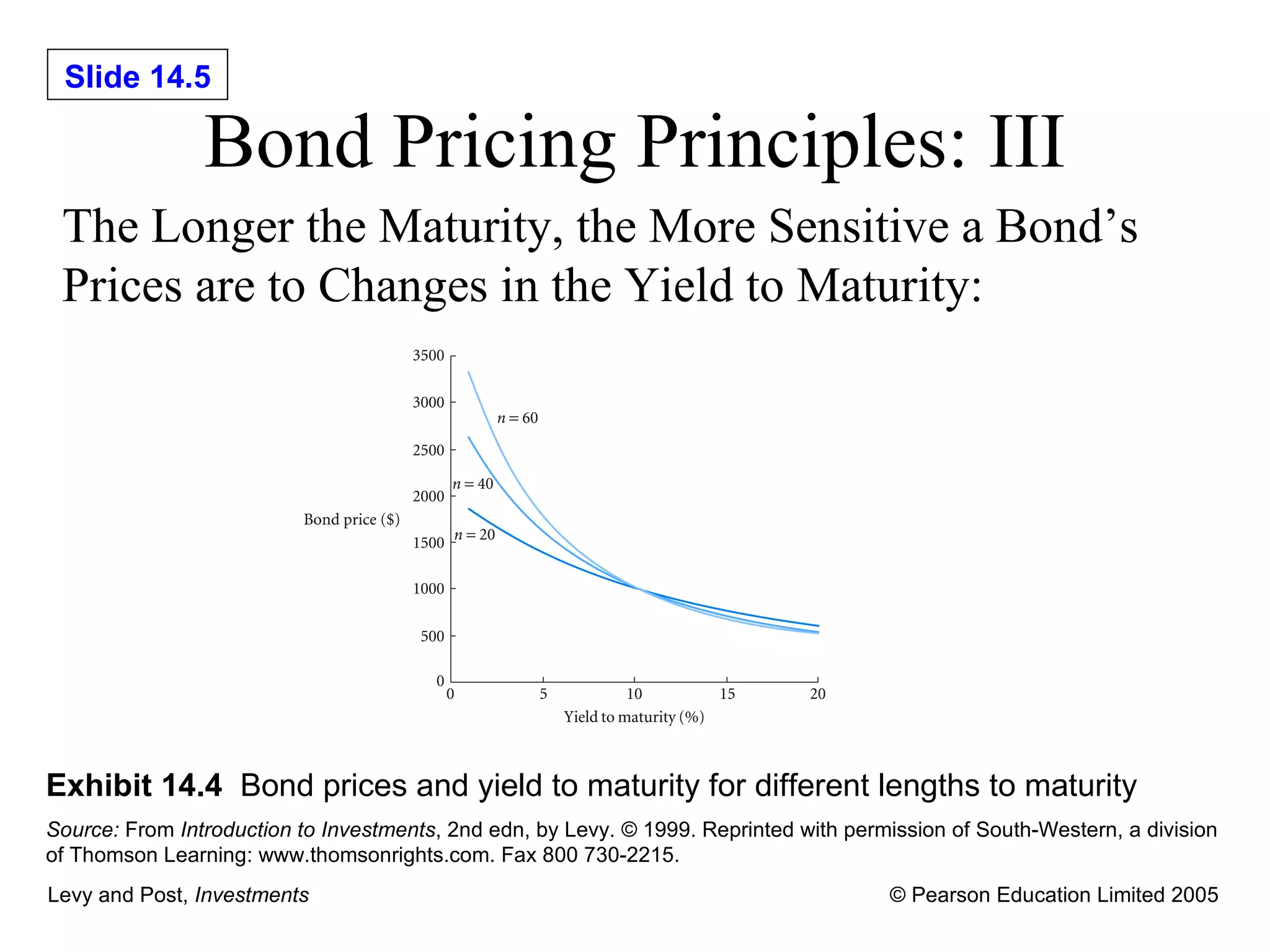
Bond Pricing Principles: III The Longer the Maturity, the More Sensitive a Bond’s Prices are to Changes in the Yield to Maturity: Exhibit 14.4   Bond prices and yield to maturity for different lengths to maturity Source:  From  Introduction to Investments , 2nd edn, by Levy.  © 1999. Reprinted with permission of South-Western, a division of Thomson Learning: www.thomsonrights.com. Fax 800 730-2215.
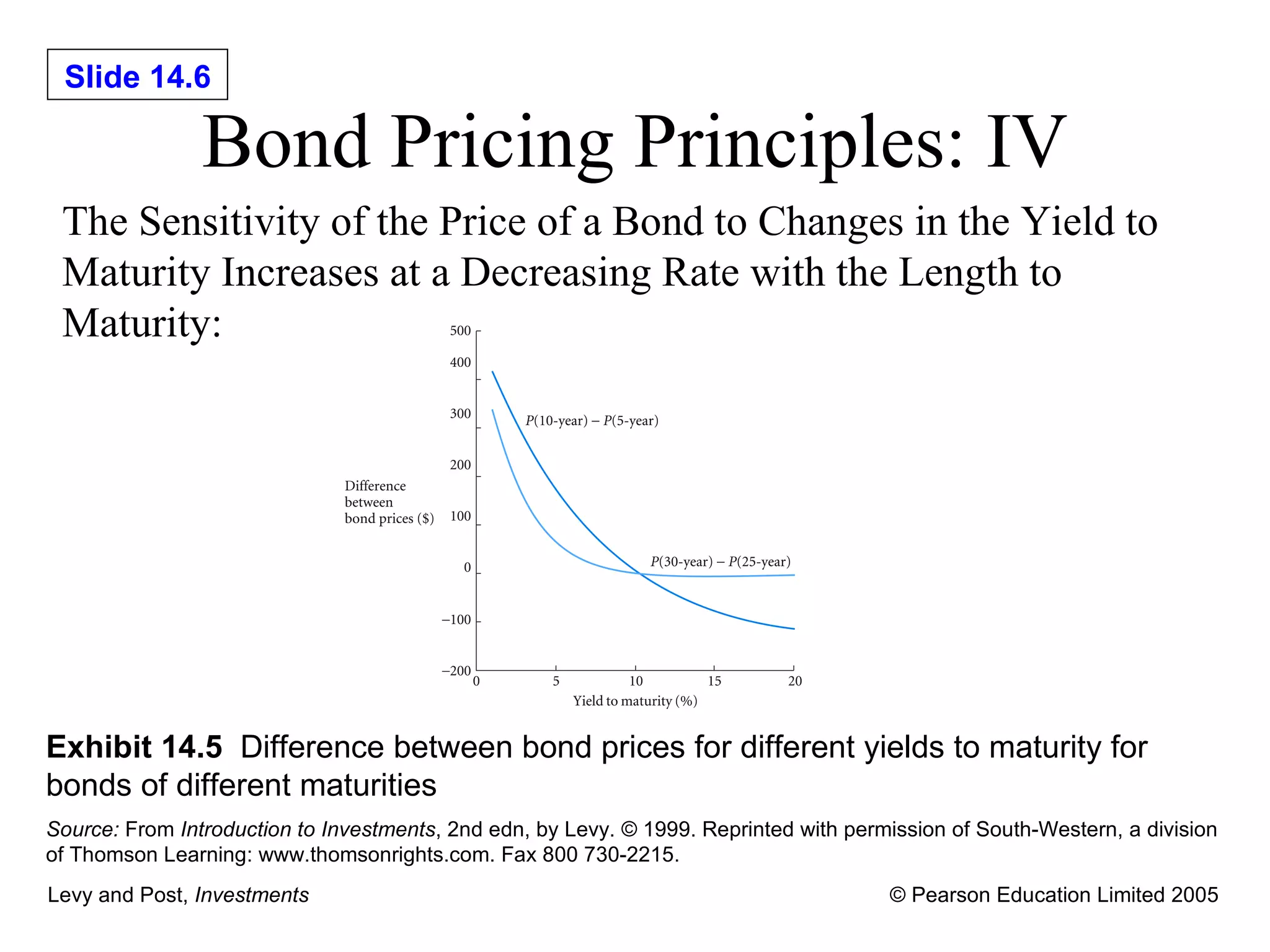
Bond Pricing Principles: IV The Sensitivity of the Price of a Bond to Changes in the Yield to Maturity Increases at a Decreasing Rate with the Length to Maturity: Exhibit 14.5   Difference between bond prices for different yields to maturity for bonds of different maturities Source:  From  Introduction to Investments , 2nd edn, by Levy.  © 1999. Reprinted with permission of South-Western, a division of Thomson Learning: www.thomsonrights.com. Fax 800 730-2215.
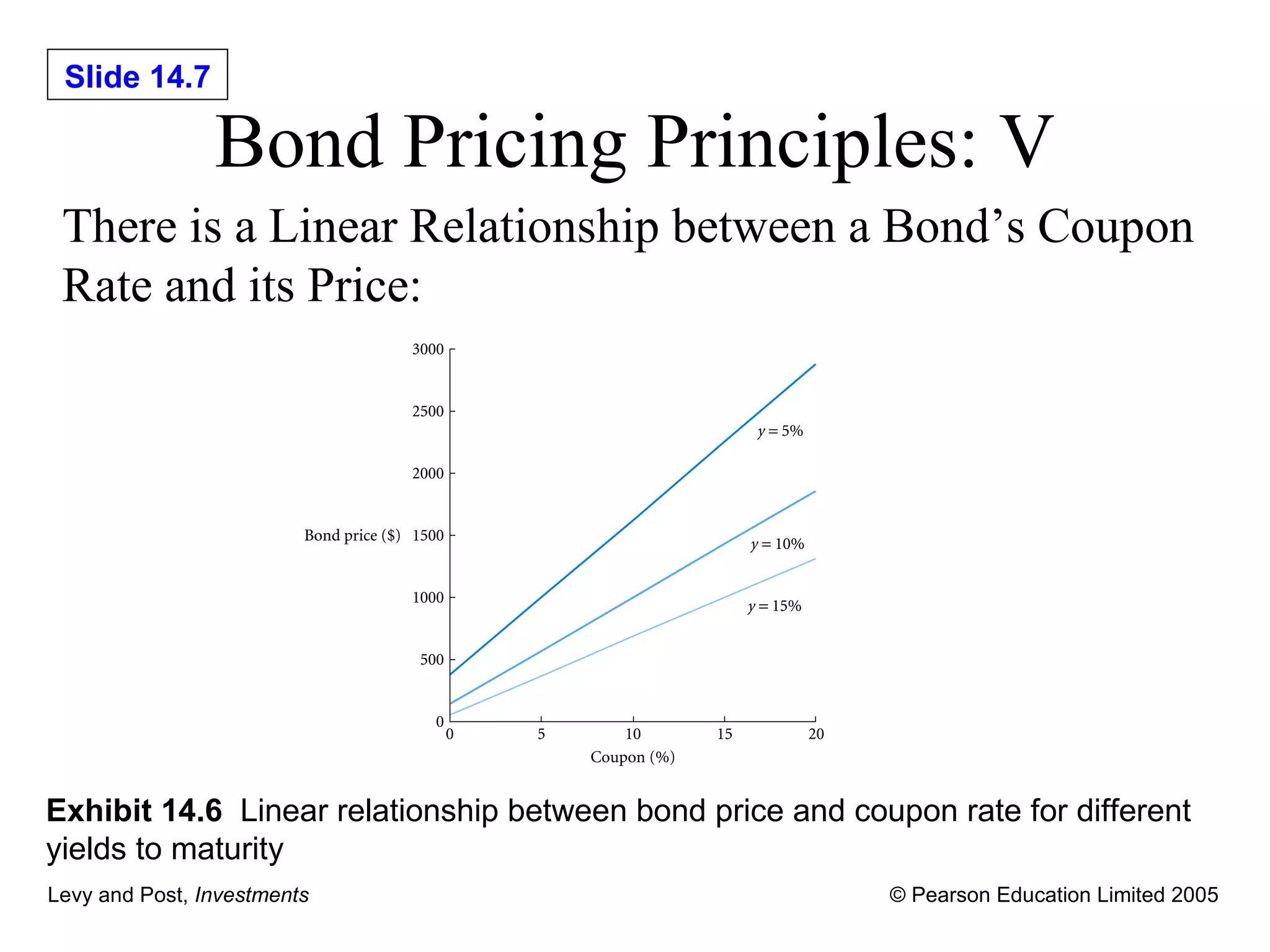
Bond Pricing Principles: V There is a Linear Relationship between a Bond’s Coupon Rate and its Price: Exhibit 14.6   Linear relationship between bond price and coupon rate for different yields to maturity
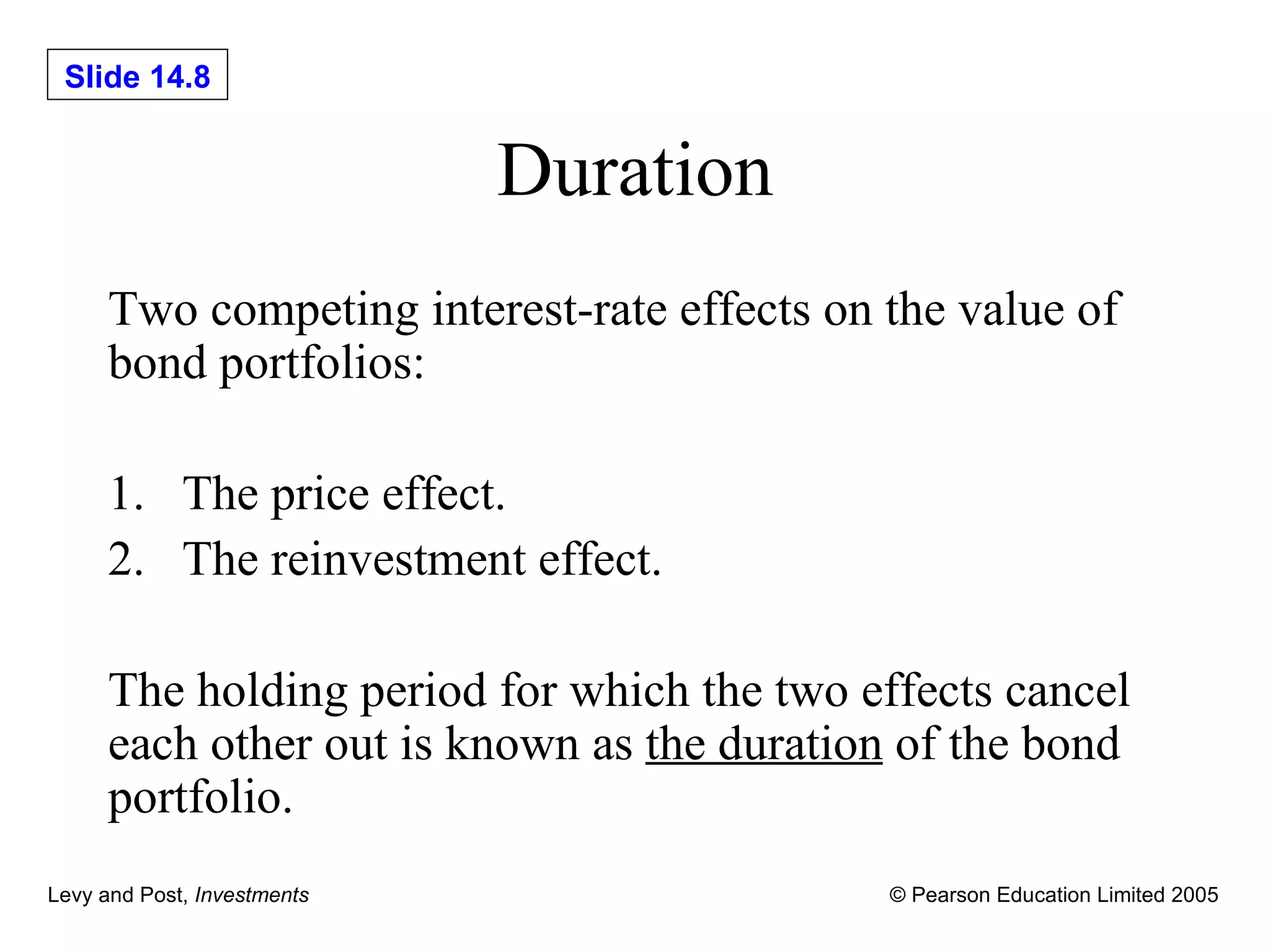
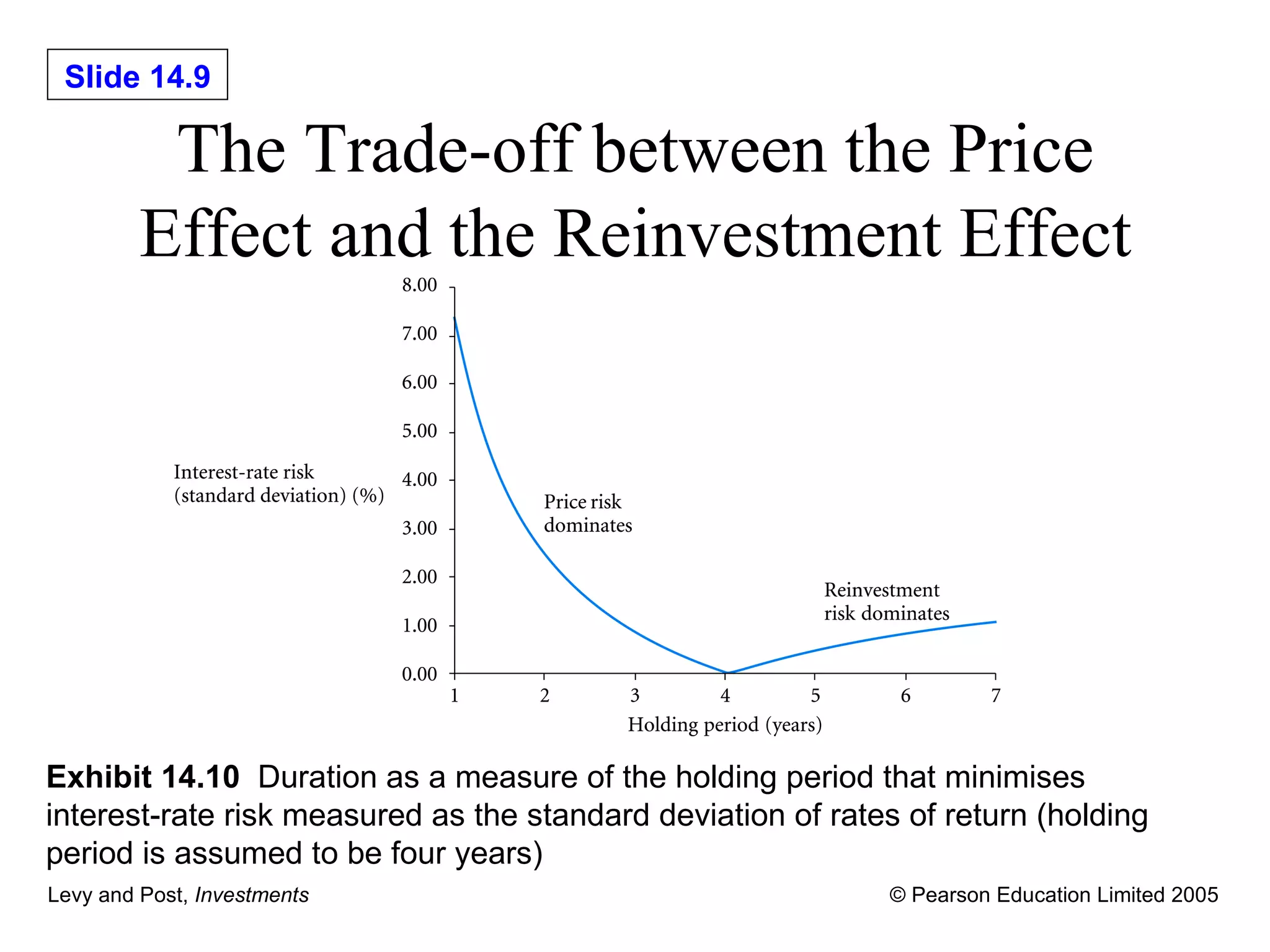
Duration Two competing interest-rate effects on the value of bond portfolios: 1. The price effect. 2. The reinvestment effect. The holding period for which the two effects cancel each other out is known as  the duration  of the bond portfolio.
The Trade-off between the Price Effect and the Reinvestment Effect Exhibit 14.10   Duration as a measure of the holding period that minimises  interest-rate risk measured as the standard deviation of rates of return (holding period is assumed to be four years)
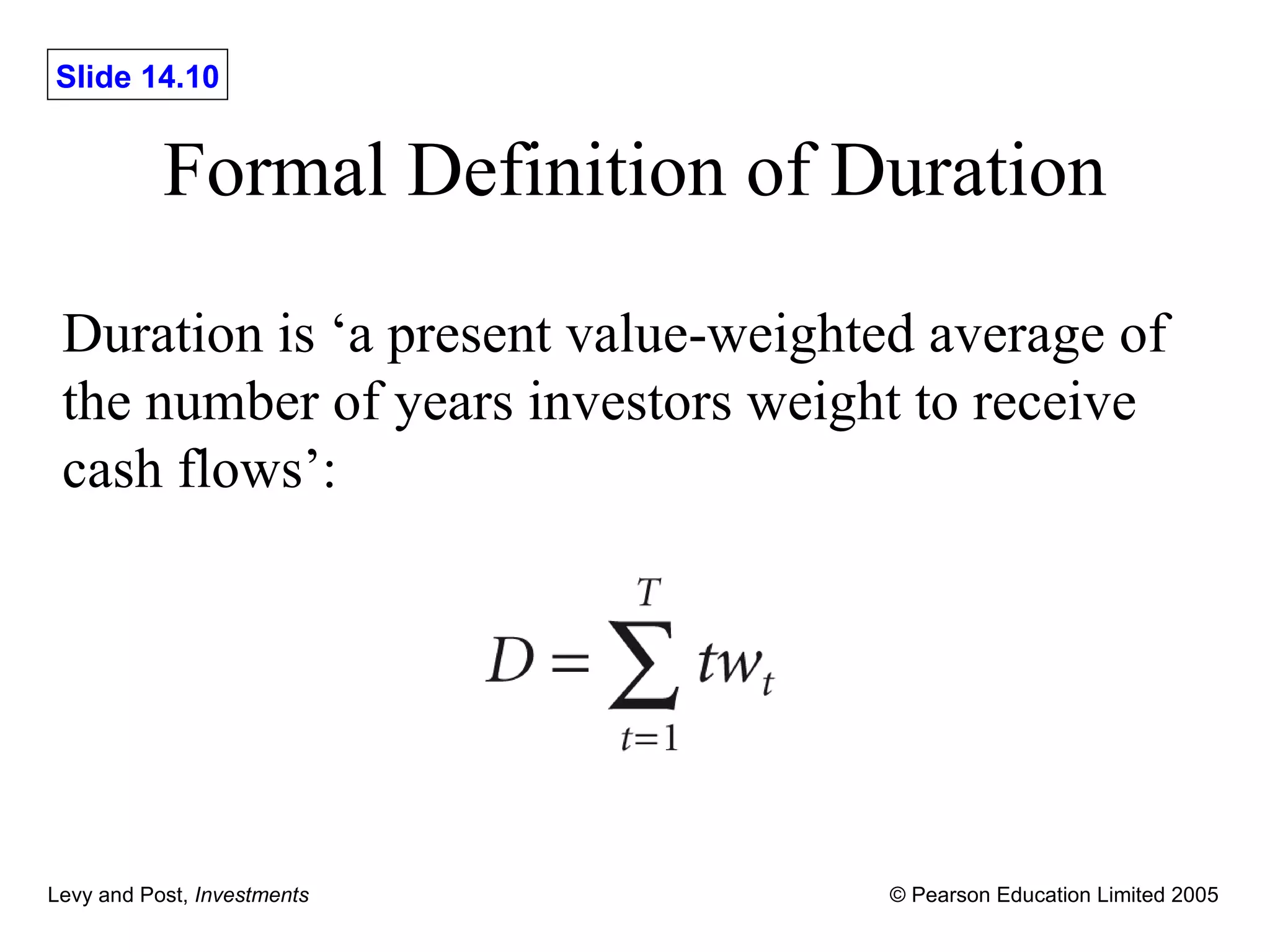
Formal Definition of Duration Duration is ‘a present value-weighted average of the number of years investors weight to receive cash flows’:
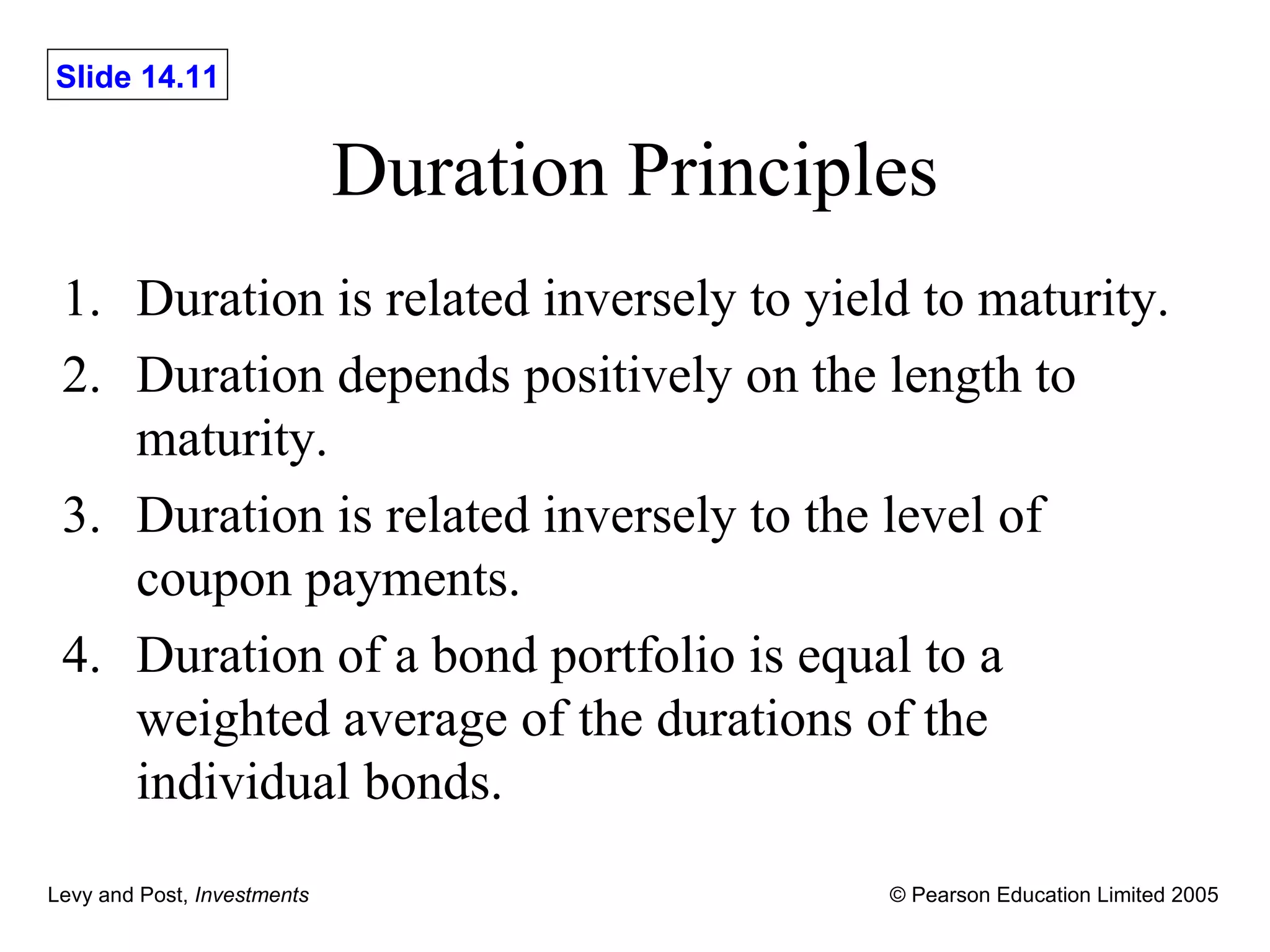
Duration Principles Duration is related inversely to yield to maturity. Duration depends positively on the length to maturity. Duration is related inversely to the level of coupon payments. Duration of a bond portfolio is equal to a weighted average of the durations of the individual bonds.
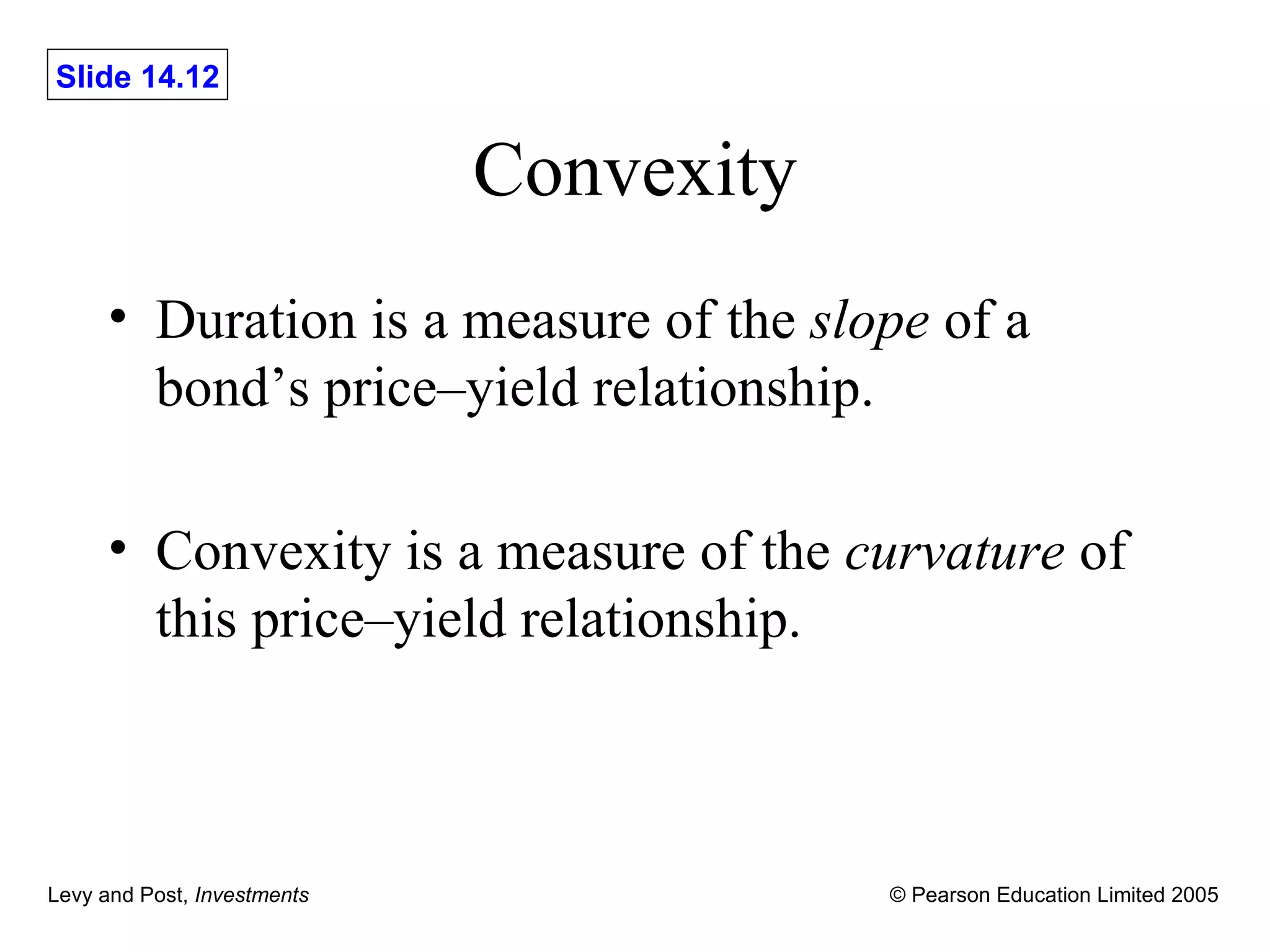
Convexity Duration is a measure of the  slope  of a bond’s price – yield relationship. Convexity is a measure of the  curvature  of this price – yield relationship.
Convexity Principles 1. Convexity is related inversely to yield to maturity. 2. Convexity is related positively to length to maturity. 3. Convexity is related inversely to the coupon. 4. The convexity of a bond portfolio is equal to a weighted average of the convexity of the individual bonds.
Passive vs. Active Bond Management Passive Bond Management Manager does not attempt to identify bonds that are under- or overpriced. Active Bond Management Manager does attempt to identify bonds that are under- or overpriced.
Passive Bond Management Strategies Indexing strategies. Immunisation strategies/duration-matching strategies.
Active Bond Management Strategies There are many different bond-management strategies, for example:  A substitution swap.  A pure yield pick-up swap.  A rate anticipation swap.

L Pch14

  • 1.
    Investments Chapter 14:Bonds: Analysis and Management
  • 2.
    Pricing Bonds The price of a bond is the present value of all future coupon payments plus the par value discounted at the yield to maturity:
  • 3.
    Bond Pricing Principles:I Exhibit 14.1 Bond prices and the passage of time for different yields to maturity (spikes due to the coupon accrual) Source: From Introduction to Investments , 2nd edn, by Levy. © 1999. Reprinted with permission of South-Western, a division of Thomson Learning: www.thomsonrights.com. Fax 800 730-2215.
  • 4.
    Bond Pricing Principles:II Bond Prices are Related Inversely to the Yield to Maturity: Exhibit 14.2 Convex relationship between bond prices and yield to maturity Source: From Introduction to Investments , 2nd edn, by Levy. © 1999. Reprinted with permission of South-Western, a division of Thomson Learning: www.thomsonrights.com. Fax 800 730-2215.
  • 5.
    Bond Pricing Principles:III The Longer the Maturity, the More Sensitive a Bond’s Prices are to Changes in the Yield to Maturity: Exhibit 14.4 Bond prices and yield to maturity for different lengths to maturity Source: From Introduction to Investments , 2nd edn, by Levy. © 1999. Reprinted with permission of South-Western, a division of Thomson Learning: www.thomsonrights.com. Fax 800 730-2215.
  • 6.
    Bond Pricing Principles:IV The Sensitivity of the Price of a Bond to Changes in the Yield to Maturity Increases at a Decreasing Rate with the Length to Maturity: Exhibit 14.5 Difference between bond prices for different yields to maturity for bonds of different maturities Source: From Introduction to Investments , 2nd edn, by Levy. © 1999. Reprinted with permission of South-Western, a division of Thomson Learning: www.thomsonrights.com. Fax 800 730-2215.
  • 7.
    Bond Pricing Principles:V There is a Linear Relationship between a Bond’s Coupon Rate and its Price: Exhibit 14.6 Linear relationship between bond price and coupon rate for different yields to maturity
  • 8.
    Duration Two competinginterest-rate effects on the value of bond portfolios: 1. The price effect. 2. The reinvestment effect. The holding period for which the two effects cancel each other out is known as the duration of the bond portfolio.
  • 9.
    The Trade-off betweenthe Price Effect and the Reinvestment Effect Exhibit 14.10 Duration as a measure of the holding period that minimises interest-rate risk measured as the standard deviation of rates of return (holding period is assumed to be four years)
  • 10.
    Formal Definition ofDuration Duration is ‘a present value-weighted average of the number of years investors weight to receive cash flows’:
  • 11.
    Duration Principles Durationis related inversely to yield to maturity. Duration depends positively on the length to maturity. Duration is related inversely to the level of coupon payments. Duration of a bond portfolio is equal to a weighted average of the durations of the individual bonds.
  • 12.
    Convexity Duration isa measure of the slope of a bond’s price – yield relationship. Convexity is a measure of the curvature of this price – yield relationship.
  • 13.
    Convexity Principles 1.Convexity is related inversely to yield to maturity. 2. Convexity is related positively to length to maturity. 3. Convexity is related inversely to the coupon. 4. The convexity of a bond portfolio is equal to a weighted average of the convexity of the individual bonds.
  • 14.
    Passive vs. ActiveBond Management Passive Bond Management Manager does not attempt to identify bonds that are under- or overpriced. Active Bond Management Manager does attempt to identify bonds that are under- or overpriced.
  • 15.
    Passive Bond ManagementStrategies Indexing strategies. Immunisation strategies/duration-matching strategies.
  • 16.
    Active Bond ManagementStrategies There are many different bond-management strategies, for example:  A substitution swap.  A pure yield pick-up swap.  A rate anticipation swap.