GLOBAL SOURCING


                  By:
            Ashok Rawat - 13
          Burhanuddin H D - 15
           Chetan Gandhi - 16
GLOBAL SOURCING


The procurement of products or services from
independent suppliers or company owned subsidiaries
located abroad for consumption in home country or third
country.
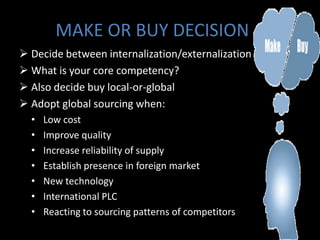
MAKE OR BUY DECISION
 Decide between internalization/externalization
 What is your core competency?
 Also decide buy local-or-global
 Adopt global sourcing when:
  •   Low cost
  •   Improve quality
  •   Increase reliability of supply
  •   Establish presence in foreign market
  •   New technology
  •   International PLC
  •   Reacting to sourcing patterns of competitors
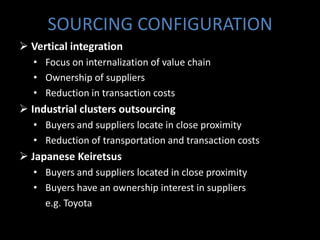
SOURCING CONFIGURATION
 Vertical integration
   • Focus on internalization of value chain
   • Ownership of suppliers
   • Reduction in transaction costs
 Industrial clusters outsourcing
   • Buyers and suppliers locate in close proximity
   • Reduction of transportation and transaction costs
 Japanese Keiretsus
   • Buyers and suppliers located in close proximity
   • Buyers have an ownership interest in suppliers
     e.g. Toyota
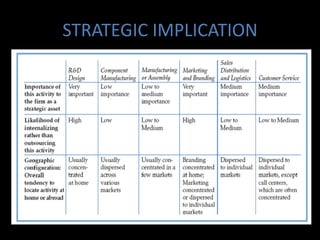
STRATEGIC IMPLICATION
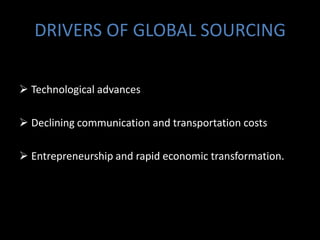
DRIVERS OF GLOBAL SOURCING

 Technological advances

 Declining communication and transportation costs

 Entrepreneurship and rapid economic transformation.
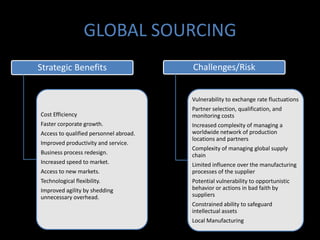
GLOBAL SOURCING
Strategic Benefits                      Challenges/Risk


                                        Vulnerability to exchange rate fluctuations
                                        Partner selection, qualification, and
Cost Efficiency                         monitoring costs
Faster corporate growth.                Increased complexity of managing a
Access to qualified personnel abroad.   worldwide network of production
                                        locations and partners
Improved productivity and service.
                                        Complexity of managing global supply
Business process redesign.              chain
Increased speed to market.              Limited influence over the manufacturing
Access to new markets.                  processes of the supplier
Technological flexibility.              Potential vulnerability to opportunistic
Improved agility by shedding            behavior or actions in bad faith by
unnecessary overhead.                   suppliers
                                        Constrained ability to safeguard
                                        intellectual assets
                                        Local Manufacturing
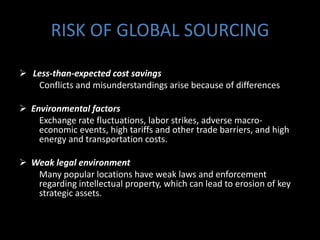
RISK OF GLOBAL SOURCING

 Less-than-expected cost savings
   Conflicts and misunderstandings arise because of differences

 Environmental factors
    Exchange rate fluctuations, labor strikes, adverse macro-
    economic events, high tariffs and other trade barriers, and high
    energy and transportation costs.

 Weak legal environment
   Many popular locations have weak laws and enforcement
   regarding intellectual property, which can lead to erosion of key
   strategic assets.
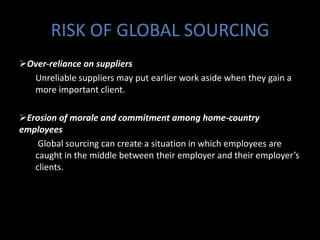
RISK OF GLOBAL SOURCING
Over-reliance on suppliers
  Unreliable suppliers may put earlier work aside when they gain a
  more important client.

Erosion of morale and commitment among home-country
employees
    Global sourcing can create a situation in which employees are
   caught in the middle between their employer and their employer’s
   clients.
RISK OF GLOBAL SOURCING
Risk of creating competitors
    As firms share its intellectual property and business-process
    knowledge with foreign suppliers

Inadequate or low-skilled workers
   Employees may lack KSAs or high rapid turnover of skilled
   employees.
STRATEGIES FOR MINIMIZING RISK IN
        GLOBAL SOURCING
 Firms ought to go offshore for the right reasons

 Need to get employees on board

 Choose between a captive operation and a contract with outside
specialists carefully

 Choose countries and suppliers carefully

 The focal firm needs to invest in supplier development and
collaboration
JiJun Xia & Yaching Chang   12
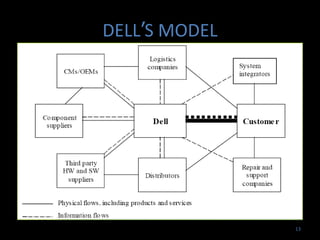
DELL’S MODEL


               13
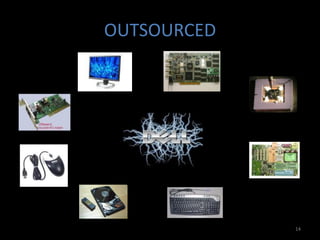
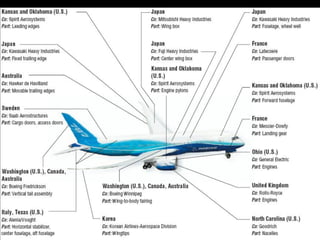
OUTSOURCED


             14
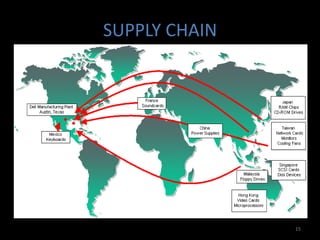
SUPPLY CHAIN


               15
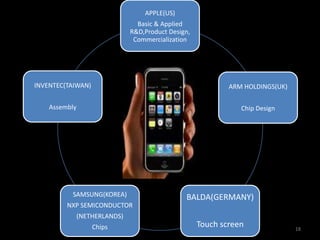
APPLE(US)
                                 Basic & Applied
                               R&D,Product Design,
                                Commercialization


INVENTEC(TAIWAN)                                             ARM HOLDINGS(UK)

    Assembly                                                    Chip Design


          SAMSUNG(KOREA)                        BALDA(GERMANY)
         NXP SEMICONDUCTOR
               (NETHERLANDS)
                   Chips                             Touch screen               18
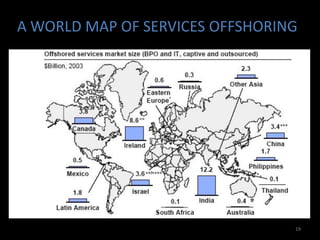
A WORLD MAP OF SERVICES OFFSHORING


                                 19
REFERENCES
• “Global Sourcing of Services and Market Performance: An Empirical
  Investigation," Journal of International Marketing,6 (1998):10-31.
• International Journal of Global Logistics & Supply Chain
  Management Vol. 1, No. 2, 1 November 2006, 90 – 97.
• Globalization of Work :Outsourcing and Offshoring,Global Executive
  Forum,2005,6-7
• The Real Cost of Offshoring,Michael Mandel,Business Week, June
  18,2007
• “Outsourcing: Time to Bring it back Home?” Economists, March
  5,2005,63
• “Outsourcing: Pros and Cons", Murray Weidenbaum,Executive
  Speeches 19(2004):31-35

Group 5 global sourcing ib final

  • 1.
    GLOBAL SOURCING By: Ashok Rawat - 13 Burhanuddin H D - 15 Chetan Gandhi - 16
  • 2.
    GLOBAL SOURCING The procurementof products or services from independent suppliers or company owned subsidiaries located abroad for consumption in home country or third country.
  • 3.
    MAKE OR BUYDECISION  Decide between internalization/externalization  What is your core competency?  Also decide buy local-or-global  Adopt global sourcing when: • Low cost • Improve quality • Increase reliability of supply • Establish presence in foreign market • New technology • International PLC • Reacting to sourcing patterns of competitors
  • 4.
    SOURCING CONFIGURATION  Verticalintegration • Focus on internalization of value chain • Ownership of suppliers • Reduction in transaction costs  Industrial clusters outsourcing • Buyers and suppliers locate in close proximity • Reduction of transportation and transaction costs  Japanese Keiretsus • Buyers and suppliers located in close proximity • Buyers have an ownership interest in suppliers e.g. Toyota
  • 5.
  • 6.
    DRIVERS OF GLOBALSOURCING  Technological advances  Declining communication and transportation costs  Entrepreneurship and rapid economic transformation.
  • 7.
    GLOBAL SOURCING Strategic Benefits Challenges/Risk Vulnerability to exchange rate fluctuations Partner selection, qualification, and Cost Efficiency monitoring costs Faster corporate growth. Increased complexity of managing a Access to qualified personnel abroad. worldwide network of production locations and partners Improved productivity and service. Complexity of managing global supply Business process redesign. chain Increased speed to market. Limited influence over the manufacturing Access to new markets. processes of the supplier Technological flexibility. Potential vulnerability to opportunistic Improved agility by shedding behavior or actions in bad faith by unnecessary overhead. suppliers Constrained ability to safeguard intellectual assets Local Manufacturing
  • 8.
    RISK OF GLOBALSOURCING  Less-than-expected cost savings Conflicts and misunderstandings arise because of differences  Environmental factors Exchange rate fluctuations, labor strikes, adverse macro- economic events, high tariffs and other trade barriers, and high energy and transportation costs.  Weak legal environment Many popular locations have weak laws and enforcement regarding intellectual property, which can lead to erosion of key strategic assets.
  • 9.
    RISK OF GLOBALSOURCING Over-reliance on suppliers Unreliable suppliers may put earlier work aside when they gain a more important client. Erosion of morale and commitment among home-country employees Global sourcing can create a situation in which employees are caught in the middle between their employer and their employer’s clients.
  • 10.
    RISK OF GLOBALSOURCING Risk of creating competitors As firms share its intellectual property and business-process knowledge with foreign suppliers Inadequate or low-skilled workers Employees may lack KSAs or high rapid turnover of skilled employees.
  • 11.
    STRATEGIES FOR MINIMIZINGRISK IN GLOBAL SOURCING  Firms ought to go offshore for the right reasons  Need to get employees on board  Choose between a captive operation and a contract with outside specialists carefully  Choose countries and suppliers carefully  The focal firm needs to invest in supplier development and collaboration
  • 12.
    JiJun Xia &Yaching Chang 12
  • 13.
  • 14.
  • 15.
  • 18.
    APPLE(US) Basic & Applied R&D,Product Design, Commercialization INVENTEC(TAIWAN) ARM HOLDINGS(UK) Assembly Chip Design SAMSUNG(KOREA) BALDA(GERMANY) NXP SEMICONDUCTOR (NETHERLANDS) Chips Touch screen 18
  • 19.
    A WORLD MAPOF SERVICES OFFSHORING 19
  • 20.
    REFERENCES • “Global Sourcingof Services and Market Performance: An Empirical Investigation," Journal of International Marketing,6 (1998):10-31. • International Journal of Global Logistics & Supply Chain Management Vol. 1, No. 2, 1 November 2006, 90 – 97. • Globalization of Work :Outsourcing and Offshoring,Global Executive Forum,2005,6-7 • The Real Cost of Offshoring,Michael Mandel,Business Week, June 18,2007 • “Outsourcing: Time to Bring it back Home?” Economists, March 5,2005,63 • “Outsourcing: Pros and Cons", Murray Weidenbaum,Executive Speeches 19(2004):31-35