SERIS is a research institute at the National University of Singapore (NUS). SERIS is sponsored by the National University of
Singapore (NUS) and Singapore’s National Research Foundation (NRF) through the Singapore Economic Development Board (EDB).
1
Solar DC nano-grids:
A technology perspective on village electrification
Timothy WALSH
Solar Energy Research Institute of Singapore (SERIS)
National University of Singapore (NUS)
Smart Villages Workshop
Kuching, Sarawak, Malaysia
27-29 January 2015
2SERIS is a research institute at the National University of Singapore (NUS). SERIS is sponsored by the National University of
Singapore (NUS) and Singapore’s National Research Foundation (NRF) through the Singapore Economic Development Board (EDB).
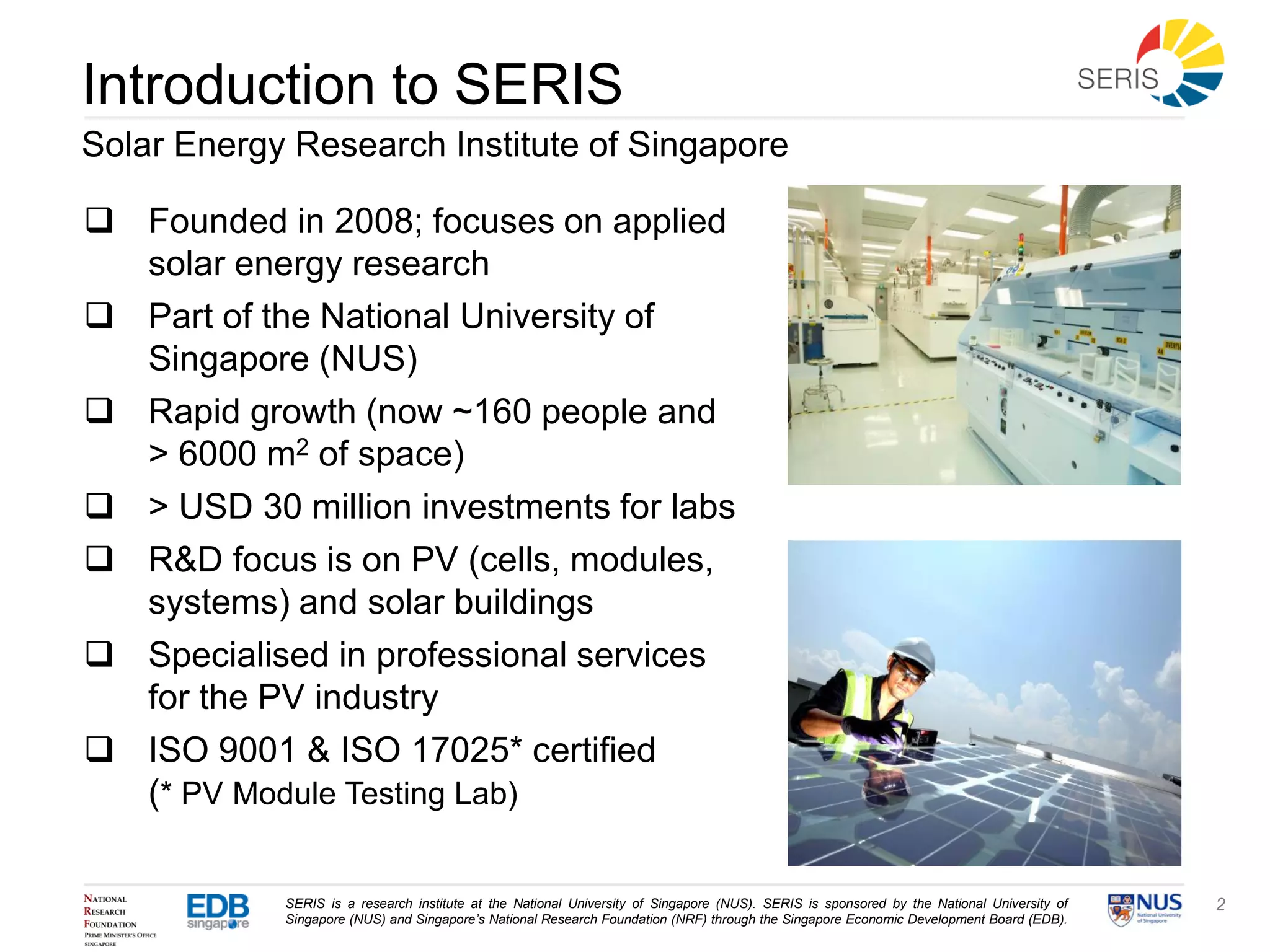
 Founded in 2008; focuses on applied
solar energy research
 Part of the National University of
Singapore (NUS)
 Rapid growth (now ~160 people and
> 6000 m2 of space)
 > USD 30 million investments for labs
 R&D focus is on PV (cells, modules,
systems) and solar buildings
 Specialised in professional services
for the PV industry
 ISO 9001 & ISO 17025* certified
(* PV Module Testing Lab)
Introduction to SERIS
Solar Energy Research Institute of Singapore
SERIS is a research institute at the National University of Singapore (NUS). SERIS is sponsored by the National University of
Singapore (NUS) and Singapore’s National Research Foundation (NRF) through the Singapore Economic Development Board (EDB).
3
Off-grid PV systems group at SERIS
 Obviously Singapore is not a big market for off-grid PV systems
 Thus the group focuses on the wider South East Asian region
 Research topics include;
 Innovative applications of off-grid PV for “productive use”,
particularly where the storage is provided by the load
 Solar refrigeration and solar ice making
 Solar air-conditioning using peltier devices
 Solar-powered boats
 Solar DC nano-grids
 PhD candidates are welcome to apply
SERIS is a research institute at the National University of Singapore (NUS). SERIS is sponsored by the National University of
Singapore (NUS) and Singapore’s National Research Foundation (NRF) through the Singapore Economic Development Board (EDB).
4
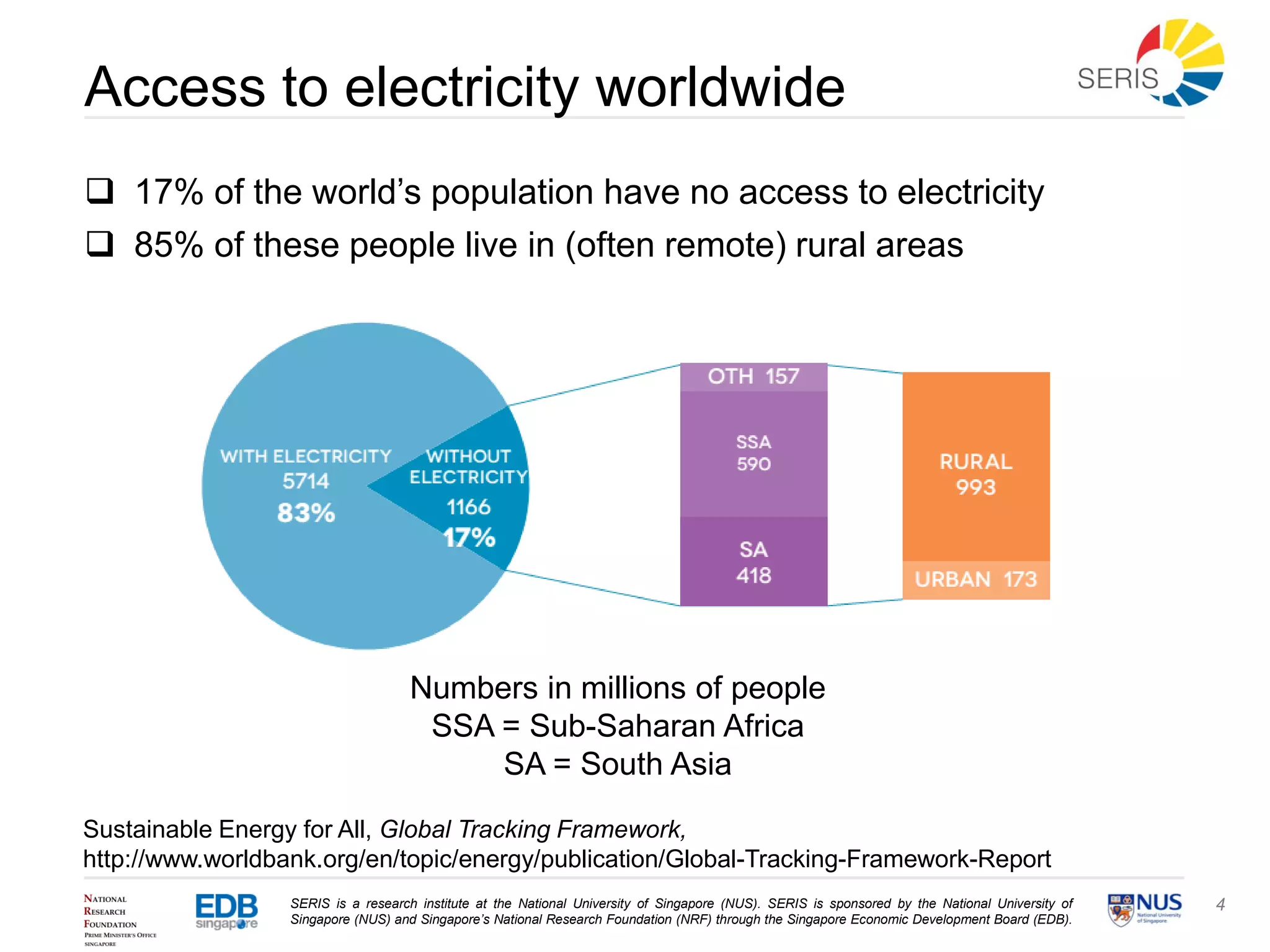
Access to electricity worldwide
 17% of the world’s population have no access to electricity
 85% of these people live in (often remote) rural areas
Sustainable Energy for All, Global Tracking Framework,
http://www.worldbank.org/en/topic/energy/publication/Global-Tracking-Framework-Report
Numbers in millions of people
SSA = Sub-Saharan Africa
SA = South Asia
SERIS is a research institute at the National University of Singapore (NUS). SERIS is sponsored by the National University of
Singapore (NUS) and Singapore’s National Research Foundation (NRF) through the Singapore Economic Development Board (EDB).
5
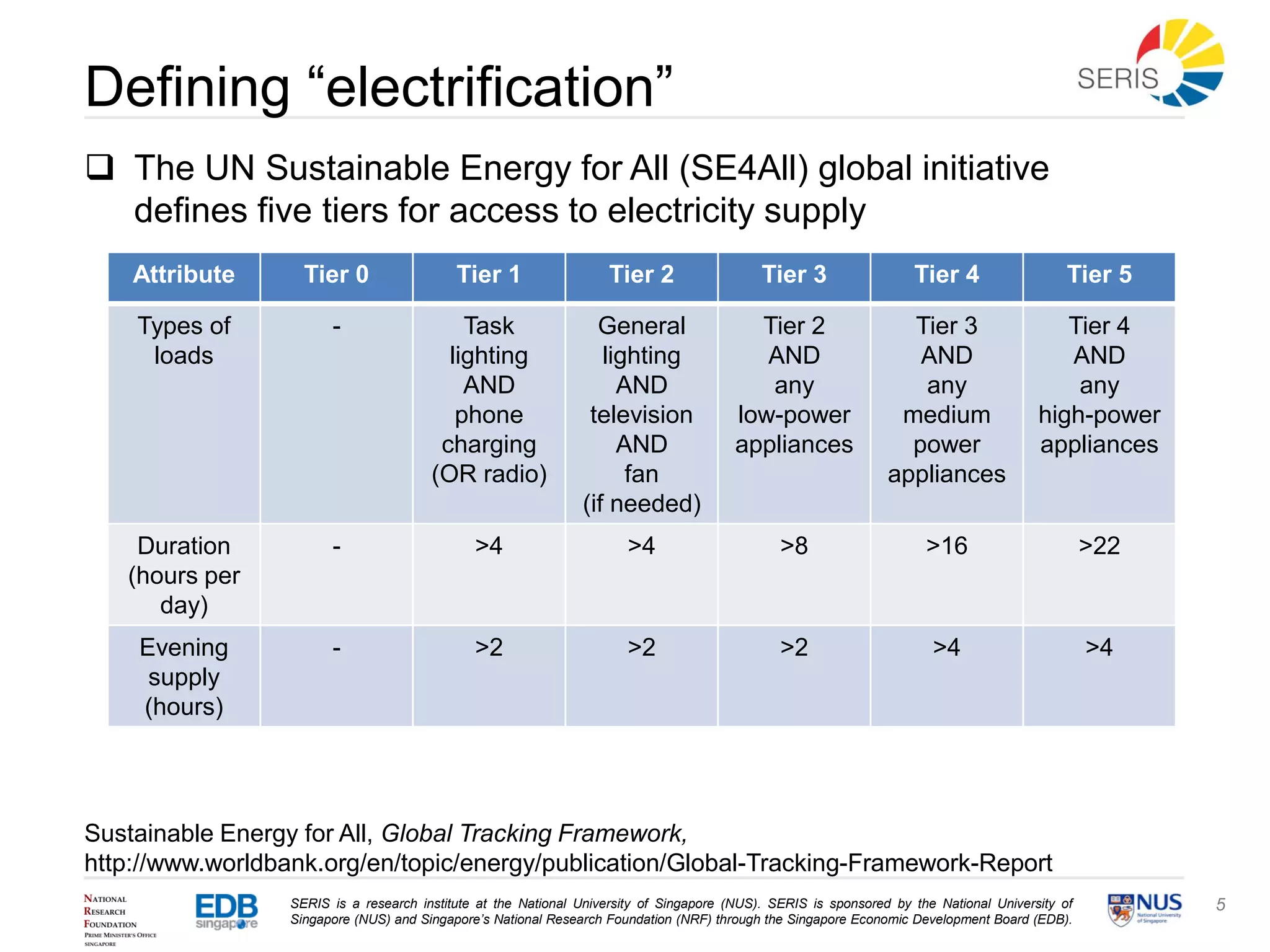
Defining “electrification”
 The UN Sustainable Energy for All (SE4All) global initiative
defines five tiers for access to electricity supply
Attribute Tier 0 Tier 1 Tier 2 Tier 3 Tier 4 Tier 5
Types of
loads
- Task
lighting
AND
phone
charging
(OR radio)
General
lighting
AND
television
AND
fan
(if needed)
Tier 2
AND
any
low-power
appliances
Tier 3
AND
any
medium
power
appliances
Tier 4
AND
any
high-power
appliances
Duration
(hours per
day)
- >4 >4 >8 >16 >22
Evening
supply
(hours)
- >2 >2 >2 >4 >4
Sustainable Energy for All, Global Tracking Framework,
http://www.worldbank.org/en/topic/energy/publication/Global-Tracking-Framework-Report
SERIS is a research institute at the National University of Singapore (NUS). SERIS is sponsored by the National University of
Singapore (NUS) and Singapore’s National Research Foundation (NRF) through the Singapore Economic Development Board (EDB).
6
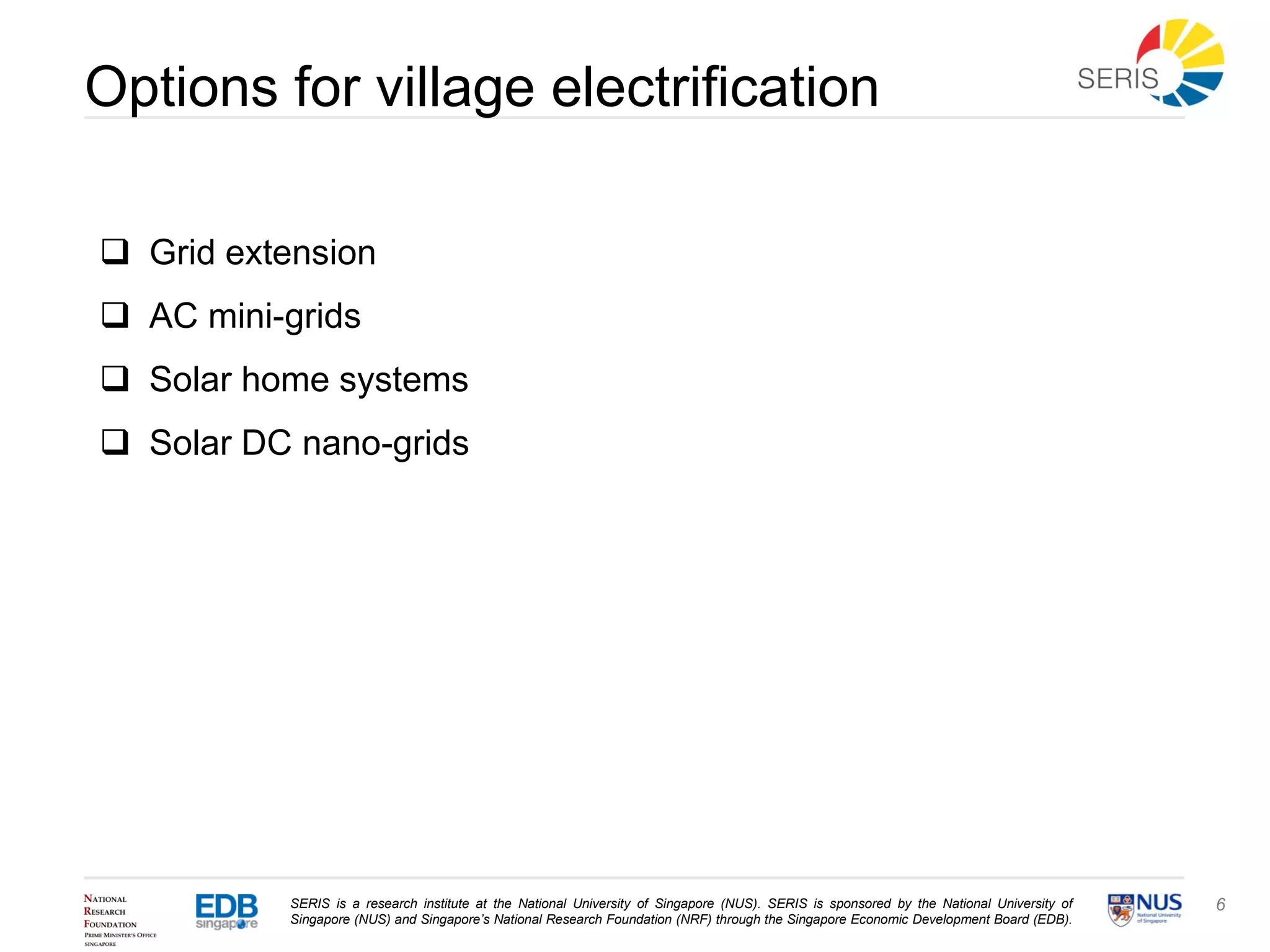
Options for village electrification
 Grid extension
 AC mini-grids
 Solar home systems
 Solar DC nano-grids
SERIS is a research institute at the National University of Singapore (NUS). SERIS is sponsored by the National University of
Singapore (NUS) and Singapore’s National Research Foundation (NRF) through the Singapore Economic Development Board (EDB).
7
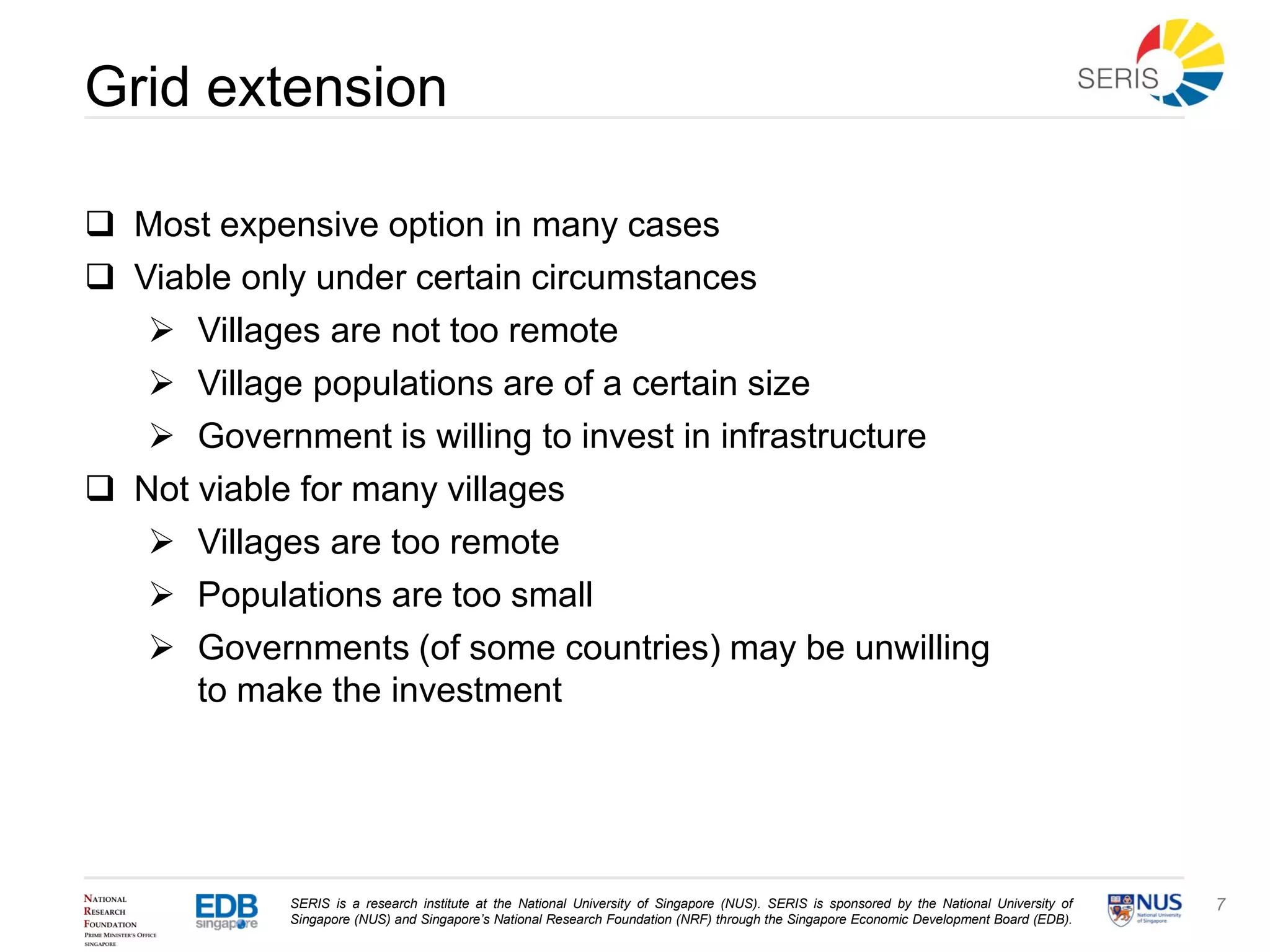
Grid extension
 Most expensive option in many cases
 Viable only under certain circumstances
 Villages are not too remote
 Village populations are of a certain size
 Government is willing to invest in infrastructure
 Not viable for many villages
 Villages are too remote
 Populations are too small
 Governments (of some countries) may be unwilling
to make the investment
SERIS is a research institute at the National University of Singapore (NUS). SERIS is sponsored by the National University of
Singapore (NUS) and Singapore’s National Research Foundation (NRF) through the Singapore Economic Development Board (EDB).
8
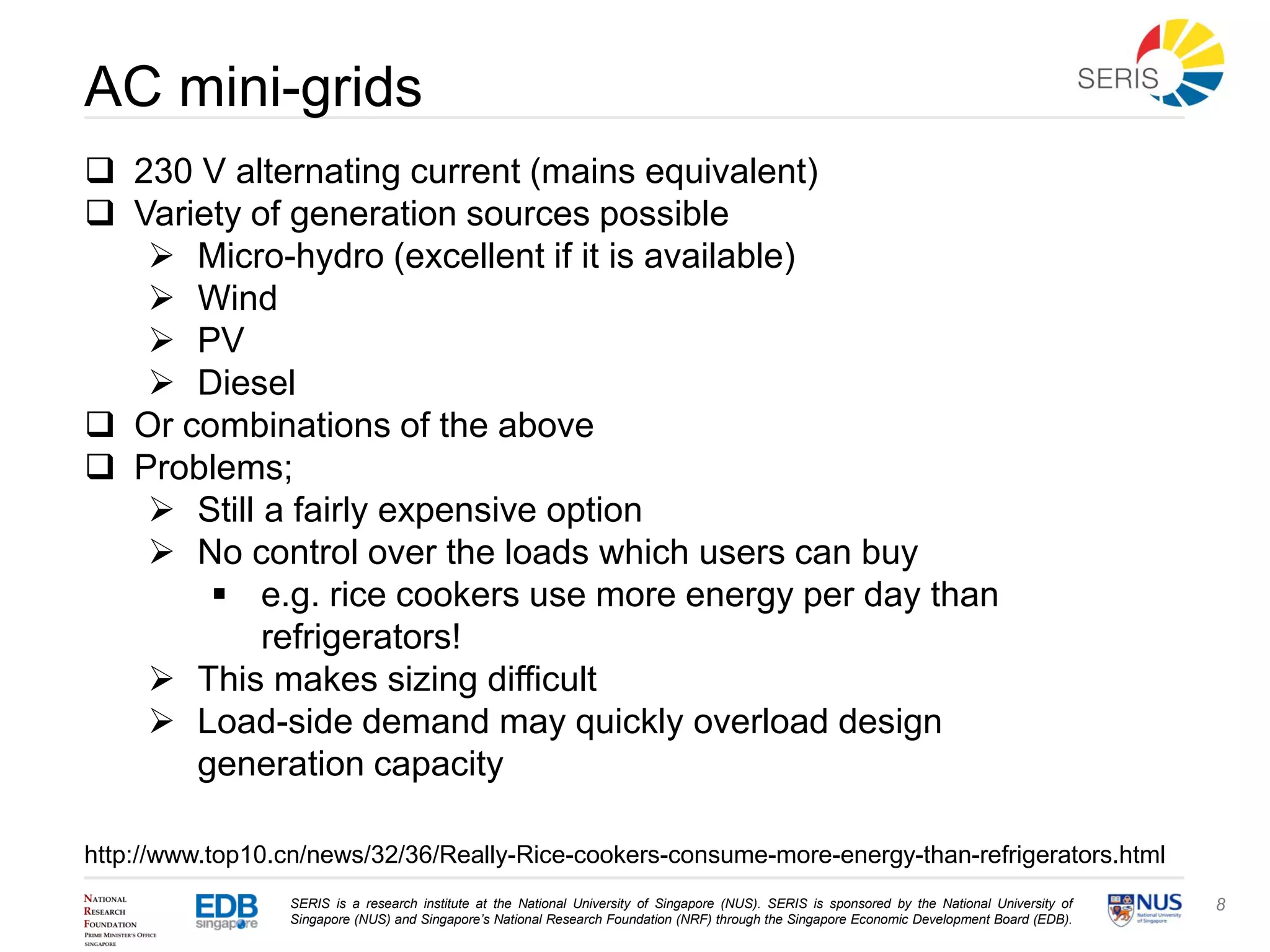
AC mini-grids
 230 V alternating current (mains equivalent)
 Variety of generation sources possible
 Micro-hydro (excellent if it is available)
 Wind
 PV
 Diesel
 Or combinations of the above
 Problems;
 Still a fairly expensive option
 No control over the loads which users can buy
 e.g. rice cookers use more energy per day than
refrigerators!
 This makes sizing difficult
 Load-side demand may quickly overload design
generation capacity
http://www.top10.cn/news/32/36/Really-Rice-cookers-consume-more-energy-than-refrigerators.html
SERIS is a research institute at the National University of Singapore (NUS). SERIS is sponsored by the National University of
Singapore (NUS) and Singapore’s National Research Foundation (NRF) through the Singapore Economic Development Board (EDB).
9
Solar home systems
 Provide a reasonable level of energy services
 Cheaper than AC mini-grids, but still fairly expensive
 Require either “donation” by governments or NGOs (not
recommended)
 Or individual households must borrow capital to pay for them
 Enormous micro-credit infrastructure is required
 Individual households pose a credit risk
SERIS is a research institute at the National University of Singapore (NUS). SERIS is sponsored by the National University of
Singapore (NUS) and Singapore’s National Research Foundation (NRF) through the Singapore Economic Development Board (EDB).
10
Solar DC nano-grids
 Least expensive option
 Electricity from PV is very cheap
 < USD $0.10/kWh (DC) when the sun is shining
 If energy needs to be stored in batteries, then price goes
up by a factor of 3 or 4
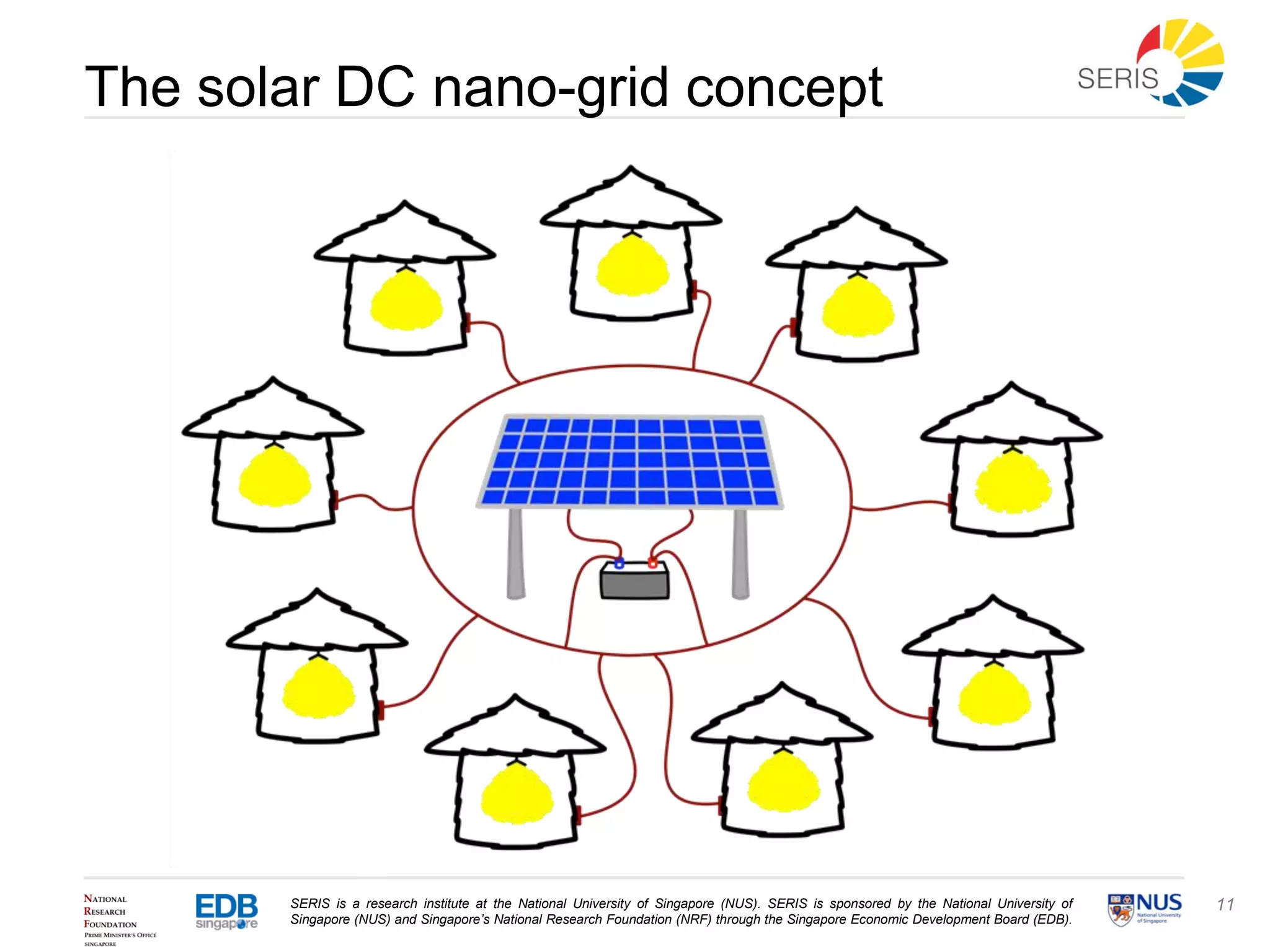
 One set of PV panels and batteries serve a cluster of
households (i.e. a village)
 Each house is connected via a cable and energy meter
 Each household gets a fixed number of Watt-hours per day
 The users are charged a flat fee for service, depending on
their tier
 A daily energy quota is provided on a “use it or lose it” basis
SERIS is a research institute at the National University of Singapore (NUS). SERIS is sponsored by the National University of
Singapore (NUS) and Singapore’s National Research Foundation (NRF) through the Singapore Economic Development Board (EDB).
11
The solar DC nano-grid concept
SERIS is a research institute at the National University of Singapore (NUS). SERIS is sponsored by the National University of
Singapore (NUS) and Singapore’s National Research Foundation (NRF) through the Singapore Economic Development Board (EDB).
12
Business aspects
of solar DC nano-grids
 Infrastructure is (at least partially) owned and managed locally
 Either as a private enterprise owned by an entrepreneur
 Or as a cooperative owned by all the users
 Fees are collected locally, door-to-door
 No complex centralized payment infrastructure is required
 Maximum of one loan per village is required
 Risk of default is spread over all users
 Amortization period of < 2 years at kerosene prices
 Future profits can be used for maintenance or expansion
 The profitability of a mini-grid enterprise makes it “bankable”
SERIS is a research institute at the National University of Singapore (NUS). SERIS is sponsored by the National University of
Singapore (NUS) and Singapore’s National Research Foundation (NRF) through the Singapore Economic Development Board (EDB).
13
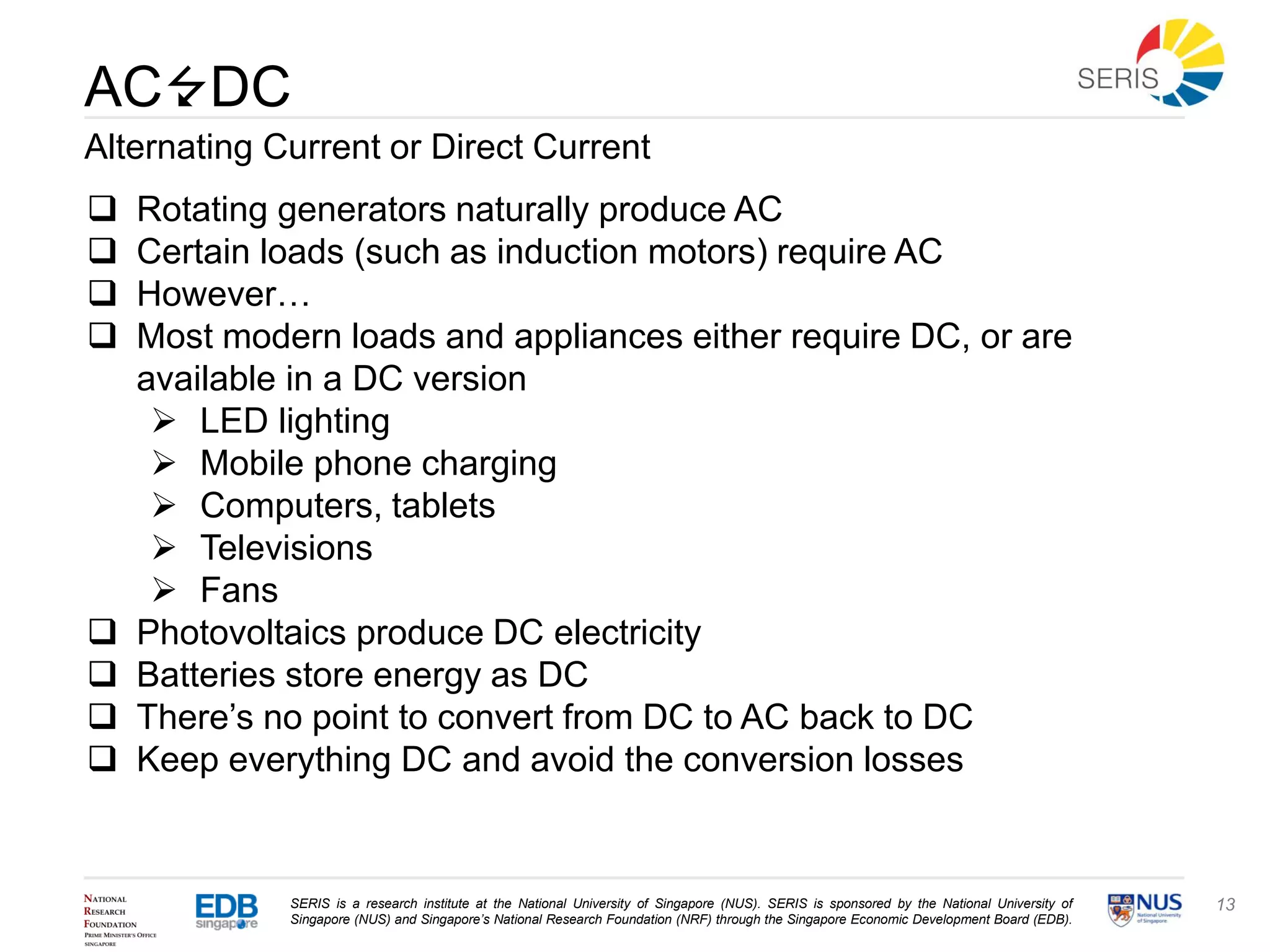
AC DC
Alternating Current or Direct Current
 Rotating generators naturally produce AC
 Certain loads (such as induction motors) require AC
 However…
 Most modern loads and appliances either require DC, or are
available in a DC version
 LED lighting
 Mobile phone charging
 Computers, tablets
 Televisions
 Fans
 Photovoltaics produce DC electricity
 Batteries store energy as DC
 There’s no point to convert from DC to AC back to DC
 Keep everything DC and avoid the conversion losses
SERIS is a research institute at the National University of Singapore (NUS). SERIS is sponsored by the National University of
Singapore (NUS) and Singapore’s National Research Foundation (NRF) through the Singapore Economic Development Board (EDB).
14
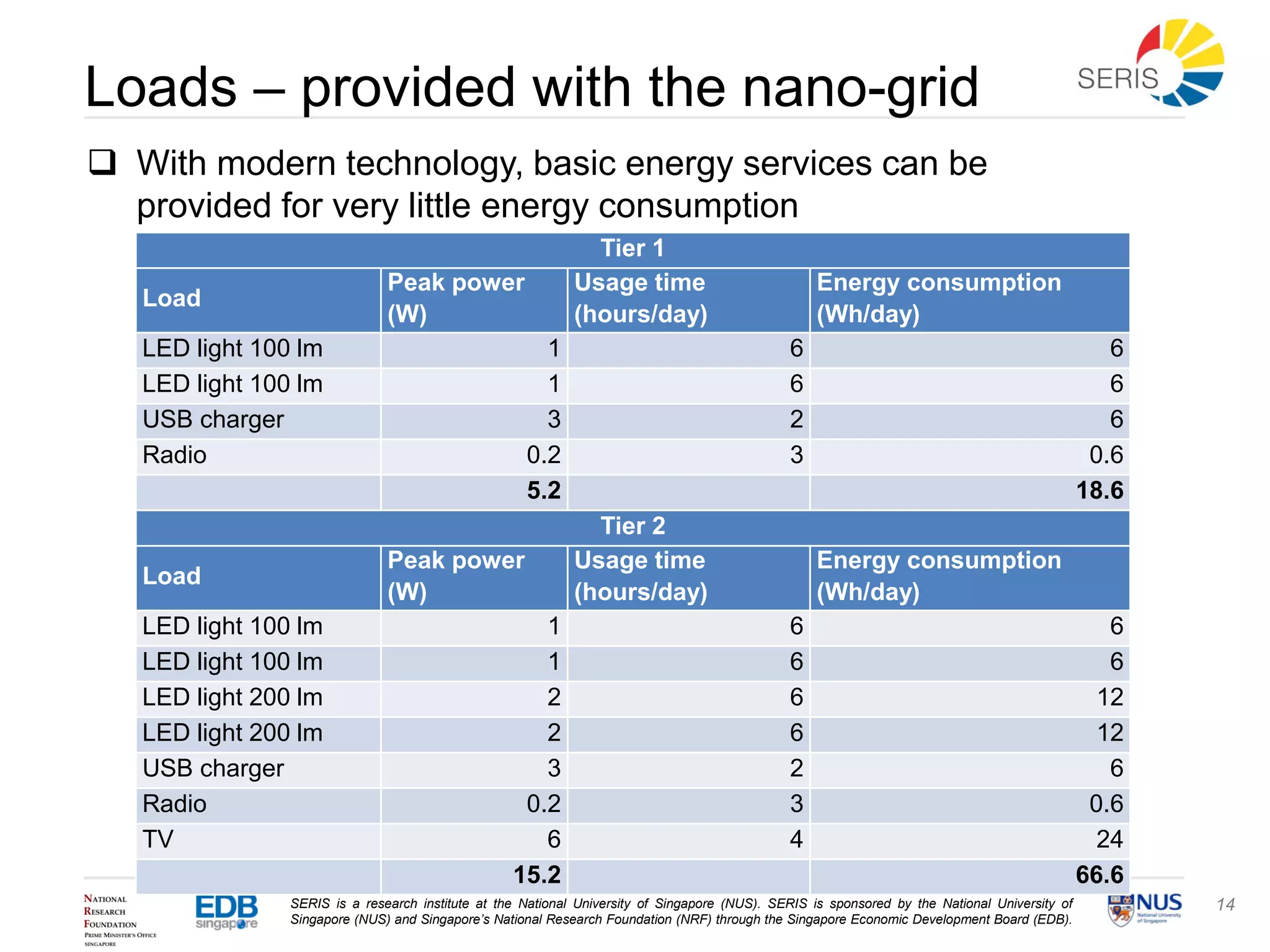
Loads – provided with the nano-grid
 With modern technology, basic energy services can be
provided for very little energy consumption
Tier 1
Load
Peak power
(W)
Usage time
(hours/day)
Energy consumption
(Wh/day)
LED light 100 lm 1 6 6
USB charger 3 2 6
Radio 0.2 3 0.6
5.2 18.6
Tier 2
Load
Peak power
(W)
Usage time
(hours/day)
Energy consumption
(Wh/day)
LED light 100 lm 1 6 6
LED light 200 lm 2 6 12
USB charger 3 2 6
Radio 0.2 3 0.6
TV 6 4 24
15.2 66.6
SERIS is a research institute at the National University of Singapore (NUS). SERIS is sponsored by the National University of
Singapore (NUS) and Singapore’s National Research Foundation (NRF) through the Singapore Economic Development Board (EDB).
15
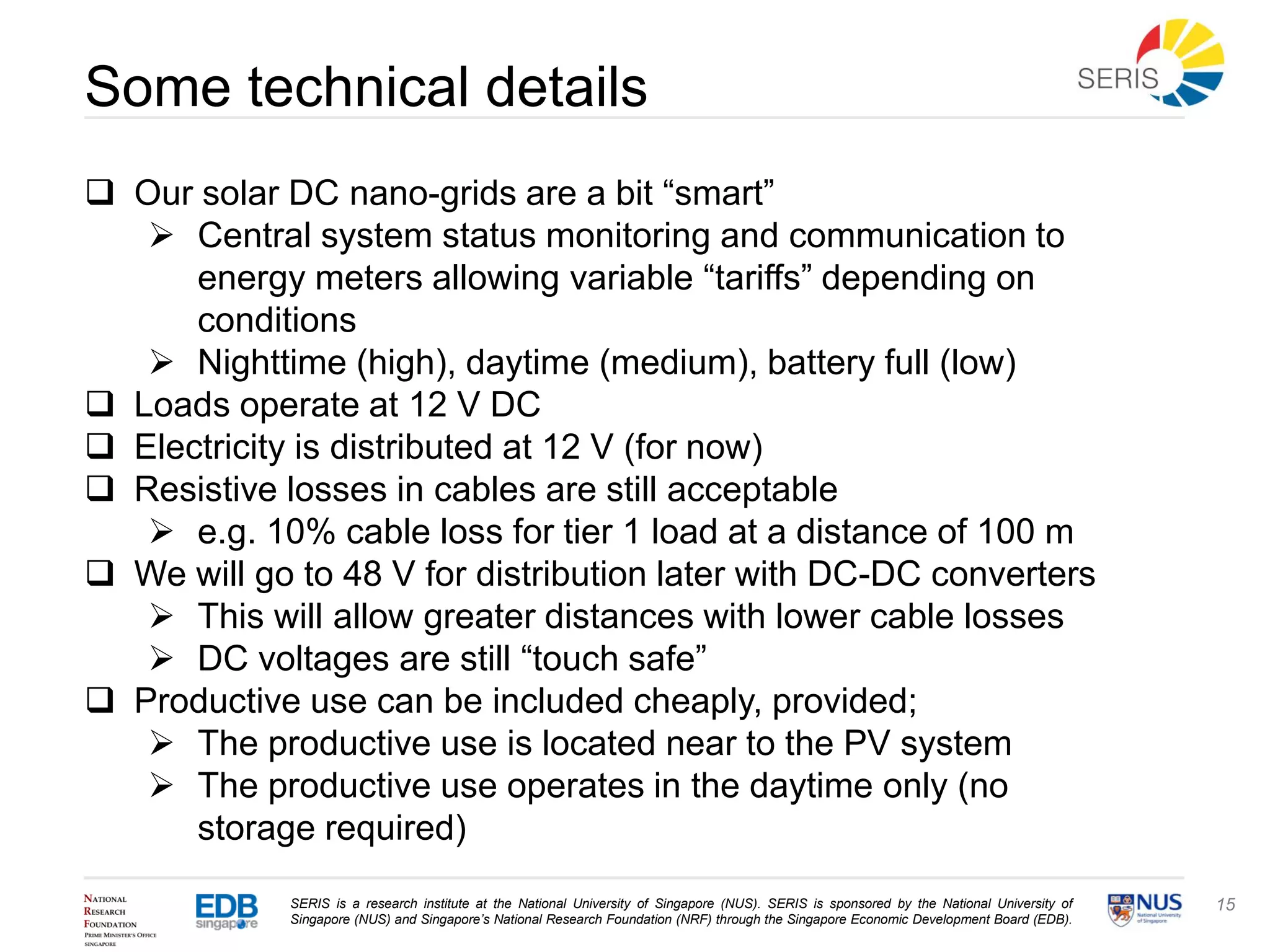
Some technical details
 Our solar DC nano-grids are a bit “smart”
 Central system status monitoring and communication to
energy meters allowing variable “tariffs” depending on
conditions
 Nighttime (high), daytime (medium), battery full (low)
 Loads operate at 12 V DC
 Electricity is distributed at 12 V (for now)
 Resistive losses in cables are still acceptable
 e.g. 10% cable loss for tier 1 load at a distance of 100 m
 We will go to 48 V for distribution later with DC-DC converters
 This will allow greater distances with lower cable losses
 DC voltages are still “touch safe”
 Productive use can be included cheaply, provided;
 The productive use is located near to the PV system
 The productive use operates in the daytime only (no
storage required)
SERIS is a research institute at the National University of Singapore (NUS). SERIS is sponsored by the National University of
Singapore (NUS) and Singapore’s National Research Foundation (NRF) through the Singapore Economic Development Board (EDB).
16
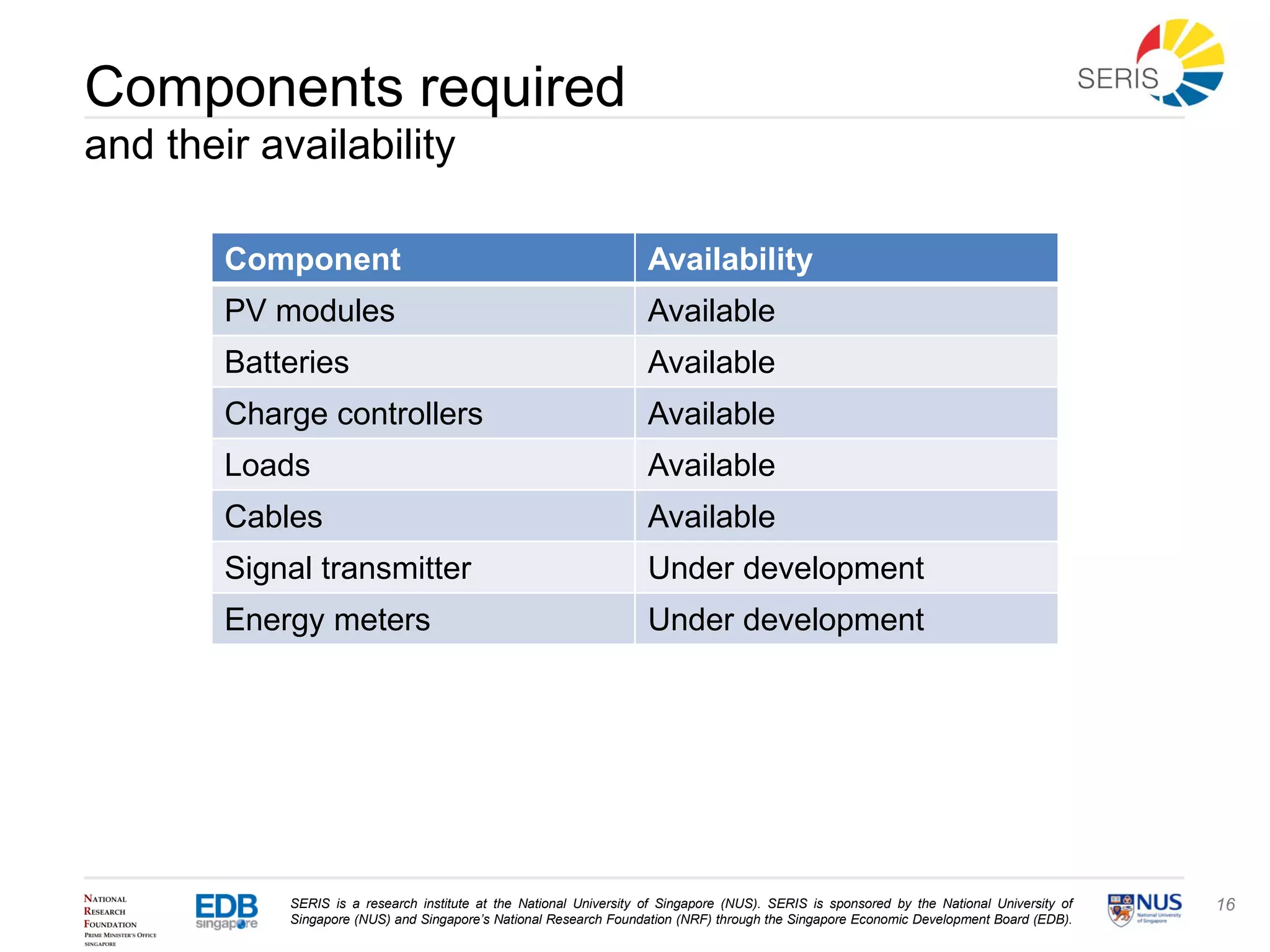
Components required
and their availability
Component Availability
PV modules Available
Batteries Available
Charge controllers Available
Loads Available
Cables Available
Signal transmitter Under development
Energy meters Under development
SERIS is a research institute at the National University of Singapore (NUS). SERIS is sponsored by the National University of
Singapore (NUS) and Singapore’s National Research Foundation (NRF) through the Singapore Economic Development Board (EDB).
17
Conclusion
 Solar DC nano-grids are the least expensive way to bring
modern energy services to rural villages
 They provide a business model along with the technology
which makes them feasible without subsidies or donations
 We are implementing several such nano-grids under a pilot
project in Bangladesh sponsored by GIZ
 Partnerships and collaborations with interested parties in
South East Asia are most welcome
SERIS is a research institute at the National University of Singapore (NUS). SERIS is sponsored by the National University of
Singapore (NUS) and Singapore’s National Research Foundation (NRF) through the Singapore Economic Development Board (EDB).
18
Thank you for your attention!
For more information, contact me
tim.walsh@nus.edu.sg

Kuching | Jan-15 | Solar DC nano-grids: A technology perspective on village electrification

  • 1.
    SERIS is aresearch institute at the National University of Singapore (NUS). SERIS is sponsored by the National University of Singapore (NUS) and Singapore’s National Research Foundation (NRF) through the Singapore Economic Development Board (EDB). 1 Solar DC nano-grids: A technology perspective on village electrification Timothy WALSH Solar Energy Research Institute of Singapore (SERIS) National University of Singapore (NUS) Smart Villages Workshop Kuching, Sarawak, Malaysia 27-29 January 2015
  • 2.
    2SERIS is aresearch institute at the National University of Singapore (NUS). SERIS is sponsored by the National University of Singapore (NUS) and Singapore’s National Research Foundation (NRF) through the Singapore Economic Development Board (EDB).  Founded in 2008; focuses on applied solar energy research  Part of the National University of Singapore (NUS)  Rapid growth (now ~160 people and > 6000 m2 of space)  > USD 30 million investments for labs  R&D focus is on PV (cells, modules, systems) and solar buildings  Specialised in professional services for the PV industry  ISO 9001 & ISO 17025* certified (* PV Module Testing Lab) Introduction to SERIS Solar Energy Research Institute of Singapore
  • 3.
    SERIS is aresearch institute at the National University of Singapore (NUS). SERIS is sponsored by the National University of Singapore (NUS) and Singapore’s National Research Foundation (NRF) through the Singapore Economic Development Board (EDB). 3 Off-grid PV systems group at SERIS  Obviously Singapore is not a big market for off-grid PV systems  Thus the group focuses on the wider South East Asian region  Research topics include;  Innovative applications of off-grid PV for “productive use”, particularly where the storage is provided by the load  Solar refrigeration and solar ice making  Solar air-conditioning using peltier devices  Solar-powered boats  Solar DC nano-grids  PhD candidates are welcome to apply
  • 4.
    SERIS is aresearch institute at the National University of Singapore (NUS). SERIS is sponsored by the National University of Singapore (NUS) and Singapore’s National Research Foundation (NRF) through the Singapore Economic Development Board (EDB). 4 Access to electricity worldwide  17% of the world’s population have no access to electricity  85% of these people live in (often remote) rural areas Sustainable Energy for All, Global Tracking Framework, http://www.worldbank.org/en/topic/energy/publication/Global-Tracking-Framework-Report Numbers in millions of people SSA = Sub-Saharan Africa SA = South Asia
  • 5.
    SERIS is aresearch institute at the National University of Singapore (NUS). SERIS is sponsored by the National University of Singapore (NUS) and Singapore’s National Research Foundation (NRF) through the Singapore Economic Development Board (EDB). 5 Defining “electrification”  The UN Sustainable Energy for All (SE4All) global initiative defines five tiers for access to electricity supply Attribute Tier 0 Tier 1 Tier 2 Tier 3 Tier 4 Tier 5 Types of loads - Task lighting AND phone charging (OR radio) General lighting AND television AND fan (if needed) Tier 2 AND any low-power appliances Tier 3 AND any medium power appliances Tier 4 AND any high-power appliances Duration (hours per day) - >4 >4 >8 >16 >22 Evening supply (hours) - >2 >2 >2 >4 >4 Sustainable Energy for All, Global Tracking Framework, http://www.worldbank.org/en/topic/energy/publication/Global-Tracking-Framework-Report
  • 6.
    SERIS is aresearch institute at the National University of Singapore (NUS). SERIS is sponsored by the National University of Singapore (NUS) and Singapore’s National Research Foundation (NRF) through the Singapore Economic Development Board (EDB). 6 Options for village electrification  Grid extension  AC mini-grids  Solar home systems  Solar DC nano-grids
  • 7.
    SERIS is aresearch institute at the National University of Singapore (NUS). SERIS is sponsored by the National University of Singapore (NUS) and Singapore’s National Research Foundation (NRF) through the Singapore Economic Development Board (EDB). 7 Grid extension  Most expensive option in many cases  Viable only under certain circumstances  Villages are not too remote  Village populations are of a certain size  Government is willing to invest in infrastructure  Not viable for many villages  Villages are too remote  Populations are too small  Governments (of some countries) may be unwilling to make the investment
  • 8.
    SERIS is aresearch institute at the National University of Singapore (NUS). SERIS is sponsored by the National University of Singapore (NUS) and Singapore’s National Research Foundation (NRF) through the Singapore Economic Development Board (EDB). 8 AC mini-grids  230 V alternating current (mains equivalent)  Variety of generation sources possible  Micro-hydro (excellent if it is available)  Wind  PV  Diesel  Or combinations of the above  Problems;  Still a fairly expensive option  No control over the loads which users can buy  e.g. rice cookers use more energy per day than refrigerators!  This makes sizing difficult  Load-side demand may quickly overload design generation capacity http://www.top10.cn/news/32/36/Really-Rice-cookers-consume-more-energy-than-refrigerators.html
  • 9.
    SERIS is aresearch institute at the National University of Singapore (NUS). SERIS is sponsored by the National University of Singapore (NUS) and Singapore’s National Research Foundation (NRF) through the Singapore Economic Development Board (EDB). 9 Solar home systems  Provide a reasonable level of energy services  Cheaper than AC mini-grids, but still fairly expensive  Require either “donation” by governments or NGOs (not recommended)  Or individual households must borrow capital to pay for them  Enormous micro-credit infrastructure is required  Individual households pose a credit risk
  • 10.
    SERIS is aresearch institute at the National University of Singapore (NUS). SERIS is sponsored by the National University of Singapore (NUS) and Singapore’s National Research Foundation (NRF) through the Singapore Economic Development Board (EDB). 10 Solar DC nano-grids  Least expensive option  Electricity from PV is very cheap  < USD $0.10/kWh (DC) when the sun is shining  If energy needs to be stored in batteries, then price goes up by a factor of 3 or 4  One set of PV panels and batteries serve a cluster of households (i.e. a village)  Each house is connected via a cable and energy meter  Each household gets a fixed number of Watt-hours per day  The users are charged a flat fee for service, depending on their tier  A daily energy quota is provided on a “use it or lose it” basis
  • 11.
    SERIS is aresearch institute at the National University of Singapore (NUS). SERIS is sponsored by the National University of Singapore (NUS) and Singapore’s National Research Foundation (NRF) through the Singapore Economic Development Board (EDB). 11 The solar DC nano-grid concept
  • 12.
    SERIS is aresearch institute at the National University of Singapore (NUS). SERIS is sponsored by the National University of Singapore (NUS) and Singapore’s National Research Foundation (NRF) through the Singapore Economic Development Board (EDB). 12 Business aspects of solar DC nano-grids  Infrastructure is (at least partially) owned and managed locally  Either as a private enterprise owned by an entrepreneur  Or as a cooperative owned by all the users  Fees are collected locally, door-to-door  No complex centralized payment infrastructure is required  Maximum of one loan per village is required  Risk of default is spread over all users  Amortization period of < 2 years at kerosene prices  Future profits can be used for maintenance or expansion  The profitability of a mini-grid enterprise makes it “bankable”
  • 13.
    SERIS is aresearch institute at the National University of Singapore (NUS). SERIS is sponsored by the National University of Singapore (NUS) and Singapore’s National Research Foundation (NRF) through the Singapore Economic Development Board (EDB). 13 AC DC Alternating Current or Direct Current  Rotating generators naturally produce AC  Certain loads (such as induction motors) require AC  However…  Most modern loads and appliances either require DC, or are available in a DC version  LED lighting  Mobile phone charging  Computers, tablets  Televisions  Fans  Photovoltaics produce DC electricity  Batteries store energy as DC  There’s no point to convert from DC to AC back to DC  Keep everything DC and avoid the conversion losses
  • 14.
    SERIS is aresearch institute at the National University of Singapore (NUS). SERIS is sponsored by the National University of Singapore (NUS) and Singapore’s National Research Foundation (NRF) through the Singapore Economic Development Board (EDB). 14 Loads – provided with the nano-grid  With modern technology, basic energy services can be provided for very little energy consumption Tier 1 Load Peak power (W) Usage time (hours/day) Energy consumption (Wh/day) LED light 100 lm 1 6 6 LED light 100 lm 1 6 6 USB charger 3 2 6 Radio 0.2 3 0.6 5.2 18.6 Tier 2 Load Peak power (W) Usage time (hours/day) Energy consumption (Wh/day) LED light 100 lm 1 6 6 LED light 100 lm 1 6 6 LED light 200 lm 2 6 12 LED light 200 lm 2 6 12 USB charger 3 2 6 Radio 0.2 3 0.6 TV 6 4 24 15.2 66.6
  • 15.
    SERIS is aresearch institute at the National University of Singapore (NUS). SERIS is sponsored by the National University of Singapore (NUS) and Singapore’s National Research Foundation (NRF) through the Singapore Economic Development Board (EDB). 15 Some technical details  Our solar DC nano-grids are a bit “smart”  Central system status monitoring and communication to energy meters allowing variable “tariffs” depending on conditions  Nighttime (high), daytime (medium), battery full (low)  Loads operate at 12 V DC  Electricity is distributed at 12 V (for now)  Resistive losses in cables are still acceptable  e.g. 10% cable loss for tier 1 load at a distance of 100 m  We will go to 48 V for distribution later with DC-DC converters  This will allow greater distances with lower cable losses  DC voltages are still “touch safe”  Productive use can be included cheaply, provided;  The productive use is located near to the PV system  The productive use operates in the daytime only (no storage required)
  • 16.
    SERIS is aresearch institute at the National University of Singapore (NUS). SERIS is sponsored by the National University of Singapore (NUS) and Singapore’s National Research Foundation (NRF) through the Singapore Economic Development Board (EDB). 16 Components required and their availability Component Availability PV modules Available Batteries Available Charge controllers Available Loads Available Cables Available Signal transmitter Under development Energy meters Under development
  • 17.
    SERIS is aresearch institute at the National University of Singapore (NUS). SERIS is sponsored by the National University of Singapore (NUS) and Singapore’s National Research Foundation (NRF) through the Singapore Economic Development Board (EDB). 17 Conclusion  Solar DC nano-grids are the least expensive way to bring modern energy services to rural villages  They provide a business model along with the technology which makes them feasible without subsidies or donations  We are implementing several such nano-grids under a pilot project in Bangladesh sponsored by GIZ  Partnerships and collaborations with interested parties in South East Asia are most welcome
  • 18.
    SERIS is aresearch institute at the National University of Singapore (NUS). SERIS is sponsored by the National University of Singapore (NUS) and Singapore’s National Research Foundation (NRF) through the Singapore Economic Development Board (EDB). 18 Thank you for your attention! For more information, contact me tim.walsh@nus.edu.sg