13 Go security tips
Karthik Gaekwad - @iteration1
I’m Karthik
@iteration1
I speak
docker
golang
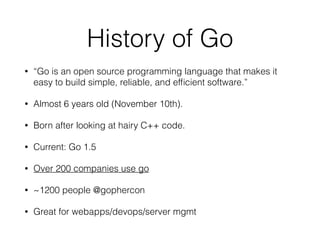
History of Go
• “Go is an open source programming language that makes it
easy to build simple, reliable, and efficient software.”
• Almost 6 years old (November 10th).
• Born after looking at hairy C++ code.
• Current: Go 1.5
• Over 200 companies use go
• ~1200 people @gophercon
• Great for webapps/devops/server mgmt
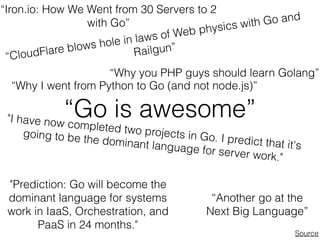
“Go is awesome”
“Iron.io: How We Went from 30 Servers to 2
with Go”
“Another go at the
Next Big Language”
“CloudFlare blows hole in laws of Web physics with Go and
Railgun”
"I have now completed two projects in Go. I predict that it's
going to be the dominant language for server work."
Source
“Why I went from Python to Go (and not node.js)”
“Why you PHP guys should learn Golang”
"Prediction: Go will become the
dominant language for systems
work in IaaS, Orchestration, and
PaaS in 24 months."
Pwnage?
Does anyone care?
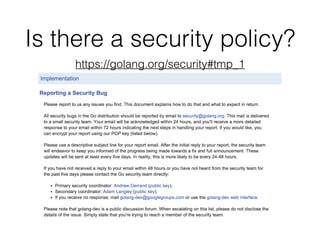
Is there a security policy?
https://golang.org/security#tmp_1
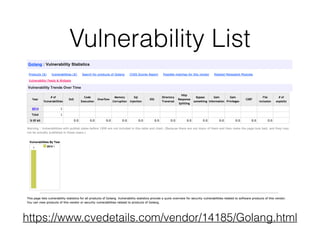
Vulnerability List
https://www.cvedetails.com/vendor/14185/Golang.html
Okay, so it’s not all
bad news…
Features!
Go is strongly-typed
• The type of every object is known at runtime.
• This cannot be changed.
• Pointers exist, but pointer arithmetic does not.
Memory Managed
• Garbage collector FTW.
• Accessing out of bound indexes in arrays ends
with a hard panic.
• Once again, no pointer arithmetic:: can’t create
buffer overflows.
Gofmt
• Source code formatter.
• Spend time writing code, not formatting it.
• Integrated with editors (vim/sublimetext/eclipse etc)
• Untweakable!
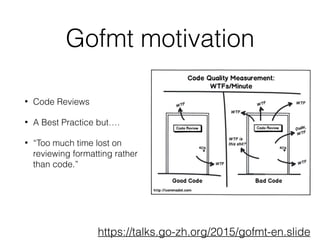
Gofmt motivation
• Code Reviews
• A Best Practice but….
• “Too much time lost on
reviewing formatting rather
than code.”
https://talks.go-zh.org/2015/gofmt-en.slide
Other tooling
• golint
• Code linter.
• Finds common lint issues or things that don’t belong to a standard.
• Could add this to your CI pipeline, but is volatile.
• go vet
• Looks for weird constructs in your code.
• Examples: Useless assignments, incorrect printf format, unreachable code
• Good list of tools to review: http://dominik.honnef.co/posts/2014/12/
an_incomplete_list_of_go_tools/
Standard Packages ftw
• Standard libs have pretty good support for most things
you need.
• Don’t have to search for 3rd party libs first…
• All crypto algorithms are in packages under the crypto
package.
• crypto.random uses /dev/urandom by default
• good read: https://leanpub.com/gocrypto (Kyle
Isom)
Single Binary
• Statically linked, so everything you need is in your
binary.
• Helps with product distribution.
• Reduces burden with installation issues on client
host.
App Dependencies
• Package management:
• Keeps team on the same page.
• Reproducible builds.
• Godep:
• Most popular
• Code is vendorized.
• All your dependencies live inside your application.
• Sorta like (java) ant, but with the source.
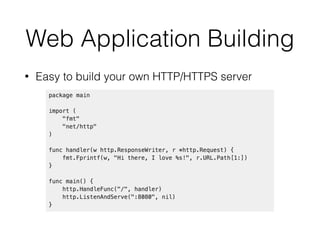
Web Application Building
• Easy to build your own HTTP/HTTPS server
Web Applications: XSS
• Go Templates- html/template and text/template:
• You want to use html/template for your webapps.
• html/template package escapes all html tags!
(template.HTMLEscape or ExecuteTemplate).
• text/template does not!!
Gorilla toolkit
• Awesome toolkit for writing web applications.
• Assists with writing more secure code when you
don’t know how to code.
• Gorilla toolkit >>> roll your own
• http://www.gorillatoolkit.org/
Gorilla toolkit
• gorilla/securecookie
• Secure cookie: Encodes/Decodes cookie values for you.
• Value is validated with HMAC.
• Add encryption, and content is inaccessible to end user.
• gorilla/sessions
• Simple API for signed (and encrypted) cookies.
• Clean mechanism to rotate session authentication and encryption keys.
• gorilla/mux: Great for routing web apps
• Also gorilla/context, gorilla/websockets and a few others
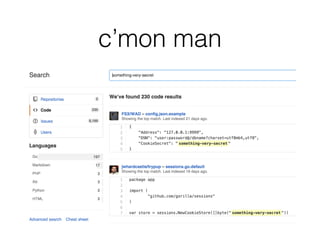
c’mon man
Secure middleware
• https://github.com/unrolled/secure
• Middleware that helps you with some quick security
wins.
• + XSS Protection headers
• + CSP headers
• + SSL Check/SSL Redirects
Example:
secureMiddleware := secure.New(secure.Options{
AllowedHosts: []string{"example.com", "ssl.example.com"},
SSLRedirect: true,
SSLHost: "ssl.example.com",
SSLProxyHeaders: map[string]string{"X-Forwarded-Proto": "https"},
STSSeconds: 315360000,
STSIncludeSubdomains: true,
STSPreload: true,
FrameDeny: true,
ContentTypeNosniff: true,
BrowserXssFilter: true,
ContentSecurityPolicy: "default-src 'self'",
PublicKey: `pin-sha256="base64+primary=="; pin-
sha256="base64+backup=="; max-age=5184000; includeSubdomains; report-
uri="https://www.example.com/hpkp-report"`,
})
CSRF
• nosurf is an HTTP package that helps with
prevention of cross site request forgery.
• https://github.com/justinas/nosurf
nosurf example
var templateString = `
<!doctype html>
<html><body>
{{ if .name }}
<p>Your name: {{ .name }}</p>
{{ end }}
<form action="/" method="POST">
<input type="text" name="name">
<!-- Try removing this or changing its value
and see what happens -->
<input type="hidden" name="csrf_token" value="{{ .token }}">
<input type="submit" value="Send">
</form></body></html>
`
var templ = template.Must(template.New("t1").Parse(templateString))
func myFunc(w http.ResponseWriter, r *http.Request) {
context := make(map[string]string)
context["token"] = nosurf.Token(r)
if r.Method == "POST" {
context["name"] = r.FormValue("name")
}
templ.Execute(w, context)
}
func main() {
myHandler := http.HandlerFunc(myFunc)
fmt.Println("Listening on http://127.0.0.1:8000/")
http.ListenAndServe(":8000", nosurf.New(myHandler))
}
SQL Injections
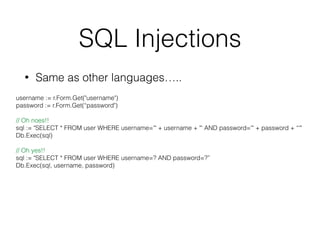
• Same as other languages…..
username := r.Form.Get("username")
password := r.Form.Get(“password")
// Oh noes!!
sql := "SELECT * FROM user WHERE username='" + username + "' AND password='" + password + “'"
Db.Exec(sql)
// Oh yes!!
sql := "SELECT * FROM user WHERE username=? AND password=?”
Db.Exec(sql, username, password)
SQL Injections
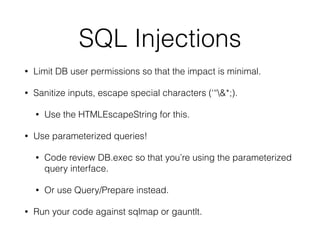
• Limit DB user permissions so that the impact is minimal.
• Sanitize inputs, escape special characters (‘“&*;).
• Use the HTMLEscapeString for this.
• Use parameterized queries!
• Code review DB.exec so that you’re using the parameterized
query interface.
• Or use Query/Prepare instead.
• Run your code against sqlmap or gauntlt.
Friends who Go!
This could be you
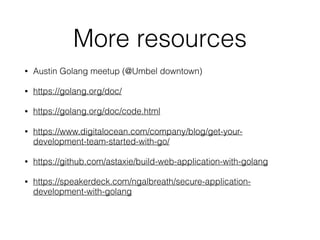
More resources
• Austin Golang meetup (@Umbel downtown)
• https://golang.org/doc/
• https://golang.org/doc/code.html
• https://www.digitalocean.com/company/blog/get-your-
development-team-started-with-go/
• https://github.com/astaxie/build-web-application-with-golang
• https://speakerdeck.com/ngalbreath/secure-application-
development-with-golang
Thanks!

13 practical tips for writing secure golang applications

  • 1.
    13 Go securitytips Karthik Gaekwad - @iteration1
  • 2.
  • 3.
    History of Go •“Go is an open source programming language that makes it easy to build simple, reliable, and efficient software.” • Almost 6 years old (November 10th). • Born after looking at hairy C++ code. • Current: Go 1.5 • Over 200 companies use go • ~1200 people @gophercon • Great for webapps/devops/server mgmt
  • 4.
    “Go is awesome” “Iron.io:How We Went from 30 Servers to 2 with Go” “Another go at the Next Big Language” “CloudFlare blows hole in laws of Web physics with Go and Railgun” "I have now completed two projects in Go. I predict that it's going to be the dominant language for server work." Source “Why I went from Python to Go (and not node.js)” “Why you PHP guys should learn Golang” "Prediction: Go will become the dominant language for systems work in IaaS, Orchestration, and PaaS in 24 months."
  • 5.
  • 7.
    Is there asecurity policy? https://golang.org/security#tmp_1
  • 8.
  • 9.
    Okay, so it’snot all bad news…
  • 10.
  • 11.
    Go is strongly-typed •The type of every object is known at runtime. • This cannot be changed. • Pointers exist, but pointer arithmetic does not.
  • 12.
    Memory Managed • Garbagecollector FTW. • Accessing out of bound indexes in arrays ends with a hard panic. • Once again, no pointer arithmetic:: can’t create buffer overflows.
  • 13.
    Gofmt • Source codeformatter. • Spend time writing code, not formatting it. • Integrated with editors (vim/sublimetext/eclipse etc) • Untweakable!
  • 14.
    Gofmt motivation • CodeReviews • A Best Practice but…. • “Too much time lost on reviewing formatting rather than code.” https://talks.go-zh.org/2015/gofmt-en.slide
  • 15.
    Other tooling • golint •Code linter. • Finds common lint issues or things that don’t belong to a standard. • Could add this to your CI pipeline, but is volatile. • go vet • Looks for weird constructs in your code. • Examples: Useless assignments, incorrect printf format, unreachable code • Good list of tools to review: http://dominik.honnef.co/posts/2014/12/ an_incomplete_list_of_go_tools/
  • 16.
    Standard Packages ftw •Standard libs have pretty good support for most things you need. • Don’t have to search for 3rd party libs first… • All crypto algorithms are in packages under the crypto package. • crypto.random uses /dev/urandom by default • good read: https://leanpub.com/gocrypto (Kyle Isom)
  • 17.
    Single Binary • Staticallylinked, so everything you need is in your binary. • Helps with product distribution. • Reduces burden with installation issues on client host.
  • 18.
    App Dependencies • Packagemanagement: • Keeps team on the same page. • Reproducible builds. • Godep: • Most popular • Code is vendorized. • All your dependencies live inside your application. • Sorta like (java) ant, but with the source.
  • 19.
    Web Application Building •Easy to build your own HTTP/HTTPS server
  • 20.
    Web Applications: XSS •Go Templates- html/template and text/template: • You want to use html/template for your webapps. • html/template package escapes all html tags! (template.HTMLEscape or ExecuteTemplate). • text/template does not!!
  • 21.
    Gorilla toolkit • Awesometoolkit for writing web applications. • Assists with writing more secure code when you don’t know how to code. • Gorilla toolkit >>> roll your own • http://www.gorillatoolkit.org/
  • 22.
    Gorilla toolkit • gorilla/securecookie •Secure cookie: Encodes/Decodes cookie values for you. • Value is validated with HMAC. • Add encryption, and content is inaccessible to end user. • gorilla/sessions • Simple API for signed (and encrypted) cookies. • Clean mechanism to rotate session authentication and encryption keys. • gorilla/mux: Great for routing web apps • Also gorilla/context, gorilla/websockets and a few others
  • 23.
  • 24.
    Secure middleware • https://github.com/unrolled/secure •Middleware that helps you with some quick security wins. • + XSS Protection headers • + CSP headers • + SSL Check/SSL Redirects
  • 25.
    Example: secureMiddleware := secure.New(secure.Options{ AllowedHosts:[]string{"example.com", "ssl.example.com"}, SSLRedirect: true, SSLHost: "ssl.example.com", SSLProxyHeaders: map[string]string{"X-Forwarded-Proto": "https"}, STSSeconds: 315360000, STSIncludeSubdomains: true, STSPreload: true, FrameDeny: true, ContentTypeNosniff: true, BrowserXssFilter: true, ContentSecurityPolicy: "default-src 'self'", PublicKey: `pin-sha256="base64+primary=="; pin- sha256="base64+backup=="; max-age=5184000; includeSubdomains; report- uri="https://www.example.com/hpkp-report"`, })
  • 26.
    CSRF • nosurf isan HTTP package that helps with prevention of cross site request forgery. • https://github.com/justinas/nosurf
  • 27.
    nosurf example var templateString= ` <!doctype html> <html><body> {{ if .name }} <p>Your name: {{ .name }}</p> {{ end }} <form action="/" method="POST"> <input type="text" name="name"> <!-- Try removing this or changing its value and see what happens --> <input type="hidden" name="csrf_token" value="{{ .token }}"> <input type="submit" value="Send"> </form></body></html> ` var templ = template.Must(template.New("t1").Parse(templateString)) func myFunc(w http.ResponseWriter, r *http.Request) { context := make(map[string]string) context["token"] = nosurf.Token(r) if r.Method == "POST" { context["name"] = r.FormValue("name") } templ.Execute(w, context) } func main() { myHandler := http.HandlerFunc(myFunc) fmt.Println("Listening on http://127.0.0.1:8000/") http.ListenAndServe(":8000", nosurf.New(myHandler)) }
  • 28.
    SQL Injections • Sameas other languages….. username := r.Form.Get("username") password := r.Form.Get(“password") // Oh noes!! sql := "SELECT * FROM user WHERE username='" + username + "' AND password='" + password + “'" Db.Exec(sql) // Oh yes!! sql := "SELECT * FROM user WHERE username=? AND password=?” Db.Exec(sql, username, password)
  • 29.
    SQL Injections • LimitDB user permissions so that the impact is minimal. • Sanitize inputs, escape special characters (‘“&*;). • Use the HTMLEscapeString for this. • Use parameterized queries! • Code review DB.exec so that you’re using the parameterized query interface. • Or use Query/Prepare instead. • Run your code against sqlmap or gauntlt.
  • 30.
  • 31.
    More resources • AustinGolang meetup (@Umbel downtown) • https://golang.org/doc/ • https://golang.org/doc/code.html • https://www.digitalocean.com/company/blog/get-your- development-team-started-with-go/ • https://github.com/astaxie/build-web-application-with-golang • https://speakerdeck.com/ngalbreath/secure-application- development-with-golang
  • 32.