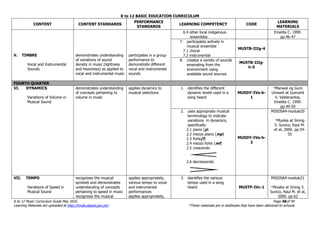
Republic of the Philippines
Department of Education
DepEd Complex, Meralco Avenue
Pasig City
May 2016
K to 12 Curriculum Guide
MUSIC
(Grade 1 to Grade 10)
K to 12 BASIC EDUCATION CURRICULUM
K to 12 Music Curriculum Guide May 2016 Page 2of 94
Learning Materials are uploaded at http://lrmds.deped.gov.ph/. *These materials are in textbooks that have been delivered to schools.
CONCEPTUAL FRAMEWORK
Both the Music and the Arts curricula focus on the learner as recipient of the knowledge, skills, and values necessary for artistic expression and
cultural literacy. The design of the curricula is student-centered, based on spiral progression of processes, concepts and skills and grounded in performance-
based learning. Thus, the learner is empowered, through active involvement and participation, to effectively correlate music and art to the development of his/her
own cultural identity and the expansion of his/her vision of the world.
As Music and Arts are performance-based disciplines, effective learning occurs through active experience, participation, and performance, creative
expression, aesthetic valuation, critical response, and interpretation. The skills that are developed include reading/analyzing, listening/observing, performing,
(singing, using musical instruments, movement, acting, and playing, using different art materials, techniques and processes, responding, composing, and
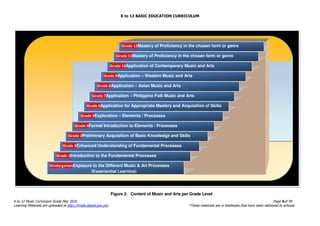
creating. (See Figure 1 and Figure 2)
The philosophical foundations upon which standards and competencies are based include: A Process of Education by Jerome Bruner, Performance-Based
Learning by Cleve Miller, Aesthetic Education by Bennett Reimer, Multiple Intelligences by Howard Gardner, A Structure for Music Education by Ronald
Thomas, Gongs and Bamboo by Jose Maceda, Compendium on the Humanities: Musical Arts produced by the National Research Council of the Philippines,
Cultural Dictionary for Filipinos by Thelma Kintanar and Associates, Creative and Mental Growth by Viktor Lowenfeld and W. Lambert Brittain, Discipline-Based
Art Education by Elliot Eisner, Encyclopedia of Philippine Arts and Tuklas Sining, both produced by the Cultural Center of the Philippines.
K to 12 BASIC EDUCATION CURRICULUM
K to 12 Music Curriculum Guide May 2016 Page 3of 94
Learning Materials are uploaded at http://lrmds.deped.gov.ph/. *These materials are in textbooks that have been delivered to schools.
PHILOSOPHY AND RATIONALE FOR MUSIC EDUCATION
Music is both an aural and a temporal art. All its elements, when interwoven in the highest artistic order, are likened into a -- tapestry moving in time.
The global weavings of this tapestry in historical and cultural contexts are diverse -- having spurred a continued metamorphosis to include a full range of
purposes, functions, and identities, from the utilitarian to aesthetic.
However, the basic nature of music does not change. In his book A Structure for Music Education, Ronald Thomas articulates that the nature of music is
expressive, ongoing, and creative. Through a language and medium of its own, music conveys ideas and feelings in a way that addresses the human spirit, and
has great value in its communicative process. Music, being responsive in interpreting contemporary times, is a continuing art. Aaron Copland describes this
characteristic as a continuous state of becoming. Like the other arts, music is a creative avenue for man’s individual quest for self- expression and fulfillment.
On these basic characteristics are founded the rationale of music study. A keen sensitivity to environmental and musical sounds needs to be
developed. The student must learn to ―hear, ―speak, and ―think in the medium of music. Simultaneously, growth and development in the skills that enable the
application of the learner’s knowledge should be encouraged, through active involvement in the various musical processes.
Drawing from the development of music pedagogy through the years, the K-10 Music Curriculum embodies the best practices advocated by the
SPIRAL, MULTI-CULTURAL, and INTEGRATIVE approaches in music education, as well as current philosophical thought about contemporary general
education.
We envision that Music in the K-10 Program will effectively nurture and refine the learner’s artistic expression and cultural literacy, and celebrate his/her
national heritage, while it instils, within every individual Filipino learner, pride in his/her own cultural identity.
K to 12 BASIC EDUCATION CURRICULUM
K to 12 Music Curriculum Guide May 2016 Page 4of 94
Learning Materials are uploaded at http://lrmds.deped.gov.ph/. *These materials are in textbooks that have been delivered to schools.
Figure 1. The Curriculum Framework of Music and Arts Education
K to 12 BASIC EDUCATION CURRICULUM
K to 12 Music Curriculum Guide May 2016 Page 5of 94
Learning Materials are uploaded at http://lrmds.deped.gov.ph/. *These materials are in textbooks that have been delivered to schools.
Figure 2. Content of Music and Arts per Grade Level
Grade 12Mastery of Proficiency in the chosen form or genre
Grade 11Mastery of Proficiency in the chosen form or genre
Grade 10Application of Contemporary Music and Arts
Grade 9Application – Western Music and Arts
Grade 8Application – Asian Music and Arts
Grade 7Application – Philippine Folk Music and Arts
Grade 6Application for Appropriate Mastery and Acquisition of Skills
Grade 5Exploration – Elements / Processes
Grade 4Formal Introduction to Elements / Processes
Grade 3Preliminary Acquisition of Basic Knowledge and Skills
Grade 2Enhanced Understanding of Fundamental Processes
Grade 1Introduction to the Fundamental Processes
KindergartenExposure to the Different Music & Art Processes
(Experiential Learning)
K to 12 BASIC EDUCATION CURRICULUM
K to 12 Music Curriculum Guide May 2016 Page 6of 94
Learning Materials are uploaded at http://lrmds.deped.gov.ph/. *These materials are in textbooks that have been delivered to schools.
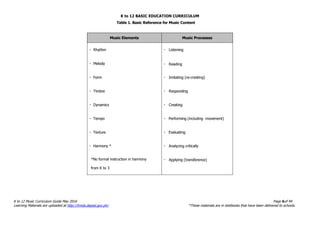
Table 1. Basic Reference for Music Content
Music Elements Music Processes
-creating)
(including movement)
*No formal instruction in harmony
from K to 3
K to 12 BASIC EDUCATION CURRICULUM
K to 12 Music Curriculum Guide May 2016 Page 7of 94
Learning Materials are uploaded at http://lrmds.deped.gov.ph/. *These materials are in textbooks that have been delivered to schools.
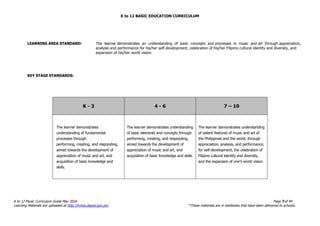
LEARNING AREA STANDARD: The learner demonstrates an understanding of basic concepts and processes in music and art through appreciation,
analysis and performance for his/her self-development, celebration of his/her Filipino cultural identity and diversity, and
expansion of his/her world vision.
KEY STAGE STANDARDS:
K - 3 4 - 6 7 – 10
The learner demonstrates
understanding of fundamental
processes through
performing, creating, and responding,
aimed towards the development of
appreciation of music and art, and
acquisition of basic knowledge and
skills.
The learner demonstrates understanding
of basic elements and concepts through
performing, creating, and responding,
aimed towards the development of
appreciation of music and art, and
acquisition of basic knowledge and skills.
The learner demonstrates understanding
of salient features of music and art of
the Philippines and the world, through
appreciation, analysis, and performance,
for self-development, the celebration of
Filipino cultural identity and diversity,
and the expansion of one’s world vision.
K to 12 BASIC EDUCATION CURRICULUM
K to 12 Music Curriculum Guide May 2016 Page 8of 94
Learning Materials are uploaded at http://lrmds.deped.gov.ph/. *These materials are in textbooks that have been delivered to schools.
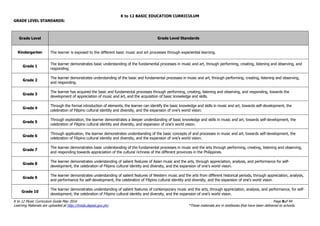
GRADE LEVEL STANDARDS:
Grade Level Grade Level Standards
Kindergarten The learner is exposed to the different basic music and art processes through experiential learning.
Grade 1
The learner demonstrates basic understanding of the fundamental processes in music and art, through performing, creating, listening and observing, and
responding.
Grade 2
The learner demonstrates understanding of the basic and fundamental processes in music and art, through performing, creating, listening and observing,
and responding.
Grade 3
The learner has acquired the basic and fundamental processes through performing, creating, listening and observing, and responding, towards the
development of appreciation of music and art, and the acquisition of basic knowledge and skills.
Grade 4
Through the formal introduction of elements, the learner can identify the basic knowledge and skills in music and art, towards self-development, the
celebration of Filipino cultural identity and diversity, and the expansion of one’s world vision.
Grade 5
Through exploration, the learner demonstrates a deeper understanding of basic knowledge and skills in music and art, towards self-development, the
celebration of Filipino cultural identity and diversity, and expansion of one’s world vision.
Grade 6
Through application, the learner demonstrates understanding of the basic concepts of and processes in music and art, towards self-development, the
celebration of Filipino cultural identity and diversity, and the expansion of one’s world vision.
Grade 7
The learner demonstrates basic understanding of the fundamental processes in music and the arts through performing, creating, listening and observing,
and responding towards appreciation of the cultural richness of the different provinces in the Philippines.
Grade 8
The learner demonstrates understanding of salient features of Asian music and the arts, through appreciation, analysis, and performance for self-
development, the celebration of Filipino cultural identity and diversity, and the expansion of one’s world vision.
Grade 9
The learner demonstrates understanding of salient features of Western music and the arts from different historical periods, through appreciation, analysis,
and performance for self-development, the celebration of Filipino cultural identity and diversity, and the expansion of one’s world vision.
Grade 10
The learner demonstrates understanding of salient features of contemporary music and the arts, through appreciation, analysis, and performance, for self-
development, the celebration of Filipino cultural identity and diversity, and the expansion of one’s world vision.
K to 12 BASIC EDUCATION CURRICULUM
K to 12 Music Curriculum Guide May 2016 Page 9of 94
Learning Materials are uploaded at http://lrmds.deped.gov.ph/. *These materials are in textbooks that have been delivered to schools.
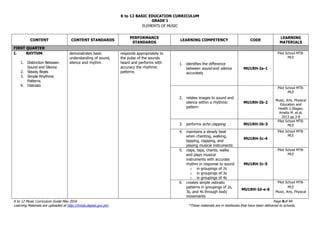
GRADE 1
ELEMENTS OF MUSIC
CONTENT CONTENT STANDARDS
PERFORMANCE
STANDARDS
LEARNING COMPETENCY CODE
LEARNING
MATERIALS
FIRST QUARTER
I. RHYTHM
1. Distinction Between
Sound and Silence
2. Steady Beats
3. Simple Rhythmic
Patterns
4. Ostinato
demonstrates basic
understanding of sound,
silence and rhythm
responds appropriately to
the pulse of the sounds
heard and performs with
accuracy the rhythmic
patterns
1. identifies the difference
between sound and silence
accurately
MU1RH-Ia-1
Pilot School MTB-
MLE
2. relates images to sound and
silence within a rhythmic
pattern
MU1RH-Ib-2
Pilot School MTB-
MLE
Music, Arts, Physical
Education and
Health 2.Illagan,
Amelia M. et.al,
2013 pp.3-8
3. performs echo clapping MU1RH-Ib-3
Pilot School MTB-
MLE
4. maintains a steady beat
when chanting, walking,
tapping, clapping, and
playing musical instruments
MU1RH-Ic-4
Pilot School MTB-
MLE
5. claps, taps, chants, walks
and plays musical
instruments with accurate
rhythm in response to sound
o in groupings of 2s
o in groupings of 3s
o in groupings of 4s
MU1RH-Ic-5
Pilot School MTB-
MLE
6. creates simple ostinato
patterns in groupings of 2s,
3s, and 4s through body
movements
MU1RH-Id-e-6
Pilot School MTB-
MLE
Music, Arts, Physical
K to 12 BASIC EDUCATION CURRICULUM
K to 12 Music Curriculum Guide May 2016 Page 10of 94
Learning Materials are uploaded at http://lrmds.deped.gov.ph/. *These materials are in textbooks that have been delivered to schools.
CONTENT CONTENT STANDARDS
PERFORMANCE
STANDARDS
LEARNING COMPETENCY CODE
LEARNING
MATERIALS
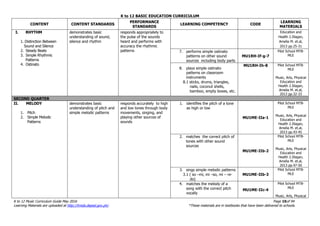
I. RHYTHM
1. Distinction Between
Sound and Silence
2. Steady Beats
3. Simple Rhythmic
Patterns
4. Ostinato
demonstrates basic
understanding of sound,
silence and rhythm
responds appropriately to
the pulse of the sounds
heard and performs with
accuracy the rhythmic
patterns
Education and
Health 2.Illagan,
Amelia M. et.al,
2013 pp.25-31
7. performs simple ostinato
patterns on other sound
sources including body parts
MU1RH-If-g-7
Pilot School MTB-
MLE
8. plays simple ostinato
patterns on classroom
instruments
8.1 sticks, drums, triangles,
nails, coconut shells,
bamboo, empty boxes, etc.
MU1RH-Ih-8 Pilot School MTB-
MLE
Music, Arts, Physical
Education and
Health 2.Illagan,
Amelia M. et.al,
2013 pp.32-33
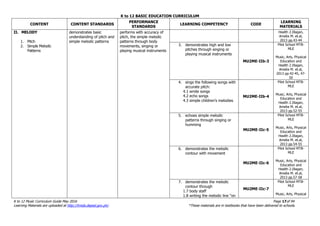
SECOND QUARTER
II. MELODY
1. Pitch
2. Simple Melodic
Patterns
demonstrates basic
understanding of pitch and
simple melodic patterns
responds accurately to high
and low tones through body
movements, singing, and
playing other sources of
sounds
1. identifies the pitch of a tone
as high or low
MU1ME-IIa-1
Pilot School MTB-
MLE
Music, Arts, Physical
Education and
Health 2.Illagan,
Amelia M. et.al,
2013 pp.43-45
2. matches the correct pitch of
tones with other sound
sources
MU1ME-IIb-2
Pilot School MTB-
MLE
Music, Arts, Physical
Education and
Health 2.Illagan,
Amelia M. et.al,
2013 pp.47-50
3. sings simple melodic patterns
3.1 ( so –mi, mi –so, mi – re-
do)
MU1ME-IIb-3
Pilot School MTB-
MLE
4. matches the melody of a
song with the correct pitch
vocally
MU1ME-IIc-4
Pilot School MTB-
MLE
Music, Arts, Physical
K to 12 BASIC EDUCATION CURRICULUM
K to 12 Music Curriculum Guide May 2016 Page 11of 94
Learning Materials are uploaded at http://lrmds.deped.gov.ph/. *These materials are in textbooks that have been delivered to schools.
CONTENT CONTENT STANDARDS
PERFORMANCE
STANDARDS
LEARNING COMPETENCY CODE
LEARNING
MATERIALS
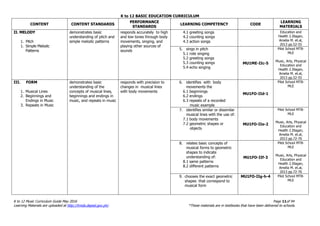
II. MELODY
1. Pitch
1. Simple Melodic
Patterns
demonstrates basic
understanding of pitch and
simple melodic patterns
responds accurately to high
and low tones through body
movements, singing, and
playing other sources of
sounds
4.1 greeting songs
4.2 counting songs
4.3 action songs
Education and
Health 2.Illagan,
Amelia M. et.al,
2013 pp.52-55
5. sings in pitch
5.1 rote singing
5.2 greeting songs
5.3 counting songs
5.4 echo singing
MU1ME-IIc-5
Pilot School MTB-
MLE
Music, Arts, Physical
Education and
Health 2.Illagan,
Amelia M. et.al,
2013 pp.52-55
III. FORM
1. Musical Lines
2. Beginnings and
Endings in Music
3. Repeats in Music
demonstrates basic
understanding of the
concepts of musical lines,
beginnings and endings in
music, and repeats in music
responds with precision to
changes in musical lines
with body movements
6. identifies with body
movements the
6.1 beginnings
6.2 endings
6.3 repeats of a recorded
music example
MU1FO-IId-1
Pilot School MTB-
MLE
7. identifies similar or dissimilar
musical lines with the use of:
7.1 body movements
7.2 geometric shapes or
objects
MU1FO-IIe-2
Pilot School MTB-
MLE
Music, Arts, Physical
Education and
Health 2.Illagan,
Amelia M. et.al,
2013 pp.72-76
8. relates basic concepts of
musical forms to geometric
shapes to indicate
understanding of:
8.1 same patterns
8.2 different patterns
MU1FO-IIf-3
Pilot School MTB-
MLE
Music, Arts, Physical
Education and
Health 2.Illagan,
Amelia M. et.al,
2013 pp.72-76
9. chooses the exact geometric
shapes that correspond to
musical form
MU1FO-IIg-h-4 Pilot School MTB-
MLE
K to 12 BASIC EDUCATION CURRICULUM
K to 12 Music Curriculum Guide May 2016 Page 12of 94
Learning Materials are uploaded at http://lrmds.deped.gov.ph/. *These materials are in textbooks that have been delivered to schools.
CONTENT CONTENT STANDARDS
PERFORMANCE
STANDARDS
LEARNING COMPETENCY CODE
LEARNING
MATERIALS
THIRD QUARTER
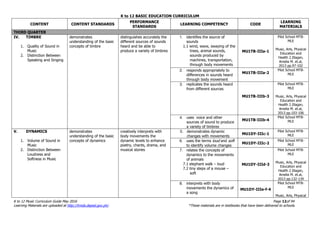
IV. TIMBRE
1. Quality of Sound in
Music
2. Distinction Between
Speaking and Singing
demonstrates
understanding of the basic
concepts of timbre
distinguishes accurately the
different sources of sounds
heard and be able to
produce a variety of timbres
1. identifies the source of
sounds
1.1 wind, wave, swaying of the
trees, animal sounds,
sounds produced by
machines, transportation,
through body movements
MU1TB-IIIa-1
Pilot School MTB-
MLE
Music, Arts, Physical
Education and
Health 2.Illagan,
Amelia M. et.al,
2013 pp.97-102
2. responds appropriately to
differences in sounds heard
through body movement
MU1TB-IIIa-2
Pilot School MTB-
MLE
3. replicates the sounds heard
from different sources
MU1TB-IIIb-3
Pilot School MTB-
MLE
Music, Arts, Physical
Education and
Health 2.Illagan,
Amelia M. et.al,
2013 pp.103-106
4. uses voice and other
sources of sound to produce
a variety of timbres
MU1TB-IIIb-4
Pilot School MTB-
MLE
V. DYNAMICS
1. Volume of Sound in
Music
2. Distinction Between
Loudness and
Softness in Music
demonstrates
understanding of the basic
concepts of dynamics
creatively interprets with
body movements the
dynamic levels to enhance
poetry, chants, drama, and
musical stories
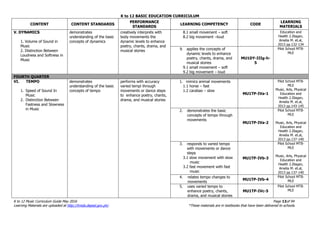
5. demonstrates dynamic
changes with movements
MU1DY-IIIc-1
Pilot School MTB-
MLE
6. uses the terms loud and soft
to identify volume changes
MU1DY-IIIc-2
Pilot School MTB-
MLE
7. relates the concepts of
dynamics to the movements
of animals
7.1 elephant walk – loud
7.2 tiny steps of a mouse –
soft
MU1DY-IIId-3
Pilot School MTB-
MLE
Music, Arts, Physical
Education and
Health 2.Illagan,
Amelia M. et.al,
2013 pp.132-134
8. interprets with body
movements the dynamics of
a song
MU1DY-IIIe-f-4
Pilot School MTB-
MLE
Music, Arts, Physical
K to 12 BASIC EDUCATION CURRICULUM
K to 12 Music Curriculum Guide May 2016 Page 13of 94
Learning Materials are uploaded at http://lrmds.deped.gov.ph/. *These materials are in textbooks that have been delivered to schools.
CONTENT CONTENT STANDARDS
PERFORMANCE
STANDARDS
LEARNING COMPETENCY CODE
LEARNING
MATERIALS
V. DYNAMICS
1. Volume of Sound in
Music
2. Distinction Between
Loudness and Softness in
Music
demonstrates
understanding of the basic
concepts of dynamics
creatively interprets with
body movements the
dynamic levels to enhance
poetry, chants, drama, and
musical stories
8.1 small movement – soft
8.2 big movement –loud
Education and
Health 2.Illagan,
Amelia M. et.al,
2013 pp.132-134
9. applies the concepts of
dynamic levels to enhance
poetry, chants, drama, and
musical stories
9.1 small movement – soft
9.2 big movement – loud
MU1DY-IIIg-h-
5
Pilot School MTB-
MLE
FOURTH QUARTER
VI. TEMPO
1. Speed of Sound In
Music
2. Distinction Between
Fastness and Slowness
in Music
demonstrates
understanding of the basic
concepts of tempo
performs with accuracy
varied tempi through
movements or dance steps
to enhance poetry, chants,
drama, and musical stories
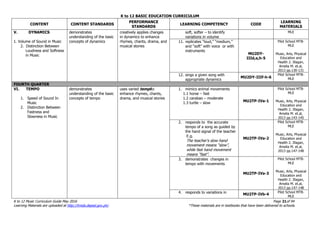
1. mimics animal movements
1.1 horse – fast
1.2 carabao – slow
MU1TP-IVa-1
Pilot School MTB-
MLE
Music, Arts, Physical
Education and
Health 2.Illagan,
Amelia M. et.al,
2013 pp.143-145
2. demonstrates the basic
concepts of tempo through
movements
MU1TP-IVa-2
Pilot School MTB-
MLE
Music, Arts, Physical
Education and
Health 2.Illagan,
Amelia M. et.al,
2013 pp.137-140
3. responds to varied tempo
with movements or dance
steps
3.1 slow movement with slow
music
3.2 fast movement with fast
music
MU1TP-IVb-3
Pilot School MTB-
MLE
Music, Arts, Physical
Education and
Health 2.Illagan,
Amelia M. et.al,
2013 pp.137-140
4. relates tempo changes to
movements
MU1TP-IVb-4
Pilot School MTB-
MLE
5. uses varied tempo to
enhance poetry, chants,
drama, and musical stories
MU1TP-IVc-5
Pilot School MTB-
MLE
K to 12 BASIC EDUCATION CURRICULUM
K to 12 Music Curriculum Guide May 2016 Page 14of 94
Learning Materials are uploaded at http://lrmds.deped.gov.ph/. *These materials are in textbooks that have been delivered to schools.
CONTENT CONTENT STANDARDS
PERFORMANCE
STANDARDS
LEARNING COMPETENCY CODE
LEARNING
MATERIALS
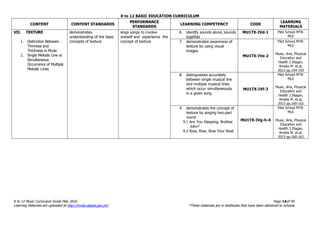
VII. TEXTURE
1. Distinction Between
Thinness and
Thickness in Music
2. Single Melodic Line or
Simultaneous
Occurrence of Multiple
Melodic Lines
demonstrates
understanding of the basic
concepts of texture
sings songs to involve
oneself and experience the
concept of texture
6. identify sounds alone, sounds
together
MU1TX-IVd-1 Pilot School MTB-
MLE
7. demonstrates awareness of
texture by using visual
images
MU1TX-IVe-2
Pilot School MTB-
MLE
Music, Arts, Physical
Education and
Health 2.Illagan,
Amelia M. et.al,
2013 pp.154-159
8. distinguishes accurately
between single musical line
and multiple musical lines
which occur simultaneously
in a given song
MU1TX-IVf-3
Pilot School MTB-
MLE
Music, Arts, Physical
Education and
Health 2.Illagan,
Amelia M. et.al,
2013 pp.160-162
9. demonstrates the concept of
texture by singing two-part
round
9.1 Are You Sleeping, Brother
John?
9.2 Row, Row, Row Your Boat
MU1TX-IVg-h-4
Pilot School MTB-
MLE
Music, Arts, Physical
Education and
Health 2.Illagan,
Amelia M. et.al,
2013 pp.160-162
K to 12 BASIC EDUCATION CURRICULUM
K to 12 Music Curriculum Guide May 2016 Page 15of 94
Learning Materials are uploaded at http://lrmds.deped.gov.ph/. *These materials are in textbooks that have been delivered to schools.
GRADE 2
ELEMENTS OF MUSIC
CONTENT CONTENT STANDARDS
PERFORMANCE
STANDARDS
LEARNING COMPETENCY CODE
LEARNING
MATERIALS
FIRST QUARTER
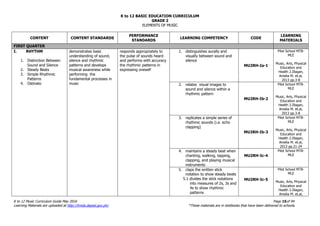
I. RHYTHM
1. Distinction Between
Sound and Silence
2. Steady Beats
3. Simple Rhythmic
Patterns
4. Ostinato
demonstrates basic
understanding of sound,
silence and rhythmic
patterns and develops
musical awareness while
performing the
fundamental processes in
music
responds appropriately to
the pulse of sounds heard
and performs with accuracy
the rhythmic patterns in
expressing oneself
1. distinguishes aurally and
visually between sound and
silence
MU2RH-Ia-1
Pilot School MTB-
MLE
Music, Arts, Physical
Education and
Health 2.Illagan,
Amelia M. et.al,
2013 pp.3-8
2. relates visual images to
sound and silence within a
rhythmic pattern
MU2RH-Ib-2
Pilot School MTB-
MLE
Music, Arts, Physical
Education and
Health 2.Illagan,
Amelia M. et.al,
2013 pp.3-8
3. replicates a simple series of
rhythmic sounds (i.e. echo
clapping)
MU2RH-Ib-3
Pilot School MTB-
MLE
Music, Arts, Physical
Education and
Health 2.Illagan,
Amelia M. et.al,
2013 pp.21-24
4. maintains a steady beat when
chanting, walking, tapping,
clapping, and playing musical
instruments
MU2RH-Ic-4
Pilot School MTB-
MLE
5. claps the written stick
notation to show steady beats
5.1 divides the stick notations
into measures of 2s, 3s and
4s to show rhythmic
patterns
MU2RH-Ic-5
Pilot School MTB-
MLE
Music, Arts, Physical
Education and
Health 2.Illagan,
Amelia M. et.al,
K to 12 BASIC EDUCATION CURRICULUM
K to 12 Music Curriculum Guide May 2016 Page 16of 94
Learning Materials are uploaded at http://lrmds.deped.gov.ph/. *These materials are in textbooks that have been delivered to schools.
CONTENT CONTENT STANDARDS
PERFORMANCE
STANDARDS
LEARNING COMPETENCY CODE
LEARNING
MATERIALS
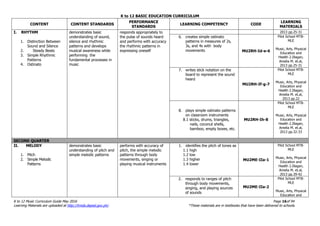
I. RHYTHM
1. Distinction Between
Sound and Silence
2. Steady Beats
3. Simple Rhythmic
Patterns
4. Ostinato
demonstrates basic
understanding of sound,
silence and rhythmic
patterns and develops
musical awareness while
performing the
fundamental processes in
music
responds appropriately to
the pulse of sounds heard
and performs with accuracy
the rhythmic patterns in
expressing oneself
2013 pp.25-31
6. creates simple ostinato
patterns in measures of 2s,
3s, and 4s with body
movements MU2RH-Id-e-6
Pilot School MTB-
MLE
Music, Arts, Physical
Education and
Health 2.Illagan,
Amelia M. et.al,
2013 pp.25-31
7. writes stick notation on the
board to represent the sound
heard
MU2RH-If-g-7
Pilot School MTB-
MLE
Music, Arts, Physical
Education and
Health 2.Illagan,
Amelia M. et.al,
2013 pp.22
8. plays simple ostinato patterns
on classroom instruments
8.1 sticks, drums, triangles,
nails, coconut shells,
bamboo, empty boxes, etc.
MU2RH-Ih-8
Pilot School MTB-
MLE
Music, Arts, Physical
Education and
Health 2.Illagan,
Amelia M. et.al,
2013 pp.32-33
SECOND QUARTER
II. MELODY
1. Pitch
2. Simple Melodic
Patterns
demonstrates basic
understanding of pitch and
simple melodic patterns
performs with accuracy of
pitch, the simple melodic
patterns through body
movements, singing or
playing musical instruments
1. identifies the pitch of tones as
1.1 high
1.2 low
1.3 higher
1.4 lower
MU2ME-IIa-1
Pilot School MTB-
MLE
Music, Arts, Physical
Education and
Health 2.Illagan,
Amelia M. et.al,
2013 pp.39-42
2. responds to ranges of pitch
through body movements,
singing, and playing sources
of sounds
MU2ME-IIa-2
Pilot School MTB-
MLE
Music, Arts, Physical
Education and
K to 12 BASIC EDUCATION CURRICULUM
K to 12 Music Curriculum Guide May 2016 Page 17of 94
Learning Materials are uploaded at http://lrmds.deped.gov.ph/. *These materials are in textbooks that have been delivered to schools.
CONTENT CONTENT STANDARDS
PERFORMANCE
STANDARDS
LEARNING COMPETENCY CODE
LEARNING
MATERIALS
II. MELODY
1. Pitch
2. Simple Melodic
Patterns
demonstrates basic
understanding of pitch and
simple melodic patterns
performs with accuracy of
pitch, the simple melodic
patterns through body
movements, singing or
playing musical instruments
Health 2.Illagan,
Amelia M. et.al,
2013 pp.43-44
3. demonstrates high and low
pitches through singing or
playing musical instruments
MU2ME-IIb-3
Pilot School MTB-
MLE
Music, Arts, Physical
Education and
Health 2.Illagan,
Amelia M. et.al,
2013 pp.42-45, 47-
50
4. sings the following songs with
accurate pitch:
4.1 wrote songs
4.2 echo songs
4.3 simple children’s melodies
MU2ME-IIb-4
Pilot School MTB-
MLE
Music, Arts, Physical
Education and
Health 2.Illagan,
Amelia M. et.al,
2013 pp.52-55
5. echoes simple melodic
patterns through singing or
humming
MU2ME-IIc-5
Pilot School MTB-
MLE
Music, Arts, Physical
Education and
Health 2.Illagan,
Amelia M. et.al,
2013 pp.54-55
6. demonstrates the melodic
contour with movement
MU2ME-IIc-6
Pilot School MTB-
MLE
Music, Arts, Physical
Education and
Health 2.Illagan,
Amelia M. et.al,
2013 pp.57-58
7. demonstrates the melodic
contour through
1.7 body staff
1.8 writing the melodic line “on
MU2ME-IIc-7
Pilot School MTB-
MLE
Music, Arts, Physical
K to 12 BASIC EDUCATION CURRICULUM
K to 12 Music Curriculum Guide May 2016 Page 18of 94
Learning Materials are uploaded at http://lrmds.deped.gov.ph/. *These materials are in textbooks that have been delivered to schools.
CONTENT CONTENT STANDARDS
PERFORMANCE
STANDARDS
LEARNING COMPETENCY CODE
LEARNING
MATERIALS
II. MELODY
1. Pitch
2. Simple Melodic
Patterns
demonstrates basic
understanding of pitch and
simple melodic patterns
performs with accuracy of
pitch, the simple melodic
patterns through body
movements, singing or
playing musical instruments
the air”
1.9 line notation
Education and
Health 2.Illagan,
Amelia M. et.al,
2013 pp.58-62
8. relates visual imagery to
melodic patterns
MU2ME-IIc-8
Pilot School MTB-
MLE
Music, Arts, Physical
Education and
Health 2.Illagan,
Amelia M. et.al,
2013 pp.63-65
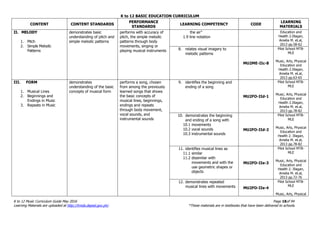
III. FORM
1. Musical Lines
2. Beginnings and
Endings in Music
3. Repeats in Music
demonstrates
understanding of the basic
concepts of musical form
performs a song, chosen
from among the previously
learned songs that shows
the basic concepts of
musical lines, beginnings,
endings and repeats
through body movement,
vocal sounds, and
instrumental sounds
9. identifies the beginning and
ending of a song
MU2FO-IId-1
Pilot School MTB-
MLE
Music, Arts, Physical
Education and
Health 2.Illagan,
Amelia M. et.al,
2013 pp.78-82
10. demonstrates the beginning
and ending of a song with
10.1 movements
10.2 vocal sounds
10.3 instrumental sounds
MU2FO-IId-2
Pilot School MTB-
MLE
Music, Arts, Physical
Education and
Health 2. Illagan,
Amelia M. et.al,
2013 pp.78-82
11. identifies musical lines as
11.1 similar
11.2 dissimilar with
movements and with the
use geometric shapes or
objects
MU2FO-IIe-3
Pilot School MTB-
MLE
Music, Arts, Physical
Education and
Health 2. Illagan,
Amelia M. et.al,
2013 pp.72-76
12. demonstrates repeated
musical lines with movements MU2FO-IIe-4
Pilot School MTB-
MLE
Music, Arts, Physical
K to 12 BASIC EDUCATION CURRICULUM
K to 12 Music Curriculum Guide May 2016 Page 19of 94
Learning Materials are uploaded at http://lrmds.deped.gov.ph/. *These materials are in textbooks that have been delivered to schools.
CONTENT CONTENT STANDARDS
PERFORMANCE
STANDARDS
LEARNING COMPETENCY CODE
LEARNING
MATERIALS
Education and
Health 2. Illagan,
Amelia M. et.al,
2013 pp.84-88
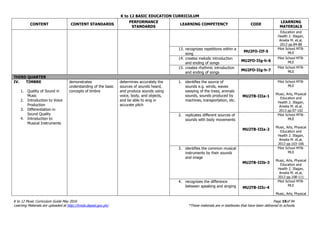
13. recognizes repetitions within a
song
MU2FO-IIf-5
Pilot School MTB-
MLE
14. creates melodic introduction
and ending of songs
MU2FO-IIg-h-6
Pilot School MTB-
MLE
15. creates rhythmic introduction
and ending of songs
MU2FO-IIg-h-7
Pilot School MTB-
MLE
THIRD QUARTER
IV. TIMBRE
1. Quality of Sound in
Music
2. Introduction to Voice
Production
3. Differentiation in
Sound Quality
4. Introduction to
Musical Instruments
demonstrates
understanding of the basic
concepts of timbre
determines accurately the
sources of sounds heard,
and produce sounds using
voice, body, and objects,
and be able to sing in
accurate pitch
1. identifies the source of
sounds e.g. winds, waves
swaying of the trees, animals
sounds, sounds produced by
machines, transportation, etc.
MU2TB-IIIa-1
Pilot School MTB-
MLE
Music, Arts, Physical
Education and
Health 2. Illagan,
Amelia M. et.al,
2013 pp.97-102
2. replicates different sources of
sounds with body movements
MU2TB-IIIa-2
Pilot School MTB-
MLE
Music, Arts, Physical
Education and
Health 2. Illagan,
Amelia M. et.al,
2013 pp.103-106
3. identifies the common musical
instruments by their sounds
and image
MU2TB-IIIb-3
Pilot School MTB-
MLE
Music, Arts, Physical
Education and
Health 2. Illagan,
Amelia M. et.al,
2013 pp.108-111
4. recognizes the difference
between speaking and singing MU2TB-IIIc-4
Pilot School MTB-
MLE
Music, Arts, Physical
K to 12 BASIC EDUCATION CURRICULUM
K to 12 Music Curriculum Guide May 2016 Page 20of 94
Learning Materials are uploaded at http://lrmds.deped.gov.ph/. *These materials are in textbooks that have been delivered to schools.
CONTENT CONTENT STANDARDS
PERFORMANCE
STANDARDS
LEARNING COMPETENCY CODE
LEARNING
MATERIALS
IV. TIMBRE
1. Quality of Sound in
Music
2. Introduction to Voice
Production
3. Differentiation in Sound
Quality
4. Introduction to Musical
Instruments
demonstrates
understanding of the basic
concepts of timbre
determines accurately the
sources of sounds heard,
and produce sounds using
voice, body, and objects,
and be able to sing in
accurate pitch
Education and
Health 2. Illagan,
Amelia M. et.al,
2013 pp.112-115
5. sings songs with accurate
pitch and pleasing vocal
quality
MU2TB-IIIc-5
Pilot School MTB-
MLE
Music, Arts, Physical
Education and
Health 2. Illagan,
Amelia M. et.al,
2013 pp.121-122
6. produces sounds using voice,
body, and objects to enhance
a given story
MU2TB-IIId-6
Pilot School MTB-
MLE
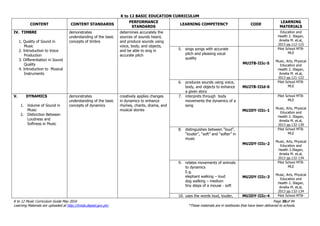
V. DYNAMICS
1. Volume of Sound in
Music
2. Distinction Between
Loudness and
Softness in Music
demonstrates
understanding of the basic
concepts of dynamics
creatively applies changes
in dynamics to enhance
rhymes, chants, drama, and
musical stories
7. interprets through body
movements the dynamics of a
song
MU2DY-IIIc-1
Pilot School MTB-
MLE
Music, Arts, Physical
Education and
Health 2. Illagan,
Amelia M. et.al,
2013 pp.132-139
8. distinguishes between “loud”,
“louder”, “soft” and “softer” in
music
MU2DY-IIIc-2
Pilot School MTB-
MLE
Music, Arts, Physical
Education and
Health 2.Illagan,
Amelia M. et.al,
2013 pp.132-134
9. relates movements of animals
to dynamics
E.g.
elephant walking – loud
dog walking – medium
tiny steps of a mouse - soft
MU2DY-IIIc-3
Pilot School MTB-
MLE
Music, Arts, Physical
Education and
Health 2. Illagan,
Amelia M. et.al,
2013 pp.132-134
10. uses the words loud, louder, MU2DY-IIIc-4 Pilot School MTB-
K to 12 BASIC EDUCATION CURRICULUM
K to 12 Music Curriculum Guide May 2016 Page 21of 94
Learning Materials are uploaded at http://lrmds.deped.gov.ph/. *These materials are in textbooks that have been delivered to schools.
CONTENT CONTENT STANDARDS
PERFORMANCE
STANDARDS
LEARNING COMPETENCY CODE
LEARNING
MATERIALS
V. DYNAMICS
1. Volume of Sound in Music
2. Distinction Between
Loudness and Softness
in Music
demonstrates
understanding of the basic
concepts of dynamics
creatively applies changes
in dynamics to enhance
rhymes, chants, drama, and
musical stories
soft, softer – to identify
variations in volume
MLE
11. replicates “loud,” “medium,”
and “soft” with voice or with
instruments
MU2DY-
IIId,e,h-5
Pilot School MTB-
MLE
Music, Arts, Physical
Education and
Health 2. Illagan,
Amelia M. et.al,
2013 pp.130-131
12. sings a given song with
appropriate dynamics
MU2DY-IIIf-h-6
Pilot School MTB-
MLE
FOURTH QUARTER
VI. TEMPO
1. Speed of Sound In
Music
2. Distinction Between
Fastness and
Slowness in Music
demonstrates
understanding of the basic
concepts of tempo
uses varied tempito
enhance rhymes, chants,
drama, and musical stories
1. mimics animal movements
1.1 horse – fast
1.2 carabao – moderate
1.3 turtle – slow MU2TP-IVa-1
Pilot School MTB-
MLE
Music, Arts, Physical
Education and
Health 2. Illagan,
Amelia M. et.al,
2013 pp.143-145
2. responds to the accurate
tempo of a song as guided by
the hand signal of the teacher
E.g.
The teacher’s slow hand
movement means “slow”,
while fast hand movement
means “fast”.
MU2TP-IVa-2
Pilot School MTB-
MLE
Music, Arts, Physical
Education and
Health 2. Illagan,
Amelia M. et.al,
2013 pp.147-148
3. demonstrates changes in
tempo with movements
MU2TP-IVa-3
Pilot School MTB-
MLE
Music, Arts, Physical
Education and
Health 2. Illagan,
Amelia M. et.al,
2013 pp.147-148
4. responds to variations in MU2TP-IVb-4
Pilot School MTB-
MLE
K to 12 BASIC EDUCATION CURRICULUM
K to 12 Music Curriculum Guide May 2016 Page 22of 94
Learning Materials are uploaded at http://lrmds.deped.gov.ph/. *These materials are in textbooks that have been delivered to schools.
CONTENT CONTENT STANDARDS
PERFORMANCE
STANDARDS
LEARNING COMPETENCY CODE
LEARNING
MATERIALS
VI. TEMPO
1. Speed of Sound In
Music
2. Distinction Between
Fastness and Slowness
in Music
demonstrates
understanding of the basic
concepts of tempo
uses varied tempito
enhance rhymes, chants,
drama, and musical stories
tempo with dance steps
4.1 slow movement with slow
music
4.2 s music
Music, Arts, Physical
Education and
Health 2. Illagan,
Amelia M. et.al,
2013 pp.137-140
5. distinguishes “slow,”
“slower,”“fast,” and “faster” in
recorded music with voice or
with instruments MU2TP-IVb-5
Pilot School MTB-
MLE
Music, Arts, Physical
Education and
Health 2. Illagan,
Amelia M. et.al,
2013 pp.137-140
6. uses the terms “fast,”
“faster,” “slow,” and “slower”
to identify variations in tempo
MU2TP-IVb-6
Pilot School MTB-
MLE
Music, Arts, Physical
Education and
Health 2. Illagan,
Amelia M. et.al,
2013 pp.145
7. replicates “slow,”
“slower,”“fast,” and “faster”
with voice or with
instruments MU2TP-IVc-7
Pilot School MTB-
MLE
Music, Arts, Physical
Education and
Health 2. Illagan,
Amelia M. et.al,
2013 pp.137-140
VII. TEXTURE
1. Single Melodic Line or
Simultaneous
Occurrence of Multiple
Melodic Lines
2. Distinction Between
Thinness and
Thickness in Music
demonstrates
understanding of the basic
concepts of texture
distinguishes accurately
between single musical line
and multiple musical lines
which occur simultaneously
in a given song
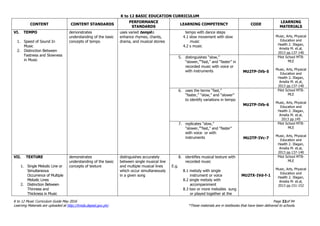
8. identifies musical texture with
recorded music
E.g.
8.1 melody with single
instrument or voice
8.2 single melody with
accompaniment
8.3 two or more melodies sung
or played together at the
MU2TX-IVd-f-1
Pilot School MTB-
MLE
Music, Arts, Physical
Education and
Health 2. Illagan,
Amelia M. et.al,
2013 pp.151-152
K to 12 BASIC EDUCATION CURRICULUM
K to 12 Music Curriculum Guide May 2016 Page 23of 94
Learning Materials are uploaded at http://lrmds.deped.gov.ph/. *These materials are in textbooks that have been delivered to schools.
CONTENT CONTENT STANDARDS
PERFORMANCE
STANDARDS
LEARNING COMPETENCY CODE
LEARNING
MATERIALS
VII. TEXTURE
1. Single Melodic Line or
Simultaneous
Occurrence of Multiple
Melodic Lines
2. Distinction Between
Thinness and
Thickness in Music
demonstrates
understanding of the basic
concepts of texture
distinguishes accurately
between single musical line
and multiple musical lines
which occur simultaneously
in a given song
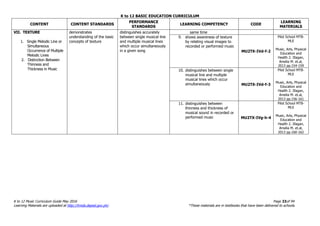
same time
9. shows awareness of texture
by relating visual images to
recorded or performed music
MU2TX-IVd-f-2
Pilot School MTB-
MLE
Music, Arts, Physical
Education and
Health 2. Illagan,
Amelia M. et.al,
2013 pp.154-159
10. distinguishes between single
musical line and multiple
musical lines which occur
simultaneously MU2TX-IVd-f-3
Pilot School MTB-
MLE
Music, Arts, Physical
Education and
Health 2. Illagan,
Amelia M. et.al,
2013 pp.156-161
11. distinguishes between
thinness and thickness of
musical sound in recorded or
performed music MU2TX-IVg-h-4
Pilot School MTB-
MLE
Music, Arts, Physical
Education and
Health 2. Illagan,
Amelia M. et.al,
2013 pp.160-162
K to 12 BASIC EDUCATION CURRICULUM
K to 12 Music Curriculum Guide May 2016 Page 24of 94
Learning Materials are uploaded at http://lrmds.deped.gov.ph/. *These materials are in textbooks that have been delivered to schools.
GRADE 3
ELEMENTS OF MUSIC
CONTENT CONTENT STANDARDS
PERFORMANCE
STANDARDS
LEARNING COMPETENCY CODE
LEARNING
MATERIALS
FIRST QUARTER
I. RHYTHM
1. Sound and Silence
2. Steady Beats
3. Simple Rhythmic
Pattern
4. Ostinato
demonstrates
understanding of the basic
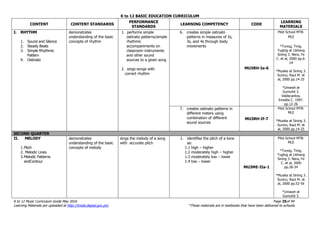
concepts of rhythm
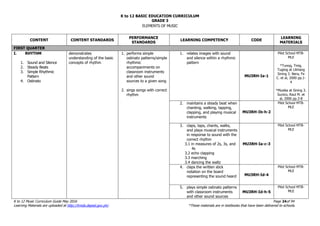
1. performs simple
ostinato patterns/simple
rhythmic
accompaniments on
classroom instruments
and other sound
sources to a given song
2. sings songs with correct
rhythm
1. relates images with sound
and silence within a rhythmic
pattern
MU3RH-Ia-1
Pilot School MTB-
MLE
*Tunog, Tinig,
Tugtog at Likhang
Sining 3. Nera, Fe
C. et al, 2000 pp.1-
4
*Musika at Sining 3.
Sunico, Raul M. et
al, 2000 pp.3-8
2. maintains a steady beat when
chanting, walking, tapping,
clapping, and playing musical
instruments
MU3RH-Ib-h-2
Pilot School MTB-
MLE
3. claps, taps, chants, walks,
and plays musical instruments
in response to sound with the
correct rhythm
3.1 in measures of 2s, 3s, and
4s
3.2 echo clapping
3.3 marching
3.4 dancing the waltz
MU3RH-Ia-c-3
Pilot School MTB-
MLE
4. claps the written stick
notation on the board
representing the sound heard MU3RH-Id-4
Pilot School MTB-
MLE
5. plays simple ostinato patterns
with classroom instruments
and other sound sources
MU3RH-Id-h-5
Pilot School MTB-
MLE
K to 12 BASIC EDUCATION CURRICULUM
K to 12 Music Curriculum Guide May 2016 Page 25of 94
Learning Materials are uploaded at http://lrmds.deped.gov.ph/. *These materials are in textbooks that have been delivered to schools.
CONTENT CONTENT STANDARDS
PERFORMANCE
STANDARDS
LEARNING COMPETENCY CODE
LEARNING
MATERIALS
I. RHYTHM
1. Sound and Silence
2. Steady Beats
3. Simple Rhythmic
Pattern
4. Ostinato
demonstrates
understanding of the basic
concepts of rhythm
1. performs simple
ostinato patterns/simple
rhythmic
accompaniments on
classroom instruments
and other sound
sources to a given song
2. sings songs with
correct rhythm
6. creates simple ostinato
patterns in measures of 2s,
3s, and 4s through body
movements
MU3RH-Ie-6
Pilot School MTB-
MLE
*Tunog, Tinig,
Tugtog at Likhang
Sining 3. Nera, Fe
C. et al, 2000 pp.6-
14
*Musika at Sining 3.
Sunico, Raul M. et
al, 2000 pp.14-25
*Umawit at
Gumuhit 3.
Valdecantos,
Emelita C. 1997.
pp.12-26
7. creates ostinato patterns in
different meters using
combination of different
sound sources
MU3RH-If-7
Pilot School MTB-
MLE
*Musika at Sining 3.
Sunico, Raul M. et
al, 2000 pp.14-25
SECOND QUARTER
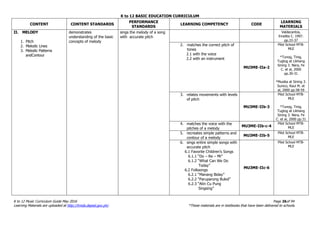
II. MELODY
1.Pitch
2. Melodic Lines
3.Melodic Patterns
andContour
demonstrates
understanding of the basic
concepts of melody
sings the melody of a song
with accurate pitch
1. identifies the pitch of a tone
as:
1.1 high – higher
1.2 moderately high – higher
1.3 moderately low – lower
1.4 low – lower
MU3ME-IIa-1
Pilot School MTB-
MLE
*Tunog, Tinig,
Tugtog at Likhang
Sining 3. Nera, Fe
C. et al, 2000
pp.28-34
*Musika at Sining 3.
Sunico, Raul M. et
al, 2000 pp.52-56
*Umawit at
Gumuhit 3.
K to 12 BASIC EDUCATION CURRICULUM
K to 12 Music Curriculum Guide May 2016 Page 26of 94
Learning Materials are uploaded at http://lrmds.deped.gov.ph/. *These materials are in textbooks that have been delivered to schools.
CONTENT CONTENT STANDARDS
PERFORMANCE
STANDARDS
LEARNING COMPETENCY CODE
LEARNING
MATERIALS
II. MELODY
1. Pitch
2. Melodic Lines
3. Melodic Patterns
andContour
demonstrates
understanding of the basic
concepts of melody
sings the melody of a song
with accurate pitch
Valdecantos,
Emelita C. 1997.
pp.33-37
2. matches the correct pitch of
tones
2.1 with the voice
2.2 with an instrument
MU3ME-IIa-2
Pilot School MTB-
MLE
*Tunog, Tinig,
Tugtog at Likhang
Sining 3. Nera, Fe
C. et al, 2000
pp.30-31
*Musika at Sining 3.
Sunico, Raul M. et
al, 2000 pp.58-59
3. relates movements with levels
of pitch
MU3ME-IIb-3
Pilot School MTB-
MLE
*Tunog, Tinig,
Tugtog at Likhang
Sining 3. Nera, Fe
C. et al, 2000 pp.31
4. matches the voice with the
pitches of a melody
MU3ME-IIb-c-4
Pilot School MTB-
MLE
5. recreates simple patterns and
contour of a melody
MU3ME-IIb-5
Pilot School MTB-
MLE
6. sings entire simple songs with
accurate pitch
6.1 Favorite Children’s Songs
6.1.1 “Do – Re – Mi”
6.1.2 “What Can We Do
Today”
6.2 Folksongs
6.2.1 “Manang Biday”
6.2.2 “Paruparong Bukid”
6.2.3 “Atin Cu Pung
Singsing”
MU3ME-IIc-6
Pilot School MTB-
MLE
K to 12 BASIC EDUCATION CURRICULUM
K to 12 Music Curriculum Guide May 2016 Page 27of 94
Learning Materials are uploaded at http://lrmds.deped.gov.ph/. *These materials are in textbooks that have been delivered to schools.
CONTENT CONTENT STANDARDS
PERFORMANCE
STANDARDS
LEARNING COMPETENCY CODE
LEARNING
MATERIALS
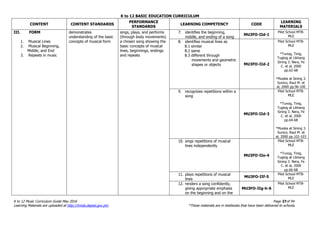
III. FORM
1. Musical Lines
2. Musical Beginning,
Middle, and End
3. Repeats in music
demonstrates
understanding of the basic
concepts of musical form
sings, plays, and performs
(through body movements)
a chosen song showing the
basic concepts of musical
lines, beginnings, endings
and repeats
7. identifies the beginning,
middle, and ending of a song
MU3FO-IId-1
Pilot School MTB-
MLE
8. identifies musical lines as
8.1 similar
8.2 same
8.3 different through
movements and geometric
shapes or objects MU3FO-IId-2
Pilot School MTB-
MLE
*Tunog, Tinig,
Tugtog at Likhang
Sining 3. Nera, Fe
C. et al, 2000
pp.62-68
*Musika at Sining 3.
Sunico, Raul M. et
al, 2000 pp.96-100
9. recognizes repetitions within a
song
MU3FO-IId-3
Pilot School MTB-
MLE
*Tunog, Tinig,
Tugtog at Likhang
Sining 3. Nera, Fe
C. et al, 2000
pp.64-68
*Musika at Sining 3.
Sunico, Raul M. et
al, 2000 pp.102-103
10. sings repetitions of musical
lines independently
MU3FO-IIe-4
Pilot School MTB-
MLE
*Tunog, Tinig,
Tugtog at Likhang
Sining 3. Nera, Fe
C. et al, 2000
pp.66-68
11. plays repetitions of musical
lines
MU3FO-IIf-5
Pilot School MTB-
MLE
12. renders a song confidently,
giving appropriate emphasis
on the beginning and on the
MU3FO-IIg-h-6
Pilot School MTB-
MLE
K to 12 BASIC EDUCATION CURRICULUM
K to 12 Music Curriculum Guide May 2016 Page 28of 94
Learning Materials are uploaded at http://lrmds.deped.gov.ph/. *These materials are in textbooks that have been delivered to schools.
CONTENT CONTENT STANDARDS
PERFORMANCE
STANDARDS
LEARNING COMPETENCY CODE
LEARNING
MATERIALS
ending
THIRD QUARTER
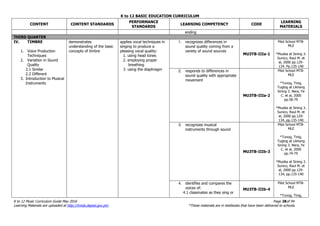
IV. TIMBRE
1. Voice Production
Techniques
2. Variation in Sound
Quality
2.1 Similar
2.2 Different
3. Introduction to Musical
Instruments
demonstrates
understanding of the basic
concepts of timbre
applies vocal techniques in
singing to produce a
pleasing vocal quality:
1. using head tones
2. employing proper
breathing
3. using the diaphragm
1. recognizes differences in
sound quality coming from a
variety of sound sources
MU3TB-IIIa-1
Pilot School MTB-
MLE
*Musika at Sining 3.
Sunico, Raul M. et
al, 2000 pp.129-
134. Pp.135-140
2. responds to differences in
sound quality with appropriate
movement
MU3TB-IIIa-2
Pilot School MTB-
MLE
*Tunog, Tinig,
Tugtog at Likhang
Sining 3. Nera, Fe
C. et al, 2000
pp.58-79
*Musika at Sining 3.
Sunico, Raul M. et
al, 2000 pp.129-
134, pp.135-140
3. recognizes musical
instruments through sound
MU3TB-IIIb-3
Pilot School MTB-
MLE
*Tunog, Tinig,
Tugtog at Likhang
Sining 3. Nera, Fe
C. et al, 2000
pp.74-79
*Musika at Sining 3.
Sunico, Raul M. et
al, 2000 pp.129-
134, pp.135-140
4. identifies and compares the
voices of:
4.1 classmates as they sing or
MU3TB-IIIb-4
Pilot School MTB-
MLE
*Tunog, Tinig,
K to 12 BASIC EDUCATION CURRICULUM
K to 12 Music Curriculum Guide May 2016 Page 29of 94
Learning Materials are uploaded at http://lrmds.deped.gov.ph/. *These materials are in textbooks that have been delivered to schools.
CONTENT CONTENT STANDARDS
PERFORMANCE
STANDARDS
LEARNING COMPETENCY CODE
LEARNING
MATERIALS
III. TIMBRE
1. Voice Production
Techniques
2. Variation in Sound
Quality
2.1 Similar
2.2 Different
3. Introduction to Musical
Instruments
demonstrates
understanding of the basic
concepts of timbre
applies vocal techniques in
singing to produce a
pleasing vocal quality:
1. using head tones
2. employing proper
breathing
3. using the diaphragm
speak
4.2 selected popular singers in
recordings
Tugtog at Likhang
Sining 3. Nera, Fe
C. et al, 2000
pp.72-73
*Manwal ng Guro
Umawit at Gumuhit
3. Valdecantos,
Emelita C. 1997.
pp.64-68
5. compares the use of the voice
in speaking and in singing
MU3TB-IIIb-5
Pilot School MTB-
MLE
*Tunog, Tinig,
Tugtog at Likhang
Sining 3. Nera, Fe
C. et al, 2000
pp.70-72
*Musika at Sining 3.
Sunico, Raul M. et
al, 2000 pp.125-128
*Manwal ng Guro
Umawit at Gumuhit
3. Valdecantos,
Emelita C. 1997.
pp.64
6. uses the voice and other
sources of sound to produce a
variety of timbres
MU3TB-IIIc-6
*Manwal ng Guro
Umawit at Gumuhit
3. Valdecantos,
Emelita C. 1997.
pp.64
IV. DYNAMICS
1. Volume of Sound in
Music
2. Conducting and
demonstrates
understanding of the basic
concepts of dynamics in
order to respond to
conducting gestures using
sings songs with proper
dynamics following basic
conducting gestures
7. interprets the dynamics of a
song through body movements
7.1 small movement – soft
7.2 big movement – loud
MU3DY-IIId-1
Pilot School MTB-
MLE
*Tunog, Tinig,
Tugtog at Likhang
K to 12 BASIC EDUCATION CURRICULUM
K to 12 Music Curriculum Guide May 2016 Page 30of 94
Learning Materials are uploaded at http://lrmds.deped.gov.ph/. *These materials are in textbooks that have been delivered to schools.
CONTENT CONTENT STANDARDS
PERFORMANCE
STANDARDS
LEARNING COMPETENCY CODE
LEARNING
MATERIALS
Dynamics symbols indicating
variances in dynamics
Sining 3. Nera, Fe
C. et al, 2000.
pp.82-86
8. distinguishes “loud,”
“medium,” and “soft” in music
MU3DY-IIId-2
Pilot School MTB-
MLE
*Tunog, Tinig,
Tugtog at Likhang
Sining 3. Nera, Fe
C. et al, 2000.
pp.82-86
9. relates dynamics to the
movements of animals
e.g.
9.1 elephant walking – loud
9.2 mice scurrying – soft
MU3DY-IIId-3
Pilot School MTB-
MLE
10. uses terms “loud,” “medium,”
and “soft” (louder, softer) to
identify changes and
variations in volume MU3DY-IIIe-4
Pilot School MTB-
MLE
*Manwal ng Guro
Umawit at Gumuhit
3. Valdecantos,
Emelita C. 1997.
pp.73
11. responds to conducting
gestures of the teacher for
“loud” and “soft”
E.g.
11.1 Teacher’s palm down
means “soft” and palm up
means “loud.”
11.2 Hands moving farther from
each other mean sound
becomes louder.
MU3DY-IIIe-h-
5
Pilot School MTB-
MLE
*Umawit at
Gumuhit 3.
Valdecantos,
Emelita C. 1997.
pp.73-75
12. uses varied dynamics to
enhance poetry, chants,
drama, songs and musical
stories
MU3DY-IIIf-h-
6
Pilot School MTB-
MLE
K to 12 BASIC EDUCATION CURRICULUM
K to 12 Music Curriculum Guide May 2016 Page 31of 94
Learning Materials are uploaded at http://lrmds.deped.gov.ph/. *These materials are in textbooks that have been delivered to schools.
CONTENT CONTENT STANDARDS
PERFORMANCE
STANDARDS
LEARNING COMPETENCY CODE
LEARNING
MATERIALS
FOURTH QUARTER
V. TEMPO
1. Speed of Sound in
Music
1.1 Fast
1.2 Slow
2. Conducting and Tempo
demonstrates
understanding of the
concepts of tempo in order
to respond to conducting
symbols indicating
variations in tempo
enhances performance of
poetry, chants, drama,
musical stories, and songs
by using a variety of tempo
1. mimics animal movements
according to speed
1.1 horse – fast
1.2 carabao – slow
1.3 turtle – slow
1.4 rabbit - fast
1.5 dog – fast
MU3TP-IVa-1
Pilot School MTB-
MLE
2. sings songs with proper
tempo following basic
conducting gestures
MU3TP-IVa-2
Pilot School MTB-
MLE
*Tunog, Tinig,
Tugtog at Likhang
Sining 3. Nera, Fe
C. et al, 2000
pp.88-89
*Umawit at
Gumuhit 3.
Valdecantos,
Emelita C. 1997.
pp.75-80
3. relates movement to changes
and variations in tempo
MU3TP-IVb-3
Pilot School MTB-
MLE
*Tunog, Tinig,
Tugtog at Likhang
Sining 3. Nera, Fe
C. et al, 2000
pp.88-93
4. responds with movement to
tempo changes
4.1 (i.e. doing locomotor and
non-locomotor movements)
to a variety of tempo in
recorded music
MU3TP-IVb-c-4
Pilot School MTB-
MLE
*Tunog, Tinig,
Tugtog at Likhang
Sining 3. Nera, Fe
C. et al, 2000 pp.90
5. distinguishes among fast,
moderate, and slow in music
MU3TP-IVb-5
Pilot School MTB-
MLE
K to 12 BASIC EDUCATION CURRICULUM
K to 12 Music Curriculum Guide May 2016 Page 32of 94
Learning Materials are uploaded at http://lrmds.deped.gov.ph/. *These materials are in textbooks that have been delivered to schools.
CONTENT CONTENT STANDARDS
PERFORMANCE
STANDARDS
LEARNING COMPETENCY CODE
LEARNING
MATERIALS
V. TEMPO
1. Speed of Sound in
Music
1.1 Fast
1.2 Slow
2. Conducting and Tempo
demonstrates
understanding of the
concepts of tempo in order
to respond to conducting
symbols indicating
variations in tempo
enhances performance of
poetry, chants, drama,
musical stories, and songs
by using a variety of tempo
*Tunog, Tinig,
Tugtog at Likhang
Sining 3. Nera, Fe
C. et al, 2000
pp.88-93
6. uses the terms: fast,
moderate, and slow, (faster,
slower etc.) to identify tempo
changes and variations
MU3TP-IVb-6
Pilot School MTB-
MLE
*Tunog, Tinig,
Tugtog at Likhang
Sining 3. Nera, Fe
C. et al, 2000
pp.88-93
*Musika at Sining
3.Sunico, Raul M. et
al, 2000. pp.111-
123
*Manwal ng Guro
Umawit at Gumuhit
3. Valdecantos,
Emelita C. 1997.
pp.75
7. sings songs with designated
tempo
E.g.
7.1 Lullaby – slow
7.2 Joyful songs – fast
MU3TP-IVa-c-7
Pilot School MTB-
MLE
*Tunog, Tinig,
Tugtog at Likhang
Sining 3. Nera, Fe
C. et al, 2000
pp.88-93
VI. TEXTURE
1. Single Melodic Line or
Simultaneous
Occurrence of Multiple
Melodic Lines
demonstrates
understanding of the basic
concepts of texture
sings
1. “two-part rounds”
2. “partner songs”
8. demonstrates the concept of
texture by singing “two-part
rounds”
E.g.
8.1 “Are You Sleeping, Brother
John?”
MU3TX-IVd-f-1
Pilot School MTB-
MLE
K to 12 BASIC EDUCATION CURRICULUM
K to 12 Music Curriculum Guide May 2016 Page 33of 94
Learning Materials are uploaded at http://lrmds.deped.gov.ph/. *These materials are in textbooks that have been delivered to schools.
CONTENT CONTENT STANDARDS
PERFORMANCE
STANDARDS
LEARNING COMPETENCY CODE
LEARNING
MATERIALS
2. Distinction Between
Thinness and
Thickness in Music
8.2 “Row, Row, Row Your Boat”
8.3 “Musika Ay Di Kukupas”
9. demonstrates the concept of
texture by singing “partner
songs
E.g.
9.1 “Leron, Leron Sinta”
9.2 “Pamulinawen”
9.3 “It’s A Small World”
9.4 “He’s Got the Whole World in
His Hands
MU3TX-IVd-f-2
Pilot School MTB-
MLE
10. distinguishes between single
musical line and multiple
musical lines which occur
simultaneously
MU3TX-IVd-f-3
Pilot School MTB-
MLE
11. distinguishes between
thinness and thickness of
musical sound
MU3TX-IVg-h-
4
Pilot School MTB-
MLE
K to 12 BASIC EDUCATION CURRICULUM
K to 12 Music Curriculum Guide May 2016 Page 34of 94
Learning Materials are uploaded at http://lrmds.deped.gov.ph/. *These materials are in textbooks that have been delivered to schools.
GRADE 4
ELEMENTS OF MUSIC
CONTENT CONTENT STANDARDS
PERFORMANCE
STANDARDS
LEARNING COMPETENCY CODE
LEARNING
MATERIALS
FIRST QUARTER
I. RHYTHM
1. Musical Symbols and
Concepts:
1.1 Notes and Rests
1.2 Meters
1.3 Rhythmic Patterns
1.4 Simple Time
Signatures
1.5 Ostinato
demonstrates
understanding of concepts
pertaining to rhythm and
musical symbols
creates rhythmic patterns
in:
1. simple time signatures
2. simple one-measure
ostinato pattern
1. identifies different kinds of
notes and rests
MU4RH-Ia-1
MISOSA4-
module6,7
MISOSA5-
module1
*Manwal ng
Guro Umawit
at Gumuhit 4.
Valdecantos,
Emelita C.
1999. pp.7-9
2. organizes notes and rests
according to simple meters
(grouping notes and rests into
measures given simple
meters)
MU4RH-Ib-2
MISOSA4-
module8
*Umawit at
Gumuhit 4.
Valdecantos,
Emelita C.
1999. pp.8-12
3. states the meaning of the
different rhythmic patterns MU4RH-Ic-3
MISOSA4-
module2,8
4. demonstrates the meaning of
rhythmic patterns by clapping
in time signatures
MU4RH-Ic-4
MISOSA4-
module3,4,5
*Manwal ng
Guro Umawit
at Gumuhit 4.
Valdecantos,
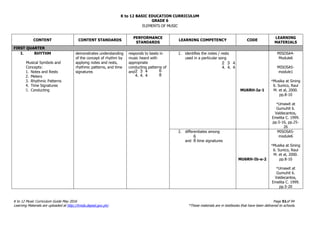
Emelita C.
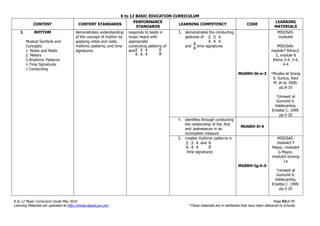
3
4,
2
4,
4
4
K to 12 BASIC EDUCATION CURRICULUM
K to 12 Music Curriculum Guide May 2016 Page 35of 94
Learning Materials are uploaded at http://lrmds.deped.gov.ph/. *These materials are in textbooks that have been delivered to schools.
CONTENT CONTENT STANDARDS
PERFORMANCE
STANDARDS
LEARNING COMPETENCY CODE
LEARNING
MATERIALS
I.I. RHYTHM
1. Musical Symbols and
Concepts:
1.1 Notes and Rests
1.2 Meters
1.3 Rhythmic Patterns
1.4 Simple Time
Signatures
1.5 Ostinato
demonstrates
understanding of concepts
pertaining to rhythm and
musical symbols
creates rhythmic patterns
in:
1. simple time signatures
2. simple one-measure
ostinato pattern
1999. pp.7
5. uses the bar line to indicate
groupings of beats in
MU4RH-Ic-5
MISOSA4-
module3,4,5
6. identifies accented and
unaccented pulses MU4RH-Id-6
MISOSA4-
module1
7. places the accent (>) on the
notation of recorded music MU4RH-Id-7
8. responds to metric pulses of
music heard with appropriate
con
9. ducting gestures
MU4RH-Ie-g-8 MISOSA4-
module3,4
MISOSA5-
module6
3
4,
2
4,
4
4
K to 12 BASIC EDUCATION CURRICULUM
K to 12 Music Curriculum Guide May 2016 Page 36of 94
Learning Materials are uploaded at http://lrmds.deped.gov.ph/. *These materials are in textbooks that have been delivered to schools.
CONTENT CONTENT STANDARDS
PERFORMANCE
STANDARDS
LEARNING COMPETENCY CODE
LEARNING
MATERIALS
SECOND QUARTER
II. MELODY
1. Musical Symbols and
Concepts:
1.1 Intervals
1.2 Scales
1.3 Melodic Contours
1.4 Patterns of successive
pitches of a C Major
scale
recognizes the musical
symbols and demonstrates
understanding of concepts
pertaining to melody
analyzes melodic
movement and range and
be able to create and
perform simple melodies
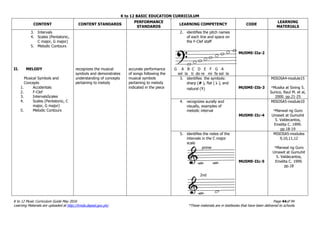
1. identifies the pitch name of
each line and space of the G-
clef staff
MU4ME-IIa-1
MISOSA4-
module13
2. identifies the pitch names of
notes on the ledger lines and
spaces below the G-clef staff
(middle C and D)
MU4ME-IIb-2
MISOSA4-
module13,14
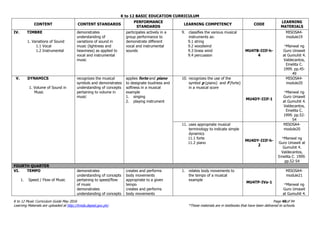
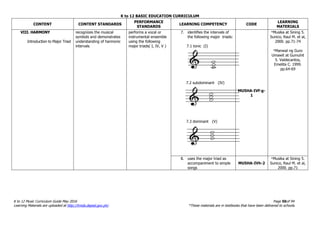
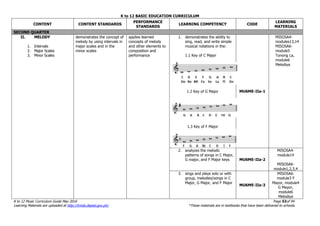
3. recognizes the meaning and
use of G- Clef
do re mi fa so la ti do
MU4ME-IIc-3
MISOSA4-
module13
E
G
B
D
F
F
A
C
E
K to 12 BASIC EDUCATION CURRICULUM
K to 12 Music Curriculum Guide May 2016 Page 37of 94
Learning Materials are uploaded at http://lrmds.deped.gov.ph/. *These materials are in textbooks that have been delivered to schools.
CONTENT CONTENT STANDARDS
PERFORMANCE
STANDARDS
LEARNING COMPETENCY CODE
LEARNING
MATERIALS
II. MELODY
1. Musical Symbols and
Concepts:
1.1 Intervals
1.2 Scales
1.3 Melodic Contours
1.4 Patterns of successive
pitches of a C Major
scale
recognizes the musical
symbols and demonstrates
understanding of concepts
pertaining to melody
analyzes melodic
movement and range and
be able to create and
perform simple melodies
4. identifies the movement of the
melody as:
- no movement
- ascending stepwise
- descending stepwise
- ascending skip wise
- descending skip wise
MU4ME-IId-4
MISOSA4-
module10
MISOSA5-
module8
*Manwal ng
Guro Umawit
at Gumuhit 4.
Valdecantos,
Emelita C.
1999. pp.28-
30
5. identifies the highest and
lowest pitch in a given
notation of a musical piece to
determine its range
MU4ME-IIe-5
MISOSA4-
module9
*Manwal ng
Guro Umawit
at Gumuhit 4.
Valdecantos,
Emelita C.
K to 12 BASIC EDUCATION CURRICULUM
K to 12 Music Curriculum Guide May 2016 Page 38of 94
Learning Materials are uploaded at http://lrmds.deped.gov.ph/. *These materials are in textbooks that have been delivered to schools.
CONTENT CONTENT STANDARDS
PERFORMANCE
STANDARDS
LEARNING COMPETENCY CODE
LEARNING
MATERIALS
II. MELODY
1. Musical Symbols and
Concepts:
1.1 Intervals
1.2 Scales
1.3 Melodic Contours
1.4 Patterns of successive
pitches of a C Major
scale
recognizes the musical
symbols and demonstrates
understanding of concepts
pertaining to melody
analyzes melodic
movement and range and
be able to create and
perform simple melodies
1999. pp.24-
30
6. sings with accurate pitch the
simple intervals of a melody
MU4ME-IIf-6
MISOSA4-
module12
*Manwal ng
Guro Umawit at
Gumuhit 4.
Valdecantos,
Emelita C. 1999.
pp.24-31
7. performs his/her own created
melody
MU4ME-IIg-h-
7
MISOSA4-
module12
*Manwal ng
Guro Umawit at
Gumuhit 4.
Valdecantos,
Emelita C. 1999.
pp.30
THIRD QUARTER
III. FORM
1. Phrases in a Musical Piece
2. Structure of Musical Sound
2.1 Antecedent (Question)
Phrase
2.2 Consequent (Answer)
Phrase
2.3 Introduction
2.4 CODA (ending)Phrase
demonstrates
understanding of musical
phrases, and the uses and
meaning of musical terms
in form
performs similar and
contrasting musical
phrases
1. identifies aurally and visually
the introduction and coda
(ending) of a musical piece
MU4FO-IIIa-1
MISOSA4-
module16,17
*Manwal ng
Guro Umawit at
Gumuhit 4.
Valdecantos,
Emelita C. 1999.
pp.38-39
2. identifies aurally and visually
the antecedent and
consequent in a musical piece
MU4FO-IIIa-2
3. listens to similar and
contrasting phrases in
recorded music
MU4FO-IIIa-
b-3
K to 12 BASIC EDUCATION CURRICULUM
K to 12 Music Curriculum Guide May 2016 Page 39of 94
Learning Materials are uploaded at http://lrmds.deped.gov.ph/. *These materials are in textbooks that have been delivered to schools.
CONTENT CONTENT STANDARDS
PERFORMANCE
STANDARDS
LEARNING COMPETENCY CODE
LEARNING
MATERIALS
4. identifies similar and
contrasting phrases in vocal
and instrumental music from
the previous lessons
4.1 melodic
4.2 rhythmic
MU4FO-IIIc-4
5. sings similar and contrasting
phrases in music
5.1 melodic
5.2 rhythmic
MU4FO-IIId-5
IV. TIMBRE
1. Variations of Sound
1.1 Vocal
1.2 Instrumental
demonstrates
understanding of
variations of sound in
music (lightness and
heaviness) as applied to
vocal and instrumental
music
participates actively in a
group performance to
demonstrate different
vocal and instrumental
sounds
6. distinguishes vocal and
instrumental sounds
MU4TB-IIIe-1
MISOSA4-
module18
*Manwal ng
Guro Umawit at
Gumuhit 4.
Valdecantos,
Emelita C. 1999.
pp.39-49
7. identifies as vocal or
instrumental, a recording of
the following:
7.1 solo
7.2 duet
7.3 trio
7.4 ensemble
MU4TB-IIIe-2
MISOSA4-
module19
8. identifies aurally and visually
different instruments
MU4TB-IIIf-3
MISOSA4-
module19
*Manwal ng
Guro Umawit at
Gumuhit 4.
Valdecantos,
Emelita C. 1999.
pp.45-49
K to 12 BASIC EDUCATION CURRICULUM
K to 12 Music Curriculum Guide May 2016 Page 40of 94
Learning Materials are uploaded at http://lrmds.deped.gov.ph/. *These materials are in textbooks that have been delivered to schools.
CONTENT CONTENT STANDARDS
PERFORMANCE
STANDARDS
LEARNING COMPETENCY CODE
LEARNING
MATERIALS
IV. TIMBRE
1. Variations of Sound
1.1 Vocal
1.2 Instrumental
demonstrates
understanding of
variations of sound in
music (lightness and
heaviness) as applied to
vocal and instrumental
music
participates actively in a
group performance to
demonstrate different
vocal and instrumental
sounds
9. classifies the various musical
instruments as:
9.1 string
9.2 woodwind
9.3 brass wind
9.4 percussion
MU4TB-IIIf-h-
4
MISOSA4-
module19
*Manwal ng
Guro Umawit
at Gumuhit 4.
Valdecantos,
Emelita C.
1999. pp.45-
49
V. DYNAMICS
1. Volume of Sound in
Music
recognizes the musical
symbols and demonstrates
understanding of concepts
pertaining to volume in
music
applies forte and piano
to designate loudness and
softness in a musical
example
1. singing
2. playing instrument
10. recognizes the use of the
symbol p (piano) and f (forte)
in a musical score
MU4DY-IIIf-1
MISOSA4-
module20
*Manwal ng
Guro Umawit
at Gumuhit 4.
Valdecantos,
Emelita C.
1999. pp.52-
54
11. uses appropriate musical
terminology to indicate simple
dynamics
11.1 forte
11.2 piano
MU4DY-IIIf-h-
2
MISOSA4-
module20
*Manwal ng
Guro Umawit at
Gumuhit 4.
Valdecantos,
Emelita C. 1999.
pp.52-54
FOURTH QUARTER
VI. TEMPO
1. Speed / Flow of Music
demonstrates
understanding of concepts
pertaining to speed/flow
of music
demonstrates
understanding of concepts
creates and performs
body movements
appropriate to a given
tempo
creates and performs
body movements
1. relates body movements to
the tempo of a musical
example
MU4TP-IVa-1
MISOSA4-
module21
*Manwal ng
Guro Umawit
at Gumuhit 4.
K to 12 BASIC EDUCATION CURRICULUM
K to 12 Music Curriculum Guide May 2016 Page 41of 94
Learning Materials are uploaded at http://lrmds.deped.gov.ph/. *These materials are in textbooks that have been delivered to schools.
CONTENT CONTENT STANDARDS
PERFORMANCE
STANDARDS
LEARNING COMPETENCY CODE
LEARNING
MATERIALS
pertaining to speed/flow
of music
appropriate to a given
tempo
Valdecantos,
Emelita C.
1999. pp.57
2. uses appropriate musical
terminology to indicate
variations in tempo
2.1 largo
2.2 presto MU4TP-IVb-2
MISOSA4-
module21
*Manwal ng
Guro Umawit at
Gumuhit 4.
Valdecantos,
Emelita C. 1999.
pp.56
VII. TEXTURE
1. Simultaneous
Occurrence of Multiple
Melodic Lines
2. Distinction Between
Thinness and Thickness
in Music
demonstrates
understanding of concepts
pertaining to texture in
music
sings two-part rounds
and partner songs with
others
3. identifies aurally the texture of
a music example
MU4TX-IVc-1
4. identifies aurally and visually
an ostinato or descant in a
musical example
MU4TX-IVd-2
5. recognizes aurally and visually,
examples of 2-part vocal or
instrumental music
MU4TX-IVe-3
*Manwal ng
Guro Umawit at
Gumuhit 4.
Valdecantos,
Emelita C. 1999.
pp.59-63
VIII. HARMONY
1. Simultaneous
Sounding of Two
Tones / Pitches
demonstrates
understanding of
harmonic intervals
performs examples of
harmonic interval with
others
6. identifies harmonic interval (2
pitches) in a musical example
MU4HA-IVf-1
*Manwal ng
Guro Umawit at
Gumuhit 4.
Valdecantos,
Emelita C. 1999.
pp.59-63
7. recognizes aurally and visually,
examples of harmonic
intervals
MU4HA-IVg-2
*Manwal ng
Guro Umawit at
Gumuhit 4.
Valdecantos,
Emelita C. 1999.
pp.59-63
K to 12 BASIC EDUCATION CURRICULUM
K to 12 Music Curriculum Guide May 2016 Page 42of 94
Learning Materials are uploaded at http://lrmds.deped.gov.ph/. *These materials are in textbooks that have been delivered to schools.
CONTENT CONTENT STANDARDS
PERFORMANCE
STANDARDS
LEARNING COMPETENCY CODE
LEARNING
MATERIALS
8. creates examples of harmonic
interval (2 pitches) with others
MU4HA-IVh-3
*Manwal ng
Guro Umawit at
Gumuhit 4.
Valdecantos,
Emelita C. 1999.
pp.59-63
GRADE 5
ELEMENTS OF MUSIC
CONTENT CONTENT STANDARDS
PERFORMANCE
STANDARDS
LEARNING COMPETENCY CODE
LEARNING
MATERIALS
FIRST QUARTER
I. RHYTHM
Musical Symbols and
Concepts
1. Notes and Rests
2. Meters
3. Rhythmic Patterns
4. Simple Time
Signatures
recognizes the musical
symbols and demonstrates
understanding of concepts
pertaining to rhythm
performs with a
conductor, a speech
chorus in simple time
signatures
1. choral
2. instrumental
1. identifies visually and
aurally the kinds of notes
and rests in a song MU5RH-Ia-b-1
MISOSA5-
module1,2
*Musika at Sining 5.
Sunico, Raul M. et
al, 2000. pp.8
2. recognizes rhythmic
patterns using quarter
note, half note, dotted half
note, dotted quarter note,
and eighth note in simple
time signatures
MU5RH-Ia-b-2
MISOSA5-
module7,2
3. identifies accurately the
duration of notes and rests
in
time signatures
MU5RH-Ic-e-3
MISOSA5-
module3,4,5
*Musika at Sining 5.
Sunico, Raul M. et
al, 2000. pp.8-10
3
4,
2
4,
4
4
K to 12 BASIC EDUCATION CURRICULUM
K to 12 Music Curriculum Guide May 2016 Page 43of 94
Learning Materials are uploaded at http://lrmds.deped.gov.ph/. *These materials are in textbooks that have been delivered to schools.
CONTENT CONTENT STANDARDS
PERFORMANCE
STANDARDS
LEARNING COMPETENCY CODE
LEARNING
MATERIALS
I. RHYTHM
Musical Symbols and
Concepts
3. Notes and Rests
4. Meters
5. Rhythmic Patterns
6. Simple Time
Signatures
recognizes the musical
symbols and demonstrates
understanding of concepts
pertaining to rhythm
performs with a
conductor, a speech
chorus in simple time
signatures
1. choral
2. instrumental
4. creates different rhythmic
patterns using notes and
rests in time signatures as:
MU5RH-If-g-4
MISOSA5-module7
MISOSA4-module8
*Musika at Sining 5.
Sunico, Raul M. et
al, 2000. pp.8-10
*Manwal ng Guro
Umawit at Gumuhit
3. Valdecantos,
Emelita C. 1999.
pp.4-9
5. responds to metric pulses
of music heard with
appropriate conducting
gestures
MU5RH-Ih-5 MISOSA5-
module6,7
*Musika at Sining 5.
Sunico, Raul M. et
al, 2000. pp.4-6
*Manwal ng Guro
Umawit at Gumuhit
3. Valdecantos,
Emelita C. 1999.
pp.4-6
SECOND QUARTER
II. MELODY
Musical Symbols and
Concepts
1. Accidentals
2. F-Clef
recognizes the musical
symbols and demonstrates
understanding of concepts
pertaining to melody
accurate performance
of songs following the
musical symbols
pertaining to melody
indicated in the piece
1. recognizes the meaning
and uses of
F-Clef on the staff
MU5ME-IIa-1
3
4,
2
4,
4
4
K to 12 BASIC EDUCATION CURRICULUM
K to 12 Music Curriculum Guide May 2016 Page 44of 94
Learning Materials are uploaded at http://lrmds.deped.gov.ph/. *These materials are in textbooks that have been delivered to schools.
CONTENT CONTENT STANDARDS
PERFORMANCE
STANDARDS
LEARNING COMPETENCY CODE
LEARNING
MATERIALS
3. Intervals
4. Scales (Pentatonic,
C major, G major)
5. Melodic Contours
II. MELODY
Musical Symbols and
Concepts
1. Accidentals
2. F-Clef
3. IntervalsScales
4. Scales (Pentatonic, C
major, G major)
5. Melodic Contours
recognizes the musical
symbols and demonstrates
understanding of concepts
pertaining to melody
accurate performance
of songs following the
musical symbols
pertaining to melody
indicated in the piece
2. identifies the pitch names
of each line and space on
the F-Clef staff
G A B C D E F G A
sol la ti do re mi fa sol la
MU5ME-IIa-2
3. identifies the symbols:
sharp (# ), flat (♭), and
natural (♮) MU5ME-IIb-3
MISOSA4-module15
*Musika at Sining 5.
Sunico, Raul M. et al,
2000. pp.21-25
4. recognizes aurally and
visually, examples of
melodic interval
MU5ME-IIc-4
MISOSA5-module10
*Manwal ng Guro
Umawit at Gumuhit
5. Valdecantos,
Emelita C. 1999.
pp.18-19
5. identifies the notes of the
intervals in the C major
scale
prime
2nd
MU5ME-IIc-5
MISOSA5-modules
9,10,11,12
*Manwal ng Guro
Umawit at Gumuhit
5. Valdecantos,
Emelita C. 1999.
pp.18
K to 12 BASIC EDUCATION CURRICULUM
K to 12 Music Curriculum Guide May 2016 Page 45of 94
Learning Materials are uploaded at http://lrmds.deped.gov.ph/. *These materials are in textbooks that have been delivered to schools.
CONTENT CONTENT STANDARDS
PERFORMANCE
STANDARDS
LEARNING COMPETENCY CODE
LEARNING
MATERIALS
III. MELODY
Musical Symbols and
Concepts
1. Accidentals
2. F-Clef
3. Intervals
4. Scales (Pentatonic,
C major, G major)
5. Melodic Contours
recognizes the musical
symbols and demonstrates
understanding of concepts
pertaining to melody
accurate performance
of songs following the
musical symbols
pertaining to melody
indicated in the piece
3rd
4th
5th
octave
6. identifies successive
sounding of two pitches
MU5ME-IId-6
7. identifies the beginning
melodic contour of a
musical example
MU5ME-IId-7
8. determines the range of a
musical example
8.1 wide
8.2 narrow
MU5ME-IIe-8
K to 12 BASIC EDUCATION CURRICULUM
K to 12 Music Curriculum Guide May 2016 Page 46of 94
Learning Materials are uploaded at http://lrmds.deped.gov.ph/. *These materials are in textbooks that have been delivered to schools.
CONTENT CONTENT STANDARDS
PERFORMANCE
STANDARDS
LEARNING COMPETENCY CODE
LEARNING
MATERIALS
III. MELODY
Musical Symbols and
Concepts
1. Accidentals
2. F-Clef
3. Intervals
4. Scales (Pentatonic,
C major, G major)
5. Melodic Contours
recognizes the musical
symbols and demonstrates
understanding of concepts
pertaining to melody
accurate performance
of songs following the
musical symbols
pertaining to melody
indicated in the piece
9. reads / sings notes in
different scales
- Pentatonic scale
- C major scale
- G major scale
MU5ME-IIf-9
MISOSA4-modules
12,14,15
MISOSA5-module6
*Manwal ng Guro
Umawit at Gumuhit
5. Valdecantos,
Emelita C. 1999.
pp.23-31
10. creates simple melodies MU5ME-IIg-10
*Manwal ng Guro
Umawit at Gumuhit
5. Valdecantos,
Emelita C. 1999.
pp.30-33
11. performs his/her own
created melody
MU5ME-IIh-
11
*Manwal ng Guro
Umawit at Gumuhit
5. Valdecantos,
Emelita C. 1999.
pp.30-33
THIRD QUARTER
IV. FORM
Structure of Musical
Sound
1. Strophic
2. Unitary
demonstrates understanding
of the uses and meaning of
musical terms in Form
performs the created
song with appropriate
musicality
1. recognizes the design or
structure of simple musical
forms:
1.1 unitary(one section)
1.2 strophic(same tune with 2
or more sections and 2 or
more verses)
MU5FO-IIIa-1
K to 12 BASIC EDUCATION CURRICULUM
K to 12 Music Curriculum Guide May 2016 Page 47of 94
Learning Materials are uploaded at http://lrmds.deped.gov.ph/. *These materials are in textbooks that have been delivered to schools.
CONTENT CONTENT STANDARDS
PERFORMANCE
STANDARDS
LEARNING COMPETENCY CODE
LEARNING
MATERIALS
2. creates a 4- line unitary
song
MU5FO-IIIb-2
3. creates a 4 –line strophic
song with 2 sections and 2
verses
MU5FO-IIIc-
d-3
V. TIMBRE
Vocal and Instrumental
Sounds
demonstrates understanding
of variations of sound
density in music (lightness
and heaviness) as applied to
vocal and instrumental music
participates in a group
performance to
demonstrate different
vocal and instrumental
sounds
4. describes the
characteristics of each type
of voice
MU5TB-IIIe-1
*Musika at Sining 5.
Sunico, Raul M. et al,
2000. pp.44-46
*Manwal ng Guro
Umawit at Gumuhit
5. Valdecantos,
Emelita C. 1999.
pp.44-45
5. identifies the following
vocal timbres:
5.1 soprano
5.2 alto
5.3 tenor
5.4 bass
MU5TB-IIIe-2
MISOSA4-
module18
*Musika at Sining
5. Sunico, Raul M.
et al, 2000. pp.44-
46
*Manwal ng Guro
Umawit at
Gumuhit 5.
Valdecantos,
Emelita C. 1999.
pp.44-45
6. identifies aurally and
visually different
instruments in:
6.1 rondalla
6.2 drum and lyre band
6.3 bamboo group/ensemble
(Pangkat Kawayan)
MU5TB-IIIf-3
*Musika at Sining 5.
Sunico, Raul M. et al,
2000. pp.47-50
*Manwal ng Guro
Umawit at Gumuhit
5. Valdecantos,
K to 12 BASIC EDUCATION CURRICULUM
K to 12 Music Curriculum Guide May 2016 Page 48of 94
Learning Materials are uploaded at http://lrmds.deped.gov.ph/. *These materials are in textbooks that have been delivered to schools.
CONTENT CONTENT STANDARDS
PERFORMANCE
STANDARDS
LEARNING COMPETENCY CODE
LEARNING
MATERIALS
V. TIMBRE
Vocal and Instrumental
Sounds
demonstrates understanding
of variations of sound
density in music (lightness
and heaviness) as applied to
vocal and instrumental music
participates in a group
performance to
demonstrate different
vocal and instrumental
sounds
6.4 other local indigenous
ensembles
Emelita C. 1999.
pp.46-47
7. participates actively in
musical ensemble
7.1 choral
7.2 instrumental
MU5TB-IIIg-4
8. creates a variety of sounds
emanating from the
environment using
available sound sources
MU5TB-IIIg-
h-5
FOURTH QUARTER
VI. DYNAMICS
Variations of Volume in
Musical Sound
demonstrates understanding
of concepts pertaining to
volume in music
applies dynamics to
musical selections
1. identifies the different
dynamic levels used in a
song heard
MU5DY-IVa-b-
1
*Manwal ng Guro
Umawit at Gumuhit
5. Valdecantos,
Emelita C. 1999.
pp.49-50
2. uses appropriate musical
terminology to indicate
variations in dynamics,
specifically:
2.1 piano (p)
2.2 mezzo piano (mp)
2.3 forte(f)
2.4 mezzo forte (mf)
2.5 crescendo
2.6 decrescendo
MU5DY-IVa-b-
2
MISOSA4-module20
*Musika at Sining
5. Sunico, Raul M.
et al, 2000. pp.54-
55
VII. TEMPO
Variations of Speed in
Musical Sound
recognizes the musical
symbols and demonstrates
understanding of concepts
pertaining to speed in music
recognizes the musical
applies appropriately,
various tempo to vocal
and instrumental
performances
applies appropriately,
3. identifies the various
tempo used in a song
heard MU5TP-IVc-1
MISOSA4-module21
*Musika at Sining 5.
Sunico, Raul M. et al,
2000. pp.62
K to 12 BASIC EDUCATION CURRICULUM
K to 12 Music Curriculum Guide May 2016 Page 49of 94
Learning Materials are uploaded at http://lrmds.deped.gov.ph/. *These materials are in textbooks that have been delivered to schools.
CONTENT CONTENT STANDARDS
PERFORMANCE
STANDARDS
LEARNING COMPETENCY CODE
LEARNING
MATERIALS
VII. TEMPO
Variations of Speed in
Musical Sound
symbols and demonstrates
understanding of concepts
pertaining to speed in music
various tempo to vocal
and instrumental
performances
*Manwal ng Guro
Umawit at Gumuhit
5. Valdecantos,
Emelita C. 1999.
pp.54-56
4. uses appropriate musical
terminology to indicate
variations in tempo:
4.1 largo
4.2 presto
4.3 allegro
4.4 moderato
4.5 andante
4.6 vivace
4.7 ritardando
4.8 accelerando
MU5TP-IVc-d-
2
*Musika at Sining 5.
Sunico, Raul M. et al,
2000. pp.62
*Manwal ng Guro
Umawit at
Gumuhit 5.
Valdecantos,
Emelita C. 1999.
pp.54-58
VIII. TEXTURE
Densities of Musical Sound
demonstrates understanding
of concepts pertaining to
texture in music
recognizes examples of
horizontal 3-part vocal
or instrumental texture,
aurally and visually
5. identifies aurally the
texture of a musical piece
MU5TX-IVe-1
*Musika at Sining 5.
Sunico, Raul M. et al,
2000. pp.65
*Manwal ng Guro
Umawit at
Gumuhit 5.
Valdecantos,
Emelita C. 1999.
pp.60-61
6. performs 3-part rounds
and partner songs
MU5TX-IVe-2
*Musika at Sining 5.
Sunico, Raul M. et al,
2000. pp.68
*Manwal ng Guro
Umawit at Gumuhit
5. Valdecantos,
Emelita C. 1999.
pp.59
K to 12 BASIC EDUCATION CURRICULUM
K to 12 Music Curriculum Guide May 2016 Page 50of 94
Learning Materials are uploaded at http://lrmds.deped.gov.ph/. *These materials are in textbooks that have been delivered to schools.
CONTENT CONTENT STANDARDS
PERFORMANCE
STANDARDS
LEARNING COMPETENCY CODE
LEARNING
MATERIALS
VIII. HARMONY
Introduction to Major Triad
recognizes the musical
symbols and demonstrates
understanding of harmonic
intervals
performs a vocal or
instrumental ensemble
using the following
major triads( I, IV, V )
7. identifies the intervals of
the following major triads:
7.1 tonic (I)
7.2 subdominant (IV)
7.3 dominant (V)
MU5HA-IVf-g-
1
*Musika at Sining 5.
Sunico, Raul M. et al,
2000. pp.71-74
*Manwal ng Guro
Umawit at Gumuhit
5. Valdecantos,
Emelita C. 1999.
pp.64-69
8. uses the major triad as
accompaniment to simple
songs
MU5HA-IVh-2
*Musika at Sining 5.
Sunico, Raul M. et al,
2000. pp.71
K to 12 BASIC EDUCATION CURRICULUM
K to 12 Music Curriculum Guide May 2016 Page 51of 94
Learning Materials are uploaded at http://lrmds.deped.gov.ph/. *These materials are in textbooks that have been delivered to schools.
GRADE 6
ELEMENTS OF MUSIC
CONTENT CONTENT STANDARDS
PERFORMANCE
STANDARDS
LEARNING COMPETENCY CODE
LEARNING
MATERIALS
FIRST QUARTER
I. RHYTHM
Musical Symbols and
Concepts:
1. Notes and Rests
2. Meters
3. Rhythmic Patterns
4. Time Signatures
5. Conducting
demonstrates understanding
of the concept of rhythm by
applying notes and rests,
rhythmic patterns, and time
signatures
responds to beats in
music heard with
appropriate
conducting patterns of
and
1. identifies the notes / rests
used in a particular song
MU6RH-Ia-1
MISOSA4-
Module6
MISOSA5-
module1
*Musika at Sining
6. Sunico, Raul
M. et al, 2000.
pp.8-10
*Umawit at
Gumuhit 6.
Valdecantos,
Emelita C. 1999.
pp.5-16, pp.25-
26
2. differentiates among
and time signatures
MU6RH-Ib-e-2
MISOSA5-
module6
*Musika at Sining
6. Sunico, Raul
M. et al, 2000.
pp.8-10
*Umawit at
Gumuhit 6.
Valdecantos,
Emelita C. 1999.
pp.5-20
3
4,
2
4,
4
4
6
8
3
4,
2
4,
4
4
6
8
K to 12 BASIC EDUCATION CURRICULUM
K to 12 Music Curriculum Guide May 2016 Page 52of 94
Learning Materials are uploaded at http://lrmds.deped.gov.ph/. *These materials are in textbooks that have been delivered to schools.
CONTENT CONTENT STANDARDS
PERFORMANCE
STANDARDS
LEARNING COMPETENCY CODE
LEARNING
MATERIALS
I. RHYTHM
Musical Symbols and
Concepts:
1. Notes and Rests
2. Meters
3.Rhythmic Patterns
4.Time Signatures
5.Conducting
demonstrates understanding
of the concept of rhythm by
applying notes and rests,
rhythmic patterns, and time
signatures
responds to beats in
music heard with
appropriate
conducting patterns of
and
3. demonstrates the conducting
gestures of
and time signatures
MU6RH-Ib-e-3
MISOSA5-
module6
MISOSA6-
module7 Ritmo2-
2, module 8
Ritmo 2-4, 3-4,
4-4
*Musika at Sining
6. Sunico, Raul
M. et al, 2000.
pp.8-10
*Umawit at
Gumuhit 6.
Valdecantos,
Emelita C. 1999.
pp.5-20
4. identifies through conducting
the relationship of the first
and lastmeasure in an
incomplete measure
MU6RH-If-4
5. creates rhythmic patterns in
and
time signatures
MU6RH-Ig-h-5
MISOSA5-
module3 F
Mayor, module4
G Mayor,
module5 tonong
La
*Umawit at
Gumuhit 6.
Valdecantos,
Emelita C. 1999.
pp.5-20
3
4,
2
4,
4
4
6
8
3
4,
2
4,
4
4
6
8
3
4,
2
4,
4
4
6
8
K to 12 BASIC EDUCATION CURRICULUM
K to 12 Music Curriculum Guide May 2016 Page 53of 94
Learning Materials are uploaded at http://lrmds.deped.gov.ph/. *These materials are in textbooks that have been delivered to schools.
CONTENT CONTENT STANDARDS
PERFORMANCE
STANDARDS
LEARNING COMPETENCY CODE
LEARNING
MATERIALS
SECOND QUARTER
II. MELODY
1. Intervals
2. Major Scales
3. Minor Scales
demonstrates the concept of
melody by using intervals in
major scales and in the
minor scales
applies learned
concepts of melody
and other elements to
composition and
performance
1. demonstrates the ability to
sing, read, and write simple
musical notations in the:
1.1 Key of C Major
1.2 Key of G Major
1.3 Key of F Major
MU6ME-IIa-1
MISOSA4-
modules13,14
MISOSA6-
module5
Tonong La,
module6
Melodiya
2. analyzes the melodic
patterns of songs in C Major,
G major, and F Major keys MU6ME-IIa-2
MISOSA4-
module14
MISOSA6-
module1,2,3,4
3. sings and plays solo or with
group, melodies/songs in C
Major, G Major, and F Major
MU6ME-IIa-3
MISOSA6-
module3 F
Mayor, module4
G Mayor,
module6
Melodiya
K to 12 BASIC EDUCATION CURRICULUM
K to 12 Music Curriculum Guide May 2016 Page 54of 94
Learning Materials are uploaded at http://lrmds.deped.gov.ph/. *These materials are in textbooks that have been delivered to schools.
CONTENT CONTENT STANDARDS
PERFORMANCE
STANDARDS
LEARNING COMPETENCY CODE
LEARNING
MATERIALS
II. MELODY
1. Intervals
2. Major Scales
3. Minor Scales
demonstrates the concept of
melody by using intervals in
major scales and in the
minor scales
applies learned
concepts of melody
and other elements to
composition and
performance
4. creates simple melodies in:
4.1 C Major,
4.2 G Major, and
4.3 F Major scales
MU6ME-IIa-4
MISOSA5-
module12
MISOSA6-
module3 F
Mayor, module4
G Mayor,
module6
Melodiya
5. sings self-composed
melodies in C Major, G
major, and F Major keys
MU6ME-IIa-5
MISOSA6-
module3 F
Mayor, module4
G Mayor,
module6
Melodiya
THIRD QUARTER
III. FORM
1. Structure of Musical
Forms
1.1 binary (AB)
1.2 ternary (ABA)
1.3 rondo (ABACA)
2. Repeat Marks
2.1 Da Capo (D.C.)
2.2 Dal Segno (D.S.)
2.3 Al Fine (up to the
end)
2.4 D.C. al Fine (repeat
from the beginning
until the word Fine)
2.5║: :║
2.6 ┌───┐┌───┐
2.7 1 2
(ending 1, ending 2)
demonstrates understanding
of the concept of musical
forms and musical symbols
(repeat marks) indicated
performs accurately
the design or structure
of a given musical
piece
1. identifies simple musical
forms
1.1 binary (AB) -has 2
contrasting sections (AB)
1.2 ternary (ABA)-has 3
sections, the third section
similar to the first; (ABC)
– has 3 sections
1.3 rondo (ABACA) -has
contrasting sections in
between repetitions of
the A section (ABACA)
MU6FO-IIIa-
b-1
MISOSA4-
module17
*Manwal ng Guro
Umawit at
Gumuhit 5.
Valdecantos,
Emelita C. 1999.
pp.34-38
*Manwal ng Guro
Umawit at
Gumuhit 6.
Valdecantos,
Emelita C. 1999.
pp.37-40
Edukasyong
Pangkatawan,
Kalusugan at
K to 12 BASIC EDUCATION CURRICULUM
K to 12 Music Curriculum Guide May 2016 Page 55of 94
Learning Materials are uploaded at http://lrmds.deped.gov.ph/. *These materials are in textbooks that have been delivered to schools.
CONTENT CONTENT STANDARDS
PERFORMANCE
STANDARDS
LEARNING COMPETENCY CODE
LEARNING
MATERIALS
III. FORM
1. Structure of Musical
Forms
1.1 binary (AB)
1.2 ternary (ABA)
1.3 rondo (ABACA)
2. Repeat Marks
2.1 Da Capo (D.C.)
2.2 Dal Segno (D.S.)
2.3 Al Fine (up to the
end)
2.4 D.C. al Fine (repeat
from the beginning
until the word Fine)
2.5║: :║
2.6 ┌───┐┌───┐
2.7 1 2
(ending 1, ending 2)
demonstrates understanding
of the concept of musical
forms and musical symbols
(repeat marks) indicated
performs accurately
the design or structure
of a given musical
piece
Musika I. Abejo,
Mary Placid.
1994. pp.304-306
2. analyzes the musical forms
of the following songs:
2.1 Leron,Leron,Sinta;
Sitsiritsit
2.2 Silent Night
2.3 Happy Birthday
2.4 Joy to the World
2.5Bahay Kubo
2.6Ili-iliTulogAnay
2.7ParuparongBukid
2.8Ang Bayan Ko
2.9Pamulinawen
2.10Tinikling
2.11LupangHinirang
MU6FO-IIIa-
b-2
MISOSA4-
module23
3. uses the different repeat
marks that are related to
form:
3.1 Da Capo (D.C.)
3.2 Dal Segno (D.S.)
3.3 Al Fine (up to the end)
3.4 D.C. al Fine (repeat from
the beginning until the
word Fine)
3.5║: :║
3.6 ┌───┐┌───┐
1 2
(ending 1, ending 2)
MU6FO-IIIc-3
MISOSA4-
module17
*Manwal ng Guro
Umawit at
Gumuhit 5.
Valdecantos,
Emelita C. 1999.
pp.39
*Manwal ng Guro
Umawit at
Gumuhit 6.
Valdecantos,
Emelita C. 1999.
pp.38-40
K to 12 BASIC EDUCATION CURRICULUM
K to 12 Music Curriculum Guide May 2016 Page 56of 94
Learning Materials are uploaded at http://lrmds.deped.gov.ph/. *These materials are in textbooks that have been delivered to schools.
CONTENT CONTENT STANDARDS
PERFORMANCE
STANDARDS
LEARNING COMPETENCY CODE
LEARNING
MATERIALS
IV. TIMBRE
Introduction of Musical
Instruments
demonstrates understanding
of the concept of timbre
through recognizing musical
instruments aurally and
visually
aurally determines the
sound of a single
instrument in any
section of the
orchestra
4. identifies visually and aurally
the instrumental sections of
the Western orchestra
MU6TB-IIId-1
*Manwal ng Guro
Umawit at
Gumuhit 6.
Valdecantos,
Emelita C. 1999.
pp.47-48
5. distinguishes aurally the
sound of each section of the
Western orchestra
MU6TB-IIId-
e-2
*Manwal ng Guro
Umawit at
Gumuhit 6.
Valdecantos,
Emelita C. 1999.
pp.47-48
6. identifies the characteristics
of each instrument in each
section of the orchestra
MU6TB-IIId-3
*Manwal ng Guro
Umawit at
Gumuhit 6.
Valdecantos,
Emelita C. 1999.
pp.47-48
7. describes the distinct sound
quality of the different
instruments of the orchestra MU6TB-IIId-
e-4
*Manwal ng Guro
Umawit at
Gumuhit 6.
Valdecantos,
Emelita C. 1999.
pp.47-48
V. DYNAMICS
Variations in Dynamics
demonstrates understanding
of the concept of
dynamicsthrough a wide
variety of dynamic levels
applies the appropriate
dynamic levels in vocal
and instrumental
music
8. distinguishes varied dynamic
levels in a music heard
8.1 piano (p)
8.2 mezzo piano (mp)
8.3 pianissimo (pp)
8.4 forte (f)
8.5 mezzo forte (mf)
MU6DY-IIIf-g-
1
MISOSA5-
module16
*Musika at Sining
6. Sunico, Raul
M. et al, 2000.
pp.51-57
K to 12 BASIC EDUCATION CURRICULUM
K to 12 Music Curriculum Guide May 2016 Page 57of 94
Learning Materials are uploaded at http://lrmds.deped.gov.ph/. *These materials are in textbooks that have been delivered to schools.
CONTENT CONTENT STANDARDS
PERFORMANCE
STANDARDS
LEARNING COMPETENCY CODE
LEARNING
MATERIALS
V. DYNAMICS
Variations in Dynamics
demonstrates understanding
of the concept of dynamics
through a wide variety of
dynamic levels
applies the appropriate
dynamic levels in vocal
and instrumental
music
8.6 fortissimo (ff)
8.7 crescendo
8.8 decrescendo
*Manwal ng Guro
Umawit at
Gumuhit 6.
Valdecantos,
Emelita C. 1999.
pp.48-52
9. uses varied dynamic levels in
a song
MU6DY-IIIh-2
*Manwal ng Guro
Umawit at
Gumuhit 6.
Valdecantos,
Emelita C. 1999.
pp.48-52
FOURTH QUARTER
VI. TEMPO
Variations of Tempo
demonstrates understanding
of the various tempo
performs a given song,
using tempo marks
appropriately
1. identifies the different tempo
in a given song or music:
-allegro
-andante
-ritardando
-accelerando
-largo
-presto
-vivace
MU6TX-IVa-b-
1
*Musika at Sining
6. Sunico, Raul
M. et al, 2000.
pp.59-61
*Manwal ng Guro
Umawit at
Gumuhit 6.
Valdecantos,
Emelita C. 1999.
pp.53-54
2. distinguishes between
ritardando and accelerando
as used in a song
MU6TX-IVa-b-
2
*Musika at Sining
6. Sunico, Raul
M. et al, 2000.
pp.61
*Manwal ng Guro
Umawit at
Gumuhit 6.
K to 12 BASIC EDUCATION CURRICULUM
K to 12 Music Curriculum Guide May 2016 Page 58of 94
Learning Materials are uploaded at http://lrmds.deped.gov.ph/. *These materials are in textbooks that have been delivered to schools.
CONTENT CONTENT STANDARDS
PERFORMANCE
STANDARDS
LEARNING COMPETENCY CODE
LEARNING
MATERIALS
Valdecantos,
Emelita C. 1999.
pp.53-57
3. demonstrates the different
kinds of tempo by following
tempo marks in a familiar
song
Ex: “Pandangguhan”
MU6TX-IVa-b-
3
*Manwal ng Guro
Umawit at
Gumuhit 6.
Valdecantos,
Emelita C. 1999.
pp.54-55
VII. TEXTURE
Variations in Texture
1. Monophony
2. Homophony
3. Polyphony
demonstrates the concept of
texture as:
1. monophonic (one voice)
2. homophonic (voice and
accompaniment)
3. polyphonic (many
voices)
performs accurately a
given song with
monophonic,
homophonic, and
polyphonic textures
4. identifies aurally the texture
of musical pieces
4.1 monophonic
4.2 homophonic
4.3 polyphonic
MU6TX-IVc-d-
1
EASE MUSIC-
module6
Edukasyong
Pangkatawan,
Kalusugan at
Musika I. Abejo,
Mary Placid.1994.
pp.224-229
*Musika at Sining
6. Sunico, Raul
M. et al, 2000.
pp.70-72
*Manwal ng Guro
Umawit at
Gumuhit 6.
Valdecantos,
Emelita C. 1999.
pp.61
K to 12 BASIC EDUCATION CURRICULUM
K to 12 Music Curriculum Guide May 2016 Page 59of 94
Learning Materials are uploaded at http://lrmds.deped.gov.ph/. *These materials are in textbooks that have been delivered to schools.
CONTENT CONTENT STANDARDS
PERFORMANCE
STANDARDS
LEARNING COMPETENCY CODE
LEARNING
MATERIALS
VII. TEXTURE
Variations in Texture
1. Monophony
2. Homophony
3. Polyphony
demonstrates the concept of
texture as:
1. monophonic (one voice)
2. homophonic (voice and
accompaniment)
3. polyphonic (many
voices)
performs accurately a
given song with
monophonic,
homophonic, and
polyphonic textures
5. Identifies different textures
5.1 Vocal
5.1.1 solo voice
5.1.2 solo voice with
accompaniment
5.1.3 duet, partner
songs, round songs
5.2 Instrumental
5.2.1 solo
5.2.2 ensemble
MU6TX-IVc-d-
2
OHSP MUSIC
*Manwal ng Guro
Umawit at
Gumuhit 6.
Valdecantos,
Emelita C. 1999.
pp.59-62
6. distinguishes monophonic,
homophonic, and polyphonic
textures
MU6TX-IVc-d-
3
EASE MUSIC-
module6
7. applies primary chords (I,
IV, V) as accompaniment to
simple songs
MU6TX-IVc-d-
4
*Manwal ng Guro
Umawit at
Gumuhit 6.
Valdecantos,
Emelita C. 1999.
pp.63-65
VIII. HARMONY
1. Primary Chords
2. Harmony in Group
Performances
demonstrates understanding
of the concepts of harmony
through the intervals that
constitute the primary
chords of major and minor
scales in music
demonstrates harmony
in group performances
1. choir
2. rondalla
3. lyre band
8. identifies the intervals of the
following major triads:
tonic ( I )
MU6HA-IVe-1
*Musika at Sining
6. Sunico, Raul
M. et al, 2000.
pp.78-81
*Manwal ng Guro
Umawit at
Gumuhit 6.
Valdecantos,
Emelita C. 1999.
pp.63-65
K to 12 BASIC EDUCATION CURRICULUM
K to 12 Music Curriculum Guide May 2016 Page 60of 94
Learning Materials are uploaded at http://lrmds.deped.gov.ph/. *These materials are in textbooks that have been delivered to schools.
CONTENT CONTENT STANDARDS
PERFORMANCE
STANDARDS
LEARNING COMPETENCY CODE
LEARNING
MATERIALS
VIII. HARMONY
1. Primary Chords
2. Harmony in Group
Performances
demonstrates understanding
of the concepts of harmony
through the intervals that
constitute the primary
chords of major and minor
scales in music
demonstrates harmony
in group performances
1. choir
2. rondalla
3. lyre band
subdominant ( IV )
dominant ( V )
9. identifies the primary chords
of its relative minor scales
9.1 A minor (Am)
9.2 D minor (Dm)
9.3 E minor (Em)
A minor
E minor
MU6HA-IVf-2
K to 12 BASIC EDUCATION CURRICULUM
K to 12 Music Curriculum Guide May 2016 Page 61of 94
Learning Materials are uploaded at http://lrmds.deped.gov.ph/. *These materials are in textbooks that have been delivered to schools.
CONTENT CONTENT STANDARDS
PERFORMANCE
STANDARDS
LEARNING COMPETENCY CODE
LEARNING
MATERIALS
D minor
10. distinguishes the sound of a
major chord from a minor
chord
MU6HA-IVe-f-
3
*Manwal ng Guro
Umawit at
Gumuhit 6.
Valdecantos,
Emelita C. 1999.
pp.64-65
11. uses the major triad as
accompaniment to simple
songs MU6HA-IVg-h-
4
*Manwal ng Guro
Umawit at
Gumuhit 6.
Valdecantos,
Emelita C. 1999.
pp.67
K to 12 BASIC EDUCATION CURRICULUM
K to 12 Music Curriculum Guide May 2016 Page 62of 94
Learning Materials are uploaded at http://lrmds.deped.gov.ph/. *These materials are in textbooks that have been delivered to schools.
GRADE 7
MUSIC OF THE PHILIPPINES
CONTENT CONTENT STANDARDS
PERFORMANCE
STANDARDS
LEARNING COMPETENCY CODE
LEARNING
MATERIALS
FIRST QUARTER
Music of Luzon ( Lowlands)
Geographical and Cultural
Background
1. Vocal Music
a) Performance practice;
b) Folk songs;
c) Sacred (Liturgical and
Devotional) music: Mass,
Pastores, Senakulo,
Pasyon, Salubong, Flores
de Mayo, Santacruzan;
d) Secular music: Harana,
Balitaw, Kumintang, Polka;
e) Art music: Kundiman.
2. Instrumental Music
a) Rondalla;
b) Brass Band;
c) Musikong Bumbongl
d) Bamboo organ;
e) Angklung ensemble;
f) Himig Pangkat Kawayan.
The Learner…
demonstrates
understanding of the
musical characteristics
of representative
music from the
lowlands of Luzon
The Learner...
performs music of the
lowlands with appropriate
pitch, rhythm, expression
and style
The learner . . .
1. identifies the musical
characteristics of representative
music selections from the
lowlands of Luzon after
listening; MU7LU-Ia-1
EASE-module2
OHSP Music
Module Q1
*Edukasyong
Pangkatawan,
Kalusugan at
Musika III.
Adriano, Celia T.
et al, 1999.
pp.248-250
2. analyzes the musical elements of
some Lowland vocal and
instrumental music selections;
MU7LU-Ia-2
EASE-module2
*Edukasyong
Pangkatawan,
Kalusugan at
Musika III.
Adriano, Celia T.
et al, 1999.
pp.248-250
3. explains the distinguishing
characteristics of representative
Philippine music selections from
Luzon in relation to its culture
and geography; MU7LU-Ib-3
EASE-module1
*Edukasyong
Pangkatawan,
Kalusugan at
Musika III.
Adriano, Celia T.
et al, 1999.
pp.236-248
K to 12 BASIC EDUCATION CURRICULUM
K to 12 Music Curriculum Guide May 2016 Page 63of 94
Learning Materials are uploaded at http://lrmds.deped.gov.ph/. *These materials are in textbooks that have been delivered to schools.
CONTENT CONTENT STANDARDS
PERFORMANCE
STANDARDS
LEARNING COMPETENCY CODE
LEARNING
MATERIALS
Music of Luzon ( Lowlands)
Geographical and Cultural
Background
1. Vocal Music
a) Performance practice;
b)Folk songs;
c)Sacred (Liturgical and
Devotional) music: Mass,
Pastores, Senakulo,
Pasyon, Salubong, Flores
de Mayo, Santacruzan;
d)Secular music: Harana,
Balitaw, Kumintang, Polka;
e)Art music: Kundiman.
2. Instrumental Music
a) Rondalla;
b)Brass Band;
c) Musikong Bumbongl
d)Bamboo organ;
e) Angklung ensemble;
Himig Pangkat Kawayan.
demonstrates
understanding of the
musical characteristics of
representative music from
the lowlands of Luzon
performs music of the
lowlands with appropriate
pitch, rhythm, expression
and style
4. explores ways of producing
sounds on a variety of sources
that is similar to the instruments
being studied;
MU7LU-Ib-f-4
EASE-module1
*Edukasyong
Pangkatawan,
Kalusugan at
Musika III.
Adriano, Celia T.
et al, 1999.
pp.251
5. improvises simple
rhythmic/melodic
accompaniments to selected
music from the Lowlands of
Luzon;
MU7LU-Ic-f-5
6. performs
instruments/improvised
instruments from Luzon
lowlands;
MU7LU-Ig-h-6
7. sings folksongs from the
lowlands of Luzon;
MU7LU-Ia-h-7
*Edukasyong
Pangkatawan,
Kalusugan at
Musika III.
Adriano, Celia T.
et al, 1999.
pp.236-248
8. creates appropriate movements
or gestures to accompany the
music selections of the Lowlands
of Luzon;
MU7LU-Ia-h-8
9. provides harmonic
accompaniments to selected
music of the Lowlands of Luzon;
MU7LU-Id-9
10. evaluates music and music
performances applying
knowledge of musical elements
and styles.
MU7LU-Ic-h-
10
K to 12 BASIC EDUCATION CURRICULUM
K to 12 Music Curriculum Guide May 2016 Page 64of 94
Learning Materials are uploaded at http://lrmds.deped.gov.ph/. *These materials are in textbooks that have been delivered to schools.
CONTENT CONTENT STANDARDS
PERFORMANCE
STANDARDS
LEARNING COMPETENCY CODE
LEARNING
MATERIALS
SECOND QUARTER
Music of Cordillera, Mindoro,
Palawan, and the Visayas
A. Cordillera
Geographical, cultural, and
historical background
1. Vocal Music;
a) Performance practice;
b) Representative
songs/genre (salidummay,
oggayam, ba-diw).
2. Instrumental Music
a) Gangsa ensemble;
b) Bamboo solo/ensemble.
B. Mindoro and Palawan
1. Vocal Music;
a) Performance practice;
b) Representative
songs/genre
(Vocal chants -Ambahan,
Igway).
2. Instrumental Music
a) Instrumental ensembles:
Bamboo / Gong
ensemble ;
b) Solo instruments.
C. Visayas
The Learner…
demonstrates
understanding of the
musical characteristics of
representative music from
the highlands of Luzon,
Mindoro, Palawan, and the
Visayas
The Learner...
performs selected vocal
and instrumental music of
Cordillera, Mindoro,
Palawan and the Visayas
in appropriate style
The Learner...
1. identifies the musical
characteristics of representative
selections of Cordillera, Mindoro,
Palawan and of the Visayas after
listening;
MU7LV-IIa-f-1
*Edukasyong
Pangkatawan,
Kalusugan at
Musika III.
Adriano, Celia T.
et al, 1999.
pp.248-256,
pp.265
2. analyzes the musical elements of
some vocal and instrumental
selections from Cordillera,
Mindoro, Palawan and of the
Visayas after listening;
MU7LV-IIa-f-2
*Edukasyong
Pangkatawan,
Kalusugan at
Musika III.
Adriano, Celia T.
et al, 1999.
pp.265
3. explains the distinguishing
characteristics of representative
music from Cordillera, Mindoro,
Palawan and of the Visayasin
relation to its culture and
geography;
MU7LV-IIb-f-3
*Edukasyong
Pangkatawan,
Kalusugan at
Musika III.
Adriano, Celia T.
et al, 1999.
pp.248-259
4. explores ways of producing
sounds on a variety of sources
similar to instruments being
studied; MU7LV-IIb-g-4
*Edukasyong
Pangkatawan,
Kalusugan at
Musika III.
Adriano, Celia T.
et al, 1999.
pp.257-258
5. improvises simple
rhythmic/melodic
accompaniments to selected
music from the Cordillera,
Mindoro, Palawan and of the
Visayas;
MU7LV-IIb-g-5
*Edukasyong
Pangkatawan,
Kalusugan at
Musika III.
Adriano, Celia T.
et al, 1999.
K to 12 BASIC EDUCATION CURRICULUM
K to 12 Music Curriculum Guide May 2016 Page 65of 94
Learning Materials are uploaded at http://lrmds.deped.gov.ph/. *These materials are in textbooks that have been delivered to schools.
CONTENT CONTENT STANDARDS
PERFORMANCE
STANDARDS
LEARNING COMPETENCY CODE
LEARNING
MATERIALS
1. Vocal Music
a) Performance practice;
b) Representative
songs/genre: Balitao-
Visayan, Pastores-
Christmas, Kanta-
Folksong, Ballad,
Lullaby, Courtship,
and Composo -
Ilonggo narrative
song.
2. Instrumental Music
a) Instrumental
ensembles: Rondalla,
Tultogan, Harp, Band,
“Bird Dance” Binanog
(Panay, Bukidnon)
demonstrates
understanding of the
musical characteristics of
representative music from
the highlands of Luzon,
Mindoro, Palawan, and the
Visayas
performs selected vocal and
instrumental music of
Cordillera, Mindoro, Palawan
and the Visayas in
appropriate style
pp.252-265
6. performs
instruments/improvised
instruments from Cordillera,
Mindoro, Palawan and of the
Visayas, alone and/or with
others’
MU7LV-IIb-g-6
*Edukasyong
Pangkatawan,
Kalusugan at
Musika III.
Adriano, Celia T.
et al, 1999.
pp.258
7. provides accompaniment to
selected music of the Cordillera,
Mindoro, Palawan and of the
Visayas;
MU7LV-IIb-g-7
8. sing songs from the Cordillera,
Mindoro, Palawan and of the
Visayas;
MU7LV-IIa-f-8
*Edukasyong
Pangkatawan,
Kalusugan at
Musika III.
Adriano, Celia T.
et al, 1999.
pp.252-265
9. creates appropriate movements
to accompany music from the
Cordillera, Mindoro, Palawan and
of the Visayas;
MU7LV-IIc-h-9
10. evaluates music and music
performances applying
knowledge of musical elements
and style.
MU7LV-IIc-h-
10
THIRD QUARTER
Music of Mindanao
A. Islamic Music
1. Vocal music:
a) chants;
The Learner…
demonstrates
understanding of the
musical characteristics of
The Learner...
performs music of
Mindanao with
appropriate expression
and style
The Learner...
1. identifies the musical
characteristics of
representative music
selections from Mindanao
after listening;
MU7MN-IIIa-g-
1
*Edukasyong
Pangkatawan,
Kalusugan at
Musika III.
Adriano, Celia T.
et al, 1999.
K to 12 BASIC EDUCATION CURRICULUM
K to 12 Music Curriculum Guide May 2016 Page 66of 94
Learning Materials are uploaded at http://lrmds.deped.gov.ph/. *These materials are in textbooks that have been delivered to schools.
CONTENT CONTENT STANDARDS
PERFORMANCE
STANDARDS
LEARNING COMPETENCY CODE
LEARNING
MATERIALS
b) lullaby.
2. Instrumental Ensemble:
a) Kulintang ensemble ;
b) bamboo ensemble ;
c) solo instruments.
3. Non-Islamic
a) Christian;
b) Lumad:
(Folk songs of
Zamboanga, Butuan and
Tausug).
representative music from
Mindanao
pp.252-253
2. analyzes the musical
elements of some Mindanao
vocal and instrumental
music;
MU7MN-IIIa-g-
2
*Edukasyong
Pangkatawan,
Kalusugan at
Musika III.
Adriano, Celia T.
et al, 1999.
pp.252-253
3. explains the distinguishing
characteristics of
representative music
selections of Mindanao in
relation to its culture and
geography;
MU7MN-IIIa-g-
3
*Musika at Sining
I. Padro, Alicia N.
et al, 1998. pp.2-
3
4. explores ways of producing
sounds on a variety of
sources that is similar to the
instruments being studied;
MU7MN-IIIb-h-
4
*Edukasyong
Pangkatawan,
Kalusugan at
Musika III.
Adriano, Celia T.
et al, 1999.
pp.253-254
5. improvises simple
rhythmic/melodic
accompaniments to selected
music from Mindanao;
MU7LV-IIIc-h-
5
6. perform
instruments/improvised
instruments from Mindanao,
alone and/or with others;
MU7LV-IIIc-h-
6
7. sing songs from Mindanao; MU7LV-IIId-h-
7
8. creates appropriate
movements or gestures to
accompany the music
MU7LV-IIIc-8
K to 12 BASIC EDUCATION CURRICULUM
K to 12 Music Curriculum Guide May 2016 Page 67of 94
Learning Materials are uploaded at http://lrmds.deped.gov.ph/. *These materials are in textbooks that have been delivered to schools.
CONTENT CONTENT STANDARDS
PERFORMANCE
STANDARDS
LEARNING COMPETENCY CODE
LEARNING
MATERIALS
demonstrates
understanding of the
musical characteristics of
representative music from
Mindanao
performs music of
Mindanao with appropriate
expression and style
selections of Mindanao;
9. provides accompaniment to
selected music of
Mindanao;
MU7LV-IIIc-h-
9
10. evaluates music selections
and music performances
applying knowledge of
musical elements and
style.
MU7LV-IIIb-h-
10
FOURTH QUARTER
Philippine Festivals
a) Aklan – Ati-atihan
b) Davao - Kadayawan
c) Marinduque – Moriones
d) Cebu – Sinulog
e) Bicol – Ibalon
f) Batangas – Sublian
Theatrical Forms
a) Komedya/Moro-
moro/Arakyo
b) Sarsuela
c) Bodabil
The Learner…
1. demonstrates
understanding and
application of musical
skills related to
selected Philippine
Festivals
2. demonstrates
understanding and
application of musical
skills related to theater
The Learner...
1. performs
excerpts/selections from
Philippine musical
theater
2. performs songs and
dances from selected
Philippine festivals
The Learner...
1. identifies musical characteristics
of selected Philippine festivals
and theatrical forms through
video or live performances;
MU7FT-IVa-g-1
2. narrate the origins and cultural
background of selected Philippine
festival/s;
MU7FT-IVa-d-2
*Edukasyong
Pangkatawan,
Kalusugan at
Musika III.
Adriano, Celia T.
et al, 1999.
pp.260
3. creates movements to music of a
particular Philippine festival;
MU7FT-IVa-d-3
*Edukasyong
Pangkatawan,
Kalusugan at
Musika III.
Adriano, Celia T.
et al, 1999.
pp.260
4. describes how the music
contributes to the performance of
the musical production;
MU7FT-IVe-h-4
5. explains the distinguishing
characteristics of representative
Philippine festivals and theatrical
MU7FT-IVa-h-5
EASE-module1
K to 12 BASIC EDUCATION CURRICULUM
K to 12 Music Curriculum Guide May 2016 Page 68of 94
Learning Materials are uploaded at http://lrmds.deped.gov.ph/. *These materials are in textbooks that have been delivered to schools.
CONTENT CONTENT STANDARDS
PERFORMANCE
STANDARDS
LEARNING COMPETENCY CODE
LEARNING
MATERIALS
forms;
6. describes how a specific idea or
story is communicated through
music in a particular Philippine
musical theater;
MU7FT-IVe-h-6
EASE-module1
7. sing selection/s from chosen
Philippine musical theater;
MU7FT-IVe-h-7
K to 12 BASIC EDUCATION CURRICULUM
K to 12 Music Curriculum Guide May 2016 Page 69of 94
Learning Materials are uploaded at http://lrmds.deped.gov.ph/. *These materials are in textbooks that have been delivered to schools.
GRADE 8
MUSIC OF ASIA
CONTENT CONTENT STANDARDS
PERFORMANCE
STANDARDS
LEARNING COMPETENCY CODE
LEARNING
MATERIALS
FIRST QUARTER
MUSIC OF SOUTHEAST ASIA
Geographical, historical and cultural
background
1. Indonesia-Gamelan
a. Javanese;
b. Balinese.
2. Thailand-Piphat
3. Cambodia-Pinpeat
4. Myanmar-Saung Gauk
The Learner…
demonstrates
understanding of common
musical characteristics of
the region as well as
unique characteristics of a
particular Southeast Asian
country.
The Learner...
performs Southeast Asian
songs with appropriate
pitch, rhythm, expression
and style.
The Learner...
1. explains how the music of
a Southeast Asian country
relates to its geography
and culture;
MU8SE-Ia-h-1
OHSP Q2
*Edukasyong
Pangkatawan,
Kalusugan at
Musika III.
Adriano, Celia T.
Et al, 1999.
pp.299-308
2. listens perceptively to
music of Southeast Asia;
MU8SE-Ia-h-2
OHSP Q2
3. sings songs of Southeast
Asia;
MU8SE-Ic-h-3
OHSP Q2
4. analyzes musical elements
of selected songs and
instrumental pieces heard
and performed;
MU8SE-Ib-h-4
OHSP Q2
*Edukasyong
Pangkatawan,
Kalusugan at
Musika III.
Adriano, Celia T.
Et al, 1999.
pp.299-305,
pp.308-312
5. explores ways of
producing sounds on a
variety of sources that
would simulate
instruments being studied;
MU8SE-Ic-h-5
OHSP Q2
*Edukasyong
Pangkatawan,
Kalusugan at
Musika III.
Adriano, Celia T.
Et al, 1999.
pp.305-308,
K to 12 BASIC EDUCATION CURRICULUM
K to 12 Music Curriculum Guide May 2016 Page 70of 94
Learning Materials are uploaded at http://lrmds.deped.gov.ph/. *These materials are in textbooks that have been delivered to schools.
CONTENT CONTENT STANDARDS
PERFORMANCE
STANDARDS
LEARNING COMPETENCY CODE
LEARNING
MATERIALS
MUSIC OF SOUTHEAST ASIA
Geographical, historical and cultural
background
1. Indonesia-Gamelan
a. Javanese;
b. Balinese.
2. Thailand-Piphat
3. Cambodia-Pinpea
4. Myanmar-Saung Gauk
demonstrates
understanding of common
musical characteristics of
the region as well as
unique characteristics of a
particular Southeast Asian
country.
performs Southeast Asian
songs with appropriate
pitch, rhythm, expression
and style.
pp.312-313
6. improvises simple
accompaniment to
selected Southeast Asian
music;
MU8SE-Ic-h-6
OHSP Q2
7. performs on available
instruments from
Southeast Asia;
MU8SE-Ic-h-7
OHSP Q2
8. evaluates music and
music performances
applying knowledge of
musical elements and
style.
MU8SE-Ic-h-8
OHSP Q2
SECOND QUARTER
Music of East Asia
1. China
2. Japan
3. Korea
a) Geographical, historical and
cultural background
b) Traditional instruments
(idiophones, aerophones,
membranophones, and
chordophones)
c) Instrumental pieces (solo and
ensemble)
d) Folksongs and ritual music
e) K-Pop and J-Pop
The Learner…
demonstrates
understanding of common
and distinct musical
characteristics of East
Asian countries
The Learner...
performs East Asian
music with appropriate
pitch, rhythm, expression
and style
The Learner...
1. explains how East Asian
music relates to its
geography and culture;
MU8SE-IIa-g-1
OHSP Q2
*Edukasyong
Pangkatawan,
Kalusugan at
Musika III.
Adriano, Celia T.
Et al, 1999.
pp.267, 274, 282
2. listens perceptively to
music of East Asia;
MU8SE-IIa-h-2
OHSP Q2
*Edukasyong
Pangkatawan,
Kalusugan at
Musika III.
Adriano, Celia T.
Et al, 1999.
pp.289
K to 12 BASIC EDUCATION CURRICULUM
K to 12 Music Curriculum Guide May 2016 Page 71of 94
Learning Materials are uploaded at http://lrmds.deped.gov.ph/. *These materials are in textbooks that have been delivered to schools.
CONTENT CONTENT STANDARDS
PERFORMANCE
STANDARDS
LEARNING COMPETENCY CODE
LEARNING
MATERIALS
Music of East Asia
1. China
2. Japan
3. Korea
a) Geographical, historical and
cultural background
b) Traditional instruments
(idiophones, aerophones,
membranophones, and
chordophones)
c) Instrumental pieces (solo
and ensemble)
d) Folksongs and ritual music
e) K-Pop and J-Pop
demonstrates
understanding of common
and distinct musical
characteristics of East
Asian countries
performs East Asian
music with appropriate
pitch, rhythm, expression
and style
3. sings songs of East Asia;
MU8SE-IIc-h-3
OHSP Q2
*Edukasyong
Pangkatawan,
Kalusugan at
Musika III.
Adriano, Celia T.
Et al, 1999.
pp.268-270, 278-
279, 284-286,
4. analyzes musical elements
of selected songs and
instrumental pieces heard
and performed;
MU8SE-IIc-h-4
OHSP Q2
*Edukasyong
Pangkatawan,
Kalusugan at
Musika III.
Adriano, Celia T.
Et al, 1999.
pp.267-270, 274-
280, 283-286
5. explores ways of producing
sounds on a variety of
sources that would
simulate instruments being
studied;
MU8SE-IIb-h-5
OHSP Q2
*Edukasyong
Pangkatawan,
Kalusugan at
Musika III.
Adriano, Celia T.
Et al, 1999.
pp.271-272, 280-
282, 286-289
6. improvises simple
accompaniment to
selected East Asian music;
MU8SE-IIc-h-6
OHSP Q2
7. performs on available
instruments from East
Asia;
MU8SE-IIb-h-7
OHSP Q2
K to 12 BASIC EDUCATION CURRICULUM
K to 12 Music Curriculum Guide May 2016 Page 72of 94
Learning Materials are uploaded at http://lrmds.deped.gov.ph/. *These materials are in textbooks that have been delivered to schools.
CONTENT CONTENT STANDARDS
PERFORMANCE
STANDARDS
LEARNING COMPETENCY CODE
LEARNING
MATERIALS
Music of East Asia
1. China
2. Japan
3. Korea
a) Geographical, historical and
cultural background
b) Traditional instruments
(idiophones, aerophones,
membranophones, and
chordophones)
c) Instrumental pieces (solo
and ensemble)
d) Folksongs and ritual music
e) K-Pop and J-Pop
demonstrates
understanding of
common and distinct
musical characteristics
of East Asian countries
performs East Asian
music with
appropriate pitch,
rhythm, expression
and style
8. evaluates music and
music performances
applying knowledge of
musical elements and
style.
MU8SE-IIb-h-8
OHSP Q2
*Edukasyong
Pangkatawan,
Kalusugan at
Musika III.
Adriano, Celia T.
Et al, 1999.
pp.267-287
THIRD QUARTER
Music of South Asia and Middle
East
4. India
5. Israel
a) Geographical, historical and
cultural background;
b) Traditional instruments
(idiophones, aerophones,
membranophones, and
chordophones) ;
c) Instrumental pieces (solo and
ensemble);
d) Folksongs and ritual music
The Learner…
demonstrates an
understanding of
common and distinct
musical characteristics
of South Asia and the
Middle East.
The Learner...
performsSouth Asia
and the Middle East
music with appropriate
pitch, rhythm,
expression and style.
The Learner...
1. explains how music of a
South Asian and the Middle
East country relate to its
geography and culture;
MU8WS-IIIa-
g-1
*Edukasyong
Pangkatawan,
Kalusugan at
Musika III.
Adriano, Celia T.
Et al, 1999.
pp.291
2. listens perceptively to
music of South Asia and
the Middle East;
MU8WS-IIIa-
h-2
*Edukasyong
Pangkatawan,
Kalusugan at
Musika III.
Adriano, Celia T.
Et al, 1999.
pp.297
3. sings songs of South Asia
and the Middle East;
MU8WS-IIIc-
g-3
4. analyzes musical elements
of selected songs and
MU8WS-IIIc-
h-4
*Edukasyong
Pangkatawan,
K to 12 BASIC EDUCATION CURRICULUM
K to 12 Music Curriculum Guide May 2016 Page 73of 94
Learning Materials are uploaded at http://lrmds.deped.gov.ph/. *These materials are in textbooks that have been delivered to schools.
CONTENT CONTENT STANDARDS
PERFORMANCE
STANDARDS
LEARNING COMPETENCY CODE
LEARNING
MATERIALS
Music of South Asia and Middle
East
4. India
5. Israel
a) Geographical, historical and
cultural background;
b) Traditional instruments
(idiophones, aerophones,
membranophones, and
chordophones) ;
c) Instrumental pieces (solo and
ensemble);
d) Folksongs and ritual music
demonstrates an
understanding of
common and distinct
musical characteristics
of South Asia and the
Middle East.
performs South Asia
and the Middle East
music with appropriate
pitch, rhythm,
expression and style.
instrumental pieces heard
and performed;
Kalusugan at
Musika III.
Adriano, Celia T.
Et al, 1999.
pp.291-295
5. explores ways of
producing sounds on a
variety of sources that
would simulate
instruments being
studied;
MU8WS-IIIc-
h-5
*Edukasyong
Pangkatawan,
Kalusugan at
Musika III.
Adriano, Celia T.
Et al, 1999.
pp.296-297
6. improvises simple
accompaniment to
selected South Asia and
the Middle East music;
MU8WS-IIIb-
h-6
7. performs on available
instruments from South
Asia and Middle East;
MU8WS-IIIb-
h-7
8. evaluates music and
music performances
applying knowledge of
musical elements and
style.
MU8WS-IIIc-
h-8
FOURTH QUARTER
Traditional Asian Theater Music
1. Wayang Kulit;
2. Kabuki;
3. Peking Opera.
The Learner…
demonstrates
understanding and
application of musical skills
related to selected
traditional Asian theater
The Learner...
performs excerpts from
traditional Asian theater
with appropriate pitch,
rhythm, expression, and
style
The Learner...
1. identifies musical
characteristics of selected
Asian musical theater
through video films or live
performances;
MU8TH-IVa-g-
1
2. sing selection/s from
chosen Asian musical
theater;
MU8TH-IVa-g-
2
K to 12 BASIC EDUCATION CURRICULUM
K to 12 Music Curriculum Guide May 2016 Page 74of 94
Learning Materials are uploaded at http://lrmds.deped.gov.ph/. *These materials are in textbooks that have been delivered to schools.
CONTENT CONTENT STANDARDS
PERFORMANCE
STANDARDS
LEARNING COMPETENCY CODE
LEARNING
MATERIALS
Traditional Asian Theater Music
1. Wayang Kulit;
2. Kabuki;
3. Peking Opera.
demonstrates
understanding and
application of musical skills
related to selected
traditional Asian theater
performs excerpts from
traditional Asian theater
with appropriate pitch,
rhythm, expression, and
style
3. describe how the musical
elements contribute to the
performance of the
musical production;
MU8TH-IVb-h-
3
4. identifies the instruments
that accompany Kabuki,
Wayang Kulit, Peking
Opera;
MU8TH-IVa-g-
4
5. explains the distinguishing
characteristics of
representative Asian
musical theater;
MU8TH-IVa-g-
5
6. describe how a specific
idea or story is
communicated through
music in a particular Asian
musical theater;
MU8TH-IVa-g-
6
7. creates/improvises
appropriate sound, music,
gesture, movements,
props and costume for
performance of a chosen
Asian traditional musical
and theatrical form;
MU8TH-IVb-h-
7
8. evaluates music and
music performances
applying knowledge of
musical elements and
style.
MU8TH-IVc-h-
8
K to 12 BASIC EDUCATION CURRICULUM
K to 12 Music Curriculum Guide May 2016 Page 75of 94
Learning Materials are uploaded at http://lrmds.deped.gov.ph/. *These materials are in textbooks that have been delivered to schools.
GRADE 9
HISTORY OF WESTERN MUSIC
CONTENT CONTENT STANDARDS PERFORMANCE STANDARDS LEARNING COMPETENCY CODE
LEARNING
MATERIALS
FIRST QUARTER
1. MUSIC OF THE
MEDIEVAL PERIOD
(700-1400)
a) Historical and
cultural background;
b) Gregorian chants;
c) Troubadour music;
d) Composer - Adam
de la Halle.
2. RENAISSANCE PERIOD
(1400-1600)
a) Historical and
cultural background;
b) Mass;
c) Madrigal;
d) Composers -
Giovanni da
Palestrina and
Thomas Morley.
3. MUSIC OF THE BAROQUE
PERIOD (1685-1750)
a) Historical and cultural
background;
b) Concerto Grosso,
Fugue
The Learner…
demonstrates
understanding of
characteristic features of
the Medieval, Renaissance
and Baroque period music
The Learner...
performs selected songs from
Medieval, renaissance and
baroque periods
a) Chants;
b) Madrigals;
c) excerpts from
oratorio;
d) chorales;
e) troubadour.
The Learner...
1. listens perceptively to
selected vocal and
instrumental music of
Medieval, Renaissance and
Baroque music;
MU9MRB-Ia-h-
1
2. explains the performance
practice (setting, composition,
role of composers/performers,
and audience) during
Medieval, Renaissance and
Baroque periods;
MU9MRB -Ia-h-
2
*Edukasyong
Pangkatawan,
Kalusugan at
Musika IV.
Sacdalan,
Guinevere I. Et
al, 1999. pp.274-
286
3. relates Medieval, Renaissance
and Baroque music to its
historical and cultural
background through
dramatization;
MU9MRB -Ic-f-
3
*Edukasyong
Pangkatawan,
Kalusugan at
Musika IV.
Sacdalan,
Guinevere I. Et
al, 1999. pp.274-
283
4. sings Medieval chant,
troubadour song, madrigal,
chorale and selections from
oratorio with correct pitch,
rhythm, expression and style;
MU9MRB -Ib-h-
4
*Edukasyong
Pangkatawan,
Kalusugan at
Musika IV.
Sacdalan,
Guinevere I. Et
al, 1999. pp.274-
277, 284
K to 12 BASIC EDUCATION CURRICULUM
K to 12 Music Curriculum Guide May 2016 Page 76of 94
Learning Materials are uploaded at http://lrmds.deped.gov.ph/. *These materials are in textbooks that have been delivered to schools.
CONTENT CONTENT STANDARDS PERFORMANCE STANDARDS LEARNING COMPETENCY CODE
LEARNING
MATERIALS
c) Oratorio and chorale
d) Composers: Johann
Sebastian Bach and
George Friedrich
Handel
demonstrates
understanding of
characteristic features of
the Medieval, Renaissance
and Baroque period music
performs selected songs from
Medieval, renaissance and
baroque periods
a) Chants;
b) Madrigals;
c) excerpts from
oratorio;
d) chorales;
e) troubadour.
5. describes musical elements of
given Medieval, Renaissance
and Baroque music;
MU9MRB -Ib-f-
5
*Edukasyong
Pangkatawan,
Kalusugan at
Musika IV.
Sacdalan,
Guinevere I. Et
al, 1999. pp.274-
283
6. explores other arts and media
that portray Medieval,
Renaissance and Baroque
elements; MU9MRB -Ib-f-
6
*Edukasyong
Pangkatawan,
Kalusugan at
Musika IV.
Sacdalan,
Guinevere I. Et
al, 1999. pp.274-
286
7. improvises appropriate
accompaniment to given
Medieval and Renaissance
songs;
MU9MRB -Ib-d-
7
8. create and or perform songs
in Gregorian and troubadour
styles;
MU9MRB-Ib-h-
8
9. play simple melodies of a
chorale and provide
accompaniment.
MU9MRB-Ib-h-
9
*Edukasyong
Pangkatawan,
Kalusugan at
Musika IV.
Sacdalan,
Guinevere I. Et
al, 1999. pp.275
SECOND QUARTER
MUSIC OF THE
CLASSICAL PERIOD
(1750-1820)
The Learner…
demonstrates
understanding of
The Learner...
sings and performs themes of
symphonies and other
The Learner...
1. narrates the life and works of
classical composers after video
and movie showing;
MU9CL-IIa-f-1
K to 12 BASIC EDUCATION CURRICULUM
K to 12 Music Curriculum Guide May 2016 Page 77of 94
Learning Materials are uploaded at http://lrmds.deped.gov.ph/. *These materials are in textbooks that have been delivered to schools.
CONTENT CONTENT STANDARDS PERFORMANCE STANDARDS LEARNING COMPETENCY CODE
LEARNING
MATERIALS
a) Historical and
cultural background;
b) Sonata, sonata
allegro form,
concerto,
symphony;
c) Composers: Franz
Josef Haydn,
Wolfgang Amadeus
Mozart, and Ludwig
van Beethoven.
characteristic features of
Classical period music
demonstrates
understanding of
characteristic features of
Classical period music
instrumental forms
sings and performs themes of
symphonies and other
instrumental forms
2. relates Classical music to its
historical and cultural
background;
MU9CL-IIa-f-2
*Edukasyong
Pangkatawan,
Kalusugan at
Musika IV.
Sacdalan,
Guinevere I. Et
al, 1999. pp.261
3. explains the performance
practice (setting, composition,
role of composers/performers,
and audience) during Classical
period;
MU9CL-IIa-f-3
*Edukasyong
Pangkatawan,
Kalusugan at
Musika IV.
Sacdalan,
Guinevere I. Et
al, 1999. pp.261-
272
4. listens perceptively to
selected Classical period
music;
MU9CL-IIb-g-4
*Edukasyong
Pangkatawan,
Kalusugan at
Musika IV.
Sacdalan,
Guinevere I. Et
al, 1999. pp.263-
264
5. describes musical elements of
given Classical period pieces;
MU9CL-IIb-g-5
*Edukasyong
Pangkatawan,
Kalusugan at
Musika IV.
Sacdalan,
Guinevere I. Et al,
1999. pp.261-272
6. analyzes sonata allegro form;
MU9CL-IIe-h-6
*Edukasyong
Pangkatawan,
Kalusugan at
Musika IV.
Sacdalan,
Guinevere I. Et
K to 12 BASIC EDUCATION CURRICULUM
K to 12 Music Curriculum Guide May 2016 Page 78of 94
Learning Materials are uploaded at http://lrmds.deped.gov.ph/. *These materials are in textbooks that have been delivered to schools.
CONTENT CONTENT STANDARDS PERFORMANCE STANDARDS LEARNING COMPETENCY CODE
LEARNING
MATERIALS
MUSIC OF THE
CLASSICAL PERIOD
(1750-1820)
a) Historical and
cultural background;
b) Sonata, sonata
allegro form,
concerto,
symphony;
c) Composers: Franz
Josef Haydn,
Wolfgang Amadeus
Mozart, and Ludwig
van Beethoven.
demonstrates
understanding of
characteristic features of
Classical period music
sings and performs themes of
symphonies and other
instrumental forms
al, 1999. pp.262-
263
7. sings themes or melodic
fragments of given Classical
period pieces;
MU9CL-IIb-h-7
8. explores other arts and media
that portrays Classical
elements;
MU9CL-IIb-h-8
*Edukasyong
Pangkatawan,
Kalusugan at
Musika IV.
Sacdalan,
Guinevere I. Et
al, 1999. pp.268-
269
9. improvises appropriate
accompaniment to given short
and simple Classical pieces.
MU9CL-IIe-9
THIRD QUARTER
INSTRUMENTAL MUSIC
OF THE ROMANTIC
PERIOD (1820-1900)
a) Historical and
cultural background;
b) Program music;
c) Piano music;
d) Composers: Frederic
Chopin, Peter Illych
Tchaikovsky, Franz
Liszt, and Camille
Saint-Saens.
The Learner…
demonstrates
understanding of
characteristic features of
instrumental Romantic
music
The Learner...
sings and performs themes of
selected instrumental pieces
The Learner...
1. narrates the life and works of
romantic composers after
video and movie showing;
MU9RO-IIIa-h-
1
2. relates Romantic period music
to its historical and cultural
background;
MU9RO-IIIa-2
*Edukasyong
Pangkatawan,
Kalusugan at
Musika IV.
Sacdalan,
Guinevere I. Et
al, 1999. pp.222
3. explains the performance
practice (setting, composition,
role of composers/performers,
and audience) during the
Romantic period;
MU9RO-IIIb-h-
3
*Edukasyong
Pangkatawan,
Kalusugan at
Musika IV.
Sacdalan,
Guinevere I. Et
al, 1999. pp.222-
K to 12 BASIC EDUCATION CURRICULUM
K to 12 Music Curriculum Guide May 2016 Page 79of 94
Learning Materials are uploaded at http://lrmds.deped.gov.ph/. *These materials are in textbooks that have been delivered to schools.
CONTENT CONTENT STANDARDS PERFORMANCE STANDARDS LEARNING COMPETENCY CODE
LEARNING
MATERIALS
INSTRUMENTAL MUSIC
OF THE ROMANTIC
PERIOD (1820-1900)
a) Historical and
cultural background;
b) Program music;
c) Piano music;
d) Composers: Frederic
Chopin, Peter Illych
Tchaikovsky, Franz
Liszt, and Camille
Saint-Saens.
demonstrates
understanding of
characteristic features of
instrumental Romantic
music
sings and performs themes of
selected instrumental pieces
229
4. listens perceptively to
selected Romantic period
music ;
MU9RO-IIIb-h-
4
*Edukasyong
Pangkatawan,
Kalusugan at
Musika IV.
Sacdalan,
Guinevere I. Et
al, 1999. pp.226
5. describes musical elements of
given Romantic period pieces;
MU9RO-IIIb-h-
5
*Edukasyong
Pangkatawan,
Kalusugan at
Musika IV.
Sacdalan,
Guinevere I. Et
al, 1999. pp.222-
229, 234-242
6. sings themes or melodic
fragments of given Romantic
period pieces;
MU9RO-IIIe-h-
6
*Edukasyong
Pangkatawan,
Kalusugan at
Musika IV.
Sacdalan,
Guinevere I. Et
al, 1999. pp.228
7. explores other arts and media
that portray Romantic period
elements;
MU9RO-IIIc-h-
7
*Edukasyong
Pangkatawan,
Kalusugan at
Musika IV.
Sacdalan,
Guinevere I. Et
al, 1999. pp.229-
233
8. improvises appropriate
accompaniment to given short
and simple Romantic period
pieces.
MU9RO-IIIc-h-
8
K to 12 BASIC EDUCATION CURRICULUM
K to 12 Music Curriculum Guide May 2016 Page 80of 94
Learning Materials are uploaded at http://lrmds.deped.gov.ph/. *These materials are in textbooks that have been delivered to schools.
CONTENT CONTENT STANDARDS PERFORMANCE STANDARDS LEARNING COMPETENCY CODE
LEARNING
MATERIALS
FOURTH QUARTER
Vocal Music of the
Romantic Period
a) Art song
b) Opera
c) Composers: Franz
Schubert,
Guiseppe Verdi,
Giacomo Puccini,
and Richard
Wagner
The Learner…
demonstrates
understanding of
characteristic features
of vocal music of the
Romantic period
The Learner...
sings and performs themes
of selected songs
The Learner...
1. narrates the plot, musical and
theatrical elements of an
opera after video and movie
showing;
MU9OP-IVa-g-
1
2. listens perceptively to
selected art songs and
excerpts of opera ;
MU9OP-IVa-g-
2
3. sings themes or melodic
fragments of given selected
songs;
MU9OP-IVb-h-
3
4. explores other arts and media
that portray Romantic period
elements;
MU9OP-IVb-h-
4
5. creates / improvises
appropriate sounds, music,
gestures, movements, and
costumes for a chosen opera.
MU9OP-IVb-h-
5
K to 12 BASIC EDUCATION CURRICULUM
K to 12 Music Curriculum Guide May 2016 Page 81of 94
Learning Materials are uploaded at http://lrmds.deped.gov.ph/. *These materials are in textbooks that have been delivered to schools.
MUSIC - GRADE 10
MUSIC OF THE 20TH
CENTURY
CONTENT CONTENT STANDARDS
PERFORMANCE
STANDARDS
LEARNING COMPETENCY CODE
LEARNING
MATERIALS
FIRST QUARTER
A. Impressionism
a) Historical and cultural
background
b) Composers: Claude
Debussy, and Maurice
Ravel
B. Expressionism
a) Historical and cultural
background
b) Composer:
Schoenberg
C. Others
a) Electronic music
b) Chance music
The Learner…
demonstrates understanding
of 20th
century music styles
and characteristic features.
The Learner...
creates musical pieces
usingparticular style/s of the
20th
Century.
The Learner...
1. listens perceptively to
selected 20th
century music;
MU10TC-Ia-h-1
*Edukasyong
Pangkatawan,
Kalusugan at
Musika. Sacdalan,
Guinevere IV. et
al, 1999. pp.182,
203-208
2. describes distinctive musical
elements of given pieces in
20th
century styles;
MU10TC-Ia-h-2
*Edukasyong
Pangkatawan,
Kalusugan at
Musika. Sacdalan,
Guinevere IV. et
al, 1999. pp. 203-
208
3. relates 20th
century music to
its historical and cultural
background;
MU10TC-Ia-g-3
*Edukasyong
Pangkatawan,
Kalusugan at
Musika. Sacdalan,
Guinevere IV. et
al, 1999. pp. 203-
208
4. explains the performance
practice (setting, composition,
role of composers/performers,
and audience) of 20th
century
music;
MU10TC-Ib-g-4
*Edukasyong
Pangkatawan,
Kalusugan at
Musika. Sacdalan,
Guinevere IV. et
al, 1999. pp. 203-
208
5. sings melodic fragments of
given Impressionism period
pieces;
MU10TC-Ib-5
K to 12 BASIC EDUCATION CURRICULUM
K to 12 Music Curriculum Guide May 2016 Page 82of 94
Learning Materials are uploaded at http://lrmds.deped.gov.ph/. *These materials are in textbooks that have been delivered to schools.
CONTENT CONTENT STANDARDS
PERFORMANCE
STANDARDS
LEARNING COMPETENCY CODE
LEARNING
MATERIALS
A. Impressionism
a) Historical and cultural
background
b) Composers: Claude
Debussy, and
Maurice Ravel
B. Expressionism
a) Historical and cultural
background
b) Composer: Schoenberg
C. Others
a) Electronic music
b) Chance music
demonstrates understanding
of 20th
century music styles
and characteristic features.
creates musical pieces
usingparticular style/s of the
20th
Century.
6. explores other arts and media
that portray 20th
century
elements through video films
or live performances;
MU10TC-Ic-h-6
7. create short electronic and
chance music pieces using
knowledge of 20th
century
styles.
MU10TC-Ic-h-7
SECOND QUARTER
AFRO-LATIN AND POPULAR
MUSIC
1. Historical and (cultural
background of African
and Latin American music
2. Background of Popular
music
3. African music
a. Rhythms: Maracatu
b. Vocal forms: blues,
soul, spiritual, call
The Learner…
demonstrates understanding
of characteristic features of
Afro-Latin American music
and Popular music
The Learner...
performs vocal and dance
forms of Afro-Latin American
music and selections of
Popular music
The Learner...
1. observes dance styles,
instruments, and rhythms of
Afro Latin American and
popular music through video,
movies and live
performances;
MU10AP-IIa-g-
1
2. describes the historical and
cultural background of Afro-
Latin American and popular
music;
MU10AP-IIa-g-
2
K to 12 BASIC EDUCATION CURRICULUM
K to 12 Music Curriculum Guide May 2016 Page 83of 94
Learning Materials are uploaded at http://lrmds.deped.gov.ph/. *These materials are in textbooks that have been delivered to schools.
CONTENT CONTENT STANDARDS
PERFORMANCE
STANDARDS
LEARNING COMPETENCY CODE
LEARNING
MATERIALS
and response
4. Latin American music
a. Instruments
b. Vocal and Dance
form: Cumbia, tango,
cha-cha. Rumba,
bossanova, reggae,
foxtrot, pasa doble
5. Jazz
a. Instrumental forms:
ragtime, big band,
bebop, jazz rock
6. Popular music
a. Ballad, standard, rock
and roll, alternative
music, disco
demonstrates understanding
of characteristic features of
Afro-Latin American music
and Popular music
performs vocal and dance
forms of Afro-Latin American
music and selections of
Popular music
3. listens perceptively to Afro-
Latin American and popular
music ;
MU10AP-IIa-h-
3
4. dances to different selected
styles of Afro-Latin American
and popular music;
MU10AP-IIa-h-
4
5. analyzes musical
characteristics of Afro-Latin
American and popular music;
MU10AP-IIa-h-
5
6. sings selections of Afro-Latin
American and popular music in
appropriate pitch, rhythm,
style, and expression;
MU10AP-IIa-h-
6
7. explores ways of creating
sounds on a variety of
sources suitable to chosen
vocal and instrumental
selections;
MU10AP-IIa-7
8. improvises simple
vocal/instrumental
accompaniments to selected
songs;
MU10AP-IIe-f-
8
9. choreographs a chosen
dance music;
MU10AP-IIb-d-
9
10. evaluates music and music
performances using
knowledge of musical
elements and style.
MU10AP-IIa-h-
10
THIRD QUARTER
CONTEMPORARY
PHILIPPINE MUSIC
(Minimum of 4 composers for
each)
The Learner…
demonstrates understanding
of characteristic features of
The Learner...
sings contemporary songs
The Learner...
1. listens perceptively to
excerpts of major
Contemporary works;
MU10CM-IIIa-
h-1
K to 12 BASIC EDUCATION CURRICULUM
K to 12 Music Curriculum Guide May 2016 Page 84of 94
Learning Materials are uploaded at http://lrmds.deped.gov.ph/. *These materials are in textbooks that have been delivered to schools.
CONTENT CONTENT STANDARDS
PERFORMANCE
STANDARDS
LEARNING COMPETENCY CODE
LEARNING
MATERIALS
1. Traditional
Composers
a. Lucio San Pedro
b. Antonino
Buenaventura
c. Antonio Molina
d. Alfredo Buenaventura
e. Rodolfo Cornejo
f. Bernardino Custodio
g. Antonio Buencamino
h. Hilarion Rubio
i. Rosendo Santos
j. Ryan Cayabyab
2. New Music
a. Chino Toledo
b. Ramon Santos
c. Jose Maceda
d. Manuel Maramba
e. Lucresia Kasilag
f. Francisco Feliciano
g. Jerry Dadap
h. Jonas Baes
3. Song Composer
a. Constancio de
Guzman
b. Mike Velarde
c. Ernani Cuenco
d. Restie Umali
e. George Canseco
f. Levi Celerio
g. Angel Pena
contemporary music
demonstrates understanding
of characteristic features of
contemporary music
sings contemporary songs
2. describes characteristics of
traditional and new music;
MU10CM-IIIa-
h-2
3. gives a brief biography of
selected Contemporary
Philippine composer/s ; MU10CM-IIIc-
g-3
*Edukasyong
Pangkatawan,
Kalusugan at
Musika. Sacdalan,
Guinevere IV. et
al, 1999. pp.209-
220, 247-259
4. sings selections of
Contemporary music with
appropriate pitch, rhythm,
style, and expression;
MU10CM-IIIb-
h-4
5. explores ways of creating
sounds on a variety of
sources;
MU10CM-IIId-
e-5
6. improvises simple
vocal/instrumental
accompaniments to selected
songs;
MU10CM-IIId-
e-5
7. create a musical on the life
of a selected contemporary
Philippine composer;
MU10CM-IIIg-
h-7
8. evaluates music and music
performances using
knowledge of musical
elements and style.
MU10CM-IIIh-
8
K to 12 BASIC EDUCATION CURRICULUM
K to 12 Music Curriculum Guide May 2016 Page 85of 94
Learning Materials are uploaded at http://lrmds.deped.gov.ph/. *These materials are in textbooks that have been delivered to schools.
CONTENT CONTENT STANDARDS
PERFORMANCE
STANDARDS
LEARNING COMPETENCY CODE
LEARNING
MATERIALS
h. Leopoldo Silos
i. Santiago Suarez
FOURTH QUARTER
20th
and 21st
century
MULTIMEDIA FORMS
1. OPERA
a) La Loba Negra
b) Noli Me Tangere
c) El Filibusterismo
2. BALLET
a) Lola Basyang
b) Rama Hari
3. MUSICAL PLAY
a) Andres Bonifacio
b) Atang
c) Katy
d) Florante at Laura
e) Daragang
Magayon
f) Noli Me Tangere
g) El Filibusterismo
h) Magsimula ka
The Learner…
1. demonstrates
understanding of
characteristic
features of 20th
and
21st
century opera
musical play, ballet
and other
multimedia forms.
2. demonstrates
understanding of
the relationship
among music,
technology, and
media.
The Learner...
1. performs selections
from musical plays,
ballet, opera in a
satisfactory level of
performance.
2. creates a musical
work using media &
technology.
The Learner...
1. describes how an idea or story
in a musical play is
presented in a live
performance or video;
MU10MM-IIIa-
h-1
2. explains how theatrical
elements in a selected part of
a musical play are combined
with music and media to
achieve certain effects;
MU10MM-IIIa-
h-2
3. sings selections from musical
plays and opera expressively;
MU10MM-IIIc-
h-3
4. creates / improvises
appropriate sounds, music,
gestures,movements, and
costume using media and
technology for a selected
part of a musical play;
MU10MM-IIIc-
h-4
5. present an excerpt from a
20th
or 21st
century Philippine
musical and highlight its
similarities and differences to
other western musical play.
MU10MM-IIIg-
h-5
K to 12 BASIC EDUCATION CURRICULUM
K to 12 Music Curriculum Guide May 2016 Page 86of 94
Learning Materials are uploaded at http://lrmds.deped.gov.ph/. *These materials are in textbooks that have been delivered to schools.
GLOSSARY
Accent emphasis/stress on a note, making it louder than the other notes
Accelerando becoming faster
Aerophone Any musical instrument that produces sound primarily by causing a body of air to vibrate, without the use of strings or membrane.
Allegro fast
Alto female voice of low range
Alternative music A type of rock music that originated from the 1980s.
Andante moderately slow, walking pace
Angklung An instrument, originally from Indonesia, made of two bamboo tubes attached to a bamboo frame.
Art song A vocal musical composition usually written for one voice with piano accompaniment.
Ballad A slow or sentimental romantic song.
Ballet An artistic dance form performed to music, using precise and highly formalized set steps and gestures.
Barline a vertical line that divides the staff into measures
Bass male voice of low range
Beat regular, recurrent pulsation that divides music into equal units of time
Bebop Jazz music with complex harmony and rhythms
Big band A large group of musicians playing jazz or dance music with improvised solos by lead players.
Binary Form a song or composition with two basic parts or ideas
Blues A musical style originating from African-Americans and is typically in a twelve-bar sequence; expresses sadness or depression.
Bodabil A genre of various entertainment composed of song, dance, comedy routines, magic acts, and chorus girls.
Bossa Nova A style of Brazilian music derived from samba but placing more emphasis on melody and less on percussion.
Cha-cha A ballroom dance with small steps and swaying hip movements, performed to a Latin American rhythm.
Chance music Music created by chance and its realization is left to the performer.
K to 12 BASIC EDUCATION CURRICULUM
K to 12 Music Curriculum Guide May 2016 Page 87of 94
Learning Materials are uploaded at http://lrmds.deped.gov.ph/. *These materials are in textbooks that have been delivered to schools.
GLOSSARY
Chord combination of three or more tones sounded together
Chordophone Any musical instrument that produces sound primarily by vibrating strings.
Clef symbol placed at the beginning of the staff to show the exact pitch of each line and space
Concerto Musical composition for a solo instrument accompanied by an orchestra.
Concerto Grosso Musical composition for a group of solo instruments accompanied by an orchestra.
Crescendo gradually getting louder
Cumbia Dance music similar to salsa.
Da Capo repeat from the beginning; an indication usually meaning that the opening section of a piece is to be repeated after the middle section
Decrescendo gradually softer
Descant an independent treble melody or counterpoint usually sung or played above a basic melody
Disco Dance music typically soul-influenced and melodic with a regular bass beat popularized in the late 1970s.
Dynamics degrees of loudness and softness in music
Electronic music Music that employs electronic musical instruments and technology in production.
Expressionism A style which the maker seeks to express the inner world of emotion rather than external reality.
Flat Sign a symbol that notates the pitch of a note a half step lower
Folksongs songs handed down from generation to generation
Form organization of musical ideas in time; structure of a musical composition
Forte (f) loud
Fortissimo (ff) very loud
Foxtrot A ballroom dance with uneven rhythm of alternating slow and quick steps.
Fugue
A contrapuntal composition in which a short melody or phrase is introduced by one part and successively taken up by others; developed by the
interweaving of the various parts.
K to 12 BASIC EDUCATION CURRICULUM
K to 12 Music Curriculum Guide May 2016 Page 88of 94
Learning Materials are uploaded at http://lrmds.deped.gov.ph/. *These materials are in textbooks that have been delivered to schools.
GLOSSARY
Gamelan Indonesian musical ensemble featuring a variety of metallophones (instruments made of metal and played by hitting or striking).
Gangsa Ensemble An instrumental ensemble that uses metallophones
Grand Staff combination of the treble and bass staves, used to encompass the wide range of pitches
Harmony the pleasing sound produced when three or more tones are blended simultaneously
Homophonic Texture refers to a melody sung or played with chord accompaniment e.g. guitar or piano
Idiophones A musical instrument that creates sound through its own vibration, without the use of any strings or membrane.
Impressionism A style or movement that depicts the visual impression of the moment, especially in terms of the shifting effect of light and color.
Interval distance in pitch between two tones
J-Pop Japanese popular music.
Jazz Music originated from African-American people characterized by improvisation, syncopation, and usually a regular or forceful rhythm.
K-Pop Korean popular music.
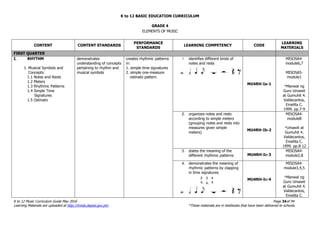
Kabuki Traditional Japanese theater performance.
Key Signature sharp or flat signs immediately following the clef sign at the beginning of a piece of music, indicating the key in which the music is to be played
Key (tonality) central note, scale and chord within a piece, in relationship to which all other tones in the composition are heard
Keynote central tone of a melody or piece of music e.g. when a piece is in the Key of C Major, C is the keynote
Kulintang A set of gongs usually played by ensembles in Mindanao.
Largo very slow
Ledger Lines short, horizontal lines above or below the staff, used to indicate a pitch that falls above or below the range indicated by the staff
Liturgical music Music composed for and played during liturgical celebrations and worship.
Lumad Means “native” or “indigenous”.
Madrigal Music for several voices with elaborate counterpoint; was popular during the Renaissance Period.
Maracatu A musical style from Brazil.
K to 12 BASIC EDUCATION CURRICULUM
K to 12 Music Curriculum Guide May 2016 Page 89of 94
Learning Materials are uploaded at http://lrmds.deped.gov.ph/. *These materials are in textbooks that have been delivered to schools.
GLOSSARY
Measure the space between two barlines, containing a fixed number of beats
Medieval Term that refers to the “Middle Ages”.
Melody the line of music that moves up and down in succession; series of single tones that add up to a recognizable whole
Melodic Contour the upward and downward direction of the notes
Melodic Pattern the combination of repeated, similar and contrasting figures, motives and phrases
Melodic Ostinato group of tones used to accompany a tone or a melody
Membranophone Any musical instrument that produces sound primarily by a vibrating stretched membrane.
Meter organization of beats into regular groups
Mezzo piano (mp) moderately soft
Mezzo forte (mf) moderately loud
Moderato moderate tempo
Monophonic Texture single melodic line without accompaniment
Motive
fragment of a theme, or short musical idea which is developed within a composition; refers to a short melody sung or played which can identify
a musical composition
Musical Texture
refers to the relationship of melodic and harmonic elements in music which produces qualities of thickness and thinness, heaviness or lightness
of a melody or sound produced
Musikong Bumbong An instrumental marching band that uses bamboo instruments.
Natural Sign symbol used to cancel a previous sharp or flat sign
Notation system of writing down music so that specific pitches and rhythms can be conveyed
Note symbol used to indicate pitch
Opera A dramatic work in one or more acts set to music for singers and instrumentalists.
Oratorio A large-scale musical work for orchestra and voices, usually narrative and typically on a sacred theme.
Ostinato motive or phrase that is repeated persistently at the same pitch
K to 12 BASIC EDUCATION CURRICULUM
K to 12 Music Curriculum Guide May 2016 Page 90of 94
Learning Materials are uploaded at http://lrmds.deped.gov.ph/. *These materials are in textbooks that have been delivered to schools.
GLOSSARY
Pangkat Kawayan An instrumental ensemble that uses different kinds of bamboo instruments.
Pasa doble A fast-paced ballroom dance based on the Latin American style of marching.
Peking Opera Traditional Chinese theater performance.
Pentatonic Scale a five-tone scale, used in folk music and music of the Far East
Phrase musical statements that express meaning or ideas
Piano (p) soft
Pianissimo (pp) very soft; as softly as possible
Pinpeat A Cambodian instrumental ensemble.
Piphat A Thai instrumental ensemble which features wind and percussion instruments.
Pitch relative highness or lowness of a sound
Pitch Range distance between the highest and lowest tones that a given voice or instrument can produce
Polyphonic Texture refers to a musical composition with two or more independent melodies sung or played to create a harmonious effect
Program music Music that is intended to evoke images or to convey the impression of events.
Ragtime A kind of music which evolved with syncopated melodic line and regularly accented accompaniment.
Reggae A style of music originally from Jamaica and popularized in the 1960s.
Renaissance Term that refers to the revival of European art under the influence of Classical Models.
Rest a symbol that indicates the duration of silence in music
Rhythm ordered flow of music through time; the pattern of durations of notes and silences in music
Rhythmic Pattern combinations of long and short sounds, notes and rests
Ritardando becoming slower
Rock and roll Popular dance music from the 1950s characterized by heavy beats and simple melodies.
Rondalla An instrumental ensemble that usually consists of musicians playing banduria, octavina, laud, guitar and double bass.
K to 12 BASIC EDUCATION CURRICULUM
K to 12 Music Curriculum Guide May 2016 Page 91of 94
Learning Materials are uploaded at http://lrmds.deped.gov.ph/. *These materials are in textbooks that have been delivered to schools.
GLOSSARY
Round
form of music wherein a melody change from a single-voiced texture to a many-voiced texture; each voice enters in succession; the effect is
that of weaving a new and richer rhythmic and harmonic texture
Rumba A rhythmic dance with Spanish and African elements originally from Cuba.
Sacred music Music that promotes devotion and faith.
Sarsuela A musical stage performance popularized in the Philippines during the Spanish colonization.
Saung gauk An arched harp used in Myanmar.
Scale series of pitches arranged in ascending or descending order
Secular music Music for non-religious purposes.
Sharp Sign symbol that notates the pitch of a note a half step higher
Sonata A composition for an instrumental soloist, often with a piano accompaniment, typically in several movements with one or more in sonata form.
Sonata-allegro form A large-scale musical structure popularly used during the middle of the 18th
century.
Soprano female voice of high range
Soul Musical style that incorporates rhythm and blues and gospel music popularized by African-American people.
Sound vibrations which are transmitted, usually through air, to the eardrum, which sends impulses to the brain
Staff a set of five lines and four spaces where notes are positioned or placed
Symphony An elaborate musical composition for full orchestra, typically in four movements, at least one of which is in sonata form.
Tango A ballroom dance originating from Buenos Aires, characterized by marked rhythms and postures and abrupt pauses.
Tempo rate of speed in music
Tenor male voice of high range
Timbre quality of sound that distinguishes one instrument or one voice from another
Time Signature
two numbers, one above the other, appearing at the beginning of a staff or the start of a piece, indicating the meter of a piece; the number
above refers to the number of beats per measure and the number below represents the kind of note getting one beat.
Tone sound that has a definite pitch or frequency
K to 12 BASIC EDUCATION CURRICULUM
K to 12 Music Curriculum Guide May 2016 Page 92of 94
Learning Materials are uploaded at http://lrmds.deped.gov.ph/. *These materials are in textbooks that have been delivered to schools.
GLOSSARY
Triad the most basic type of chord, consisting of three alternate tones of the scale e.g. do, mi, so
Troubadour Street musicians singing of love during the Medieval Period.
Unison performance of a single melodic line by more than one instrument or voice a t the same pitch
Wayang Kulit Indonesian puppet shadow theater.
K to 12 BASIC EDUCATION CURRICULUM
K to 12 Music Curriculum Guide May 2016 Page 93of 94
Learning Materials are uploaded at http://lrmds.deped.gov.ph/. *These materials are in textbooks that have been delivered to schools.
CODE BOOK LEGEND
Sample: MU7FT-IVe-h-6
LEGEND SAMPLE
First Entry
Learning Area and
Strand/ Subject or
Specialization
Music
MU7
Grade Level Grade 7
Uppercase Letter/s
Domain/Content/
Component/ Topic
Theatrical Forms FT
-
Roman Numeral
*Zero if no specific quarter
Quarter Fourth Quarter IV
Lowercase Letter/s
*Put a hyphen (-) in between
letters to indicate more than a
specific week
Week Week five to eight e-h
Arabic Number Competency
Describes how a specific
idea or story is
communicated through
music in a particular
Philippine musical theater
6
DOMAIN/ COMPONENT CODE
Rhythm RH
Melody ME
Form FO
Timbre TB
Dynamics DY
Tempo TP
Texture TX
Harmony HA
Music of Luzon LU
Music of Cordillera, Mindoro, Palawan, and the
Visayas
LV
Music of Mindanao MN
Theatrical Forms FT
Music of southeast asia SE
Music of South Asia and Middle East WS
Traditional Asian Theater Music TH
Music of the medieval period MRB
Music of the classical period CL
Instrumental music of the romantic period RO
Vocal Music of the Romantic Period OP
2Oth
Century TC
Afro-latin and popular music AP
Contemporary Philippine music CM
Multimedia forms MM
K to 12 BASIC EDUCATION CURRICULUM
K to 12 Music Curriculum Guide May 2016 Page 94of 94
Learning Materials are uploaded at http://lrmds.deped.gov.ph/. *These materials are in textbooks that have been delivered to schools.
REFERENCES
Abeles, Harold, Hoffer, Charles and Klotman, Robert. Foundations of Music Education, (New York: Schirmer Books, 1984)
Armstrong, Thomas. "American Institute for Learning and Human Development." Multiple Intelligences. 2010. http://www.thomasarmstrong.com/multiple_intelligences.htm.
Bruner, Jerome, The Process of Education. (Cambridge, Mass.: Harvard University Press, 1977)
Bureau of Elementary Education, 2002 Basic Education Curriculum. (Pasig City: Department of Education, 2002)
Bureau of Elementary Education, 2002 Philippine Elementary Learning Competencies. (Pasig City: Department of Education, 2002)
Bureau of Secondary Education, Department of Education. Basic Education Curriculum. Pasig City, 2002.
Bureau of Secondary Education, Department of Education Culture and Sports. Desired Learning Competencies New Secondary Education Curriculum. Pasig City, 1991.
Bureau of Secondary Education, Department of Education Culture and Sports. Desired Learning Competencies Philippine Secondary Schools Learning Competencies.
Pasig City, 1998.
Bureau of Secondary Education, Department of Education. Secondary Education Curriculum. Pasig City, 2010.
Gardner, Howard. "Multiple Intelligences." Howard Gardner. 2010. http://www.howardgardner.com/MI/mi.html.
Gardner, Howard, Multiple Intelligences. (New York: Basic Books Inc., 1991)
Miller, Cleve, Performance-Based Learning, (England: Cambridge University Press, 2008)
Miller, Cleve. "Performance-Based Learning (Mexico: Cambridge University Press, 2010)." Teaching Business English (audio blog), December 16, 2010. performance-based-
learning.html.
Reimer, Bennett. A Philosophy of Music Education Advancing the Vision. 1991 ed. (Aesthetic Education. Upper Saddle River, New Jersey: Prentice Hall, 2003).
Reimer, Bennet, Journal of Aesthetic Education, (USA: University of Illinois Press, 1991)
Thomas, Ronald, A Structure for Music Education. (Bardonia, N.Y.: Media Materials Inc., 1970)
Thomas, Ronald B. MMCP Synthesis: A Structure for Music Education. (Bardonia, N.Y: Sponsored by the U.S. Office of Education Media Materials, 1970).
Wade, Bonnie C., Thinking Musically: Experiencing Music, Expressing Culture, (England: Oxford University Press, 2003)

K_to_12_Curriculum_Guide_MUSIC_Grade_1_t.pdf

  • 1.
    Republic of thePhilippines Department of Education DepEd Complex, Meralco Avenue Pasig City May 2016 K to 12 Curriculum Guide MUSIC (Grade 1 to Grade 10)
  • 2.
    K to 12BASIC EDUCATION CURRICULUM K to 12 Music Curriculum Guide May 2016 Page 2of 94 Learning Materials are uploaded at http://lrmds.deped.gov.ph/. *These materials are in textbooks that have been delivered to schools. CONCEPTUAL FRAMEWORK Both the Music and the Arts curricula focus on the learner as recipient of the knowledge, skills, and values necessary for artistic expression and cultural literacy. The design of the curricula is student-centered, based on spiral progression of processes, concepts and skills and grounded in performance- based learning. Thus, the learner is empowered, through active involvement and participation, to effectively correlate music and art to the development of his/her own cultural identity and the expansion of his/her vision of the world. As Music and Arts are performance-based disciplines, effective learning occurs through active experience, participation, and performance, creative expression, aesthetic valuation, critical response, and interpretation. The skills that are developed include reading/analyzing, listening/observing, performing, (singing, using musical instruments, movement, acting, and playing, using different art materials, techniques and processes, responding, composing, and creating. (See Figure 1 and Figure 2) The philosophical foundations upon which standards and competencies are based include: A Process of Education by Jerome Bruner, Performance-Based Learning by Cleve Miller, Aesthetic Education by Bennett Reimer, Multiple Intelligences by Howard Gardner, A Structure for Music Education by Ronald Thomas, Gongs and Bamboo by Jose Maceda, Compendium on the Humanities: Musical Arts produced by the National Research Council of the Philippines, Cultural Dictionary for Filipinos by Thelma Kintanar and Associates, Creative and Mental Growth by Viktor Lowenfeld and W. Lambert Brittain, Discipline-Based Art Education by Elliot Eisner, Encyclopedia of Philippine Arts and Tuklas Sining, both produced by the Cultural Center of the Philippines.
  • 3.
    K to 12BASIC EDUCATION CURRICULUM K to 12 Music Curriculum Guide May 2016 Page 3of 94 Learning Materials are uploaded at http://lrmds.deped.gov.ph/. *These materials are in textbooks that have been delivered to schools. PHILOSOPHY AND RATIONALE FOR MUSIC EDUCATION Music is both an aural and a temporal art. All its elements, when interwoven in the highest artistic order, are likened into a -- tapestry moving in time. The global weavings of this tapestry in historical and cultural contexts are diverse -- having spurred a continued metamorphosis to include a full range of purposes, functions, and identities, from the utilitarian to aesthetic. However, the basic nature of music does not change. In his book A Structure for Music Education, Ronald Thomas articulates that the nature of music is expressive, ongoing, and creative. Through a language and medium of its own, music conveys ideas and feelings in a way that addresses the human spirit, and has great value in its communicative process. Music, being responsive in interpreting contemporary times, is a continuing art. Aaron Copland describes this characteristic as a continuous state of becoming. Like the other arts, music is a creative avenue for man’s individual quest for self- expression and fulfillment. On these basic characteristics are founded the rationale of music study. A keen sensitivity to environmental and musical sounds needs to be developed. The student must learn to ―hear, ―speak, and ―think in the medium of music. Simultaneously, growth and development in the skills that enable the application of the learner’s knowledge should be encouraged, through active involvement in the various musical processes. Drawing from the development of music pedagogy through the years, the K-10 Music Curriculum embodies the best practices advocated by the SPIRAL, MULTI-CULTURAL, and INTEGRATIVE approaches in music education, as well as current philosophical thought about contemporary general education. We envision that Music in the K-10 Program will effectively nurture and refine the learner’s artistic expression and cultural literacy, and celebrate his/her national heritage, while it instils, within every individual Filipino learner, pride in his/her own cultural identity.
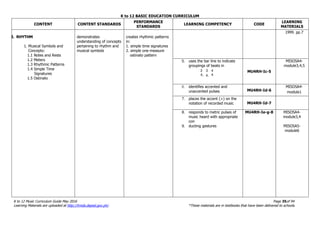
  • 4.
    K to 12BASIC EDUCATION CURRICULUM K to 12 Music Curriculum Guide May 2016 Page 4of 94 Learning Materials are uploaded at http://lrmds.deped.gov.ph/. *These materials are in textbooks that have been delivered to schools. Figure 1. The Curriculum Framework of Music and Arts Education
  • 5.
    K to 12BASIC EDUCATION CURRICULUM K to 12 Music Curriculum Guide May 2016 Page 5of 94 Learning Materials are uploaded at http://lrmds.deped.gov.ph/. *These materials are in textbooks that have been delivered to schools. Figure 2. Content of Music and Arts per Grade Level Grade 12Mastery of Proficiency in the chosen form or genre Grade 11Mastery of Proficiency in the chosen form or genre Grade 10Application of Contemporary Music and Arts Grade 9Application – Western Music and Arts Grade 8Application – Asian Music and Arts Grade 7Application – Philippine Folk Music and Arts Grade 6Application for Appropriate Mastery and Acquisition of Skills Grade 5Exploration – Elements / Processes Grade 4Formal Introduction to Elements / Processes Grade 3Preliminary Acquisition of Basic Knowledge and Skills Grade 2Enhanced Understanding of Fundamental Processes Grade 1Introduction to the Fundamental Processes KindergartenExposure to the Different Music & Art Processes (Experiential Learning)
  • 6.
    K to 12BASIC EDUCATION CURRICULUM K to 12 Music Curriculum Guide May 2016 Page 6of 94 Learning Materials are uploaded at http://lrmds.deped.gov.ph/. *These materials are in textbooks that have been delivered to schools. Table 1. Basic Reference for Music Content Music Elements Music Processes -creating) (including movement) *No formal instruction in harmony from K to 3
  • 7.
    K to 12BASIC EDUCATION CURRICULUM K to 12 Music Curriculum Guide May 2016 Page 7of 94 Learning Materials are uploaded at http://lrmds.deped.gov.ph/. *These materials are in textbooks that have been delivered to schools. LEARNING AREA STANDARD: The learner demonstrates an understanding of basic concepts and processes in music and art through appreciation, analysis and performance for his/her self-development, celebration of his/her Filipino cultural identity and diversity, and expansion of his/her world vision. KEY STAGE STANDARDS: K - 3 4 - 6 7 – 10 The learner demonstrates understanding of fundamental processes through performing, creating, and responding, aimed towards the development of appreciation of music and art, and acquisition of basic knowledge and skills. The learner demonstrates understanding of basic elements and concepts through performing, creating, and responding, aimed towards the development of appreciation of music and art, and acquisition of basic knowledge and skills. The learner demonstrates understanding of salient features of music and art of the Philippines and the world, through appreciation, analysis, and performance, for self-development, the celebration of Filipino cultural identity and diversity, and the expansion of one’s world vision.
  • 8.
    K to 12BASIC EDUCATION CURRICULUM K to 12 Music Curriculum Guide May 2016 Page 8of 94 Learning Materials are uploaded at http://lrmds.deped.gov.ph/. *These materials are in textbooks that have been delivered to schools. GRADE LEVEL STANDARDS: Grade Level Grade Level Standards Kindergarten The learner is exposed to the different basic music and art processes through experiential learning. Grade 1 The learner demonstrates basic understanding of the fundamental processes in music and art, through performing, creating, listening and observing, and responding. Grade 2 The learner demonstrates understanding of the basic and fundamental processes in music and art, through performing, creating, listening and observing, and responding. Grade 3 The learner has acquired the basic and fundamental processes through performing, creating, listening and observing, and responding, towards the development of appreciation of music and art, and the acquisition of basic knowledge and skills. Grade 4 Through the formal introduction of elements, the learner can identify the basic knowledge and skills in music and art, towards self-development, the celebration of Filipino cultural identity and diversity, and the expansion of one’s world vision. Grade 5 Through exploration, the learner demonstrates a deeper understanding of basic knowledge and skills in music and art, towards self-development, the celebration of Filipino cultural identity and diversity, and expansion of one’s world vision. Grade 6 Through application, the learner demonstrates understanding of the basic concepts of and processes in music and art, towards self-development, the celebration of Filipino cultural identity and diversity, and the expansion of one’s world vision. Grade 7 The learner demonstrates basic understanding of the fundamental processes in music and the arts through performing, creating, listening and observing, and responding towards appreciation of the cultural richness of the different provinces in the Philippines. Grade 8 The learner demonstrates understanding of salient features of Asian music and the arts, through appreciation, analysis, and performance for self- development, the celebration of Filipino cultural identity and diversity, and the expansion of one’s world vision. Grade 9 The learner demonstrates understanding of salient features of Western music and the arts from different historical periods, through appreciation, analysis, and performance for self-development, the celebration of Filipino cultural identity and diversity, and the expansion of one’s world vision. Grade 10 The learner demonstrates understanding of salient features of contemporary music and the arts, through appreciation, analysis, and performance, for self- development, the celebration of Filipino cultural identity and diversity, and the expansion of one’s world vision.
  • 9.
    K to 12BASIC EDUCATION CURRICULUM K to 12 Music Curriculum Guide May 2016 Page 9of 94 Learning Materials are uploaded at http://lrmds.deped.gov.ph/. *These materials are in textbooks that have been delivered to schools. GRADE 1 ELEMENTS OF MUSIC CONTENT CONTENT STANDARDS PERFORMANCE STANDARDS LEARNING COMPETENCY CODE LEARNING MATERIALS FIRST QUARTER I. RHYTHM 1. Distinction Between Sound and Silence 2. Steady Beats 3. Simple Rhythmic Patterns 4. Ostinato demonstrates basic understanding of sound, silence and rhythm responds appropriately to the pulse of the sounds heard and performs with accuracy the rhythmic patterns 1. identifies the difference between sound and silence accurately MU1RH-Ia-1 Pilot School MTB- MLE 2. relates images to sound and silence within a rhythmic pattern MU1RH-Ib-2 Pilot School MTB- MLE Music, Arts, Physical Education and Health 2.Illagan, Amelia M. et.al, 2013 pp.3-8 3. performs echo clapping MU1RH-Ib-3 Pilot School MTB- MLE 4. maintains a steady beat when chanting, walking, tapping, clapping, and playing musical instruments MU1RH-Ic-4 Pilot School MTB- MLE 5. claps, taps, chants, walks and plays musical instruments with accurate rhythm in response to sound o in groupings of 2s o in groupings of 3s o in groupings of 4s MU1RH-Ic-5 Pilot School MTB- MLE 6. creates simple ostinato patterns in groupings of 2s, 3s, and 4s through body movements MU1RH-Id-e-6 Pilot School MTB- MLE Music, Arts, Physical
  • 10.
    K to 12BASIC EDUCATION CURRICULUM K to 12 Music Curriculum Guide May 2016 Page 10of 94 Learning Materials are uploaded at http://lrmds.deped.gov.ph/. *These materials are in textbooks that have been delivered to schools. CONTENT CONTENT STANDARDS PERFORMANCE STANDARDS LEARNING COMPETENCY CODE LEARNING MATERIALS I. RHYTHM 1. Distinction Between Sound and Silence 2. Steady Beats 3. Simple Rhythmic Patterns 4. Ostinato demonstrates basic understanding of sound, silence and rhythm responds appropriately to the pulse of the sounds heard and performs with accuracy the rhythmic patterns Education and Health 2.Illagan, Amelia M. et.al, 2013 pp.25-31 7. performs simple ostinato patterns on other sound sources including body parts MU1RH-If-g-7 Pilot School MTB- MLE 8. plays simple ostinato patterns on classroom instruments 8.1 sticks, drums, triangles, nails, coconut shells, bamboo, empty boxes, etc. MU1RH-Ih-8 Pilot School MTB- MLE Music, Arts, Physical Education and Health 2.Illagan, Amelia M. et.al, 2013 pp.32-33 SECOND QUARTER II. MELODY 1. Pitch 2. Simple Melodic Patterns demonstrates basic understanding of pitch and simple melodic patterns responds accurately to high and low tones through body movements, singing, and playing other sources of sounds 1. identifies the pitch of a tone as high or low MU1ME-IIa-1 Pilot School MTB- MLE Music, Arts, Physical Education and Health 2.Illagan, Amelia M. et.al, 2013 pp.43-45 2. matches the correct pitch of tones with other sound sources MU1ME-IIb-2 Pilot School MTB- MLE Music, Arts, Physical Education and Health 2.Illagan, Amelia M. et.al, 2013 pp.47-50 3. sings simple melodic patterns 3.1 ( so –mi, mi –so, mi – re- do) MU1ME-IIb-3 Pilot School MTB- MLE 4. matches the melody of a song with the correct pitch vocally MU1ME-IIc-4 Pilot School MTB- MLE Music, Arts, Physical
  • 11.
    K to 12BASIC EDUCATION CURRICULUM K to 12 Music Curriculum Guide May 2016 Page 11of 94 Learning Materials are uploaded at http://lrmds.deped.gov.ph/. *These materials are in textbooks that have been delivered to schools. CONTENT CONTENT STANDARDS PERFORMANCE STANDARDS LEARNING COMPETENCY CODE LEARNING MATERIALS II. MELODY 1. Pitch 1. Simple Melodic Patterns demonstrates basic understanding of pitch and simple melodic patterns responds accurately to high and low tones through body movements, singing, and playing other sources of sounds 4.1 greeting songs 4.2 counting songs 4.3 action songs Education and Health 2.Illagan, Amelia M. et.al, 2013 pp.52-55 5. sings in pitch 5.1 rote singing 5.2 greeting songs 5.3 counting songs 5.4 echo singing MU1ME-IIc-5 Pilot School MTB- MLE Music, Arts, Physical Education and Health 2.Illagan, Amelia M. et.al, 2013 pp.52-55 III. FORM 1. Musical Lines 2. Beginnings and Endings in Music 3. Repeats in Music demonstrates basic understanding of the concepts of musical lines, beginnings and endings in music, and repeats in music responds with precision to changes in musical lines with body movements 6. identifies with body movements the 6.1 beginnings 6.2 endings 6.3 repeats of a recorded music example MU1FO-IId-1 Pilot School MTB- MLE 7. identifies similar or dissimilar musical lines with the use of: 7.1 body movements 7.2 geometric shapes or objects MU1FO-IIe-2 Pilot School MTB- MLE Music, Arts, Physical Education and Health 2.Illagan, Amelia M. et.al, 2013 pp.72-76 8. relates basic concepts of musical forms to geometric shapes to indicate understanding of: 8.1 same patterns 8.2 different patterns MU1FO-IIf-3 Pilot School MTB- MLE Music, Arts, Physical Education and Health 2.Illagan, Amelia M. et.al, 2013 pp.72-76 9. chooses the exact geometric shapes that correspond to musical form MU1FO-IIg-h-4 Pilot School MTB- MLE
  • 12.
    K to 12BASIC EDUCATION CURRICULUM K to 12 Music Curriculum Guide May 2016 Page 12of 94 Learning Materials are uploaded at http://lrmds.deped.gov.ph/. *These materials are in textbooks that have been delivered to schools. CONTENT CONTENT STANDARDS PERFORMANCE STANDARDS LEARNING COMPETENCY CODE LEARNING MATERIALS THIRD QUARTER IV. TIMBRE 1. Quality of Sound in Music 2. Distinction Between Speaking and Singing demonstrates understanding of the basic concepts of timbre distinguishes accurately the different sources of sounds heard and be able to produce a variety of timbres 1. identifies the source of sounds 1.1 wind, wave, swaying of the trees, animal sounds, sounds produced by machines, transportation, through body movements MU1TB-IIIa-1 Pilot School MTB- MLE Music, Arts, Physical Education and Health 2.Illagan, Amelia M. et.al, 2013 pp.97-102 2. responds appropriately to differences in sounds heard through body movement MU1TB-IIIa-2 Pilot School MTB- MLE 3. replicates the sounds heard from different sources MU1TB-IIIb-3 Pilot School MTB- MLE Music, Arts, Physical Education and Health 2.Illagan, Amelia M. et.al, 2013 pp.103-106 4. uses voice and other sources of sound to produce a variety of timbres MU1TB-IIIb-4 Pilot School MTB- MLE V. DYNAMICS 1. Volume of Sound in Music 2. Distinction Between Loudness and Softness in Music demonstrates understanding of the basic concepts of dynamics creatively interprets with body movements the dynamic levels to enhance poetry, chants, drama, and musical stories 5. demonstrates dynamic changes with movements MU1DY-IIIc-1 Pilot School MTB- MLE 6. uses the terms loud and soft to identify volume changes MU1DY-IIIc-2 Pilot School MTB- MLE 7. relates the concepts of dynamics to the movements of animals 7.1 elephant walk – loud 7.2 tiny steps of a mouse – soft MU1DY-IIId-3 Pilot School MTB- MLE Music, Arts, Physical Education and Health 2.Illagan, Amelia M. et.al, 2013 pp.132-134 8. interprets with body movements the dynamics of a song MU1DY-IIIe-f-4 Pilot School MTB- MLE Music, Arts, Physical
  • 13.
    K to 12BASIC EDUCATION CURRICULUM K to 12 Music Curriculum Guide May 2016 Page 13of 94 Learning Materials are uploaded at http://lrmds.deped.gov.ph/. *These materials are in textbooks that have been delivered to schools. CONTENT CONTENT STANDARDS PERFORMANCE STANDARDS LEARNING COMPETENCY CODE LEARNING MATERIALS V. DYNAMICS 1. Volume of Sound in Music 2. Distinction Between Loudness and Softness in Music demonstrates understanding of the basic concepts of dynamics creatively interprets with body movements the dynamic levels to enhance poetry, chants, drama, and musical stories 8.1 small movement – soft 8.2 big movement –loud Education and Health 2.Illagan, Amelia M. et.al, 2013 pp.132-134 9. applies the concepts of dynamic levels to enhance poetry, chants, drama, and musical stories 9.1 small movement – soft 9.2 big movement – loud MU1DY-IIIg-h- 5 Pilot School MTB- MLE FOURTH QUARTER VI. TEMPO 1. Speed of Sound In Music 2. Distinction Between Fastness and Slowness in Music demonstrates understanding of the basic concepts of tempo performs with accuracy varied tempi through movements or dance steps to enhance poetry, chants, drama, and musical stories 1. mimics animal movements 1.1 horse – fast 1.2 carabao – slow MU1TP-IVa-1 Pilot School MTB- MLE Music, Arts, Physical Education and Health 2.Illagan, Amelia M. et.al, 2013 pp.143-145 2. demonstrates the basic concepts of tempo through movements MU1TP-IVa-2 Pilot School MTB- MLE Music, Arts, Physical Education and Health 2.Illagan, Amelia M. et.al, 2013 pp.137-140 3. responds to varied tempo with movements or dance steps 3.1 slow movement with slow music 3.2 fast movement with fast music MU1TP-IVb-3 Pilot School MTB- MLE Music, Arts, Physical Education and Health 2.Illagan, Amelia M. et.al, 2013 pp.137-140 4. relates tempo changes to movements MU1TP-IVb-4 Pilot School MTB- MLE 5. uses varied tempo to enhance poetry, chants, drama, and musical stories MU1TP-IVc-5 Pilot School MTB- MLE
  • 14.
    K to 12BASIC EDUCATION CURRICULUM K to 12 Music Curriculum Guide May 2016 Page 14of 94 Learning Materials are uploaded at http://lrmds.deped.gov.ph/. *These materials are in textbooks that have been delivered to schools. CONTENT CONTENT STANDARDS PERFORMANCE STANDARDS LEARNING COMPETENCY CODE LEARNING MATERIALS VII. TEXTURE 1. Distinction Between Thinness and Thickness in Music 2. Single Melodic Line or Simultaneous Occurrence of Multiple Melodic Lines demonstrates understanding of the basic concepts of texture sings songs to involve oneself and experience the concept of texture 6. identify sounds alone, sounds together MU1TX-IVd-1 Pilot School MTB- MLE 7. demonstrates awareness of texture by using visual images MU1TX-IVe-2 Pilot School MTB- MLE Music, Arts, Physical Education and Health 2.Illagan, Amelia M. et.al, 2013 pp.154-159 8. distinguishes accurately between single musical line and multiple musical lines which occur simultaneously in a given song MU1TX-IVf-3 Pilot School MTB- MLE Music, Arts, Physical Education and Health 2.Illagan, Amelia M. et.al, 2013 pp.160-162 9. demonstrates the concept of texture by singing two-part round 9.1 Are You Sleeping, Brother John? 9.2 Row, Row, Row Your Boat MU1TX-IVg-h-4 Pilot School MTB- MLE Music, Arts, Physical Education and Health 2.Illagan, Amelia M. et.al, 2013 pp.160-162
  • 15.
    K to 12BASIC EDUCATION CURRICULUM K to 12 Music Curriculum Guide May 2016 Page 15of 94 Learning Materials are uploaded at http://lrmds.deped.gov.ph/. *These materials are in textbooks that have been delivered to schools. GRADE 2 ELEMENTS OF MUSIC CONTENT CONTENT STANDARDS PERFORMANCE STANDARDS LEARNING COMPETENCY CODE LEARNING MATERIALS FIRST QUARTER I. RHYTHM 1. Distinction Between Sound and Silence 2. Steady Beats 3. Simple Rhythmic Patterns 4. Ostinato demonstrates basic understanding of sound, silence and rhythmic patterns and develops musical awareness while performing the fundamental processes in music responds appropriately to the pulse of sounds heard and performs with accuracy the rhythmic patterns in expressing oneself 1. distinguishes aurally and visually between sound and silence MU2RH-Ia-1 Pilot School MTB- MLE Music, Arts, Physical Education and Health 2.Illagan, Amelia M. et.al, 2013 pp.3-8 2. relates visual images to sound and silence within a rhythmic pattern MU2RH-Ib-2 Pilot School MTB- MLE Music, Arts, Physical Education and Health 2.Illagan, Amelia M. et.al, 2013 pp.3-8 3. replicates a simple series of rhythmic sounds (i.e. echo clapping) MU2RH-Ib-3 Pilot School MTB- MLE Music, Arts, Physical Education and Health 2.Illagan, Amelia M. et.al, 2013 pp.21-24 4. maintains a steady beat when chanting, walking, tapping, clapping, and playing musical instruments MU2RH-Ic-4 Pilot School MTB- MLE 5. claps the written stick notation to show steady beats 5.1 divides the stick notations into measures of 2s, 3s and 4s to show rhythmic patterns MU2RH-Ic-5 Pilot School MTB- MLE Music, Arts, Physical Education and Health 2.Illagan, Amelia M. et.al,
  • 16.
    K to 12BASIC EDUCATION CURRICULUM K to 12 Music Curriculum Guide May 2016 Page 16of 94 Learning Materials are uploaded at http://lrmds.deped.gov.ph/. *These materials are in textbooks that have been delivered to schools. CONTENT CONTENT STANDARDS PERFORMANCE STANDARDS LEARNING COMPETENCY CODE LEARNING MATERIALS I. RHYTHM 1. Distinction Between Sound and Silence 2. Steady Beats 3. Simple Rhythmic Patterns 4. Ostinato demonstrates basic understanding of sound, silence and rhythmic patterns and develops musical awareness while performing the fundamental processes in music responds appropriately to the pulse of sounds heard and performs with accuracy the rhythmic patterns in expressing oneself 2013 pp.25-31 6. creates simple ostinato patterns in measures of 2s, 3s, and 4s with body movements MU2RH-Id-e-6 Pilot School MTB- MLE Music, Arts, Physical Education and Health 2.Illagan, Amelia M. et.al, 2013 pp.25-31 7. writes stick notation on the board to represent the sound heard MU2RH-If-g-7 Pilot School MTB- MLE Music, Arts, Physical Education and Health 2.Illagan, Amelia M. et.al, 2013 pp.22 8. plays simple ostinato patterns on classroom instruments 8.1 sticks, drums, triangles, nails, coconut shells, bamboo, empty boxes, etc. MU2RH-Ih-8 Pilot School MTB- MLE Music, Arts, Physical Education and Health 2.Illagan, Amelia M. et.al, 2013 pp.32-33 SECOND QUARTER II. MELODY 1. Pitch 2. Simple Melodic Patterns demonstrates basic understanding of pitch and simple melodic patterns performs with accuracy of pitch, the simple melodic patterns through body movements, singing or playing musical instruments 1. identifies the pitch of tones as 1.1 high 1.2 low 1.3 higher 1.4 lower MU2ME-IIa-1 Pilot School MTB- MLE Music, Arts, Physical Education and Health 2.Illagan, Amelia M. et.al, 2013 pp.39-42 2. responds to ranges of pitch through body movements, singing, and playing sources of sounds MU2ME-IIa-2 Pilot School MTB- MLE Music, Arts, Physical Education and
  • 17.
    K to 12BASIC EDUCATION CURRICULUM K to 12 Music Curriculum Guide May 2016 Page 17of 94 Learning Materials are uploaded at http://lrmds.deped.gov.ph/. *These materials are in textbooks that have been delivered to schools. CONTENT CONTENT STANDARDS PERFORMANCE STANDARDS LEARNING COMPETENCY CODE LEARNING MATERIALS II. MELODY 1. Pitch 2. Simple Melodic Patterns demonstrates basic understanding of pitch and simple melodic patterns performs with accuracy of pitch, the simple melodic patterns through body movements, singing or playing musical instruments Health 2.Illagan, Amelia M. et.al, 2013 pp.43-44 3. demonstrates high and low pitches through singing or playing musical instruments MU2ME-IIb-3 Pilot School MTB- MLE Music, Arts, Physical Education and Health 2.Illagan, Amelia M. et.al, 2013 pp.42-45, 47- 50 4. sings the following songs with accurate pitch: 4.1 wrote songs 4.2 echo songs 4.3 simple children’s melodies MU2ME-IIb-4 Pilot School MTB- MLE Music, Arts, Physical Education and Health 2.Illagan, Amelia M. et.al, 2013 pp.52-55 5. echoes simple melodic patterns through singing or humming MU2ME-IIc-5 Pilot School MTB- MLE Music, Arts, Physical Education and Health 2.Illagan, Amelia M. et.al, 2013 pp.54-55 6. demonstrates the melodic contour with movement MU2ME-IIc-6 Pilot School MTB- MLE Music, Arts, Physical Education and Health 2.Illagan, Amelia M. et.al, 2013 pp.57-58 7. demonstrates the melodic contour through 1.7 body staff 1.8 writing the melodic line “on MU2ME-IIc-7 Pilot School MTB- MLE Music, Arts, Physical
  • 18.
    K to 12BASIC EDUCATION CURRICULUM K to 12 Music Curriculum Guide May 2016 Page 18of 94 Learning Materials are uploaded at http://lrmds.deped.gov.ph/. *These materials are in textbooks that have been delivered to schools. CONTENT CONTENT STANDARDS PERFORMANCE STANDARDS LEARNING COMPETENCY CODE LEARNING MATERIALS II. MELODY 1. Pitch 2. Simple Melodic Patterns demonstrates basic understanding of pitch and simple melodic patterns performs with accuracy of pitch, the simple melodic patterns through body movements, singing or playing musical instruments the air” 1.9 line notation Education and Health 2.Illagan, Amelia M. et.al, 2013 pp.58-62 8. relates visual imagery to melodic patterns MU2ME-IIc-8 Pilot School MTB- MLE Music, Arts, Physical Education and Health 2.Illagan, Amelia M. et.al, 2013 pp.63-65 III. FORM 1. Musical Lines 2. Beginnings and Endings in Music 3. Repeats in Music demonstrates understanding of the basic concepts of musical form performs a song, chosen from among the previously learned songs that shows the basic concepts of musical lines, beginnings, endings and repeats through body movement, vocal sounds, and instrumental sounds 9. identifies the beginning and ending of a song MU2FO-IId-1 Pilot School MTB- MLE Music, Arts, Physical Education and Health 2.Illagan, Amelia M. et.al, 2013 pp.78-82 10. demonstrates the beginning and ending of a song with 10.1 movements 10.2 vocal sounds 10.3 instrumental sounds MU2FO-IId-2 Pilot School MTB- MLE Music, Arts, Physical Education and Health 2. Illagan, Amelia M. et.al, 2013 pp.78-82 11. identifies musical lines as 11.1 similar 11.2 dissimilar with movements and with the use geometric shapes or objects MU2FO-IIe-3 Pilot School MTB- MLE Music, Arts, Physical Education and Health 2. Illagan, Amelia M. et.al, 2013 pp.72-76 12. demonstrates repeated musical lines with movements MU2FO-IIe-4 Pilot School MTB- MLE Music, Arts, Physical
  • 19.
    K to 12BASIC EDUCATION CURRICULUM K to 12 Music Curriculum Guide May 2016 Page 19of 94 Learning Materials are uploaded at http://lrmds.deped.gov.ph/. *These materials are in textbooks that have been delivered to schools. CONTENT CONTENT STANDARDS PERFORMANCE STANDARDS LEARNING COMPETENCY CODE LEARNING MATERIALS Education and Health 2. Illagan, Amelia M. et.al, 2013 pp.84-88 13. recognizes repetitions within a song MU2FO-IIf-5 Pilot School MTB- MLE 14. creates melodic introduction and ending of songs MU2FO-IIg-h-6 Pilot School MTB- MLE 15. creates rhythmic introduction and ending of songs MU2FO-IIg-h-7 Pilot School MTB- MLE THIRD QUARTER IV. TIMBRE 1. Quality of Sound in Music 2. Introduction to Voice Production 3. Differentiation in Sound Quality 4. Introduction to Musical Instruments demonstrates understanding of the basic concepts of timbre determines accurately the sources of sounds heard, and produce sounds using voice, body, and objects, and be able to sing in accurate pitch 1. identifies the source of sounds e.g. winds, waves swaying of the trees, animals sounds, sounds produced by machines, transportation, etc. MU2TB-IIIa-1 Pilot School MTB- MLE Music, Arts, Physical Education and Health 2. Illagan, Amelia M. et.al, 2013 pp.97-102 2. replicates different sources of sounds with body movements MU2TB-IIIa-2 Pilot School MTB- MLE Music, Arts, Physical Education and Health 2. Illagan, Amelia M. et.al, 2013 pp.103-106 3. identifies the common musical instruments by their sounds and image MU2TB-IIIb-3 Pilot School MTB- MLE Music, Arts, Physical Education and Health 2. Illagan, Amelia M. et.al, 2013 pp.108-111 4. recognizes the difference between speaking and singing MU2TB-IIIc-4 Pilot School MTB- MLE Music, Arts, Physical
  • 20.
    K to 12BASIC EDUCATION CURRICULUM K to 12 Music Curriculum Guide May 2016 Page 20of 94 Learning Materials are uploaded at http://lrmds.deped.gov.ph/. *These materials are in textbooks that have been delivered to schools. CONTENT CONTENT STANDARDS PERFORMANCE STANDARDS LEARNING COMPETENCY CODE LEARNING MATERIALS IV. TIMBRE 1. Quality of Sound in Music 2. Introduction to Voice Production 3. Differentiation in Sound Quality 4. Introduction to Musical Instruments demonstrates understanding of the basic concepts of timbre determines accurately the sources of sounds heard, and produce sounds using voice, body, and objects, and be able to sing in accurate pitch Education and Health 2. Illagan, Amelia M. et.al, 2013 pp.112-115 5. sings songs with accurate pitch and pleasing vocal quality MU2TB-IIIc-5 Pilot School MTB- MLE Music, Arts, Physical Education and Health 2. Illagan, Amelia M. et.al, 2013 pp.121-122 6. produces sounds using voice, body, and objects to enhance a given story MU2TB-IIId-6 Pilot School MTB- MLE V. DYNAMICS 1. Volume of Sound in Music 2. Distinction Between Loudness and Softness in Music demonstrates understanding of the basic concepts of dynamics creatively applies changes in dynamics to enhance rhymes, chants, drama, and musical stories 7. interprets through body movements the dynamics of a song MU2DY-IIIc-1 Pilot School MTB- MLE Music, Arts, Physical Education and Health 2. Illagan, Amelia M. et.al, 2013 pp.132-139 8. distinguishes between “loud”, “louder”, “soft” and “softer” in music MU2DY-IIIc-2 Pilot School MTB- MLE Music, Arts, Physical Education and Health 2.Illagan, Amelia M. et.al, 2013 pp.132-134 9. relates movements of animals to dynamics E.g. elephant walking – loud dog walking – medium tiny steps of a mouse - soft MU2DY-IIIc-3 Pilot School MTB- MLE Music, Arts, Physical Education and Health 2. Illagan, Amelia M. et.al, 2013 pp.132-134 10. uses the words loud, louder, MU2DY-IIIc-4 Pilot School MTB-
  • 21.
    K to 12BASIC EDUCATION CURRICULUM K to 12 Music Curriculum Guide May 2016 Page 21of 94 Learning Materials are uploaded at http://lrmds.deped.gov.ph/. *These materials are in textbooks that have been delivered to schools. CONTENT CONTENT STANDARDS PERFORMANCE STANDARDS LEARNING COMPETENCY CODE LEARNING MATERIALS V. DYNAMICS 1. Volume of Sound in Music 2. Distinction Between Loudness and Softness in Music demonstrates understanding of the basic concepts of dynamics creatively applies changes in dynamics to enhance rhymes, chants, drama, and musical stories soft, softer – to identify variations in volume MLE 11. replicates “loud,” “medium,” and “soft” with voice or with instruments MU2DY- IIId,e,h-5 Pilot School MTB- MLE Music, Arts, Physical Education and Health 2. Illagan, Amelia M. et.al, 2013 pp.130-131 12. sings a given song with appropriate dynamics MU2DY-IIIf-h-6 Pilot School MTB- MLE FOURTH QUARTER VI. TEMPO 1. Speed of Sound In Music 2. Distinction Between Fastness and Slowness in Music demonstrates understanding of the basic concepts of tempo uses varied tempito enhance rhymes, chants, drama, and musical stories 1. mimics animal movements 1.1 horse – fast 1.2 carabao – moderate 1.3 turtle – slow MU2TP-IVa-1 Pilot School MTB- MLE Music, Arts, Physical Education and Health 2. Illagan, Amelia M. et.al, 2013 pp.143-145 2. responds to the accurate tempo of a song as guided by the hand signal of the teacher E.g. The teacher’s slow hand movement means “slow”, while fast hand movement means “fast”. MU2TP-IVa-2 Pilot School MTB- MLE Music, Arts, Physical Education and Health 2. Illagan, Amelia M. et.al, 2013 pp.147-148 3. demonstrates changes in tempo with movements MU2TP-IVa-3 Pilot School MTB- MLE Music, Arts, Physical Education and Health 2. Illagan, Amelia M. et.al, 2013 pp.147-148 4. responds to variations in MU2TP-IVb-4 Pilot School MTB- MLE
  • 22.
    K to 12BASIC EDUCATION CURRICULUM K to 12 Music Curriculum Guide May 2016 Page 22of 94 Learning Materials are uploaded at http://lrmds.deped.gov.ph/. *These materials are in textbooks that have been delivered to schools. CONTENT CONTENT STANDARDS PERFORMANCE STANDARDS LEARNING COMPETENCY CODE LEARNING MATERIALS VI. TEMPO 1. Speed of Sound In Music 2. Distinction Between Fastness and Slowness in Music demonstrates understanding of the basic concepts of tempo uses varied tempito enhance rhymes, chants, drama, and musical stories tempo with dance steps 4.1 slow movement with slow music 4.2 s music Music, Arts, Physical Education and Health 2. Illagan, Amelia M. et.al, 2013 pp.137-140 5. distinguishes “slow,” “slower,”“fast,” and “faster” in recorded music with voice or with instruments MU2TP-IVb-5 Pilot School MTB- MLE Music, Arts, Physical Education and Health 2. Illagan, Amelia M. et.al, 2013 pp.137-140 6. uses the terms “fast,” “faster,” “slow,” and “slower” to identify variations in tempo MU2TP-IVb-6 Pilot School MTB- MLE Music, Arts, Physical Education and Health 2. Illagan, Amelia M. et.al, 2013 pp.145 7. replicates “slow,” “slower,”“fast,” and “faster” with voice or with instruments MU2TP-IVc-7 Pilot School MTB- MLE Music, Arts, Physical Education and Health 2. Illagan, Amelia M. et.al, 2013 pp.137-140 VII. TEXTURE 1. Single Melodic Line or Simultaneous Occurrence of Multiple Melodic Lines 2. Distinction Between Thinness and Thickness in Music demonstrates understanding of the basic concepts of texture distinguishes accurately between single musical line and multiple musical lines which occur simultaneously in a given song 8. identifies musical texture with recorded music E.g. 8.1 melody with single instrument or voice 8.2 single melody with accompaniment 8.3 two or more melodies sung or played together at the MU2TX-IVd-f-1 Pilot School MTB- MLE Music, Arts, Physical Education and Health 2. Illagan, Amelia M. et.al, 2013 pp.151-152
  • 23.
    K to 12BASIC EDUCATION CURRICULUM K to 12 Music Curriculum Guide May 2016 Page 23of 94 Learning Materials are uploaded at http://lrmds.deped.gov.ph/. *These materials are in textbooks that have been delivered to schools. CONTENT CONTENT STANDARDS PERFORMANCE STANDARDS LEARNING COMPETENCY CODE LEARNING MATERIALS VII. TEXTURE 1. Single Melodic Line or Simultaneous Occurrence of Multiple Melodic Lines 2. Distinction Between Thinness and Thickness in Music demonstrates understanding of the basic concepts of texture distinguishes accurately between single musical line and multiple musical lines which occur simultaneously in a given song same time 9. shows awareness of texture by relating visual images to recorded or performed music MU2TX-IVd-f-2 Pilot School MTB- MLE Music, Arts, Physical Education and Health 2. Illagan, Amelia M. et.al, 2013 pp.154-159 10. distinguishes between single musical line and multiple musical lines which occur simultaneously MU2TX-IVd-f-3 Pilot School MTB- MLE Music, Arts, Physical Education and Health 2. Illagan, Amelia M. et.al, 2013 pp.156-161 11. distinguishes between thinness and thickness of musical sound in recorded or performed music MU2TX-IVg-h-4 Pilot School MTB- MLE Music, Arts, Physical Education and Health 2. Illagan, Amelia M. et.al, 2013 pp.160-162
  • 24.
    K to 12BASIC EDUCATION CURRICULUM K to 12 Music Curriculum Guide May 2016 Page 24of 94 Learning Materials are uploaded at http://lrmds.deped.gov.ph/. *These materials are in textbooks that have been delivered to schools. GRADE 3 ELEMENTS OF MUSIC CONTENT CONTENT STANDARDS PERFORMANCE STANDARDS LEARNING COMPETENCY CODE LEARNING MATERIALS FIRST QUARTER I. RHYTHM 1. Sound and Silence 2. Steady Beats 3. Simple Rhythmic Pattern 4. Ostinato demonstrates understanding of the basic concepts of rhythm 1. performs simple ostinato patterns/simple rhythmic accompaniments on classroom instruments and other sound sources to a given song 2. sings songs with correct rhythm 1. relates images with sound and silence within a rhythmic pattern MU3RH-Ia-1 Pilot School MTB- MLE *Tunog, Tinig, Tugtog at Likhang Sining 3. Nera, Fe C. et al, 2000 pp.1- 4 *Musika at Sining 3. Sunico, Raul M. et al, 2000 pp.3-8 2. maintains a steady beat when chanting, walking, tapping, clapping, and playing musical instruments MU3RH-Ib-h-2 Pilot School MTB- MLE 3. claps, taps, chants, walks, and plays musical instruments in response to sound with the correct rhythm 3.1 in measures of 2s, 3s, and 4s 3.2 echo clapping 3.3 marching 3.4 dancing the waltz MU3RH-Ia-c-3 Pilot School MTB- MLE 4. claps the written stick notation on the board representing the sound heard MU3RH-Id-4 Pilot School MTB- MLE 5. plays simple ostinato patterns with classroom instruments and other sound sources MU3RH-Id-h-5 Pilot School MTB- MLE
  • 25.
    K to 12BASIC EDUCATION CURRICULUM K to 12 Music Curriculum Guide May 2016 Page 25of 94 Learning Materials are uploaded at http://lrmds.deped.gov.ph/. *These materials are in textbooks that have been delivered to schools. CONTENT CONTENT STANDARDS PERFORMANCE STANDARDS LEARNING COMPETENCY CODE LEARNING MATERIALS I. RHYTHM 1. Sound and Silence 2. Steady Beats 3. Simple Rhythmic Pattern 4. Ostinato demonstrates understanding of the basic concepts of rhythm 1. performs simple ostinato patterns/simple rhythmic accompaniments on classroom instruments and other sound sources to a given song 2. sings songs with correct rhythm 6. creates simple ostinato patterns in measures of 2s, 3s, and 4s through body movements MU3RH-Ie-6 Pilot School MTB- MLE *Tunog, Tinig, Tugtog at Likhang Sining 3. Nera, Fe C. et al, 2000 pp.6- 14 *Musika at Sining 3. Sunico, Raul M. et al, 2000 pp.14-25 *Umawit at Gumuhit 3. Valdecantos, Emelita C. 1997. pp.12-26 7. creates ostinato patterns in different meters using combination of different sound sources MU3RH-If-7 Pilot School MTB- MLE *Musika at Sining 3. Sunico, Raul M. et al, 2000 pp.14-25 SECOND QUARTER II. MELODY 1.Pitch 2. Melodic Lines 3.Melodic Patterns andContour demonstrates understanding of the basic concepts of melody sings the melody of a song with accurate pitch 1. identifies the pitch of a tone as: 1.1 high – higher 1.2 moderately high – higher 1.3 moderately low – lower 1.4 low – lower MU3ME-IIa-1 Pilot School MTB- MLE *Tunog, Tinig, Tugtog at Likhang Sining 3. Nera, Fe C. et al, 2000 pp.28-34 *Musika at Sining 3. Sunico, Raul M. et al, 2000 pp.52-56 *Umawit at Gumuhit 3.
  • 26.
    K to 12BASIC EDUCATION CURRICULUM K to 12 Music Curriculum Guide May 2016 Page 26of 94 Learning Materials are uploaded at http://lrmds.deped.gov.ph/. *These materials are in textbooks that have been delivered to schools. CONTENT CONTENT STANDARDS PERFORMANCE STANDARDS LEARNING COMPETENCY CODE LEARNING MATERIALS II. MELODY 1. Pitch 2. Melodic Lines 3. Melodic Patterns andContour demonstrates understanding of the basic concepts of melody sings the melody of a song with accurate pitch Valdecantos, Emelita C. 1997. pp.33-37 2. matches the correct pitch of tones 2.1 with the voice 2.2 with an instrument MU3ME-IIa-2 Pilot School MTB- MLE *Tunog, Tinig, Tugtog at Likhang Sining 3. Nera, Fe C. et al, 2000 pp.30-31 *Musika at Sining 3. Sunico, Raul M. et al, 2000 pp.58-59 3. relates movements with levels of pitch MU3ME-IIb-3 Pilot School MTB- MLE *Tunog, Tinig, Tugtog at Likhang Sining 3. Nera, Fe C. et al, 2000 pp.31 4. matches the voice with the pitches of a melody MU3ME-IIb-c-4 Pilot School MTB- MLE 5. recreates simple patterns and contour of a melody MU3ME-IIb-5 Pilot School MTB- MLE 6. sings entire simple songs with accurate pitch 6.1 Favorite Children’s Songs 6.1.1 “Do – Re – Mi” 6.1.2 “What Can We Do Today” 6.2 Folksongs 6.2.1 “Manang Biday” 6.2.2 “Paruparong Bukid” 6.2.3 “Atin Cu Pung Singsing” MU3ME-IIc-6 Pilot School MTB- MLE
  • 27.
    K to 12BASIC EDUCATION CURRICULUM K to 12 Music Curriculum Guide May 2016 Page 27of 94 Learning Materials are uploaded at http://lrmds.deped.gov.ph/. *These materials are in textbooks that have been delivered to schools. CONTENT CONTENT STANDARDS PERFORMANCE STANDARDS LEARNING COMPETENCY CODE LEARNING MATERIALS III. FORM 1. Musical Lines 2. Musical Beginning, Middle, and End 3. Repeats in music demonstrates understanding of the basic concepts of musical form sings, plays, and performs (through body movements) a chosen song showing the basic concepts of musical lines, beginnings, endings and repeats 7. identifies the beginning, middle, and ending of a song MU3FO-IId-1 Pilot School MTB- MLE 8. identifies musical lines as 8.1 similar 8.2 same 8.3 different through movements and geometric shapes or objects MU3FO-IId-2 Pilot School MTB- MLE *Tunog, Tinig, Tugtog at Likhang Sining 3. Nera, Fe C. et al, 2000 pp.62-68 *Musika at Sining 3. Sunico, Raul M. et al, 2000 pp.96-100 9. recognizes repetitions within a song MU3FO-IId-3 Pilot School MTB- MLE *Tunog, Tinig, Tugtog at Likhang Sining 3. Nera, Fe C. et al, 2000 pp.64-68 *Musika at Sining 3. Sunico, Raul M. et al, 2000 pp.102-103 10. sings repetitions of musical lines independently MU3FO-IIe-4 Pilot School MTB- MLE *Tunog, Tinig, Tugtog at Likhang Sining 3. Nera, Fe C. et al, 2000 pp.66-68 11. plays repetitions of musical lines MU3FO-IIf-5 Pilot School MTB- MLE 12. renders a song confidently, giving appropriate emphasis on the beginning and on the MU3FO-IIg-h-6 Pilot School MTB- MLE
  • 28.
    K to 12BASIC EDUCATION CURRICULUM K to 12 Music Curriculum Guide May 2016 Page 28of 94 Learning Materials are uploaded at http://lrmds.deped.gov.ph/. *These materials are in textbooks that have been delivered to schools. CONTENT CONTENT STANDARDS PERFORMANCE STANDARDS LEARNING COMPETENCY CODE LEARNING MATERIALS ending THIRD QUARTER IV. TIMBRE 1. Voice Production Techniques 2. Variation in Sound Quality 2.1 Similar 2.2 Different 3. Introduction to Musical Instruments demonstrates understanding of the basic concepts of timbre applies vocal techniques in singing to produce a pleasing vocal quality: 1. using head tones 2. employing proper breathing 3. using the diaphragm 1. recognizes differences in sound quality coming from a variety of sound sources MU3TB-IIIa-1 Pilot School MTB- MLE *Musika at Sining 3. Sunico, Raul M. et al, 2000 pp.129- 134. Pp.135-140 2. responds to differences in sound quality with appropriate movement MU3TB-IIIa-2 Pilot School MTB- MLE *Tunog, Tinig, Tugtog at Likhang Sining 3. Nera, Fe C. et al, 2000 pp.58-79 *Musika at Sining 3. Sunico, Raul M. et al, 2000 pp.129- 134, pp.135-140 3. recognizes musical instruments through sound MU3TB-IIIb-3 Pilot School MTB- MLE *Tunog, Tinig, Tugtog at Likhang Sining 3. Nera, Fe C. et al, 2000 pp.74-79 *Musika at Sining 3. Sunico, Raul M. et al, 2000 pp.129- 134, pp.135-140 4. identifies and compares the voices of: 4.1 classmates as they sing or MU3TB-IIIb-4 Pilot School MTB- MLE *Tunog, Tinig,
  • 29.
    K to 12BASIC EDUCATION CURRICULUM K to 12 Music Curriculum Guide May 2016 Page 29of 94 Learning Materials are uploaded at http://lrmds.deped.gov.ph/. *These materials are in textbooks that have been delivered to schools. CONTENT CONTENT STANDARDS PERFORMANCE STANDARDS LEARNING COMPETENCY CODE LEARNING MATERIALS III. TIMBRE 1. Voice Production Techniques 2. Variation in Sound Quality 2.1 Similar 2.2 Different 3. Introduction to Musical Instruments demonstrates understanding of the basic concepts of timbre applies vocal techniques in singing to produce a pleasing vocal quality: 1. using head tones 2. employing proper breathing 3. using the diaphragm speak 4.2 selected popular singers in recordings Tugtog at Likhang Sining 3. Nera, Fe C. et al, 2000 pp.72-73 *Manwal ng Guro Umawit at Gumuhit 3. Valdecantos, Emelita C. 1997. pp.64-68 5. compares the use of the voice in speaking and in singing MU3TB-IIIb-5 Pilot School MTB- MLE *Tunog, Tinig, Tugtog at Likhang Sining 3. Nera, Fe C. et al, 2000 pp.70-72 *Musika at Sining 3. Sunico, Raul M. et al, 2000 pp.125-128 *Manwal ng Guro Umawit at Gumuhit 3. Valdecantos, Emelita C. 1997. pp.64 6. uses the voice and other sources of sound to produce a variety of timbres MU3TB-IIIc-6 *Manwal ng Guro Umawit at Gumuhit 3. Valdecantos, Emelita C. 1997. pp.64 IV. DYNAMICS 1. Volume of Sound in Music 2. Conducting and demonstrates understanding of the basic concepts of dynamics in order to respond to conducting gestures using sings songs with proper dynamics following basic conducting gestures 7. interprets the dynamics of a song through body movements 7.1 small movement – soft 7.2 big movement – loud MU3DY-IIId-1 Pilot School MTB- MLE *Tunog, Tinig, Tugtog at Likhang
  • 30.
    K to 12BASIC EDUCATION CURRICULUM K to 12 Music Curriculum Guide May 2016 Page 30of 94 Learning Materials are uploaded at http://lrmds.deped.gov.ph/. *These materials are in textbooks that have been delivered to schools. CONTENT CONTENT STANDARDS PERFORMANCE STANDARDS LEARNING COMPETENCY CODE LEARNING MATERIALS Dynamics symbols indicating variances in dynamics Sining 3. Nera, Fe C. et al, 2000. pp.82-86 8. distinguishes “loud,” “medium,” and “soft” in music MU3DY-IIId-2 Pilot School MTB- MLE *Tunog, Tinig, Tugtog at Likhang Sining 3. Nera, Fe C. et al, 2000. pp.82-86 9. relates dynamics to the movements of animals e.g. 9.1 elephant walking – loud 9.2 mice scurrying – soft MU3DY-IIId-3 Pilot School MTB- MLE 10. uses terms “loud,” “medium,” and “soft” (louder, softer) to identify changes and variations in volume MU3DY-IIIe-4 Pilot School MTB- MLE *Manwal ng Guro Umawit at Gumuhit 3. Valdecantos, Emelita C. 1997. pp.73 11. responds to conducting gestures of the teacher for “loud” and “soft” E.g. 11.1 Teacher’s palm down means “soft” and palm up means “loud.” 11.2 Hands moving farther from each other mean sound becomes louder. MU3DY-IIIe-h- 5 Pilot School MTB- MLE *Umawit at Gumuhit 3. Valdecantos, Emelita C. 1997. pp.73-75 12. uses varied dynamics to enhance poetry, chants, drama, songs and musical stories MU3DY-IIIf-h- 6 Pilot School MTB- MLE
  • 31.
    K to 12BASIC EDUCATION CURRICULUM K to 12 Music Curriculum Guide May 2016 Page 31of 94 Learning Materials are uploaded at http://lrmds.deped.gov.ph/. *These materials are in textbooks that have been delivered to schools. CONTENT CONTENT STANDARDS PERFORMANCE STANDARDS LEARNING COMPETENCY CODE LEARNING MATERIALS FOURTH QUARTER V. TEMPO 1. Speed of Sound in Music 1.1 Fast 1.2 Slow 2. Conducting and Tempo demonstrates understanding of the concepts of tempo in order to respond to conducting symbols indicating variations in tempo enhances performance of poetry, chants, drama, musical stories, and songs by using a variety of tempo 1. mimics animal movements according to speed 1.1 horse – fast 1.2 carabao – slow 1.3 turtle – slow 1.4 rabbit - fast 1.5 dog – fast MU3TP-IVa-1 Pilot School MTB- MLE 2. sings songs with proper tempo following basic conducting gestures MU3TP-IVa-2 Pilot School MTB- MLE *Tunog, Tinig, Tugtog at Likhang Sining 3. Nera, Fe C. et al, 2000 pp.88-89 *Umawit at Gumuhit 3. Valdecantos, Emelita C. 1997. pp.75-80 3. relates movement to changes and variations in tempo MU3TP-IVb-3 Pilot School MTB- MLE *Tunog, Tinig, Tugtog at Likhang Sining 3. Nera, Fe C. et al, 2000 pp.88-93 4. responds with movement to tempo changes 4.1 (i.e. doing locomotor and non-locomotor movements) to a variety of tempo in recorded music MU3TP-IVb-c-4 Pilot School MTB- MLE *Tunog, Tinig, Tugtog at Likhang Sining 3. Nera, Fe C. et al, 2000 pp.90 5. distinguishes among fast, moderate, and slow in music MU3TP-IVb-5 Pilot School MTB- MLE
  • 32.
    K to 12BASIC EDUCATION CURRICULUM K to 12 Music Curriculum Guide May 2016 Page 32of 94 Learning Materials are uploaded at http://lrmds.deped.gov.ph/. *These materials are in textbooks that have been delivered to schools. CONTENT CONTENT STANDARDS PERFORMANCE STANDARDS LEARNING COMPETENCY CODE LEARNING MATERIALS V. TEMPO 1. Speed of Sound in Music 1.1 Fast 1.2 Slow 2. Conducting and Tempo demonstrates understanding of the concepts of tempo in order to respond to conducting symbols indicating variations in tempo enhances performance of poetry, chants, drama, musical stories, and songs by using a variety of tempo *Tunog, Tinig, Tugtog at Likhang Sining 3. Nera, Fe C. et al, 2000 pp.88-93 6. uses the terms: fast, moderate, and slow, (faster, slower etc.) to identify tempo changes and variations MU3TP-IVb-6 Pilot School MTB- MLE *Tunog, Tinig, Tugtog at Likhang Sining 3. Nera, Fe C. et al, 2000 pp.88-93 *Musika at Sining 3.Sunico, Raul M. et al, 2000. pp.111- 123 *Manwal ng Guro Umawit at Gumuhit 3. Valdecantos, Emelita C. 1997. pp.75 7. sings songs with designated tempo E.g. 7.1 Lullaby – slow 7.2 Joyful songs – fast MU3TP-IVa-c-7 Pilot School MTB- MLE *Tunog, Tinig, Tugtog at Likhang Sining 3. Nera, Fe C. et al, 2000 pp.88-93 VI. TEXTURE 1. Single Melodic Line or Simultaneous Occurrence of Multiple Melodic Lines demonstrates understanding of the basic concepts of texture sings 1. “two-part rounds” 2. “partner songs” 8. demonstrates the concept of texture by singing “two-part rounds” E.g. 8.1 “Are You Sleeping, Brother John?” MU3TX-IVd-f-1 Pilot School MTB- MLE
  • 33.
    K to 12BASIC EDUCATION CURRICULUM K to 12 Music Curriculum Guide May 2016 Page 33of 94 Learning Materials are uploaded at http://lrmds.deped.gov.ph/. *These materials are in textbooks that have been delivered to schools. CONTENT CONTENT STANDARDS PERFORMANCE STANDARDS LEARNING COMPETENCY CODE LEARNING MATERIALS 2. Distinction Between Thinness and Thickness in Music 8.2 “Row, Row, Row Your Boat” 8.3 “Musika Ay Di Kukupas” 9. demonstrates the concept of texture by singing “partner songs E.g. 9.1 “Leron, Leron Sinta” 9.2 “Pamulinawen” 9.3 “It’s A Small World” 9.4 “He’s Got the Whole World in His Hands MU3TX-IVd-f-2 Pilot School MTB- MLE 10. distinguishes between single musical line and multiple musical lines which occur simultaneously MU3TX-IVd-f-3 Pilot School MTB- MLE 11. distinguishes between thinness and thickness of musical sound MU3TX-IVg-h- 4 Pilot School MTB- MLE
  • 34.
    K to 12BASIC EDUCATION CURRICULUM K to 12 Music Curriculum Guide May 2016 Page 34of 94 Learning Materials are uploaded at http://lrmds.deped.gov.ph/. *These materials are in textbooks that have been delivered to schools. GRADE 4 ELEMENTS OF MUSIC CONTENT CONTENT STANDARDS PERFORMANCE STANDARDS LEARNING COMPETENCY CODE LEARNING MATERIALS FIRST QUARTER I. RHYTHM 1. Musical Symbols and Concepts: 1.1 Notes and Rests 1.2 Meters 1.3 Rhythmic Patterns 1.4 Simple Time Signatures 1.5 Ostinato demonstrates understanding of concepts pertaining to rhythm and musical symbols creates rhythmic patterns in: 1. simple time signatures 2. simple one-measure ostinato pattern 1. identifies different kinds of notes and rests MU4RH-Ia-1 MISOSA4- module6,7 MISOSA5- module1 *Manwal ng Guro Umawit at Gumuhit 4. Valdecantos, Emelita C. 1999. pp.7-9 2. organizes notes and rests according to simple meters (grouping notes and rests into measures given simple meters) MU4RH-Ib-2 MISOSA4- module8 *Umawit at Gumuhit 4. Valdecantos, Emelita C. 1999. pp.8-12 3. states the meaning of the different rhythmic patterns MU4RH-Ic-3 MISOSA4- module2,8 4. demonstrates the meaning of rhythmic patterns by clapping in time signatures MU4RH-Ic-4 MISOSA4- module3,4,5 *Manwal ng Guro Umawit at Gumuhit 4. Valdecantos, Emelita C. 3 4, 2 4, 4 4
  • 35.
    K to 12BASIC EDUCATION CURRICULUM K to 12 Music Curriculum Guide May 2016 Page 35of 94 Learning Materials are uploaded at http://lrmds.deped.gov.ph/. *These materials are in textbooks that have been delivered to schools. CONTENT CONTENT STANDARDS PERFORMANCE STANDARDS LEARNING COMPETENCY CODE LEARNING MATERIALS I.I. RHYTHM 1. Musical Symbols and Concepts: 1.1 Notes and Rests 1.2 Meters 1.3 Rhythmic Patterns 1.4 Simple Time Signatures 1.5 Ostinato demonstrates understanding of concepts pertaining to rhythm and musical symbols creates rhythmic patterns in: 1. simple time signatures 2. simple one-measure ostinato pattern 1999. pp.7 5. uses the bar line to indicate groupings of beats in MU4RH-Ic-5 MISOSA4- module3,4,5 6. identifies accented and unaccented pulses MU4RH-Id-6 MISOSA4- module1 7. places the accent (>) on the notation of recorded music MU4RH-Id-7 8. responds to metric pulses of music heard with appropriate con 9. ducting gestures MU4RH-Ie-g-8 MISOSA4- module3,4 MISOSA5- module6 3 4, 2 4, 4 4
  • 36.
    K to 12BASIC EDUCATION CURRICULUM K to 12 Music Curriculum Guide May 2016 Page 36of 94 Learning Materials are uploaded at http://lrmds.deped.gov.ph/. *These materials are in textbooks that have been delivered to schools. CONTENT CONTENT STANDARDS PERFORMANCE STANDARDS LEARNING COMPETENCY CODE LEARNING MATERIALS SECOND QUARTER II. MELODY 1. Musical Symbols and Concepts: 1.1 Intervals 1.2 Scales 1.3 Melodic Contours 1.4 Patterns of successive pitches of a C Major scale recognizes the musical symbols and demonstrates understanding of concepts pertaining to melody analyzes melodic movement and range and be able to create and perform simple melodies 1. identifies the pitch name of each line and space of the G- clef staff MU4ME-IIa-1 MISOSA4- module13 2. identifies the pitch names of notes on the ledger lines and spaces below the G-clef staff (middle C and D) MU4ME-IIb-2 MISOSA4- module13,14 3. recognizes the meaning and use of G- Clef do re mi fa so la ti do MU4ME-IIc-3 MISOSA4- module13 E G B D F F A C E
  • 37.
    K to 12BASIC EDUCATION CURRICULUM K to 12 Music Curriculum Guide May 2016 Page 37of 94 Learning Materials are uploaded at http://lrmds.deped.gov.ph/. *These materials are in textbooks that have been delivered to schools. CONTENT CONTENT STANDARDS PERFORMANCE STANDARDS LEARNING COMPETENCY CODE LEARNING MATERIALS II. MELODY 1. Musical Symbols and Concepts: 1.1 Intervals 1.2 Scales 1.3 Melodic Contours 1.4 Patterns of successive pitches of a C Major scale recognizes the musical symbols and demonstrates understanding of concepts pertaining to melody analyzes melodic movement and range and be able to create and perform simple melodies 4. identifies the movement of the melody as: - no movement - ascending stepwise - descending stepwise - ascending skip wise - descending skip wise MU4ME-IId-4 MISOSA4- module10 MISOSA5- module8 *Manwal ng Guro Umawit at Gumuhit 4. Valdecantos, Emelita C. 1999. pp.28- 30 5. identifies the highest and lowest pitch in a given notation of a musical piece to determine its range MU4ME-IIe-5 MISOSA4- module9 *Manwal ng Guro Umawit at Gumuhit 4. Valdecantos, Emelita C.
  • 38.
    K to 12BASIC EDUCATION CURRICULUM K to 12 Music Curriculum Guide May 2016 Page 38of 94 Learning Materials are uploaded at http://lrmds.deped.gov.ph/. *These materials are in textbooks that have been delivered to schools. CONTENT CONTENT STANDARDS PERFORMANCE STANDARDS LEARNING COMPETENCY CODE LEARNING MATERIALS II. MELODY 1. Musical Symbols and Concepts: 1.1 Intervals 1.2 Scales 1.3 Melodic Contours 1.4 Patterns of successive pitches of a C Major scale recognizes the musical symbols and demonstrates understanding of concepts pertaining to melody analyzes melodic movement and range and be able to create and perform simple melodies 1999. pp.24- 30 6. sings with accurate pitch the simple intervals of a melody MU4ME-IIf-6 MISOSA4- module12 *Manwal ng Guro Umawit at Gumuhit 4. Valdecantos, Emelita C. 1999. pp.24-31 7. performs his/her own created melody MU4ME-IIg-h- 7 MISOSA4- module12 *Manwal ng Guro Umawit at Gumuhit 4. Valdecantos, Emelita C. 1999. pp.30 THIRD QUARTER III. FORM 1. Phrases in a Musical Piece 2. Structure of Musical Sound 2.1 Antecedent (Question) Phrase 2.2 Consequent (Answer) Phrase 2.3 Introduction 2.4 CODA (ending)Phrase demonstrates understanding of musical phrases, and the uses and meaning of musical terms in form performs similar and contrasting musical phrases 1. identifies aurally and visually the introduction and coda (ending) of a musical piece MU4FO-IIIa-1 MISOSA4- module16,17 *Manwal ng Guro Umawit at Gumuhit 4. Valdecantos, Emelita C. 1999. pp.38-39 2. identifies aurally and visually the antecedent and consequent in a musical piece MU4FO-IIIa-2 3. listens to similar and contrasting phrases in recorded music MU4FO-IIIa- b-3
  • 39.
    K to 12BASIC EDUCATION CURRICULUM K to 12 Music Curriculum Guide May 2016 Page 39of 94 Learning Materials are uploaded at http://lrmds.deped.gov.ph/. *These materials are in textbooks that have been delivered to schools. CONTENT CONTENT STANDARDS PERFORMANCE STANDARDS LEARNING COMPETENCY CODE LEARNING MATERIALS 4. identifies similar and contrasting phrases in vocal and instrumental music from the previous lessons 4.1 melodic 4.2 rhythmic MU4FO-IIIc-4 5. sings similar and contrasting phrases in music 5.1 melodic 5.2 rhythmic MU4FO-IIId-5 IV. TIMBRE 1. Variations of Sound 1.1 Vocal 1.2 Instrumental demonstrates understanding of variations of sound in music (lightness and heaviness) as applied to vocal and instrumental music participates actively in a group performance to demonstrate different vocal and instrumental sounds 6. distinguishes vocal and instrumental sounds MU4TB-IIIe-1 MISOSA4- module18 *Manwal ng Guro Umawit at Gumuhit 4. Valdecantos, Emelita C. 1999. pp.39-49 7. identifies as vocal or instrumental, a recording of the following: 7.1 solo 7.2 duet 7.3 trio 7.4 ensemble MU4TB-IIIe-2 MISOSA4- module19 8. identifies aurally and visually different instruments MU4TB-IIIf-3 MISOSA4- module19 *Manwal ng Guro Umawit at Gumuhit 4. Valdecantos, Emelita C. 1999. pp.45-49
  • 40.
    K to 12BASIC EDUCATION CURRICULUM K to 12 Music Curriculum Guide May 2016 Page 40of 94 Learning Materials are uploaded at http://lrmds.deped.gov.ph/. *These materials are in textbooks that have been delivered to schools. CONTENT CONTENT STANDARDS PERFORMANCE STANDARDS LEARNING COMPETENCY CODE LEARNING MATERIALS IV. TIMBRE 1. Variations of Sound 1.1 Vocal 1.2 Instrumental demonstrates understanding of variations of sound in music (lightness and heaviness) as applied to vocal and instrumental music participates actively in a group performance to demonstrate different vocal and instrumental sounds 9. classifies the various musical instruments as: 9.1 string 9.2 woodwind 9.3 brass wind 9.4 percussion MU4TB-IIIf-h- 4 MISOSA4- module19 *Manwal ng Guro Umawit at Gumuhit 4. Valdecantos, Emelita C. 1999. pp.45- 49 V. DYNAMICS 1. Volume of Sound in Music recognizes the musical symbols and demonstrates understanding of concepts pertaining to volume in music applies forte and piano to designate loudness and softness in a musical example 1. singing 2. playing instrument 10. recognizes the use of the symbol p (piano) and f (forte) in a musical score MU4DY-IIIf-1 MISOSA4- module20 *Manwal ng Guro Umawit at Gumuhit 4. Valdecantos, Emelita C. 1999. pp.52- 54 11. uses appropriate musical terminology to indicate simple dynamics 11.1 forte 11.2 piano MU4DY-IIIf-h- 2 MISOSA4- module20 *Manwal ng Guro Umawit at Gumuhit 4. Valdecantos, Emelita C. 1999. pp.52-54 FOURTH QUARTER VI. TEMPO 1. Speed / Flow of Music demonstrates understanding of concepts pertaining to speed/flow of music demonstrates understanding of concepts creates and performs body movements appropriate to a given tempo creates and performs body movements 1. relates body movements to the tempo of a musical example MU4TP-IVa-1 MISOSA4- module21 *Manwal ng Guro Umawit at Gumuhit 4.
  • 41.
    K to 12BASIC EDUCATION CURRICULUM K to 12 Music Curriculum Guide May 2016 Page 41of 94 Learning Materials are uploaded at http://lrmds.deped.gov.ph/. *These materials are in textbooks that have been delivered to schools. CONTENT CONTENT STANDARDS PERFORMANCE STANDARDS LEARNING COMPETENCY CODE LEARNING MATERIALS pertaining to speed/flow of music appropriate to a given tempo Valdecantos, Emelita C. 1999. pp.57 2. uses appropriate musical terminology to indicate variations in tempo 2.1 largo 2.2 presto MU4TP-IVb-2 MISOSA4- module21 *Manwal ng Guro Umawit at Gumuhit 4. Valdecantos, Emelita C. 1999. pp.56 VII. TEXTURE 1. Simultaneous Occurrence of Multiple Melodic Lines 2. Distinction Between Thinness and Thickness in Music demonstrates understanding of concepts pertaining to texture in music sings two-part rounds and partner songs with others 3. identifies aurally the texture of a music example MU4TX-IVc-1 4. identifies aurally and visually an ostinato or descant in a musical example MU4TX-IVd-2 5. recognizes aurally and visually, examples of 2-part vocal or instrumental music MU4TX-IVe-3 *Manwal ng Guro Umawit at Gumuhit 4. Valdecantos, Emelita C. 1999. pp.59-63 VIII. HARMONY 1. Simultaneous Sounding of Two Tones / Pitches demonstrates understanding of harmonic intervals performs examples of harmonic interval with others 6. identifies harmonic interval (2 pitches) in a musical example MU4HA-IVf-1 *Manwal ng Guro Umawit at Gumuhit 4. Valdecantos, Emelita C. 1999. pp.59-63 7. recognizes aurally and visually, examples of harmonic intervals MU4HA-IVg-2 *Manwal ng Guro Umawit at Gumuhit 4. Valdecantos, Emelita C. 1999. pp.59-63
  • 42.
    K to 12BASIC EDUCATION CURRICULUM K to 12 Music Curriculum Guide May 2016 Page 42of 94 Learning Materials are uploaded at http://lrmds.deped.gov.ph/. *These materials are in textbooks that have been delivered to schools. CONTENT CONTENT STANDARDS PERFORMANCE STANDARDS LEARNING COMPETENCY CODE LEARNING MATERIALS 8. creates examples of harmonic interval (2 pitches) with others MU4HA-IVh-3 *Manwal ng Guro Umawit at Gumuhit 4. Valdecantos, Emelita C. 1999. pp.59-63 GRADE 5 ELEMENTS OF MUSIC CONTENT CONTENT STANDARDS PERFORMANCE STANDARDS LEARNING COMPETENCY CODE LEARNING MATERIALS FIRST QUARTER I. RHYTHM Musical Symbols and Concepts 1. Notes and Rests 2. Meters 3. Rhythmic Patterns 4. Simple Time Signatures recognizes the musical symbols and demonstrates understanding of concepts pertaining to rhythm performs with a conductor, a speech chorus in simple time signatures 1. choral 2. instrumental 1. identifies visually and aurally the kinds of notes and rests in a song MU5RH-Ia-b-1 MISOSA5- module1,2 *Musika at Sining 5. Sunico, Raul M. et al, 2000. pp.8 2. recognizes rhythmic patterns using quarter note, half note, dotted half note, dotted quarter note, and eighth note in simple time signatures MU5RH-Ia-b-2 MISOSA5- module7,2 3. identifies accurately the duration of notes and rests in time signatures MU5RH-Ic-e-3 MISOSA5- module3,4,5 *Musika at Sining 5. Sunico, Raul M. et al, 2000. pp.8-10 3 4, 2 4, 4 4
  • 43.
    K to 12BASIC EDUCATION CURRICULUM K to 12 Music Curriculum Guide May 2016 Page 43of 94 Learning Materials are uploaded at http://lrmds.deped.gov.ph/. *These materials are in textbooks that have been delivered to schools. CONTENT CONTENT STANDARDS PERFORMANCE STANDARDS LEARNING COMPETENCY CODE LEARNING MATERIALS I. RHYTHM Musical Symbols and Concepts 3. Notes and Rests 4. Meters 5. Rhythmic Patterns 6. Simple Time Signatures recognizes the musical symbols and demonstrates understanding of concepts pertaining to rhythm performs with a conductor, a speech chorus in simple time signatures 1. choral 2. instrumental 4. creates different rhythmic patterns using notes and rests in time signatures as: MU5RH-If-g-4 MISOSA5-module7 MISOSA4-module8 *Musika at Sining 5. Sunico, Raul M. et al, 2000. pp.8-10 *Manwal ng Guro Umawit at Gumuhit 3. Valdecantos, Emelita C. 1999. pp.4-9 5. responds to metric pulses of music heard with appropriate conducting gestures MU5RH-Ih-5 MISOSA5- module6,7 *Musika at Sining 5. Sunico, Raul M. et al, 2000. pp.4-6 *Manwal ng Guro Umawit at Gumuhit 3. Valdecantos, Emelita C. 1999. pp.4-6 SECOND QUARTER II. MELODY Musical Symbols and Concepts 1. Accidentals 2. F-Clef recognizes the musical symbols and demonstrates understanding of concepts pertaining to melody accurate performance of songs following the musical symbols pertaining to melody indicated in the piece 1. recognizes the meaning and uses of F-Clef on the staff MU5ME-IIa-1 3 4, 2 4, 4 4
  • 44.
    K to 12BASIC EDUCATION CURRICULUM K to 12 Music Curriculum Guide May 2016 Page 44of 94 Learning Materials are uploaded at http://lrmds.deped.gov.ph/. *These materials are in textbooks that have been delivered to schools. CONTENT CONTENT STANDARDS PERFORMANCE STANDARDS LEARNING COMPETENCY CODE LEARNING MATERIALS 3. Intervals 4. Scales (Pentatonic, C major, G major) 5. Melodic Contours II. MELODY Musical Symbols and Concepts 1. Accidentals 2. F-Clef 3. IntervalsScales 4. Scales (Pentatonic, C major, G major) 5. Melodic Contours recognizes the musical symbols and demonstrates understanding of concepts pertaining to melody accurate performance of songs following the musical symbols pertaining to melody indicated in the piece 2. identifies the pitch names of each line and space on the F-Clef staff G A B C D E F G A sol la ti do re mi fa sol la MU5ME-IIa-2 3. identifies the symbols: sharp (# ), flat (♭), and natural (♮) MU5ME-IIb-3 MISOSA4-module15 *Musika at Sining 5. Sunico, Raul M. et al, 2000. pp.21-25 4. recognizes aurally and visually, examples of melodic interval MU5ME-IIc-4 MISOSA5-module10 *Manwal ng Guro Umawit at Gumuhit 5. Valdecantos, Emelita C. 1999. pp.18-19 5. identifies the notes of the intervals in the C major scale prime 2nd MU5ME-IIc-5 MISOSA5-modules 9,10,11,12 *Manwal ng Guro Umawit at Gumuhit 5. Valdecantos, Emelita C. 1999. pp.18
  • 45.
    K to 12BASIC EDUCATION CURRICULUM K to 12 Music Curriculum Guide May 2016 Page 45of 94 Learning Materials are uploaded at http://lrmds.deped.gov.ph/. *These materials are in textbooks that have been delivered to schools. CONTENT CONTENT STANDARDS PERFORMANCE STANDARDS LEARNING COMPETENCY CODE LEARNING MATERIALS III. MELODY Musical Symbols and Concepts 1. Accidentals 2. F-Clef 3. Intervals 4. Scales (Pentatonic, C major, G major) 5. Melodic Contours recognizes the musical symbols and demonstrates understanding of concepts pertaining to melody accurate performance of songs following the musical symbols pertaining to melody indicated in the piece 3rd 4th 5th octave 6. identifies successive sounding of two pitches MU5ME-IId-6 7. identifies the beginning melodic contour of a musical example MU5ME-IId-7 8. determines the range of a musical example 8.1 wide 8.2 narrow MU5ME-IIe-8
  • 46.
    K to 12BASIC EDUCATION CURRICULUM K to 12 Music Curriculum Guide May 2016 Page 46of 94 Learning Materials are uploaded at http://lrmds.deped.gov.ph/. *These materials are in textbooks that have been delivered to schools. CONTENT CONTENT STANDARDS PERFORMANCE STANDARDS LEARNING COMPETENCY CODE LEARNING MATERIALS III. MELODY Musical Symbols and Concepts 1. Accidentals 2. F-Clef 3. Intervals 4. Scales (Pentatonic, C major, G major) 5. Melodic Contours recognizes the musical symbols and demonstrates understanding of concepts pertaining to melody accurate performance of songs following the musical symbols pertaining to melody indicated in the piece 9. reads / sings notes in different scales - Pentatonic scale - C major scale - G major scale MU5ME-IIf-9 MISOSA4-modules 12,14,15 MISOSA5-module6 *Manwal ng Guro Umawit at Gumuhit 5. Valdecantos, Emelita C. 1999. pp.23-31 10. creates simple melodies MU5ME-IIg-10 *Manwal ng Guro Umawit at Gumuhit 5. Valdecantos, Emelita C. 1999. pp.30-33 11. performs his/her own created melody MU5ME-IIh- 11 *Manwal ng Guro Umawit at Gumuhit 5. Valdecantos, Emelita C. 1999. pp.30-33 THIRD QUARTER IV. FORM Structure of Musical Sound 1. Strophic 2. Unitary demonstrates understanding of the uses and meaning of musical terms in Form performs the created song with appropriate musicality 1. recognizes the design or structure of simple musical forms: 1.1 unitary(one section) 1.2 strophic(same tune with 2 or more sections and 2 or more verses) MU5FO-IIIa-1
  • 47.
    K to 12BASIC EDUCATION CURRICULUM K to 12 Music Curriculum Guide May 2016 Page 47of 94 Learning Materials are uploaded at http://lrmds.deped.gov.ph/. *These materials are in textbooks that have been delivered to schools. CONTENT CONTENT STANDARDS PERFORMANCE STANDARDS LEARNING COMPETENCY CODE LEARNING MATERIALS 2. creates a 4- line unitary song MU5FO-IIIb-2 3. creates a 4 –line strophic song with 2 sections and 2 verses MU5FO-IIIc- d-3 V. TIMBRE Vocal and Instrumental Sounds demonstrates understanding of variations of sound density in music (lightness and heaviness) as applied to vocal and instrumental music participates in a group performance to demonstrate different vocal and instrumental sounds 4. describes the characteristics of each type of voice MU5TB-IIIe-1 *Musika at Sining 5. Sunico, Raul M. et al, 2000. pp.44-46 *Manwal ng Guro Umawit at Gumuhit 5. Valdecantos, Emelita C. 1999. pp.44-45 5. identifies the following vocal timbres: 5.1 soprano 5.2 alto 5.3 tenor 5.4 bass MU5TB-IIIe-2 MISOSA4- module18 *Musika at Sining 5. Sunico, Raul M. et al, 2000. pp.44- 46 *Manwal ng Guro Umawit at Gumuhit 5. Valdecantos, Emelita C. 1999. pp.44-45 6. identifies aurally and visually different instruments in: 6.1 rondalla 6.2 drum and lyre band 6.3 bamboo group/ensemble (Pangkat Kawayan) MU5TB-IIIf-3 *Musika at Sining 5. Sunico, Raul M. et al, 2000. pp.47-50 *Manwal ng Guro Umawit at Gumuhit 5. Valdecantos,
  • 48.
    K to 12BASIC EDUCATION CURRICULUM K to 12 Music Curriculum Guide May 2016 Page 48of 94 Learning Materials are uploaded at http://lrmds.deped.gov.ph/. *These materials are in textbooks that have been delivered to schools. CONTENT CONTENT STANDARDS PERFORMANCE STANDARDS LEARNING COMPETENCY CODE LEARNING MATERIALS V. TIMBRE Vocal and Instrumental Sounds demonstrates understanding of variations of sound density in music (lightness and heaviness) as applied to vocal and instrumental music participates in a group performance to demonstrate different vocal and instrumental sounds 6.4 other local indigenous ensembles Emelita C. 1999. pp.46-47 7. participates actively in musical ensemble 7.1 choral 7.2 instrumental MU5TB-IIIg-4 8. creates a variety of sounds emanating from the environment using available sound sources MU5TB-IIIg- h-5 FOURTH QUARTER VI. DYNAMICS Variations of Volume in Musical Sound demonstrates understanding of concepts pertaining to volume in music applies dynamics to musical selections 1. identifies the different dynamic levels used in a song heard MU5DY-IVa-b- 1 *Manwal ng Guro Umawit at Gumuhit 5. Valdecantos, Emelita C. 1999. pp.49-50 2. uses appropriate musical terminology to indicate variations in dynamics, specifically: 2.1 piano (p) 2.2 mezzo piano (mp) 2.3 forte(f) 2.4 mezzo forte (mf) 2.5 crescendo 2.6 decrescendo MU5DY-IVa-b- 2 MISOSA4-module20 *Musika at Sining 5. Sunico, Raul M. et al, 2000. pp.54- 55 VII. TEMPO Variations of Speed in Musical Sound recognizes the musical symbols and demonstrates understanding of concepts pertaining to speed in music recognizes the musical applies appropriately, various tempo to vocal and instrumental performances applies appropriately, 3. identifies the various tempo used in a song heard MU5TP-IVc-1 MISOSA4-module21 *Musika at Sining 5. Sunico, Raul M. et al, 2000. pp.62
  • 49.
    K to 12BASIC EDUCATION CURRICULUM K to 12 Music Curriculum Guide May 2016 Page 49of 94 Learning Materials are uploaded at http://lrmds.deped.gov.ph/. *These materials are in textbooks that have been delivered to schools. CONTENT CONTENT STANDARDS PERFORMANCE STANDARDS LEARNING COMPETENCY CODE LEARNING MATERIALS VII. TEMPO Variations of Speed in Musical Sound symbols and demonstrates understanding of concepts pertaining to speed in music various tempo to vocal and instrumental performances *Manwal ng Guro Umawit at Gumuhit 5. Valdecantos, Emelita C. 1999. pp.54-56 4. uses appropriate musical terminology to indicate variations in tempo: 4.1 largo 4.2 presto 4.3 allegro 4.4 moderato 4.5 andante 4.6 vivace 4.7 ritardando 4.8 accelerando MU5TP-IVc-d- 2 *Musika at Sining 5. Sunico, Raul M. et al, 2000. pp.62 *Manwal ng Guro Umawit at Gumuhit 5. Valdecantos, Emelita C. 1999. pp.54-58 VIII. TEXTURE Densities of Musical Sound demonstrates understanding of concepts pertaining to texture in music recognizes examples of horizontal 3-part vocal or instrumental texture, aurally and visually 5. identifies aurally the texture of a musical piece MU5TX-IVe-1 *Musika at Sining 5. Sunico, Raul M. et al, 2000. pp.65 *Manwal ng Guro Umawit at Gumuhit 5. Valdecantos, Emelita C. 1999. pp.60-61 6. performs 3-part rounds and partner songs MU5TX-IVe-2 *Musika at Sining 5. Sunico, Raul M. et al, 2000. pp.68 *Manwal ng Guro Umawit at Gumuhit 5. Valdecantos, Emelita C. 1999. pp.59
  • 50.
    K to 12BASIC EDUCATION CURRICULUM K to 12 Music Curriculum Guide May 2016 Page 50of 94 Learning Materials are uploaded at http://lrmds.deped.gov.ph/. *These materials are in textbooks that have been delivered to schools. CONTENT CONTENT STANDARDS PERFORMANCE STANDARDS LEARNING COMPETENCY CODE LEARNING MATERIALS VIII. HARMONY Introduction to Major Triad recognizes the musical symbols and demonstrates understanding of harmonic intervals performs a vocal or instrumental ensemble using the following major triads( I, IV, V ) 7. identifies the intervals of the following major triads: 7.1 tonic (I) 7.2 subdominant (IV) 7.3 dominant (V) MU5HA-IVf-g- 1 *Musika at Sining 5. Sunico, Raul M. et al, 2000. pp.71-74 *Manwal ng Guro Umawit at Gumuhit 5. Valdecantos, Emelita C. 1999. pp.64-69 8. uses the major triad as accompaniment to simple songs MU5HA-IVh-2 *Musika at Sining 5. Sunico, Raul M. et al, 2000. pp.71
  • 51.
    K to 12BASIC EDUCATION CURRICULUM K to 12 Music Curriculum Guide May 2016 Page 51of 94 Learning Materials are uploaded at http://lrmds.deped.gov.ph/. *These materials are in textbooks that have been delivered to schools. GRADE 6 ELEMENTS OF MUSIC CONTENT CONTENT STANDARDS PERFORMANCE STANDARDS LEARNING COMPETENCY CODE LEARNING MATERIALS FIRST QUARTER I. RHYTHM Musical Symbols and Concepts: 1. Notes and Rests 2. Meters 3. Rhythmic Patterns 4. Time Signatures 5. Conducting demonstrates understanding of the concept of rhythm by applying notes and rests, rhythmic patterns, and time signatures responds to beats in music heard with appropriate conducting patterns of and 1. identifies the notes / rests used in a particular song MU6RH-Ia-1 MISOSA4- Module6 MISOSA5- module1 *Musika at Sining 6. Sunico, Raul M. et al, 2000. pp.8-10 *Umawit at Gumuhit 6. Valdecantos, Emelita C. 1999. pp.5-16, pp.25- 26 2. differentiates among and time signatures MU6RH-Ib-e-2 MISOSA5- module6 *Musika at Sining 6. Sunico, Raul M. et al, 2000. pp.8-10 *Umawit at Gumuhit 6. Valdecantos, Emelita C. 1999. pp.5-20 3 4, 2 4, 4 4 6 8 3 4, 2 4, 4 4 6 8
  • 52.
    K to 12BASIC EDUCATION CURRICULUM K to 12 Music Curriculum Guide May 2016 Page 52of 94 Learning Materials are uploaded at http://lrmds.deped.gov.ph/. *These materials are in textbooks that have been delivered to schools. CONTENT CONTENT STANDARDS PERFORMANCE STANDARDS LEARNING COMPETENCY CODE LEARNING MATERIALS I. RHYTHM Musical Symbols and Concepts: 1. Notes and Rests 2. Meters 3.Rhythmic Patterns 4.Time Signatures 5.Conducting demonstrates understanding of the concept of rhythm by applying notes and rests, rhythmic patterns, and time signatures responds to beats in music heard with appropriate conducting patterns of and 3. demonstrates the conducting gestures of and time signatures MU6RH-Ib-e-3 MISOSA5- module6 MISOSA6- module7 Ritmo2- 2, module 8 Ritmo 2-4, 3-4, 4-4 *Musika at Sining 6. Sunico, Raul M. et al, 2000. pp.8-10 *Umawit at Gumuhit 6. Valdecantos, Emelita C. 1999. pp.5-20 4. identifies through conducting the relationship of the first and lastmeasure in an incomplete measure MU6RH-If-4 5. creates rhythmic patterns in and time signatures MU6RH-Ig-h-5 MISOSA5- module3 F Mayor, module4 G Mayor, module5 tonong La *Umawit at Gumuhit 6. Valdecantos, Emelita C. 1999. pp.5-20 3 4, 2 4, 4 4 6 8 3 4, 2 4, 4 4 6 8 3 4, 2 4, 4 4 6 8
  • 53.
    K to 12BASIC EDUCATION CURRICULUM K to 12 Music Curriculum Guide May 2016 Page 53of 94 Learning Materials are uploaded at http://lrmds.deped.gov.ph/. *These materials are in textbooks that have been delivered to schools. CONTENT CONTENT STANDARDS PERFORMANCE STANDARDS LEARNING COMPETENCY CODE LEARNING MATERIALS SECOND QUARTER II. MELODY 1. Intervals 2. Major Scales 3. Minor Scales demonstrates the concept of melody by using intervals in major scales and in the minor scales applies learned concepts of melody and other elements to composition and performance 1. demonstrates the ability to sing, read, and write simple musical notations in the: 1.1 Key of C Major 1.2 Key of G Major 1.3 Key of F Major MU6ME-IIa-1 MISOSA4- modules13,14 MISOSA6- module5 Tonong La, module6 Melodiya 2. analyzes the melodic patterns of songs in C Major, G major, and F Major keys MU6ME-IIa-2 MISOSA4- module14 MISOSA6- module1,2,3,4 3. sings and plays solo or with group, melodies/songs in C Major, G Major, and F Major MU6ME-IIa-3 MISOSA6- module3 F Mayor, module4 G Mayor, module6 Melodiya
  • 54.
    K to 12BASIC EDUCATION CURRICULUM K to 12 Music Curriculum Guide May 2016 Page 54of 94 Learning Materials are uploaded at http://lrmds.deped.gov.ph/. *These materials are in textbooks that have been delivered to schools. CONTENT CONTENT STANDARDS PERFORMANCE STANDARDS LEARNING COMPETENCY CODE LEARNING MATERIALS II. MELODY 1. Intervals 2. Major Scales 3. Minor Scales demonstrates the concept of melody by using intervals in major scales and in the minor scales applies learned concepts of melody and other elements to composition and performance 4. creates simple melodies in: 4.1 C Major, 4.2 G Major, and 4.3 F Major scales MU6ME-IIa-4 MISOSA5- module12 MISOSA6- module3 F Mayor, module4 G Mayor, module6 Melodiya 5. sings self-composed melodies in C Major, G major, and F Major keys MU6ME-IIa-5 MISOSA6- module3 F Mayor, module4 G Mayor, module6 Melodiya THIRD QUARTER III. FORM 1. Structure of Musical Forms 1.1 binary (AB) 1.2 ternary (ABA) 1.3 rondo (ABACA) 2. Repeat Marks 2.1 Da Capo (D.C.) 2.2 Dal Segno (D.S.) 2.3 Al Fine (up to the end) 2.4 D.C. al Fine (repeat from the beginning until the word Fine) 2.5║: :║ 2.6 ┌───┐┌───┐ 2.7 1 2 (ending 1, ending 2) demonstrates understanding of the concept of musical forms and musical symbols (repeat marks) indicated performs accurately the design or structure of a given musical piece 1. identifies simple musical forms 1.1 binary (AB) -has 2 contrasting sections (AB) 1.2 ternary (ABA)-has 3 sections, the third section similar to the first; (ABC) – has 3 sections 1.3 rondo (ABACA) -has contrasting sections in between repetitions of the A section (ABACA) MU6FO-IIIa- b-1 MISOSA4- module17 *Manwal ng Guro Umawit at Gumuhit 5. Valdecantos, Emelita C. 1999. pp.34-38 *Manwal ng Guro Umawit at Gumuhit 6. Valdecantos, Emelita C. 1999. pp.37-40 Edukasyong Pangkatawan, Kalusugan at
  • 55.
    K to 12BASIC EDUCATION CURRICULUM K to 12 Music Curriculum Guide May 2016 Page 55of 94 Learning Materials are uploaded at http://lrmds.deped.gov.ph/. *These materials are in textbooks that have been delivered to schools. CONTENT CONTENT STANDARDS PERFORMANCE STANDARDS LEARNING COMPETENCY CODE LEARNING MATERIALS III. FORM 1. Structure of Musical Forms 1.1 binary (AB) 1.2 ternary (ABA) 1.3 rondo (ABACA) 2. Repeat Marks 2.1 Da Capo (D.C.) 2.2 Dal Segno (D.S.) 2.3 Al Fine (up to the end) 2.4 D.C. al Fine (repeat from the beginning until the word Fine) 2.5║: :║ 2.6 ┌───┐┌───┐ 2.7 1 2 (ending 1, ending 2) demonstrates understanding of the concept of musical forms and musical symbols (repeat marks) indicated performs accurately the design or structure of a given musical piece Musika I. Abejo, Mary Placid. 1994. pp.304-306 2. analyzes the musical forms of the following songs: 2.1 Leron,Leron,Sinta; Sitsiritsit 2.2 Silent Night 2.3 Happy Birthday 2.4 Joy to the World 2.5Bahay Kubo 2.6Ili-iliTulogAnay 2.7ParuparongBukid 2.8Ang Bayan Ko 2.9Pamulinawen 2.10Tinikling 2.11LupangHinirang MU6FO-IIIa- b-2 MISOSA4- module23 3. uses the different repeat marks that are related to form: 3.1 Da Capo (D.C.) 3.2 Dal Segno (D.S.) 3.3 Al Fine (up to the end) 3.4 D.C. al Fine (repeat from the beginning until the word Fine) 3.5║: :║ 3.6 ┌───┐┌───┐ 1 2 (ending 1, ending 2) MU6FO-IIIc-3 MISOSA4- module17 *Manwal ng Guro Umawit at Gumuhit 5. Valdecantos, Emelita C. 1999. pp.39 *Manwal ng Guro Umawit at Gumuhit 6. Valdecantos, Emelita C. 1999. pp.38-40
  • 56.
    K to 12BASIC EDUCATION CURRICULUM K to 12 Music Curriculum Guide May 2016 Page 56of 94 Learning Materials are uploaded at http://lrmds.deped.gov.ph/. *These materials are in textbooks that have been delivered to schools. CONTENT CONTENT STANDARDS PERFORMANCE STANDARDS LEARNING COMPETENCY CODE LEARNING MATERIALS IV. TIMBRE Introduction of Musical Instruments demonstrates understanding of the concept of timbre through recognizing musical instruments aurally and visually aurally determines the sound of a single instrument in any section of the orchestra 4. identifies visually and aurally the instrumental sections of the Western orchestra MU6TB-IIId-1 *Manwal ng Guro Umawit at Gumuhit 6. Valdecantos, Emelita C. 1999. pp.47-48 5. distinguishes aurally the sound of each section of the Western orchestra MU6TB-IIId- e-2 *Manwal ng Guro Umawit at Gumuhit 6. Valdecantos, Emelita C. 1999. pp.47-48 6. identifies the characteristics of each instrument in each section of the orchestra MU6TB-IIId-3 *Manwal ng Guro Umawit at Gumuhit 6. Valdecantos, Emelita C. 1999. pp.47-48 7. describes the distinct sound quality of the different instruments of the orchestra MU6TB-IIId- e-4 *Manwal ng Guro Umawit at Gumuhit 6. Valdecantos, Emelita C. 1999. pp.47-48 V. DYNAMICS Variations in Dynamics demonstrates understanding of the concept of dynamicsthrough a wide variety of dynamic levels applies the appropriate dynamic levels in vocal and instrumental music 8. distinguishes varied dynamic levels in a music heard 8.1 piano (p) 8.2 mezzo piano (mp) 8.3 pianissimo (pp) 8.4 forte (f) 8.5 mezzo forte (mf) MU6DY-IIIf-g- 1 MISOSA5- module16 *Musika at Sining 6. Sunico, Raul M. et al, 2000. pp.51-57
  • 57.
    K to 12BASIC EDUCATION CURRICULUM K to 12 Music Curriculum Guide May 2016 Page 57of 94 Learning Materials are uploaded at http://lrmds.deped.gov.ph/. *These materials are in textbooks that have been delivered to schools. CONTENT CONTENT STANDARDS PERFORMANCE STANDARDS LEARNING COMPETENCY CODE LEARNING MATERIALS V. DYNAMICS Variations in Dynamics demonstrates understanding of the concept of dynamics through a wide variety of dynamic levels applies the appropriate dynamic levels in vocal and instrumental music 8.6 fortissimo (ff) 8.7 crescendo 8.8 decrescendo *Manwal ng Guro Umawit at Gumuhit 6. Valdecantos, Emelita C. 1999. pp.48-52 9. uses varied dynamic levels in a song MU6DY-IIIh-2 *Manwal ng Guro Umawit at Gumuhit 6. Valdecantos, Emelita C. 1999. pp.48-52 FOURTH QUARTER VI. TEMPO Variations of Tempo demonstrates understanding of the various tempo performs a given song, using tempo marks appropriately 1. identifies the different tempo in a given song or music: -allegro -andante -ritardando -accelerando -largo -presto -vivace MU6TX-IVa-b- 1 *Musika at Sining 6. Sunico, Raul M. et al, 2000. pp.59-61 *Manwal ng Guro Umawit at Gumuhit 6. Valdecantos, Emelita C. 1999. pp.53-54 2. distinguishes between ritardando and accelerando as used in a song MU6TX-IVa-b- 2 *Musika at Sining 6. Sunico, Raul M. et al, 2000. pp.61 *Manwal ng Guro Umawit at Gumuhit 6.
  • 58.
    K to 12BASIC EDUCATION CURRICULUM K to 12 Music Curriculum Guide May 2016 Page 58of 94 Learning Materials are uploaded at http://lrmds.deped.gov.ph/. *These materials are in textbooks that have been delivered to schools. CONTENT CONTENT STANDARDS PERFORMANCE STANDARDS LEARNING COMPETENCY CODE LEARNING MATERIALS Valdecantos, Emelita C. 1999. pp.53-57 3. demonstrates the different kinds of tempo by following tempo marks in a familiar song Ex: “Pandangguhan” MU6TX-IVa-b- 3 *Manwal ng Guro Umawit at Gumuhit 6. Valdecantos, Emelita C. 1999. pp.54-55 VII. TEXTURE Variations in Texture 1. Monophony 2. Homophony 3. Polyphony demonstrates the concept of texture as: 1. monophonic (one voice) 2. homophonic (voice and accompaniment) 3. polyphonic (many voices) performs accurately a given song with monophonic, homophonic, and polyphonic textures 4. identifies aurally the texture of musical pieces 4.1 monophonic 4.2 homophonic 4.3 polyphonic MU6TX-IVc-d- 1 EASE MUSIC- module6 Edukasyong Pangkatawan, Kalusugan at Musika I. Abejo, Mary Placid.1994. pp.224-229 *Musika at Sining 6. Sunico, Raul M. et al, 2000. pp.70-72 *Manwal ng Guro Umawit at Gumuhit 6. Valdecantos, Emelita C. 1999. pp.61
  • 59.
    K to 12BASIC EDUCATION CURRICULUM K to 12 Music Curriculum Guide May 2016 Page 59of 94 Learning Materials are uploaded at http://lrmds.deped.gov.ph/. *These materials are in textbooks that have been delivered to schools. CONTENT CONTENT STANDARDS PERFORMANCE STANDARDS LEARNING COMPETENCY CODE LEARNING MATERIALS VII. TEXTURE Variations in Texture 1. Monophony 2. Homophony 3. Polyphony demonstrates the concept of texture as: 1. monophonic (one voice) 2. homophonic (voice and accompaniment) 3. polyphonic (many voices) performs accurately a given song with monophonic, homophonic, and polyphonic textures 5. Identifies different textures 5.1 Vocal 5.1.1 solo voice 5.1.2 solo voice with accompaniment 5.1.3 duet, partner songs, round songs 5.2 Instrumental 5.2.1 solo 5.2.2 ensemble MU6TX-IVc-d- 2 OHSP MUSIC *Manwal ng Guro Umawit at Gumuhit 6. Valdecantos, Emelita C. 1999. pp.59-62 6. distinguishes monophonic, homophonic, and polyphonic textures MU6TX-IVc-d- 3 EASE MUSIC- module6 7. applies primary chords (I, IV, V) as accompaniment to simple songs MU6TX-IVc-d- 4 *Manwal ng Guro Umawit at Gumuhit 6. Valdecantos, Emelita C. 1999. pp.63-65 VIII. HARMONY 1. Primary Chords 2. Harmony in Group Performances demonstrates understanding of the concepts of harmony through the intervals that constitute the primary chords of major and minor scales in music demonstrates harmony in group performances 1. choir 2. rondalla 3. lyre band 8. identifies the intervals of the following major triads: tonic ( I ) MU6HA-IVe-1 *Musika at Sining 6. Sunico, Raul M. et al, 2000. pp.78-81 *Manwal ng Guro Umawit at Gumuhit 6. Valdecantos, Emelita C. 1999. pp.63-65
  • 60.
    K to 12BASIC EDUCATION CURRICULUM K to 12 Music Curriculum Guide May 2016 Page 60of 94 Learning Materials are uploaded at http://lrmds.deped.gov.ph/. *These materials are in textbooks that have been delivered to schools. CONTENT CONTENT STANDARDS PERFORMANCE STANDARDS LEARNING COMPETENCY CODE LEARNING MATERIALS VIII. HARMONY 1. Primary Chords 2. Harmony in Group Performances demonstrates understanding of the concepts of harmony through the intervals that constitute the primary chords of major and minor scales in music demonstrates harmony in group performances 1. choir 2. rondalla 3. lyre band subdominant ( IV ) dominant ( V ) 9. identifies the primary chords of its relative minor scales 9.1 A minor (Am) 9.2 D minor (Dm) 9.3 E minor (Em) A minor E minor MU6HA-IVf-2
  • 61.
    K to 12BASIC EDUCATION CURRICULUM K to 12 Music Curriculum Guide May 2016 Page 61of 94 Learning Materials are uploaded at http://lrmds.deped.gov.ph/. *These materials are in textbooks that have been delivered to schools. CONTENT CONTENT STANDARDS PERFORMANCE STANDARDS LEARNING COMPETENCY CODE LEARNING MATERIALS D minor 10. distinguishes the sound of a major chord from a minor chord MU6HA-IVe-f- 3 *Manwal ng Guro Umawit at Gumuhit 6. Valdecantos, Emelita C. 1999. pp.64-65 11. uses the major triad as accompaniment to simple songs MU6HA-IVg-h- 4 *Manwal ng Guro Umawit at Gumuhit 6. Valdecantos, Emelita C. 1999. pp.67
  • 62.
    K to 12BASIC EDUCATION CURRICULUM K to 12 Music Curriculum Guide May 2016 Page 62of 94 Learning Materials are uploaded at http://lrmds.deped.gov.ph/. *These materials are in textbooks that have been delivered to schools. GRADE 7 MUSIC OF THE PHILIPPINES CONTENT CONTENT STANDARDS PERFORMANCE STANDARDS LEARNING COMPETENCY CODE LEARNING MATERIALS FIRST QUARTER Music of Luzon ( Lowlands) Geographical and Cultural Background 1. Vocal Music a) Performance practice; b) Folk songs; c) Sacred (Liturgical and Devotional) music: Mass, Pastores, Senakulo, Pasyon, Salubong, Flores de Mayo, Santacruzan; d) Secular music: Harana, Balitaw, Kumintang, Polka; e) Art music: Kundiman. 2. Instrumental Music a) Rondalla; b) Brass Band; c) Musikong Bumbongl d) Bamboo organ; e) Angklung ensemble; f) Himig Pangkat Kawayan. The Learner… demonstrates understanding of the musical characteristics of representative music from the lowlands of Luzon The Learner... performs music of the lowlands with appropriate pitch, rhythm, expression and style The learner . . . 1. identifies the musical characteristics of representative music selections from the lowlands of Luzon after listening; MU7LU-Ia-1 EASE-module2 OHSP Music Module Q1 *Edukasyong Pangkatawan, Kalusugan at Musika III. Adriano, Celia T. et al, 1999. pp.248-250 2. analyzes the musical elements of some Lowland vocal and instrumental music selections; MU7LU-Ia-2 EASE-module2 *Edukasyong Pangkatawan, Kalusugan at Musika III. Adriano, Celia T. et al, 1999. pp.248-250 3. explains the distinguishing characteristics of representative Philippine music selections from Luzon in relation to its culture and geography; MU7LU-Ib-3 EASE-module1 *Edukasyong Pangkatawan, Kalusugan at Musika III. Adriano, Celia T. et al, 1999. pp.236-248
  • 63.
    K to 12BASIC EDUCATION CURRICULUM K to 12 Music Curriculum Guide May 2016 Page 63of 94 Learning Materials are uploaded at http://lrmds.deped.gov.ph/. *These materials are in textbooks that have been delivered to schools. CONTENT CONTENT STANDARDS PERFORMANCE STANDARDS LEARNING COMPETENCY CODE LEARNING MATERIALS Music of Luzon ( Lowlands) Geographical and Cultural Background 1. Vocal Music a) Performance practice; b)Folk songs; c)Sacred (Liturgical and Devotional) music: Mass, Pastores, Senakulo, Pasyon, Salubong, Flores de Mayo, Santacruzan; d)Secular music: Harana, Balitaw, Kumintang, Polka; e)Art music: Kundiman. 2. Instrumental Music a) Rondalla; b)Brass Band; c) Musikong Bumbongl d)Bamboo organ; e) Angklung ensemble; Himig Pangkat Kawayan. demonstrates understanding of the musical characteristics of representative music from the lowlands of Luzon performs music of the lowlands with appropriate pitch, rhythm, expression and style 4. explores ways of producing sounds on a variety of sources that is similar to the instruments being studied; MU7LU-Ib-f-4 EASE-module1 *Edukasyong Pangkatawan, Kalusugan at Musika III. Adriano, Celia T. et al, 1999. pp.251 5. improvises simple rhythmic/melodic accompaniments to selected music from the Lowlands of Luzon; MU7LU-Ic-f-5 6. performs instruments/improvised instruments from Luzon lowlands; MU7LU-Ig-h-6 7. sings folksongs from the lowlands of Luzon; MU7LU-Ia-h-7 *Edukasyong Pangkatawan, Kalusugan at Musika III. Adriano, Celia T. et al, 1999. pp.236-248 8. creates appropriate movements or gestures to accompany the music selections of the Lowlands of Luzon; MU7LU-Ia-h-8 9. provides harmonic accompaniments to selected music of the Lowlands of Luzon; MU7LU-Id-9 10. evaluates music and music performances applying knowledge of musical elements and styles. MU7LU-Ic-h- 10
  • 64.
    K to 12BASIC EDUCATION CURRICULUM K to 12 Music Curriculum Guide May 2016 Page 64of 94 Learning Materials are uploaded at http://lrmds.deped.gov.ph/. *These materials are in textbooks that have been delivered to schools. CONTENT CONTENT STANDARDS PERFORMANCE STANDARDS LEARNING COMPETENCY CODE LEARNING MATERIALS SECOND QUARTER Music of Cordillera, Mindoro, Palawan, and the Visayas A. Cordillera Geographical, cultural, and historical background 1. Vocal Music; a) Performance practice; b) Representative songs/genre (salidummay, oggayam, ba-diw). 2. Instrumental Music a) Gangsa ensemble; b) Bamboo solo/ensemble. B. Mindoro and Palawan 1. Vocal Music; a) Performance practice; b) Representative songs/genre (Vocal chants -Ambahan, Igway). 2. Instrumental Music a) Instrumental ensembles: Bamboo / Gong ensemble ; b) Solo instruments. C. Visayas The Learner… demonstrates understanding of the musical characteristics of representative music from the highlands of Luzon, Mindoro, Palawan, and the Visayas The Learner... performs selected vocal and instrumental music of Cordillera, Mindoro, Palawan and the Visayas in appropriate style The Learner... 1. identifies the musical characteristics of representative selections of Cordillera, Mindoro, Palawan and of the Visayas after listening; MU7LV-IIa-f-1 *Edukasyong Pangkatawan, Kalusugan at Musika III. Adriano, Celia T. et al, 1999. pp.248-256, pp.265 2. analyzes the musical elements of some vocal and instrumental selections from Cordillera, Mindoro, Palawan and of the Visayas after listening; MU7LV-IIa-f-2 *Edukasyong Pangkatawan, Kalusugan at Musika III. Adriano, Celia T. et al, 1999. pp.265 3. explains the distinguishing characteristics of representative music from Cordillera, Mindoro, Palawan and of the Visayasin relation to its culture and geography; MU7LV-IIb-f-3 *Edukasyong Pangkatawan, Kalusugan at Musika III. Adriano, Celia T. et al, 1999. pp.248-259 4. explores ways of producing sounds on a variety of sources similar to instruments being studied; MU7LV-IIb-g-4 *Edukasyong Pangkatawan, Kalusugan at Musika III. Adriano, Celia T. et al, 1999. pp.257-258 5. improvises simple rhythmic/melodic accompaniments to selected music from the Cordillera, Mindoro, Palawan and of the Visayas; MU7LV-IIb-g-5 *Edukasyong Pangkatawan, Kalusugan at Musika III. Adriano, Celia T. et al, 1999.
  • 65.
    K to 12BASIC EDUCATION CURRICULUM K to 12 Music Curriculum Guide May 2016 Page 65of 94 Learning Materials are uploaded at http://lrmds.deped.gov.ph/. *These materials are in textbooks that have been delivered to schools. CONTENT CONTENT STANDARDS PERFORMANCE STANDARDS LEARNING COMPETENCY CODE LEARNING MATERIALS 1. Vocal Music a) Performance practice; b) Representative songs/genre: Balitao- Visayan, Pastores- Christmas, Kanta- Folksong, Ballad, Lullaby, Courtship, and Composo - Ilonggo narrative song. 2. Instrumental Music a) Instrumental ensembles: Rondalla, Tultogan, Harp, Band, “Bird Dance” Binanog (Panay, Bukidnon) demonstrates understanding of the musical characteristics of representative music from the highlands of Luzon, Mindoro, Palawan, and the Visayas performs selected vocal and instrumental music of Cordillera, Mindoro, Palawan and the Visayas in appropriate style pp.252-265 6. performs instruments/improvised instruments from Cordillera, Mindoro, Palawan and of the Visayas, alone and/or with others’ MU7LV-IIb-g-6 *Edukasyong Pangkatawan, Kalusugan at Musika III. Adriano, Celia T. et al, 1999. pp.258 7. provides accompaniment to selected music of the Cordillera, Mindoro, Palawan and of the Visayas; MU7LV-IIb-g-7 8. sing songs from the Cordillera, Mindoro, Palawan and of the Visayas; MU7LV-IIa-f-8 *Edukasyong Pangkatawan, Kalusugan at Musika III. Adriano, Celia T. et al, 1999. pp.252-265 9. creates appropriate movements to accompany music from the Cordillera, Mindoro, Palawan and of the Visayas; MU7LV-IIc-h-9 10. evaluates music and music performances applying knowledge of musical elements and style. MU7LV-IIc-h- 10 THIRD QUARTER Music of Mindanao A. Islamic Music 1. Vocal music: a) chants; The Learner… demonstrates understanding of the musical characteristics of The Learner... performs music of Mindanao with appropriate expression and style The Learner... 1. identifies the musical characteristics of representative music selections from Mindanao after listening; MU7MN-IIIa-g- 1 *Edukasyong Pangkatawan, Kalusugan at Musika III. Adriano, Celia T. et al, 1999.
  • 66.
    K to 12BASIC EDUCATION CURRICULUM K to 12 Music Curriculum Guide May 2016 Page 66of 94 Learning Materials are uploaded at http://lrmds.deped.gov.ph/. *These materials are in textbooks that have been delivered to schools. CONTENT CONTENT STANDARDS PERFORMANCE STANDARDS LEARNING COMPETENCY CODE LEARNING MATERIALS b) lullaby. 2. Instrumental Ensemble: a) Kulintang ensemble ; b) bamboo ensemble ; c) solo instruments. 3. Non-Islamic a) Christian; b) Lumad: (Folk songs of Zamboanga, Butuan and Tausug). representative music from Mindanao pp.252-253 2. analyzes the musical elements of some Mindanao vocal and instrumental music; MU7MN-IIIa-g- 2 *Edukasyong Pangkatawan, Kalusugan at Musika III. Adriano, Celia T. et al, 1999. pp.252-253 3. explains the distinguishing characteristics of representative music selections of Mindanao in relation to its culture and geography; MU7MN-IIIa-g- 3 *Musika at Sining I. Padro, Alicia N. et al, 1998. pp.2- 3 4. explores ways of producing sounds on a variety of sources that is similar to the instruments being studied; MU7MN-IIIb-h- 4 *Edukasyong Pangkatawan, Kalusugan at Musika III. Adriano, Celia T. et al, 1999. pp.253-254 5. improvises simple rhythmic/melodic accompaniments to selected music from Mindanao; MU7LV-IIIc-h- 5 6. perform instruments/improvised instruments from Mindanao, alone and/or with others; MU7LV-IIIc-h- 6 7. sing songs from Mindanao; MU7LV-IIId-h- 7 8. creates appropriate movements or gestures to accompany the music MU7LV-IIIc-8
  • 67.
    K to 12BASIC EDUCATION CURRICULUM K to 12 Music Curriculum Guide May 2016 Page 67of 94 Learning Materials are uploaded at http://lrmds.deped.gov.ph/. *These materials are in textbooks that have been delivered to schools. CONTENT CONTENT STANDARDS PERFORMANCE STANDARDS LEARNING COMPETENCY CODE LEARNING MATERIALS demonstrates understanding of the musical characteristics of representative music from Mindanao performs music of Mindanao with appropriate expression and style selections of Mindanao; 9. provides accompaniment to selected music of Mindanao; MU7LV-IIIc-h- 9 10. evaluates music selections and music performances applying knowledge of musical elements and style. MU7LV-IIIb-h- 10 FOURTH QUARTER Philippine Festivals a) Aklan – Ati-atihan b) Davao - Kadayawan c) Marinduque – Moriones d) Cebu – Sinulog e) Bicol – Ibalon f) Batangas – Sublian Theatrical Forms a) Komedya/Moro- moro/Arakyo b) Sarsuela c) Bodabil The Learner… 1. demonstrates understanding and application of musical skills related to selected Philippine Festivals 2. demonstrates understanding and application of musical skills related to theater The Learner... 1. performs excerpts/selections from Philippine musical theater 2. performs songs and dances from selected Philippine festivals The Learner... 1. identifies musical characteristics of selected Philippine festivals and theatrical forms through video or live performances; MU7FT-IVa-g-1 2. narrate the origins and cultural background of selected Philippine festival/s; MU7FT-IVa-d-2 *Edukasyong Pangkatawan, Kalusugan at Musika III. Adriano, Celia T. et al, 1999. pp.260 3. creates movements to music of a particular Philippine festival; MU7FT-IVa-d-3 *Edukasyong Pangkatawan, Kalusugan at Musika III. Adriano, Celia T. et al, 1999. pp.260 4. describes how the music contributes to the performance of the musical production; MU7FT-IVe-h-4 5. explains the distinguishing characteristics of representative Philippine festivals and theatrical MU7FT-IVa-h-5 EASE-module1
  • 68.
    K to 12BASIC EDUCATION CURRICULUM K to 12 Music Curriculum Guide May 2016 Page 68of 94 Learning Materials are uploaded at http://lrmds.deped.gov.ph/. *These materials are in textbooks that have been delivered to schools. CONTENT CONTENT STANDARDS PERFORMANCE STANDARDS LEARNING COMPETENCY CODE LEARNING MATERIALS forms; 6. describes how a specific idea or story is communicated through music in a particular Philippine musical theater; MU7FT-IVe-h-6 EASE-module1 7. sing selection/s from chosen Philippine musical theater; MU7FT-IVe-h-7
  • 69.
    K to 12BASIC EDUCATION CURRICULUM K to 12 Music Curriculum Guide May 2016 Page 69of 94 Learning Materials are uploaded at http://lrmds.deped.gov.ph/. *These materials are in textbooks that have been delivered to schools. GRADE 8 MUSIC OF ASIA CONTENT CONTENT STANDARDS PERFORMANCE STANDARDS LEARNING COMPETENCY CODE LEARNING MATERIALS FIRST QUARTER MUSIC OF SOUTHEAST ASIA Geographical, historical and cultural background 1. Indonesia-Gamelan a. Javanese; b. Balinese. 2. Thailand-Piphat 3. Cambodia-Pinpeat 4. Myanmar-Saung Gauk The Learner… demonstrates understanding of common musical characteristics of the region as well as unique characteristics of a particular Southeast Asian country. The Learner... performs Southeast Asian songs with appropriate pitch, rhythm, expression and style. The Learner... 1. explains how the music of a Southeast Asian country relates to its geography and culture; MU8SE-Ia-h-1 OHSP Q2 *Edukasyong Pangkatawan, Kalusugan at Musika III. Adriano, Celia T. Et al, 1999. pp.299-308 2. listens perceptively to music of Southeast Asia; MU8SE-Ia-h-2 OHSP Q2 3. sings songs of Southeast Asia; MU8SE-Ic-h-3 OHSP Q2 4. analyzes musical elements of selected songs and instrumental pieces heard and performed; MU8SE-Ib-h-4 OHSP Q2 *Edukasyong Pangkatawan, Kalusugan at Musika III. Adriano, Celia T. Et al, 1999. pp.299-305, pp.308-312 5. explores ways of producing sounds on a variety of sources that would simulate instruments being studied; MU8SE-Ic-h-5 OHSP Q2 *Edukasyong Pangkatawan, Kalusugan at Musika III. Adriano, Celia T. Et al, 1999. pp.305-308,
  • 70.
    K to 12BASIC EDUCATION CURRICULUM K to 12 Music Curriculum Guide May 2016 Page 70of 94 Learning Materials are uploaded at http://lrmds.deped.gov.ph/. *These materials are in textbooks that have been delivered to schools. CONTENT CONTENT STANDARDS PERFORMANCE STANDARDS LEARNING COMPETENCY CODE LEARNING MATERIALS MUSIC OF SOUTHEAST ASIA Geographical, historical and cultural background 1. Indonesia-Gamelan a. Javanese; b. Balinese. 2. Thailand-Piphat 3. Cambodia-Pinpea 4. Myanmar-Saung Gauk demonstrates understanding of common musical characteristics of the region as well as unique characteristics of a particular Southeast Asian country. performs Southeast Asian songs with appropriate pitch, rhythm, expression and style. pp.312-313 6. improvises simple accompaniment to selected Southeast Asian music; MU8SE-Ic-h-6 OHSP Q2 7. performs on available instruments from Southeast Asia; MU8SE-Ic-h-7 OHSP Q2 8. evaluates music and music performances applying knowledge of musical elements and style. MU8SE-Ic-h-8 OHSP Q2 SECOND QUARTER Music of East Asia 1. China 2. Japan 3. Korea a) Geographical, historical and cultural background b) Traditional instruments (idiophones, aerophones, membranophones, and chordophones) c) Instrumental pieces (solo and ensemble) d) Folksongs and ritual music e) K-Pop and J-Pop The Learner… demonstrates understanding of common and distinct musical characteristics of East Asian countries The Learner... performs East Asian music with appropriate pitch, rhythm, expression and style The Learner... 1. explains how East Asian music relates to its geography and culture; MU8SE-IIa-g-1 OHSP Q2 *Edukasyong Pangkatawan, Kalusugan at Musika III. Adriano, Celia T. Et al, 1999. pp.267, 274, 282 2. listens perceptively to music of East Asia; MU8SE-IIa-h-2 OHSP Q2 *Edukasyong Pangkatawan, Kalusugan at Musika III. Adriano, Celia T. Et al, 1999. pp.289
  • 71.
    K to 12BASIC EDUCATION CURRICULUM K to 12 Music Curriculum Guide May 2016 Page 71of 94 Learning Materials are uploaded at http://lrmds.deped.gov.ph/. *These materials are in textbooks that have been delivered to schools. CONTENT CONTENT STANDARDS PERFORMANCE STANDARDS LEARNING COMPETENCY CODE LEARNING MATERIALS Music of East Asia 1. China 2. Japan 3. Korea a) Geographical, historical and cultural background b) Traditional instruments (idiophones, aerophones, membranophones, and chordophones) c) Instrumental pieces (solo and ensemble) d) Folksongs and ritual music e) K-Pop and J-Pop demonstrates understanding of common and distinct musical characteristics of East Asian countries performs East Asian music with appropriate pitch, rhythm, expression and style 3. sings songs of East Asia; MU8SE-IIc-h-3 OHSP Q2 *Edukasyong Pangkatawan, Kalusugan at Musika III. Adriano, Celia T. Et al, 1999. pp.268-270, 278- 279, 284-286, 4. analyzes musical elements of selected songs and instrumental pieces heard and performed; MU8SE-IIc-h-4 OHSP Q2 *Edukasyong Pangkatawan, Kalusugan at Musika III. Adriano, Celia T. Et al, 1999. pp.267-270, 274- 280, 283-286 5. explores ways of producing sounds on a variety of sources that would simulate instruments being studied; MU8SE-IIb-h-5 OHSP Q2 *Edukasyong Pangkatawan, Kalusugan at Musika III. Adriano, Celia T. Et al, 1999. pp.271-272, 280- 282, 286-289 6. improvises simple accompaniment to selected East Asian music; MU8SE-IIc-h-6 OHSP Q2 7. performs on available instruments from East Asia; MU8SE-IIb-h-7 OHSP Q2
  • 72.
    K to 12BASIC EDUCATION CURRICULUM K to 12 Music Curriculum Guide May 2016 Page 72of 94 Learning Materials are uploaded at http://lrmds.deped.gov.ph/. *These materials are in textbooks that have been delivered to schools. CONTENT CONTENT STANDARDS PERFORMANCE STANDARDS LEARNING COMPETENCY CODE LEARNING MATERIALS Music of East Asia 1. China 2. Japan 3. Korea a) Geographical, historical and cultural background b) Traditional instruments (idiophones, aerophones, membranophones, and chordophones) c) Instrumental pieces (solo and ensemble) d) Folksongs and ritual music e) K-Pop and J-Pop demonstrates understanding of common and distinct musical characteristics of East Asian countries performs East Asian music with appropriate pitch, rhythm, expression and style 8. evaluates music and music performances applying knowledge of musical elements and style. MU8SE-IIb-h-8 OHSP Q2 *Edukasyong Pangkatawan, Kalusugan at Musika III. Adriano, Celia T. Et al, 1999. pp.267-287 THIRD QUARTER Music of South Asia and Middle East 4. India 5. Israel a) Geographical, historical and cultural background; b) Traditional instruments (idiophones, aerophones, membranophones, and chordophones) ; c) Instrumental pieces (solo and ensemble); d) Folksongs and ritual music The Learner… demonstrates an understanding of common and distinct musical characteristics of South Asia and the Middle East. The Learner... performsSouth Asia and the Middle East music with appropriate pitch, rhythm, expression and style. The Learner... 1. explains how music of a South Asian and the Middle East country relate to its geography and culture; MU8WS-IIIa- g-1 *Edukasyong Pangkatawan, Kalusugan at Musika III. Adriano, Celia T. Et al, 1999. pp.291 2. listens perceptively to music of South Asia and the Middle East; MU8WS-IIIa- h-2 *Edukasyong Pangkatawan, Kalusugan at Musika III. Adriano, Celia T. Et al, 1999. pp.297 3. sings songs of South Asia and the Middle East; MU8WS-IIIc- g-3 4. analyzes musical elements of selected songs and MU8WS-IIIc- h-4 *Edukasyong Pangkatawan,
  • 73.
    K to 12BASIC EDUCATION CURRICULUM K to 12 Music Curriculum Guide May 2016 Page 73of 94 Learning Materials are uploaded at http://lrmds.deped.gov.ph/. *These materials are in textbooks that have been delivered to schools. CONTENT CONTENT STANDARDS PERFORMANCE STANDARDS LEARNING COMPETENCY CODE LEARNING MATERIALS Music of South Asia and Middle East 4. India 5. Israel a) Geographical, historical and cultural background; b) Traditional instruments (idiophones, aerophones, membranophones, and chordophones) ; c) Instrumental pieces (solo and ensemble); d) Folksongs and ritual music demonstrates an understanding of common and distinct musical characteristics of South Asia and the Middle East. performs South Asia and the Middle East music with appropriate pitch, rhythm, expression and style. instrumental pieces heard and performed; Kalusugan at Musika III. Adriano, Celia T. Et al, 1999. pp.291-295 5. explores ways of producing sounds on a variety of sources that would simulate instruments being studied; MU8WS-IIIc- h-5 *Edukasyong Pangkatawan, Kalusugan at Musika III. Adriano, Celia T. Et al, 1999. pp.296-297 6. improvises simple accompaniment to selected South Asia and the Middle East music; MU8WS-IIIb- h-6 7. performs on available instruments from South Asia and Middle East; MU8WS-IIIb- h-7 8. evaluates music and music performances applying knowledge of musical elements and style. MU8WS-IIIc- h-8 FOURTH QUARTER Traditional Asian Theater Music 1. Wayang Kulit; 2. Kabuki; 3. Peking Opera. The Learner… demonstrates understanding and application of musical skills related to selected traditional Asian theater The Learner... performs excerpts from traditional Asian theater with appropriate pitch, rhythm, expression, and style The Learner... 1. identifies musical characteristics of selected Asian musical theater through video films or live performances; MU8TH-IVa-g- 1 2. sing selection/s from chosen Asian musical theater; MU8TH-IVa-g- 2
  • 74.
    K to 12BASIC EDUCATION CURRICULUM K to 12 Music Curriculum Guide May 2016 Page 74of 94 Learning Materials are uploaded at http://lrmds.deped.gov.ph/. *These materials are in textbooks that have been delivered to schools. CONTENT CONTENT STANDARDS PERFORMANCE STANDARDS LEARNING COMPETENCY CODE LEARNING MATERIALS Traditional Asian Theater Music 1. Wayang Kulit; 2. Kabuki; 3. Peking Opera. demonstrates understanding and application of musical skills related to selected traditional Asian theater performs excerpts from traditional Asian theater with appropriate pitch, rhythm, expression, and style 3. describe how the musical elements contribute to the performance of the musical production; MU8TH-IVb-h- 3 4. identifies the instruments that accompany Kabuki, Wayang Kulit, Peking Opera; MU8TH-IVa-g- 4 5. explains the distinguishing characteristics of representative Asian musical theater; MU8TH-IVa-g- 5 6. describe how a specific idea or story is communicated through music in a particular Asian musical theater; MU8TH-IVa-g- 6 7. creates/improvises appropriate sound, music, gesture, movements, props and costume for performance of a chosen Asian traditional musical and theatrical form; MU8TH-IVb-h- 7 8. evaluates music and music performances applying knowledge of musical elements and style. MU8TH-IVc-h- 8
  • 75.
    K to 12BASIC EDUCATION CURRICULUM K to 12 Music Curriculum Guide May 2016 Page 75of 94 Learning Materials are uploaded at http://lrmds.deped.gov.ph/. *These materials are in textbooks that have been delivered to schools. GRADE 9 HISTORY OF WESTERN MUSIC CONTENT CONTENT STANDARDS PERFORMANCE STANDARDS LEARNING COMPETENCY CODE LEARNING MATERIALS FIRST QUARTER 1. MUSIC OF THE MEDIEVAL PERIOD (700-1400) a) Historical and cultural background; b) Gregorian chants; c) Troubadour music; d) Composer - Adam de la Halle. 2. RENAISSANCE PERIOD (1400-1600) a) Historical and cultural background; b) Mass; c) Madrigal; d) Composers - Giovanni da Palestrina and Thomas Morley. 3. MUSIC OF THE BAROQUE PERIOD (1685-1750) a) Historical and cultural background; b) Concerto Grosso, Fugue The Learner… demonstrates understanding of characteristic features of the Medieval, Renaissance and Baroque period music The Learner... performs selected songs from Medieval, renaissance and baroque periods a) Chants; b) Madrigals; c) excerpts from oratorio; d) chorales; e) troubadour. The Learner... 1. listens perceptively to selected vocal and instrumental music of Medieval, Renaissance and Baroque music; MU9MRB-Ia-h- 1 2. explains the performance practice (setting, composition, role of composers/performers, and audience) during Medieval, Renaissance and Baroque periods; MU9MRB -Ia-h- 2 *Edukasyong Pangkatawan, Kalusugan at Musika IV. Sacdalan, Guinevere I. Et al, 1999. pp.274- 286 3. relates Medieval, Renaissance and Baroque music to its historical and cultural background through dramatization; MU9MRB -Ic-f- 3 *Edukasyong Pangkatawan, Kalusugan at Musika IV. Sacdalan, Guinevere I. Et al, 1999. pp.274- 283 4. sings Medieval chant, troubadour song, madrigal, chorale and selections from oratorio with correct pitch, rhythm, expression and style; MU9MRB -Ib-h- 4 *Edukasyong Pangkatawan, Kalusugan at Musika IV. Sacdalan, Guinevere I. Et al, 1999. pp.274- 277, 284
  • 76.
    K to 12BASIC EDUCATION CURRICULUM K to 12 Music Curriculum Guide May 2016 Page 76of 94 Learning Materials are uploaded at http://lrmds.deped.gov.ph/. *These materials are in textbooks that have been delivered to schools. CONTENT CONTENT STANDARDS PERFORMANCE STANDARDS LEARNING COMPETENCY CODE LEARNING MATERIALS c) Oratorio and chorale d) Composers: Johann Sebastian Bach and George Friedrich Handel demonstrates understanding of characteristic features of the Medieval, Renaissance and Baroque period music performs selected songs from Medieval, renaissance and baroque periods a) Chants; b) Madrigals; c) excerpts from oratorio; d) chorales; e) troubadour. 5. describes musical elements of given Medieval, Renaissance and Baroque music; MU9MRB -Ib-f- 5 *Edukasyong Pangkatawan, Kalusugan at Musika IV. Sacdalan, Guinevere I. Et al, 1999. pp.274- 283 6. explores other arts and media that portray Medieval, Renaissance and Baroque elements; MU9MRB -Ib-f- 6 *Edukasyong Pangkatawan, Kalusugan at Musika IV. Sacdalan, Guinevere I. Et al, 1999. pp.274- 286 7. improvises appropriate accompaniment to given Medieval and Renaissance songs; MU9MRB -Ib-d- 7 8. create and or perform songs in Gregorian and troubadour styles; MU9MRB-Ib-h- 8 9. play simple melodies of a chorale and provide accompaniment. MU9MRB-Ib-h- 9 *Edukasyong Pangkatawan, Kalusugan at Musika IV. Sacdalan, Guinevere I. Et al, 1999. pp.275 SECOND QUARTER MUSIC OF THE CLASSICAL PERIOD (1750-1820) The Learner… demonstrates understanding of The Learner... sings and performs themes of symphonies and other The Learner... 1. narrates the life and works of classical composers after video and movie showing; MU9CL-IIa-f-1
  • 77.
    K to 12BASIC EDUCATION CURRICULUM K to 12 Music Curriculum Guide May 2016 Page 77of 94 Learning Materials are uploaded at http://lrmds.deped.gov.ph/. *These materials are in textbooks that have been delivered to schools. CONTENT CONTENT STANDARDS PERFORMANCE STANDARDS LEARNING COMPETENCY CODE LEARNING MATERIALS a) Historical and cultural background; b) Sonata, sonata allegro form, concerto, symphony; c) Composers: Franz Josef Haydn, Wolfgang Amadeus Mozart, and Ludwig van Beethoven. characteristic features of Classical period music demonstrates understanding of characteristic features of Classical period music instrumental forms sings and performs themes of symphonies and other instrumental forms 2. relates Classical music to its historical and cultural background; MU9CL-IIa-f-2 *Edukasyong Pangkatawan, Kalusugan at Musika IV. Sacdalan, Guinevere I. Et al, 1999. pp.261 3. explains the performance practice (setting, composition, role of composers/performers, and audience) during Classical period; MU9CL-IIa-f-3 *Edukasyong Pangkatawan, Kalusugan at Musika IV. Sacdalan, Guinevere I. Et al, 1999. pp.261- 272 4. listens perceptively to selected Classical period music; MU9CL-IIb-g-4 *Edukasyong Pangkatawan, Kalusugan at Musika IV. Sacdalan, Guinevere I. Et al, 1999. pp.263- 264 5. describes musical elements of given Classical period pieces; MU9CL-IIb-g-5 *Edukasyong Pangkatawan, Kalusugan at Musika IV. Sacdalan, Guinevere I. Et al, 1999. pp.261-272 6. analyzes sonata allegro form; MU9CL-IIe-h-6 *Edukasyong Pangkatawan, Kalusugan at Musika IV. Sacdalan, Guinevere I. Et
  • 78.
    K to 12BASIC EDUCATION CURRICULUM K to 12 Music Curriculum Guide May 2016 Page 78of 94 Learning Materials are uploaded at http://lrmds.deped.gov.ph/. *These materials are in textbooks that have been delivered to schools. CONTENT CONTENT STANDARDS PERFORMANCE STANDARDS LEARNING COMPETENCY CODE LEARNING MATERIALS MUSIC OF THE CLASSICAL PERIOD (1750-1820) a) Historical and cultural background; b) Sonata, sonata allegro form, concerto, symphony; c) Composers: Franz Josef Haydn, Wolfgang Amadeus Mozart, and Ludwig van Beethoven. demonstrates understanding of characteristic features of Classical period music sings and performs themes of symphonies and other instrumental forms al, 1999. pp.262- 263 7. sings themes or melodic fragments of given Classical period pieces; MU9CL-IIb-h-7 8. explores other arts and media that portrays Classical elements; MU9CL-IIb-h-8 *Edukasyong Pangkatawan, Kalusugan at Musika IV. Sacdalan, Guinevere I. Et al, 1999. pp.268- 269 9. improvises appropriate accompaniment to given short and simple Classical pieces. MU9CL-IIe-9 THIRD QUARTER INSTRUMENTAL MUSIC OF THE ROMANTIC PERIOD (1820-1900) a) Historical and cultural background; b) Program music; c) Piano music; d) Composers: Frederic Chopin, Peter Illych Tchaikovsky, Franz Liszt, and Camille Saint-Saens. The Learner… demonstrates understanding of characteristic features of instrumental Romantic music The Learner... sings and performs themes of selected instrumental pieces The Learner... 1. narrates the life and works of romantic composers after video and movie showing; MU9RO-IIIa-h- 1 2. relates Romantic period music to its historical and cultural background; MU9RO-IIIa-2 *Edukasyong Pangkatawan, Kalusugan at Musika IV. Sacdalan, Guinevere I. Et al, 1999. pp.222 3. explains the performance practice (setting, composition, role of composers/performers, and audience) during the Romantic period; MU9RO-IIIb-h- 3 *Edukasyong Pangkatawan, Kalusugan at Musika IV. Sacdalan, Guinevere I. Et al, 1999. pp.222-
  • 79.
    K to 12BASIC EDUCATION CURRICULUM K to 12 Music Curriculum Guide May 2016 Page 79of 94 Learning Materials are uploaded at http://lrmds.deped.gov.ph/. *These materials are in textbooks that have been delivered to schools. CONTENT CONTENT STANDARDS PERFORMANCE STANDARDS LEARNING COMPETENCY CODE LEARNING MATERIALS INSTRUMENTAL MUSIC OF THE ROMANTIC PERIOD (1820-1900) a) Historical and cultural background; b) Program music; c) Piano music; d) Composers: Frederic Chopin, Peter Illych Tchaikovsky, Franz Liszt, and Camille Saint-Saens. demonstrates understanding of characteristic features of instrumental Romantic music sings and performs themes of selected instrumental pieces 229 4. listens perceptively to selected Romantic period music ; MU9RO-IIIb-h- 4 *Edukasyong Pangkatawan, Kalusugan at Musika IV. Sacdalan, Guinevere I. Et al, 1999. pp.226 5. describes musical elements of given Romantic period pieces; MU9RO-IIIb-h- 5 *Edukasyong Pangkatawan, Kalusugan at Musika IV. Sacdalan, Guinevere I. Et al, 1999. pp.222- 229, 234-242 6. sings themes or melodic fragments of given Romantic period pieces; MU9RO-IIIe-h- 6 *Edukasyong Pangkatawan, Kalusugan at Musika IV. Sacdalan, Guinevere I. Et al, 1999. pp.228 7. explores other arts and media that portray Romantic period elements; MU9RO-IIIc-h- 7 *Edukasyong Pangkatawan, Kalusugan at Musika IV. Sacdalan, Guinevere I. Et al, 1999. pp.229- 233 8. improvises appropriate accompaniment to given short and simple Romantic period pieces. MU9RO-IIIc-h- 8
  • 80.
    K to 12BASIC EDUCATION CURRICULUM K to 12 Music Curriculum Guide May 2016 Page 80of 94 Learning Materials are uploaded at http://lrmds.deped.gov.ph/. *These materials are in textbooks that have been delivered to schools. CONTENT CONTENT STANDARDS PERFORMANCE STANDARDS LEARNING COMPETENCY CODE LEARNING MATERIALS FOURTH QUARTER Vocal Music of the Romantic Period a) Art song b) Opera c) Composers: Franz Schubert, Guiseppe Verdi, Giacomo Puccini, and Richard Wagner The Learner… demonstrates understanding of characteristic features of vocal music of the Romantic period The Learner... sings and performs themes of selected songs The Learner... 1. narrates the plot, musical and theatrical elements of an opera after video and movie showing; MU9OP-IVa-g- 1 2. listens perceptively to selected art songs and excerpts of opera ; MU9OP-IVa-g- 2 3. sings themes or melodic fragments of given selected songs; MU9OP-IVb-h- 3 4. explores other arts and media that portray Romantic period elements; MU9OP-IVb-h- 4 5. creates / improvises appropriate sounds, music, gestures, movements, and costumes for a chosen opera. MU9OP-IVb-h- 5
  • 81.
    K to 12BASIC EDUCATION CURRICULUM K to 12 Music Curriculum Guide May 2016 Page 81of 94 Learning Materials are uploaded at http://lrmds.deped.gov.ph/. *These materials are in textbooks that have been delivered to schools. MUSIC - GRADE 10 MUSIC OF THE 20TH CENTURY CONTENT CONTENT STANDARDS PERFORMANCE STANDARDS LEARNING COMPETENCY CODE LEARNING MATERIALS FIRST QUARTER A. Impressionism a) Historical and cultural background b) Composers: Claude Debussy, and Maurice Ravel B. Expressionism a) Historical and cultural background b) Composer: Schoenberg C. Others a) Electronic music b) Chance music The Learner… demonstrates understanding of 20th century music styles and characteristic features. The Learner... creates musical pieces usingparticular style/s of the 20th Century. The Learner... 1. listens perceptively to selected 20th century music; MU10TC-Ia-h-1 *Edukasyong Pangkatawan, Kalusugan at Musika. Sacdalan, Guinevere IV. et al, 1999. pp.182, 203-208 2. describes distinctive musical elements of given pieces in 20th century styles; MU10TC-Ia-h-2 *Edukasyong Pangkatawan, Kalusugan at Musika. Sacdalan, Guinevere IV. et al, 1999. pp. 203- 208 3. relates 20th century music to its historical and cultural background; MU10TC-Ia-g-3 *Edukasyong Pangkatawan, Kalusugan at Musika. Sacdalan, Guinevere IV. et al, 1999. pp. 203- 208 4. explains the performance practice (setting, composition, role of composers/performers, and audience) of 20th century music; MU10TC-Ib-g-4 *Edukasyong Pangkatawan, Kalusugan at Musika. Sacdalan, Guinevere IV. et al, 1999. pp. 203- 208 5. sings melodic fragments of given Impressionism period pieces; MU10TC-Ib-5
  • 82.
    K to 12BASIC EDUCATION CURRICULUM K to 12 Music Curriculum Guide May 2016 Page 82of 94 Learning Materials are uploaded at http://lrmds.deped.gov.ph/. *These materials are in textbooks that have been delivered to schools. CONTENT CONTENT STANDARDS PERFORMANCE STANDARDS LEARNING COMPETENCY CODE LEARNING MATERIALS A. Impressionism a) Historical and cultural background b) Composers: Claude Debussy, and Maurice Ravel B. Expressionism a) Historical and cultural background b) Composer: Schoenberg C. Others a) Electronic music b) Chance music demonstrates understanding of 20th century music styles and characteristic features. creates musical pieces usingparticular style/s of the 20th Century. 6. explores other arts and media that portray 20th century elements through video films or live performances; MU10TC-Ic-h-6 7. create short electronic and chance music pieces using knowledge of 20th century styles. MU10TC-Ic-h-7 SECOND QUARTER AFRO-LATIN AND POPULAR MUSIC 1. Historical and (cultural background of African and Latin American music 2. Background of Popular music 3. African music a. Rhythms: Maracatu b. Vocal forms: blues, soul, spiritual, call The Learner… demonstrates understanding of characteristic features of Afro-Latin American music and Popular music The Learner... performs vocal and dance forms of Afro-Latin American music and selections of Popular music The Learner... 1. observes dance styles, instruments, and rhythms of Afro Latin American and popular music through video, movies and live performances; MU10AP-IIa-g- 1 2. describes the historical and cultural background of Afro- Latin American and popular music; MU10AP-IIa-g- 2
  • 83.
    K to 12BASIC EDUCATION CURRICULUM K to 12 Music Curriculum Guide May 2016 Page 83of 94 Learning Materials are uploaded at http://lrmds.deped.gov.ph/. *These materials are in textbooks that have been delivered to schools. CONTENT CONTENT STANDARDS PERFORMANCE STANDARDS LEARNING COMPETENCY CODE LEARNING MATERIALS and response 4. Latin American music a. Instruments b. Vocal and Dance form: Cumbia, tango, cha-cha. Rumba, bossanova, reggae, foxtrot, pasa doble 5. Jazz a. Instrumental forms: ragtime, big band, bebop, jazz rock 6. Popular music a. Ballad, standard, rock and roll, alternative music, disco demonstrates understanding of characteristic features of Afro-Latin American music and Popular music performs vocal and dance forms of Afro-Latin American music and selections of Popular music 3. listens perceptively to Afro- Latin American and popular music ; MU10AP-IIa-h- 3 4. dances to different selected styles of Afro-Latin American and popular music; MU10AP-IIa-h- 4 5. analyzes musical characteristics of Afro-Latin American and popular music; MU10AP-IIa-h- 5 6. sings selections of Afro-Latin American and popular music in appropriate pitch, rhythm, style, and expression; MU10AP-IIa-h- 6 7. explores ways of creating sounds on a variety of sources suitable to chosen vocal and instrumental selections; MU10AP-IIa-7 8. improvises simple vocal/instrumental accompaniments to selected songs; MU10AP-IIe-f- 8 9. choreographs a chosen dance music; MU10AP-IIb-d- 9 10. evaluates music and music performances using knowledge of musical elements and style. MU10AP-IIa-h- 10 THIRD QUARTER CONTEMPORARY PHILIPPINE MUSIC (Minimum of 4 composers for each) The Learner… demonstrates understanding of characteristic features of The Learner... sings contemporary songs The Learner... 1. listens perceptively to excerpts of major Contemporary works; MU10CM-IIIa- h-1
  • 84.
    K to 12BASIC EDUCATION CURRICULUM K to 12 Music Curriculum Guide May 2016 Page 84of 94 Learning Materials are uploaded at http://lrmds.deped.gov.ph/. *These materials are in textbooks that have been delivered to schools. CONTENT CONTENT STANDARDS PERFORMANCE STANDARDS LEARNING COMPETENCY CODE LEARNING MATERIALS 1. Traditional Composers a. Lucio San Pedro b. Antonino Buenaventura c. Antonio Molina d. Alfredo Buenaventura e. Rodolfo Cornejo f. Bernardino Custodio g. Antonio Buencamino h. Hilarion Rubio i. Rosendo Santos j. Ryan Cayabyab 2. New Music a. Chino Toledo b. Ramon Santos c. Jose Maceda d. Manuel Maramba e. Lucresia Kasilag f. Francisco Feliciano g. Jerry Dadap h. Jonas Baes 3. Song Composer a. Constancio de Guzman b. Mike Velarde c. Ernani Cuenco d. Restie Umali e. George Canseco f. Levi Celerio g. Angel Pena contemporary music demonstrates understanding of characteristic features of contemporary music sings contemporary songs 2. describes characteristics of traditional and new music; MU10CM-IIIa- h-2 3. gives a brief biography of selected Contemporary Philippine composer/s ; MU10CM-IIIc- g-3 *Edukasyong Pangkatawan, Kalusugan at Musika. Sacdalan, Guinevere IV. et al, 1999. pp.209- 220, 247-259 4. sings selections of Contemporary music with appropriate pitch, rhythm, style, and expression; MU10CM-IIIb- h-4 5. explores ways of creating sounds on a variety of sources; MU10CM-IIId- e-5 6. improvises simple vocal/instrumental accompaniments to selected songs; MU10CM-IIId- e-5 7. create a musical on the life of a selected contemporary Philippine composer; MU10CM-IIIg- h-7 8. evaluates music and music performances using knowledge of musical elements and style. MU10CM-IIIh- 8
  • 85.
    K to 12BASIC EDUCATION CURRICULUM K to 12 Music Curriculum Guide May 2016 Page 85of 94 Learning Materials are uploaded at http://lrmds.deped.gov.ph/. *These materials are in textbooks that have been delivered to schools. CONTENT CONTENT STANDARDS PERFORMANCE STANDARDS LEARNING COMPETENCY CODE LEARNING MATERIALS h. Leopoldo Silos i. Santiago Suarez FOURTH QUARTER 20th and 21st century MULTIMEDIA FORMS 1. OPERA a) La Loba Negra b) Noli Me Tangere c) El Filibusterismo 2. BALLET a) Lola Basyang b) Rama Hari 3. MUSICAL PLAY a) Andres Bonifacio b) Atang c) Katy d) Florante at Laura e) Daragang Magayon f) Noli Me Tangere g) El Filibusterismo h) Magsimula ka The Learner… 1. demonstrates understanding of characteristic features of 20th and 21st century opera musical play, ballet and other multimedia forms. 2. demonstrates understanding of the relationship among music, technology, and media. The Learner... 1. performs selections from musical plays, ballet, opera in a satisfactory level of performance. 2. creates a musical work using media & technology. The Learner... 1. describes how an idea or story in a musical play is presented in a live performance or video; MU10MM-IIIa- h-1 2. explains how theatrical elements in a selected part of a musical play are combined with music and media to achieve certain effects; MU10MM-IIIa- h-2 3. sings selections from musical plays and opera expressively; MU10MM-IIIc- h-3 4. creates / improvises appropriate sounds, music, gestures,movements, and costume using media and technology for a selected part of a musical play; MU10MM-IIIc- h-4 5. present an excerpt from a 20th or 21st century Philippine musical and highlight its similarities and differences to other western musical play. MU10MM-IIIg- h-5
  • 86.
    K to 12BASIC EDUCATION CURRICULUM K to 12 Music Curriculum Guide May 2016 Page 86of 94 Learning Materials are uploaded at http://lrmds.deped.gov.ph/. *These materials are in textbooks that have been delivered to schools. GLOSSARY Accent emphasis/stress on a note, making it louder than the other notes Accelerando becoming faster Aerophone Any musical instrument that produces sound primarily by causing a body of air to vibrate, without the use of strings or membrane. Allegro fast Alto female voice of low range Alternative music A type of rock music that originated from the 1980s. Andante moderately slow, walking pace Angklung An instrument, originally from Indonesia, made of two bamboo tubes attached to a bamboo frame. Art song A vocal musical composition usually written for one voice with piano accompaniment. Ballad A slow or sentimental romantic song. Ballet An artistic dance form performed to music, using precise and highly formalized set steps and gestures. Barline a vertical line that divides the staff into measures Bass male voice of low range Beat regular, recurrent pulsation that divides music into equal units of time Bebop Jazz music with complex harmony and rhythms Big band A large group of musicians playing jazz or dance music with improvised solos by lead players. Binary Form a song or composition with two basic parts or ideas Blues A musical style originating from African-Americans and is typically in a twelve-bar sequence; expresses sadness or depression. Bodabil A genre of various entertainment composed of song, dance, comedy routines, magic acts, and chorus girls. Bossa Nova A style of Brazilian music derived from samba but placing more emphasis on melody and less on percussion. Cha-cha A ballroom dance with small steps and swaying hip movements, performed to a Latin American rhythm. Chance music Music created by chance and its realization is left to the performer.
  • 87.
    K to 12BASIC EDUCATION CURRICULUM K to 12 Music Curriculum Guide May 2016 Page 87of 94 Learning Materials are uploaded at http://lrmds.deped.gov.ph/. *These materials are in textbooks that have been delivered to schools. GLOSSARY Chord combination of three or more tones sounded together Chordophone Any musical instrument that produces sound primarily by vibrating strings. Clef symbol placed at the beginning of the staff to show the exact pitch of each line and space Concerto Musical composition for a solo instrument accompanied by an orchestra. Concerto Grosso Musical composition for a group of solo instruments accompanied by an orchestra. Crescendo gradually getting louder Cumbia Dance music similar to salsa. Da Capo repeat from the beginning; an indication usually meaning that the opening section of a piece is to be repeated after the middle section Decrescendo gradually softer Descant an independent treble melody or counterpoint usually sung or played above a basic melody Disco Dance music typically soul-influenced and melodic with a regular bass beat popularized in the late 1970s. Dynamics degrees of loudness and softness in music Electronic music Music that employs electronic musical instruments and technology in production. Expressionism A style which the maker seeks to express the inner world of emotion rather than external reality. Flat Sign a symbol that notates the pitch of a note a half step lower Folksongs songs handed down from generation to generation Form organization of musical ideas in time; structure of a musical composition Forte (f) loud Fortissimo (ff) very loud Foxtrot A ballroom dance with uneven rhythm of alternating slow and quick steps. Fugue A contrapuntal composition in which a short melody or phrase is introduced by one part and successively taken up by others; developed by the interweaving of the various parts.
  • 88.
    K to 12BASIC EDUCATION CURRICULUM K to 12 Music Curriculum Guide May 2016 Page 88of 94 Learning Materials are uploaded at http://lrmds.deped.gov.ph/. *These materials are in textbooks that have been delivered to schools. GLOSSARY Gamelan Indonesian musical ensemble featuring a variety of metallophones (instruments made of metal and played by hitting or striking). Gangsa Ensemble An instrumental ensemble that uses metallophones Grand Staff combination of the treble and bass staves, used to encompass the wide range of pitches Harmony the pleasing sound produced when three or more tones are blended simultaneously Homophonic Texture refers to a melody sung or played with chord accompaniment e.g. guitar or piano Idiophones A musical instrument that creates sound through its own vibration, without the use of any strings or membrane. Impressionism A style or movement that depicts the visual impression of the moment, especially in terms of the shifting effect of light and color. Interval distance in pitch between two tones J-Pop Japanese popular music. Jazz Music originated from African-American people characterized by improvisation, syncopation, and usually a regular or forceful rhythm. K-Pop Korean popular music. Kabuki Traditional Japanese theater performance. Key Signature sharp or flat signs immediately following the clef sign at the beginning of a piece of music, indicating the key in which the music is to be played Key (tonality) central note, scale and chord within a piece, in relationship to which all other tones in the composition are heard Keynote central tone of a melody or piece of music e.g. when a piece is in the Key of C Major, C is the keynote Kulintang A set of gongs usually played by ensembles in Mindanao. Largo very slow Ledger Lines short, horizontal lines above or below the staff, used to indicate a pitch that falls above or below the range indicated by the staff Liturgical music Music composed for and played during liturgical celebrations and worship. Lumad Means “native” or “indigenous”. Madrigal Music for several voices with elaborate counterpoint; was popular during the Renaissance Period. Maracatu A musical style from Brazil.
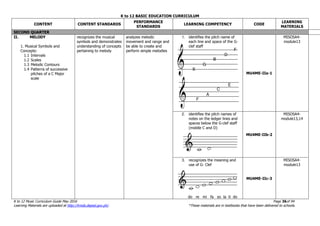
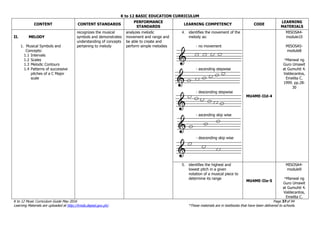
  • 89.
    K to 12BASIC EDUCATION CURRICULUM K to 12 Music Curriculum Guide May 2016 Page 89of 94 Learning Materials are uploaded at http://lrmds.deped.gov.ph/. *These materials are in textbooks that have been delivered to schools. GLOSSARY Measure the space between two barlines, containing a fixed number of beats Medieval Term that refers to the “Middle Ages”. Melody the line of music that moves up and down in succession; series of single tones that add up to a recognizable whole Melodic Contour the upward and downward direction of the notes Melodic Pattern the combination of repeated, similar and contrasting figures, motives and phrases Melodic Ostinato group of tones used to accompany a tone or a melody Membranophone Any musical instrument that produces sound primarily by a vibrating stretched membrane. Meter organization of beats into regular groups Mezzo piano (mp) moderately soft Mezzo forte (mf) moderately loud Moderato moderate tempo Monophonic Texture single melodic line without accompaniment Motive fragment of a theme, or short musical idea which is developed within a composition; refers to a short melody sung or played which can identify a musical composition Musical Texture refers to the relationship of melodic and harmonic elements in music which produces qualities of thickness and thinness, heaviness or lightness of a melody or sound produced Musikong Bumbong An instrumental marching band that uses bamboo instruments. Natural Sign symbol used to cancel a previous sharp or flat sign Notation system of writing down music so that specific pitches and rhythms can be conveyed Note symbol used to indicate pitch Opera A dramatic work in one or more acts set to music for singers and instrumentalists. Oratorio A large-scale musical work for orchestra and voices, usually narrative and typically on a sacred theme. Ostinato motive or phrase that is repeated persistently at the same pitch
  • 90.
    K to 12BASIC EDUCATION CURRICULUM K to 12 Music Curriculum Guide May 2016 Page 90of 94 Learning Materials are uploaded at http://lrmds.deped.gov.ph/. *These materials are in textbooks that have been delivered to schools. GLOSSARY Pangkat Kawayan An instrumental ensemble that uses different kinds of bamboo instruments. Pasa doble A fast-paced ballroom dance based on the Latin American style of marching. Peking Opera Traditional Chinese theater performance. Pentatonic Scale a five-tone scale, used in folk music and music of the Far East Phrase musical statements that express meaning or ideas Piano (p) soft Pianissimo (pp) very soft; as softly as possible Pinpeat A Cambodian instrumental ensemble. Piphat A Thai instrumental ensemble which features wind and percussion instruments. Pitch relative highness or lowness of a sound Pitch Range distance between the highest and lowest tones that a given voice or instrument can produce Polyphonic Texture refers to a musical composition with two or more independent melodies sung or played to create a harmonious effect Program music Music that is intended to evoke images or to convey the impression of events. Ragtime A kind of music which evolved with syncopated melodic line and regularly accented accompaniment. Reggae A style of music originally from Jamaica and popularized in the 1960s. Renaissance Term that refers to the revival of European art under the influence of Classical Models. Rest a symbol that indicates the duration of silence in music Rhythm ordered flow of music through time; the pattern of durations of notes and silences in music Rhythmic Pattern combinations of long and short sounds, notes and rests Ritardando becoming slower Rock and roll Popular dance music from the 1950s characterized by heavy beats and simple melodies. Rondalla An instrumental ensemble that usually consists of musicians playing banduria, octavina, laud, guitar and double bass.
  • 91.
    K to 12BASIC EDUCATION CURRICULUM K to 12 Music Curriculum Guide May 2016 Page 91of 94 Learning Materials are uploaded at http://lrmds.deped.gov.ph/. *These materials are in textbooks that have been delivered to schools. GLOSSARY Round form of music wherein a melody change from a single-voiced texture to a many-voiced texture; each voice enters in succession; the effect is that of weaving a new and richer rhythmic and harmonic texture Rumba A rhythmic dance with Spanish and African elements originally from Cuba. Sacred music Music that promotes devotion and faith. Sarsuela A musical stage performance popularized in the Philippines during the Spanish colonization. Saung gauk An arched harp used in Myanmar. Scale series of pitches arranged in ascending or descending order Secular music Music for non-religious purposes. Sharp Sign symbol that notates the pitch of a note a half step higher Sonata A composition for an instrumental soloist, often with a piano accompaniment, typically in several movements with one or more in sonata form. Sonata-allegro form A large-scale musical structure popularly used during the middle of the 18th century. Soprano female voice of high range Soul Musical style that incorporates rhythm and blues and gospel music popularized by African-American people. Sound vibrations which are transmitted, usually through air, to the eardrum, which sends impulses to the brain Staff a set of five lines and four spaces where notes are positioned or placed Symphony An elaborate musical composition for full orchestra, typically in four movements, at least one of which is in sonata form. Tango A ballroom dance originating from Buenos Aires, characterized by marked rhythms and postures and abrupt pauses. Tempo rate of speed in music Tenor male voice of high range Timbre quality of sound that distinguishes one instrument or one voice from another Time Signature two numbers, one above the other, appearing at the beginning of a staff or the start of a piece, indicating the meter of a piece; the number above refers to the number of beats per measure and the number below represents the kind of note getting one beat. Tone sound that has a definite pitch or frequency
  • 92.
    K to 12BASIC EDUCATION CURRICULUM K to 12 Music Curriculum Guide May 2016 Page 92of 94 Learning Materials are uploaded at http://lrmds.deped.gov.ph/. *These materials are in textbooks that have been delivered to schools. GLOSSARY Triad the most basic type of chord, consisting of three alternate tones of the scale e.g. do, mi, so Troubadour Street musicians singing of love during the Medieval Period. Unison performance of a single melodic line by more than one instrument or voice a t the same pitch Wayang Kulit Indonesian puppet shadow theater.
  • 93.
    K to 12BASIC EDUCATION CURRICULUM K to 12 Music Curriculum Guide May 2016 Page 93of 94 Learning Materials are uploaded at http://lrmds.deped.gov.ph/. *These materials are in textbooks that have been delivered to schools. CODE BOOK LEGEND Sample: MU7FT-IVe-h-6 LEGEND SAMPLE First Entry Learning Area and Strand/ Subject or Specialization Music MU7 Grade Level Grade 7 Uppercase Letter/s Domain/Content/ Component/ Topic Theatrical Forms FT - Roman Numeral *Zero if no specific quarter Quarter Fourth Quarter IV Lowercase Letter/s *Put a hyphen (-) in between letters to indicate more than a specific week Week Week five to eight e-h Arabic Number Competency Describes how a specific idea or story is communicated through music in a particular Philippine musical theater 6 DOMAIN/ COMPONENT CODE Rhythm RH Melody ME Form FO Timbre TB Dynamics DY Tempo TP Texture TX Harmony HA Music of Luzon LU Music of Cordillera, Mindoro, Palawan, and the Visayas LV Music of Mindanao MN Theatrical Forms FT Music of southeast asia SE Music of South Asia and Middle East WS Traditional Asian Theater Music TH Music of the medieval period MRB Music of the classical period CL Instrumental music of the romantic period RO Vocal Music of the Romantic Period OP 2Oth Century TC Afro-latin and popular music AP Contemporary Philippine music CM Multimedia forms MM
  • 94.
    K to 12BASIC EDUCATION CURRICULUM K to 12 Music Curriculum Guide May 2016 Page 94of 94 Learning Materials are uploaded at http://lrmds.deped.gov.ph/. *These materials are in textbooks that have been delivered to schools. REFERENCES Abeles, Harold, Hoffer, Charles and Klotman, Robert. Foundations of Music Education, (New York: Schirmer Books, 1984) Armstrong, Thomas. "American Institute for Learning and Human Development." Multiple Intelligences. 2010. http://www.thomasarmstrong.com/multiple_intelligences.htm. Bruner, Jerome, The Process of Education. (Cambridge, Mass.: Harvard University Press, 1977) Bureau of Elementary Education, 2002 Basic Education Curriculum. (Pasig City: Department of Education, 2002) Bureau of Elementary Education, 2002 Philippine Elementary Learning Competencies. (Pasig City: Department of Education, 2002) Bureau of Secondary Education, Department of Education. Basic Education Curriculum. Pasig City, 2002. Bureau of Secondary Education, Department of Education Culture and Sports. Desired Learning Competencies New Secondary Education Curriculum. Pasig City, 1991. Bureau of Secondary Education, Department of Education Culture and Sports. Desired Learning Competencies Philippine Secondary Schools Learning Competencies. Pasig City, 1998. Bureau of Secondary Education, Department of Education. Secondary Education Curriculum. Pasig City, 2010. Gardner, Howard. "Multiple Intelligences." Howard Gardner. 2010. http://www.howardgardner.com/MI/mi.html. Gardner, Howard, Multiple Intelligences. (New York: Basic Books Inc., 1991) Miller, Cleve, Performance-Based Learning, (England: Cambridge University Press, 2008) Miller, Cleve. "Performance-Based Learning (Mexico: Cambridge University Press, 2010)." Teaching Business English (audio blog), December 16, 2010. performance-based- learning.html. Reimer, Bennett. A Philosophy of Music Education Advancing the Vision. 1991 ed. (Aesthetic Education. Upper Saddle River, New Jersey: Prentice Hall, 2003). Reimer, Bennet, Journal of Aesthetic Education, (USA: University of Illinois Press, 1991) Thomas, Ronald, A Structure for Music Education. (Bardonia, N.Y.: Media Materials Inc., 1970) Thomas, Ronald B. MMCP Synthesis: A Structure for Music Education. (Bardonia, N.Y: Sponsored by the U.S. Office of Education Media Materials, 1970). Wade, Bonnie C., Thinking Musically: Experiencing Music, Expressing Culture, (England: Oxford University Press, 2003)