(Kernel) Upstreaming 101:
Social and Technical Lessons
March 5, 2013
Deepak Saxena
dsaxena@linaro.org
Who Am I? Why Listen To Me?
● Kernel Working Group TL
● I make pretty spreadsheets and run meetings
● Before that I did write code!
● 12 years kernel experience
● One of first folks at Intel to work on Linux code
● Developed and maintained IXP* Xscale NPU ports
● Kernel maintainer at MontaVista for several years
● Reviewed all patches for distro kernel
● Reviewed thousands of lines of vendor BSP code
● OLPC kernel maintainer for about 1.5 years
Today's Goals
● Provide an overview of upstreaming code
● Social and Technical
● From Design to Submitting Patches
● How does the process differ from closed development?
● Some general guidelines on design and coding.
● Some low level details on submitting patches.
● Geared at those who are completely new to this world
● For both Managers and Engineers
The Problem
● Ever increasing number of Linux developers!
● Specially in the ARM world
● Lots of good technical documentation!
● Linux Device Drivers - http://lwn.net/Kernel/LDD3/
● Understanding the Linux Kernel - http://goo.gl/p4pM4
● Linux Kernel Development - http://goo.gl/0YY27
● Organizations beginning to understand technical
and business benefits of getting code upstream!
● More developers interested in working upstream!
● This is a problem?
The Issues...
● Using documented APIs and infrastructure is easy
● Creating new APIs and infrastructure is hard
● Creating good APIs and infrastructure is harder
● Creating good APIs and infrastructure for upstream is even harder
● Many SOC problems require creating new subsystems
● Or modifying existing ones to support new features
● Books tend to be x86 oriented
● Do not cover drivers common to other arches: i2c, spi, etc
● Make assumptions about underlying HW
● (See Upcoming Porting Linux by Jon Masters, ETA 2013)
● Working with the community is not documented
● Much tribal knowledge on the process
● Same mistakes are often made by new participants
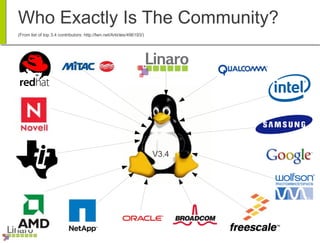
V3.4
Who Exactly Is The Community?
(From list of top 3.4 contributors: http://lwn.net/Articles/496193/)
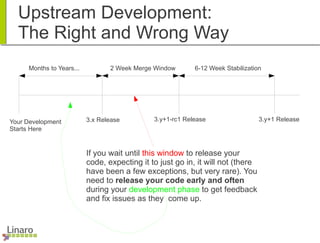
Upstream Development:
The Right and Wrong Way
3.x Release 3.y+1-rc1 Release 3.y+1 Release
2 Week Merge Window 6-12 Week Stabilization
Your Development
Starts Here
Months to Years...
If you wait until this window to release your
code, expecting it to just go in, it will not (there
have been a few exceptions, but very rare). You
need to release your code early and often
during your development phase to get feedback
and fix issues as they come up.
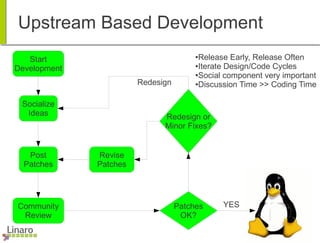
Upstream Based Development
Socialize
Ideas
Post
Patches
Community
Review
Revise
Patches
Patches
OK?
Redesign or
Minor Fixes?
Start
Development
Redesign
YES
●Release Early, Release Often
●Iterate Design/Code Cycles
●Social component very important
●Discussion Time >> Coding Time
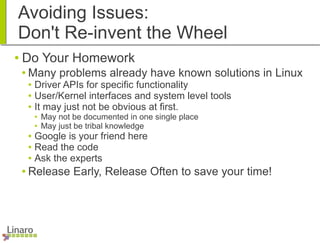
Avoiding Issues:
Don't Re-invent the Wheel
● Do Your Homework
● Many problems already have known solutions in Linux
● Driver APIs for specific functionality
● User/Kernel interfaces and system level tools
● It may just not be obvious at first.
● May not be documented in one single place
● May just be tribal knowledge
● Google is your friend here
● Read the code
● Ask the experts
● Release Early, Release Often to save your time!
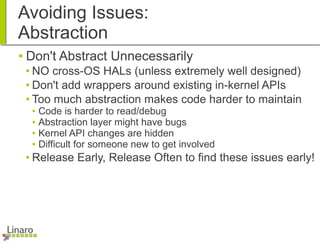
Avoiding Issues:
Abstraction
● Don't Abstract Unnecessarily
● NO cross-OS HALs (unless extremely well designed)
● Don't add wrappers around existing in-kernel APIs
● Too much abstraction makes code harder to maintain
● Code is harder to read/debug
● Abstraction layer might have bugs
● Kernel API changes are hidden
● Difficult for someone new to get involved
● Release Early, Release Often to find these issues early!
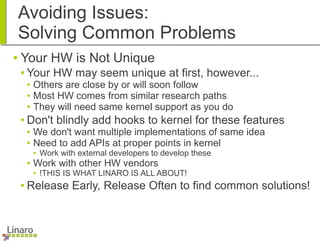
Avoiding Issues:
Solving Common Problems
● Your HW is Not Unique
● Your HW may seem unique at first, however...
● Others are close by or will soon follow
● Most HW comes from similar research paths
● They will need same kernel support as you do
● Don't blindly add hooks to kernel for these features
● We don't want multiple implementations of same idea
● Need to add APIs at proper points in kernel
● Work with external developers to develop these
● Work with other HW vendors
● !THIS IS WHAT LINARO IS ALL ABOUT!
● Release Early, Release Often to find common solutions!
Avoiding Issues:
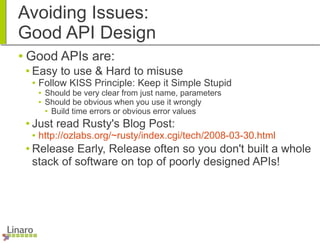
Good API Design
● Good APIs are:
● Easy to use & Hard to misuse
● Follow KISS Principle: Keep it Simple Stupid
● Should be very clear from just name, parameters
● Should be obvious when you use it wrongly
● Build time errors or obvious error values
● Just read Rusty's Blog Post:
● http://ozlabs.org/~rusty/index.cgi/tech/2008-03-30.html
● Release Early, Release often so you don't built a whole
stack of software on top of poorly designed APIs!
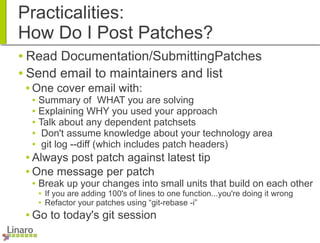
Practicalities:
How Do I Post Patches?
● Read Documentation/SubmittingPatches
● Send email to maintainers and list
● One cover email with:
● Summary of WHAT you are solving
● Explaining WHY you used your approach
● Talk about any dependent patchsets
● Don't assume knowledge about your technology area
● git log --diff (which includes patch headers)
● Always post patch against latest tip
● One message per patch
● Break up your changes into small units that build on each other
● If you are adding 100's of lines to one function...you're doing it wrong
● Refactor your patches using “git-rebase -i”
● Go to today's git session
Practicalities:
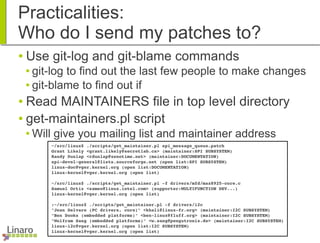
Who do I send my patches to?
● Use git-log and git-blame commands
● git-log to find out the last few people to make changes
● git-blame to find out if
● Read MAINTAINERS file in top level directory
● get-maintainers.pl script
● Will give you mailing list and maintainer address
~/src/linux$ ./scripts/get_maintainer.pl spi_message_queue.patch
Grant Likely <grant.likely@secretlab.ca> (maintainer:SPI SUBSYSTEM)
Randy Dunlap <rdunlap@xenotime.net> (maintainer:DOCUMENTATION)
spi­devel­general@lists.sourceforge.net (open list:SPI SUBSYSTEM)
linux­doc@vger.kernel.org (open list:DOCUMENTATION)
linux­kernel@vger.kernel.org (open list)
~/src/linux$ ./scripts/get_maintainer.pl ­f drivers/mfd/max8925­core.c
Samuel Ortiz <sameo@linux.intel.com> (supporter:MULTIFUNCTION DEV...)
linux­kernel@vger.kernel.org (open list)
:~/src/linux$ ./scripts/get_maintainer.pl ­f drivers/i2c
"Jean Delvare (PC drivers, core)" <khali@linux­fr.org> (maintainer:I2C SUBSYSTEM)
"Ben Dooks (embedded platforms)" <ben­linux@fluff.org> (maintainer:I2C SUBSYSTEM)
"Wolfram Sang (embedded platforms)" <w.sang@pengutronix.de> (maintainer:I2C SUBSYSTEM)
linux­i2c@vger.kernel.org (open list:I2C SUBSYSTEM)
linux­kernel@vger.kernel.org (open list)
Practicalities:
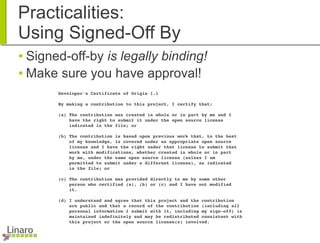
Using Signed-Off By
● Signed-off-by is legally binding!
● Make sure you have approval!
        Developer's Certificate of Origin 1.1
        By making a contribution to this project, I certify that:
        (a) The contribution was created in whole or in part by me and I
            have the right to submit it under the open source license
            indicated in the file; or
        (b) The contribution is based upon previous work that, to the best
            of my knowledge, is covered under an appropriate open source
            license and I have the right under that license to submit that
            work with modifications, whether created in whole or in part
            by me, under the same open source license (unless I am
            permitted to submit under a different license), as indicated
            in the file; or
        (c) The contribution was provided directly to me by some other
            person who certified (a), (b) or (c) and I have not modified
            it.
        (d) I understand and agree that this project and the contribution
            are public and that a record of the contribution (including all
            personal information I submit with it, including my sign­off) is
            maintained indefinitely and may be redistributed consistent with
            this project or the open source license(s) involved.
Practicalities:
Nobody Replied to My Patches!
● Be patient, don't expect an immediate response.
● Check mailing list archives:
● What's the typical response rate?
● Did the maintainer announce a vacation?
● Is this a merge window?
● Everyone is super busy, try again when it closes
● If it really seems like patches got dropped, email
the maintainer privately with a pointer to thread.
● If still no response:
● Ping one level up in tree.
● For drivers: Ping Greg KH
● Sometimes you just have to email patches to Linus directly
● Shames the maintainer, gets his/her attention
Practicalities:
Responses From Other Developers
● Acked-by: This person is OK with the changes.
Usually a maintainer of a subsystem affected by
patch.
● Reviewed-by: This person has done a thorough
technical review of the patch.
● Tested-by: This person did some level of testing.
Allows maintainer to know that it has been
validated on an environment other than original
author's.
Practicalities:
When Someone Attacks You :(
● It unfortunately happens :(
● Do NOT Escalate
● Take a step back
● Go work on something else
● Grab a beer (BUT NOT WHILE REPLYING!)
● Pick out the technical issues
● Get some help in reading the negative email
● Respond to just these
● Hint: Attending conferences and meeting people
face to face reduces the likelihood of this
happening.
Practicalities:
I can't Release Early and Often
● Ask for Private Reviews
● NDAs with upstream maintainer(s) and experts
● Linaro can possibly help here
● Several of these people are part of our organization
● We have good relationships with many upstream maintainers
● Can you release the concepts if not the code?
● Fine art of providing enough details w/o giving away the
secret sauce
● What are the high level problems you want to solve?
Summary
● The community is just a bunch of developers
● Like you, just with more experience of the process.
● Most of them really want to help!
● Good kernel code:
● Doesn't re-invent what's already there
● Doesn't add abstraction for the sake of abstraction
● Solves common issues - abstraction only when needed
● Has well-designed APIs
● Read the documentation and the code
● Participate openly and respectfully
● Ask us for help
● Release Early, Release Often :)
Questions or Comments?

Upstreaming 1013

  • 1.
    (Kernel) Upstreaming 101: Socialand Technical Lessons March 5, 2013 Deepak Saxena dsaxena@linaro.org
  • 2.
    Who Am I?Why Listen To Me? ● Kernel Working Group TL ● I make pretty spreadsheets and run meetings ● Before that I did write code! ● 12 years kernel experience ● One of first folks at Intel to work on Linux code ● Developed and maintained IXP* Xscale NPU ports ● Kernel maintainer at MontaVista for several years ● Reviewed all patches for distro kernel ● Reviewed thousands of lines of vendor BSP code ● OLPC kernel maintainer for about 1.5 years
  • 3.
    Today's Goals ● Providean overview of upstreaming code ● Social and Technical ● From Design to Submitting Patches ● How does the process differ from closed development? ● Some general guidelines on design and coding. ● Some low level details on submitting patches. ● Geared at those who are completely new to this world ● For both Managers and Engineers
  • 4.
    The Problem ● Everincreasing number of Linux developers! ● Specially in the ARM world ● Lots of good technical documentation! ● Linux Device Drivers - http://lwn.net/Kernel/LDD3/ ● Understanding the Linux Kernel - http://goo.gl/p4pM4 ● Linux Kernel Development - http://goo.gl/0YY27 ● Organizations beginning to understand technical and business benefits of getting code upstream! ● More developers interested in working upstream! ● This is a problem?
  • 5.
    The Issues... ● Usingdocumented APIs and infrastructure is easy ● Creating new APIs and infrastructure is hard ● Creating good APIs and infrastructure is harder ● Creating good APIs and infrastructure for upstream is even harder ● Many SOC problems require creating new subsystems ● Or modifying existing ones to support new features ● Books tend to be x86 oriented ● Do not cover drivers common to other arches: i2c, spi, etc ● Make assumptions about underlying HW ● (See Upcoming Porting Linux by Jon Masters, ETA 2013) ● Working with the community is not documented ● Much tribal knowledge on the process ● Same mistakes are often made by new participants
  • 6.
    V3.4 Who Exactly IsThe Community? (From list of top 3.4 contributors: http://lwn.net/Articles/496193/)
  • 7.
    Upstream Development: The Rightand Wrong Way 3.x Release 3.y+1-rc1 Release 3.y+1 Release 2 Week Merge Window 6-12 Week Stabilization Your Development Starts Here Months to Years... If you wait until this window to release your code, expecting it to just go in, it will not (there have been a few exceptions, but very rare). You need to release your code early and often during your development phase to get feedback and fix issues as they come up.
  • 8.
    Upstream Based Development Socialize Ideas Post Patches Community Review Revise Patches Patches OK? Redesignor Minor Fixes? Start Development Redesign YES ●Release Early, Release Often ●Iterate Design/Code Cycles ●Social component very important ●Discussion Time >> Coding Time
  • 9.
    Avoiding Issues: Don't Re-inventthe Wheel ● Do Your Homework ● Many problems already have known solutions in Linux ● Driver APIs for specific functionality ● User/Kernel interfaces and system level tools ● It may just not be obvious at first. ● May not be documented in one single place ● May just be tribal knowledge ● Google is your friend here ● Read the code ● Ask the experts ● Release Early, Release Often to save your time!
  • 10.
    Avoiding Issues: Abstraction ● Don'tAbstract Unnecessarily ● NO cross-OS HALs (unless extremely well designed) ● Don't add wrappers around existing in-kernel APIs ● Too much abstraction makes code harder to maintain ● Code is harder to read/debug ● Abstraction layer might have bugs ● Kernel API changes are hidden ● Difficult for someone new to get involved ● Release Early, Release Often to find these issues early!
  • 11.
    Avoiding Issues: Solving CommonProblems ● Your HW is Not Unique ● Your HW may seem unique at first, however... ● Others are close by or will soon follow ● Most HW comes from similar research paths ● They will need same kernel support as you do ● Don't blindly add hooks to kernel for these features ● We don't want multiple implementations of same idea ● Need to add APIs at proper points in kernel ● Work with external developers to develop these ● Work with other HW vendors ● !THIS IS WHAT LINARO IS ALL ABOUT! ● Release Early, Release Often to find common solutions!
  • 12.
    Avoiding Issues: Good APIDesign ● Good APIs are: ● Easy to use & Hard to misuse ● Follow KISS Principle: Keep it Simple Stupid ● Should be very clear from just name, parameters ● Should be obvious when you use it wrongly ● Build time errors or obvious error values ● Just read Rusty's Blog Post: ● http://ozlabs.org/~rusty/index.cgi/tech/2008-03-30.html ● Release Early, Release often so you don't built a whole stack of software on top of poorly designed APIs!
  • 13.
    Practicalities: How Do IPost Patches? ● Read Documentation/SubmittingPatches ● Send email to maintainers and list ● One cover email with: ● Summary of WHAT you are solving ● Explaining WHY you used your approach ● Talk about any dependent patchsets ● Don't assume knowledge about your technology area ● git log --diff (which includes patch headers) ● Always post patch against latest tip ● One message per patch ● Break up your changes into small units that build on each other ● If you are adding 100's of lines to one function...you're doing it wrong ● Refactor your patches using “git-rebase -i” ● Go to today's git session
  • 14.
    Practicalities: Who do Isend my patches to? ● Use git-log and git-blame commands ● git-log to find out the last few people to make changes ● git-blame to find out if ● Read MAINTAINERS file in top level directory ● get-maintainers.pl script ● Will give you mailing list and maintainer address ~/src/linux$ ./scripts/get_maintainer.pl spi_message_queue.patch Grant Likely <grant.likely@secretlab.ca> (maintainer:SPI SUBSYSTEM) Randy Dunlap <rdunlap@xenotime.net> (maintainer:DOCUMENTATION) spi­devel­general@lists.sourceforge.net (open list:SPI SUBSYSTEM) linux­doc@vger.kernel.org (open list:DOCUMENTATION) linux­kernel@vger.kernel.org (open list) ~/src/linux$ ./scripts/get_maintainer.pl ­f drivers/mfd/max8925­core.c Samuel Ortiz <sameo@linux.intel.com> (supporter:MULTIFUNCTION DEV...) linux­kernel@vger.kernel.org (open list) :~/src/linux$ ./scripts/get_maintainer.pl ­f drivers/i2c "Jean Delvare (PC drivers, core)" <khali@linux­fr.org> (maintainer:I2C SUBSYSTEM) "Ben Dooks (embedded platforms)" <ben­linux@fluff.org> (maintainer:I2C SUBSYSTEM) "Wolfram Sang (embedded platforms)" <w.sang@pengutronix.de> (maintainer:I2C SUBSYSTEM) linux­i2c@vger.kernel.org (open list:I2C SUBSYSTEM) linux­kernel@vger.kernel.org (open list)
  • 15.
    Practicalities: Using Signed-Off By ●Signed-off-by is legally binding! ● Make sure you have approval!         Developer's Certificate of Origin 1.1         By making a contribution to this project, I certify that:         (a) The contribution was created in whole or in part by me and I             have the right to submit it under the open source license             indicated in the file; or         (b) The contribution is based upon previous work that, to the best             of my knowledge, is covered under an appropriate open source             license and I have the right under that license to submit that             work with modifications, whether created in whole or in part             by me, under the same open source license (unless I am             permitted to submit under a different license), as indicated             in the file; or         (c) The contribution was provided directly to me by some other             person who certified (a), (b) or (c) and I have not modified             it.         (d) I understand and agree that this project and the contribution             are public and that a record of the contribution (including all             personal information I submit with it, including my sign­off) is             maintained indefinitely and may be redistributed consistent with             this project or the open source license(s) involved.
  • 16.
    Practicalities: Nobody Replied toMy Patches! ● Be patient, don't expect an immediate response. ● Check mailing list archives: ● What's the typical response rate? ● Did the maintainer announce a vacation? ● Is this a merge window? ● Everyone is super busy, try again when it closes ● If it really seems like patches got dropped, email the maintainer privately with a pointer to thread. ● If still no response: ● Ping one level up in tree. ● For drivers: Ping Greg KH ● Sometimes you just have to email patches to Linus directly ● Shames the maintainer, gets his/her attention
  • 17.
    Practicalities: Responses From OtherDevelopers ● Acked-by: This person is OK with the changes. Usually a maintainer of a subsystem affected by patch. ● Reviewed-by: This person has done a thorough technical review of the patch. ● Tested-by: This person did some level of testing. Allows maintainer to know that it has been validated on an environment other than original author's.
  • 18.
    Practicalities: When Someone AttacksYou :( ● It unfortunately happens :( ● Do NOT Escalate ● Take a step back ● Go work on something else ● Grab a beer (BUT NOT WHILE REPLYING!) ● Pick out the technical issues ● Get some help in reading the negative email ● Respond to just these ● Hint: Attending conferences and meeting people face to face reduces the likelihood of this happening.
  • 19.
    Practicalities: I can't ReleaseEarly and Often ● Ask for Private Reviews ● NDAs with upstream maintainer(s) and experts ● Linaro can possibly help here ● Several of these people are part of our organization ● We have good relationships with many upstream maintainers ● Can you release the concepts if not the code? ● Fine art of providing enough details w/o giving away the secret sauce ● What are the high level problems you want to solve?
  • 20.
    Summary ● The communityis just a bunch of developers ● Like you, just with more experience of the process. ● Most of them really want to help! ● Good kernel code: ● Doesn't re-invent what's already there ● Doesn't add abstraction for the sake of abstraction ● Solves common issues - abstraction only when needed ● Has well-designed APIs ● Read the documentation and the code ● Participate openly and respectfully ● Ask us for help ● Release Early, Release Often :)
  • 21.