
Using Web 2.0 Social Technology to Build  a Cyber-infrastructure for an Interdisciplinary Biomedical Research Community of Practice CDC National Conference  Health Communication, Marketing & Media  August 18, 2010
Background: Read/Write Web Gaining Popularity Web  2.0  social  technologies  enable  and  facilitate  social  networking,  participation,  communication,     and  knowledge  sharing.  They  aid  in  the  creation  of  an  organic  knowledge  base  for  a  Community  of   Practice  (CoP),  built  as  a  byproduct  of  team  collaboration.
Background: Read/Write Web Gaining Popularity A  new  generation  of  the  Internet  advances  to  platform  Service-­‐as-­‐a-­‐Software  (SaaS)  solutions.   Facebook  usage  increased  700%,  and  Twitter  usage  increased  3,712%  from  4/2009  to  4/2010.   Social  media  usage  increases  15%  among  Inc.  500  companies. 69%  of  McKinsey  survey  respondents  report  measureable  benefits  of  Web  2.0  social   technologies  in  business.    Technology  experts  responding  to  a  Pew  survey  believe  innovative  online  cooperation  could   result  in  more  efficient  for-­‐profit,  non-­‐profit,  and  government  agencies  by  2020,  but  they   express  concern  over  resistance  to  change. 
Background: Read/Write Web Gaining Popularity Email  is  recognized  as  the  number  one  social  software  application.  Web 2.0 popularity will grow as “Net generation” knowledge workers enter the workforce.  Although  the  importance  of  multidisciplinary  health  care  research  and  accompanying  funding   opportunities  continues  to  increase,  few  evidence-­‐based  results  of  Web  2.0  social  technology   use  in  health  care  are  available.
Purpose: Web 2.0 in Healthcare The  goal  of  this  study  is  to  evaluate  the  utility  of  Web  2.0  social  technology  for  health  care   research  by  investigating  the  viability,  and  then  analyzing  the  use  and  associated  opinions     of  research  team  members  to  ascertain  benefits  for  and  barriers  to  improved  collaboration,   knowledge  sharing    and  communication.
Methods: Exploring Innovations  in Peer-to-Peer Collaboration The  study  explored  innovative  methods  to  facilitate  collaboration,  knowledge  sharing,  and   communication  among  a  13-­‐member  multidisciplinary  biomedical  research  Community  of   Practice  (CoP)  comprised  of  faculty  and  resident  physicians,  staff,  and  students  from  two  major southwestern  universities  and  an  institute  of  brain  research.
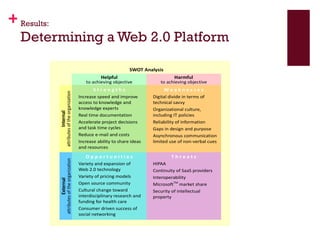
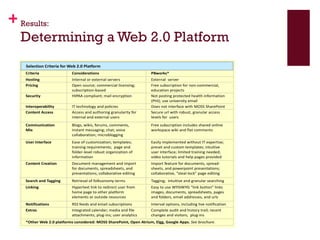
Methods: Exploring Innovations  in Peer-to-Peer Collaboration Identified  strengths  and  weaknesses  of  Web  2.0  social  technologies  using  a  SWOT  analysis Determined a Web 2.0 social technology platform based on authors’ selection criteria Architected  a  basic  wiki  with  user-friendly  interface,  and  then  invited  and  trained  users    Analyzed  CoP  email  and  wiki  usage    Administered  a  survey  using Survey  Monkey  to  obtain  CoP  perceptions   Analyzed  3-­‐month  baseline  data  
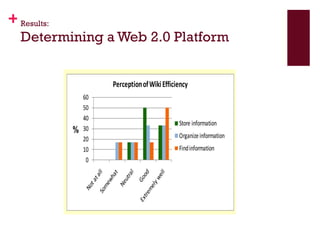
Results: Determining a Web 2.0 Platform
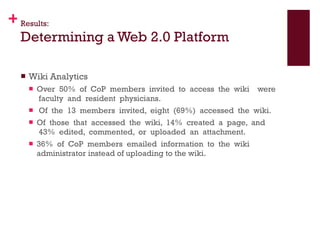
Results: Determining a Web 2.0 Platform Wiki Analytics Over  50%  of  CoP  members  invited  to  access  the  wiki    were  faculty  and  resident  physicians.    Of  the  13  members  invited,  eight  (69%)  accessed  the  wiki.   Of  those  that  accessed  the  wiki,  14%  created  a  page,  and  43%  edited,  commented,  or  uploaded  an  attachment.   36%  of  CoP  members  emailed  information  to  the  wiki administrator instead of uploading to the wiki.
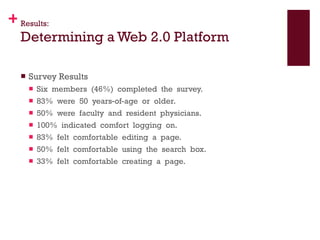
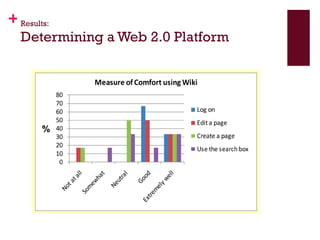
Results: Determining a Web 2.0 Platform Survey Results Six  members  (46%)  completed  the  survey. 83%  were  50  years‐of‐age  or  older. 50%  were  faculty  and  resident  physicians.    100%  indicated  comfort  logging  on.    83%  felt  comfortable  editing  a  page.    50%  felt  comfortable  using  the  search  box.    33%  felt  comfortable  creating  a  page.
Results: Determining a Web 2.0 Platform
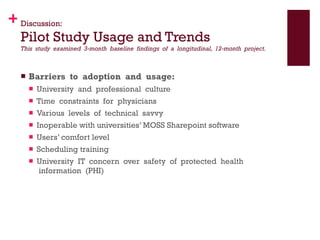
Discussion: Pilot Study Usage and Trends This  study  examined  3‐month  baseline  findings  of  a  longitudinal,  12‐month  project.  Barriers  to  adoption  and  usage:   University  and  professional  culture    Time  constraints  for  physicians    Various  levels  of  technical  savvy   Inoperable with universities’ MOSS Sharepoint software Users’ comfort level Scheduling training University  IT  concern  over  safety  of  protected  health  information  (PHI)
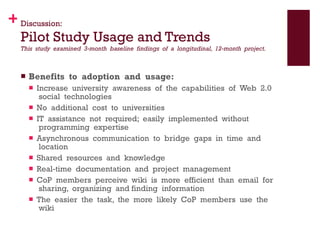
Discussion: Pilot Study Usage and Trends This  study  examined  3‐month  baseline  findings  of  a  longitudinal,  12‐month  project.  Benefits  to  adoption  and  usage:   Increase  university  awareness  of  the  capabilities  of  Web  2.0  social  technologies No  additional  cost  to  universities  IT  assistance  not  required;  easily  implemented  without  programming  expertise  Asynchronous  communication  to  bridge  gaps  in  time  and  location    Shared  resources  and  knowledge    Real‐time  documentation  and  project  management    CoP  members  perceive  wiki  is  more  efficient  than  email  for  sharing,  organizing  and finding  information   The  easier  the  task,  the  more  likely  CoP  members  use  the  wiki
Limitations and Future Direction: To be continued Ongoing research for CBPR and resident research teams Limitations:   A  relatively  small  number  of  committee  members  and  access  to  only  preliminary  baseline   data  placed  certain  limitations  on  the  ability  to  draw  conclusions  and  make  inferences  from  results. Future Direction: Analyzing  committee  email  and  wiki  usage  and  repeating  the  survey  subsequent  to   wiki  implementation  after  6-­‐  and  12-­‐months  will  aid  in  evaluation.  Additional  outcome  measures  are   recommended.  
Limitations and Future Direction: To be continued Ongoing research for CBPR and resident research teams Authors  have  initiated  a  similar  study  for  a  Community‐based  Participatory  Research  (CBPR)  CoP  looking at “Aging in Place.” A comparison of results between the current project could show trends. Another study is looking at seven resident research teams adopting a wiki for team group projects. Further  evidence‐based  investigation of  Web  2.0  social  technologies  for  peer‐to‐peer  (P2P) collaboration  and  communication  in  health  care  research  are  necessary.
Links and References For more author information about enterprise 2.0   KMRM.com How Companies are Benefiting from Web 2.0   McKinseyQuarterly.com/Business_Technology.com The Impact of the Internet on Institutions   Pew Research Center’s Internet & American Life Project   PewResearch.org Using Web 2.0 for Health Care Research and Education    Eysenbach, G. Medicine 2.0: social networking, collaboration,    participation, apomediation, and openness   J Med Internet Res 2008; 10(3):e22   http://www.jmir.org/2008/3/e22/ Boulos, K. and Wheeler, S. The emerging Web 2.0 social software:    an enabling suite of sociable technologies in health and health care    education   Health Information & Libraries Journal 2007; 24(1):e23   http://dx.doi.org/10.1111/j.1471-1842.2007.00701.x
Thank You for Visiting with Me!

CDC Health Communication

  • 1.
    Using Web 2.0Social Technology to Build a Cyber-infrastructure for an Interdisciplinary Biomedical Research Community of Practice CDC National Conference Health Communication, Marketing & Media August 18, 2010
  • 2.
    Background: Read/Write WebGaining Popularity Web  2.0  social  technologies  enable  and  facilitate  social  networking,  participation,  communication,     and  knowledge  sharing.  They  aid  in  the  creation  of  an  organic  knowledge  base  for  a  Community  of   Practice  (CoP),  built  as  a  byproduct  of  team  collaboration.
  • 3.
    Background: Read/Write WebGaining Popularity A  new  generation  of  the  Internet  advances  to  platform  Service-­‐as-­‐a-­‐Software  (SaaS)  solutions.   Facebook  usage  increased  700%,  and  Twitter  usage  increased  3,712%  from  4/2009  to  4/2010.   Social  media  usage  increases  15%  among  Inc.  500  companies. 69%  of  McKinsey  survey  respondents  report  measureable  benefits  of  Web  2.0  social   technologies  in  business.   Technology  experts  responding  to  a  Pew  survey  believe  innovative  online  cooperation  could   result  in  more  efficient  for-­‐profit,  non-­‐profit,  and  government  agencies  by  2020,  but  they   express  concern  over  resistance  to  change. 
  • 4.
    Background: Read/Write WebGaining Popularity Email  is  recognized  as  the  number  one  social  software  application. Web 2.0 popularity will grow as “Net generation” knowledge workers enter the workforce.  Although  the  importance  of  multidisciplinary  health  care  research  and  accompanying  funding   opportunities  continues  to  increase,  few  evidence-­‐based  results  of  Web  2.0  social  technology   use  in  health  care  are  available.
  • 5.
    Purpose: Web 2.0in Healthcare The  goal  of  this  study  is  to  evaluate  the  utility  of  Web  2.0  social  technology  for  health  care   research  by  investigating  the  viability,  and  then  analyzing  the  use  and  associated  opinions     of  research  team  members  to  ascertain  benefits  for  and  barriers  to  improved  collaboration,   knowledge  sharing    and  communication.
  • 6.
    Methods: Exploring Innovations in Peer-to-Peer Collaboration The  study  explored  innovative  methods  to  facilitate  collaboration,  knowledge  sharing,  and   communication  among  a  13-­‐member  multidisciplinary  biomedical  research  Community  of   Practice  (CoP)  comprised  of  faculty  and  resident  physicians,  staff,  and  students  from  two  major southwestern  universities  and  an  institute  of  brain  research.
  • 7.
    Methods: Exploring Innovations in Peer-to-Peer Collaboration Identified  strengths  and  weaknesses  of  Web  2.0  social  technologies  using  a  SWOT  analysis Determined a Web 2.0 social technology platform based on authors’ selection criteria Architected  a  basic  wiki  with  user-friendly  interface,  and  then  invited  and  trained  users   Analyzed  CoP  email  and  wiki  usage   Administered  a  survey  using Survey  Monkey  to  obtain  CoP  perceptions   Analyzed  3-­‐month  baseline  data  
  • 8.
    Results: Determining aWeb 2.0 Platform
  • 9.
    Results: Determining aWeb 2.0 Platform
  • 10.
    Results: Determining aWeb 2.0 Platform Wiki Analytics Over  50%  of  CoP  members  invited  to  access  the  wiki    were  faculty  and  resident  physicians.   Of  the  13  members  invited,  eight  (69%)  accessed  the  wiki.   Of  those  that  accessed  the  wiki,  14%  created  a  page,  and  43%  edited,  commented,  or  uploaded  an  attachment.   36%  of  CoP  members  emailed  information  to  the  wiki administrator instead of uploading to the wiki.
  • 11.
    Results: Determining aWeb 2.0 Platform Survey Results Six  members  (46%)  completed  the  survey. 83%  were  50  years‐of‐age  or  older. 50%  were  faculty  and  resident  physicians.   100%  indicated  comfort  logging  on.   83%  felt  comfortable  editing  a  page.   50%  felt  comfortable  using  the  search  box.   33%  felt  comfortable  creating  a  page.
  • 12.
    Results: Determining aWeb 2.0 Platform
  • 13.
    Results: Determining aWeb 2.0 Platform
  • 14.
    Discussion: Pilot StudyUsage and Trends This  study  examined  3‐month  baseline  findings  of  a  longitudinal,  12‐month  project. Barriers  to  adoption  and  usage:   University  and  professional  culture   Time  constraints  for  physicians   Various  levels  of  technical  savvy   Inoperable with universities’ MOSS Sharepoint software Users’ comfort level Scheduling training University  IT  concern  over  safety  of  protected  health  information  (PHI)
  • 15.
    Discussion: Pilot StudyUsage and Trends This  study  examined  3‐month  baseline  findings  of  a  longitudinal,  12‐month  project. Benefits  to  adoption  and  usage:   Increase  university  awareness  of  the  capabilities  of  Web  2.0  social  technologies No  additional  cost  to  universities IT  assistance  not  required;  easily  implemented  without  programming  expertise Asynchronous  communication  to  bridge  gaps  in  time  and  location   Shared  resources  and  knowledge   Real‐time  documentation  and  project  management   CoP  members  perceive  wiki  is  more  efficient  than  email  for  sharing,  organizing  and finding  information   The  easier  the  task,  the  more  likely  CoP  members  use  the  wiki
  • 16.
    Limitations and FutureDirection: To be continued Ongoing research for CBPR and resident research teams Limitations:   A  relatively  small  number  of  committee  members  and  access  to  only  preliminary  baseline   data  placed  certain  limitations  on  the  ability  to  draw  conclusions  and  make  inferences  from  results. Future Direction: Analyzing  committee  email  and  wiki  usage  and  repeating  the  survey  subsequent  to   wiki  implementation  after  6-­‐  and  12-­‐months  will  aid  in  evaluation.  Additional  outcome  measures  are   recommended.  
  • 17.
    Limitations and FutureDirection: To be continued Ongoing research for CBPR and resident research teams Authors  have  initiated  a  similar  study  for  a  Community‐based  Participatory  Research  (CBPR)  CoP  looking at “Aging in Place.” A comparison of results between the current project could show trends. Another study is looking at seven resident research teams adopting a wiki for team group projects. Further  evidence‐based  investigation of Web  2.0  social  technologies  for  peer‐to‐peer  (P2P) collaboration  and  communication  in  health  care  research  are  necessary.
  • 18.
    Links and ReferencesFor more author information about enterprise 2.0 KMRM.com How Companies are Benefiting from Web 2.0 McKinseyQuarterly.com/Business_Technology.com The Impact of the Internet on Institutions Pew Research Center’s Internet & American Life Project PewResearch.org Using Web 2.0 for Health Care Research and Education Eysenbach, G. Medicine 2.0: social networking, collaboration, participation, apomediation, and openness J Med Internet Res 2008; 10(3):e22 http://www.jmir.org/2008/3/e22/ Boulos, K. and Wheeler, S. The emerging Web 2.0 social software: an enabling suite of sociable technologies in health and health care education Health Information & Libraries Journal 2007; 24(1):e23 http://dx.doi.org/10.1111/j.1471-1842.2007.00701.x
  • 19.
    Thank You forVisiting with Me!