Knockout.js
 Jon Hoguet, MyWebGrocer
      March 12, 2012
Jon Who?
Bottom Line Upfront
• What is Knockout
   o MVVM framework for Javascript
      • Observable View Models
      • Declarative and Templated Views
      • Enables simpler, reusable, frontend and cleaner communication with
        backend

• Geek or Presenter (definitely Geek)
   o Slow me down
   o Ask questions
   o Give me feedback so I can get better

• Goal
   o Scratch the surface of knockout
Model serialized   Model serialized
  as HTML          as Form / Query
                   string Dictionary


                   Must know how
                    model was
                     serialized
• But we’ve always done it that way – why not…
   • Complex communication interface (send one thing and receive
      another)
   • Model Binding against a dictionary seems simple but quickly gets
                           Model serialized                 Model serialized
      complex (object graphs, as HTML
                               arrays)
                                                            as Form / Query
   • View is now server side (Razor, C#) AND client side (javascript, css)
                                                           string Dictionary
      creating coupling between these layers
   • View ultimately ‘lives’ in the DOM not in CLR / Razor
   • Client side code is coupled to the view and not the model
        • Difficult to reuse code in mobile, etc.


                                                           Must know how
                                                            model was
                                                             serialized
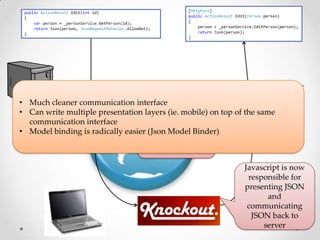
Interface is now
consistently JSON


                    Javascript is now
                     responsible for
                    presenting JSON
                          and
                     communicating
                      JSON back to
                         server
• Much cleaner communication interface
• Can write multiple presentation layers (ie. mobile) on top of the same
  communication interface
• Model binding is radically easier (Json Model Binder)
                                    Interface is now
                                   consistently JSON


                                                               Javascript is now
                                                                responsible for
                                                               presenting JSON
                                                                     and
                                                                communicating
                                                                 JSON back to
                                                                    server
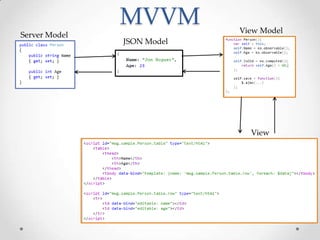
MV-WHAT…
MVVM         View Model
Server Model
               JSON Model


                              View
Demo
•   Prototype
•   Baby steps
    o   Observable
    o   View model
    o   Model
    o   Array
•   Ugh, where’s the View (look at prototype)
    o   View
    o   View Array (clean up entry should be ViewModel)
    o   Its all connected
    o   Templates (edit / view, table / list) (before / after / cleanup)
    o   Computed (simple, prototype)
    o   More bindings (css, if and value, value options, click, event, more click)
•   Actions
    o   Root ViewModel (with / root)
    o   Strategy for dealing with server (get)
•   Binding Handlers
    o   Editable
    o   If view code is bleeding into your view model – its time for a binding handler
            • Ie – animations,
•   ASP.NET
    o   JSON
    o   WEB API
    o   Bundles
Gotchas
• Dates –
   o http://feedproxy.google.com/~r/ScottHanselman/~3/MTbztRtN2l8/OnTheNight
     mareThatIsJSONDatesPlusJSONNETAndASPNETWebAPI.aspx Mapping

• Don’t self close tags – unless there will never be anything
  inside that tag – its tempting…

• Careful that you don’t ‘un-observe’ an item by not
  setting properly

• Be mindful of whether it is observable or not

• Template is a string….

• Misleading errors
Resources
• Will post slides / code
• http://jsfiddle.net/
   o Decompose a problem using this sandbox
• http://knockoutjs.com/
   o Interactive tutorials – experience them
• http://www.knockmeout.net/
   o Tons of experience captured in this blog
• http://channel9.msdn.com/Events/MIX/MIX11/FRM0
  8
   o Great video from early days of Knockout
• http://channel9.msdn.com/Events/TechDays/TechD
  ays-2012-Belgium/199
   o Recent video of Knockout + Web Api + Upshot = Amazing!

Introduction to Knockoutjs

  • 1.
    Knockout.js Jon Hoguet,MyWebGrocer March 12, 2012
  • 2.
  • 3.
    Bottom Line Upfront •What is Knockout o MVVM framework for Javascript • Observable View Models • Declarative and Templated Views • Enables simpler, reusable, frontend and cleaner communication with backend • Geek or Presenter (definitely Geek) o Slow me down o Ask questions o Give me feedback so I can get better • Goal o Scratch the surface of knockout
  • 4.
    Model serialized Model serialized as HTML as Form / Query string Dictionary Must know how model was serialized
  • 5.
    • But we’vealways done it that way – why not… • Complex communication interface (send one thing and receive another) • Model Binding against a dictionary seems simple but quickly gets Model serialized Model serialized complex (object graphs, as HTML arrays) as Form / Query • View is now server side (Razor, C#) AND client side (javascript, css) string Dictionary creating coupling between these layers • View ultimately ‘lives’ in the DOM not in CLR / Razor • Client side code is coupled to the view and not the model • Difficult to reuse code in mobile, etc. Must know how model was serialized
  • 6.
    Interface is now consistentlyJSON Javascript is now responsible for presenting JSON and communicating JSON back to server
  • 7.
    • Much cleanercommunication interface • Can write multiple presentation layers (ie. mobile) on top of the same communication interface • Model binding is radically easier (Json Model Binder) Interface is now consistently JSON Javascript is now responsible for presenting JSON and communicating JSON back to server
  • 8.
  • 9.
    MVVM View Model Server Model JSON Model View
  • 10.
    Demo • Prototype • Baby steps o Observable o View model o Model o Array • Ugh, where’s the View (look at prototype) o View o View Array (clean up entry should be ViewModel) o Its all connected o Templates (edit / view, table / list) (before / after / cleanup) o Computed (simple, prototype) o More bindings (css, if and value, value options, click, event, more click) • Actions o Root ViewModel (with / root) o Strategy for dealing with server (get) • Binding Handlers o Editable o If view code is bleeding into your view model – its time for a binding handler • Ie – animations, • ASP.NET o JSON o WEB API o Bundles
  • 11.
    Gotchas • Dates – o http://feedproxy.google.com/~r/ScottHanselman/~3/MTbztRtN2l8/OnTheNight mareThatIsJSONDatesPlusJSONNETAndASPNETWebAPI.aspx Mapping • Don’t self close tags – unless there will never be anything inside that tag – its tempting… • Careful that you don’t ‘un-observe’ an item by not setting properly • Be mindful of whether it is observable or not • Template is a string…. • Misleading errors
  • 12.
    Resources • Will postslides / code • http://jsfiddle.net/ o Decompose a problem using this sandbox • http://knockoutjs.com/ o Interactive tutorials – experience them • http://www.knockmeout.net/ o Tons of experience captured in this blog • http://channel9.msdn.com/Events/MIX/MIX11/FRM0 8 o Great video from early days of Knockout • http://channel9.msdn.com/Events/TechDays/TechD ays-2012-Belgium/199 o Recent video of Knockout + Web Api + Upshot = Amazing!

Editor's Notes

  • #2 We all bleed red…Load habitometerLoad fiddlesClose google talk, email, etc.Increase font sizeSwagConfirm timelineCurious about MyWebGrocer
  • #8 Now transferring data – not presentation…. Which means… we can put another presentation (mobile, etc.) no top
  • #9 Now transferring data – not presentation…. Which means… we can put another presentation (mobile, etc.) no top
  • #12 How about validationHow about back buttonHow about complex view modelsHow about to / from serverInlineAJAXWep API
  • #27 Observables Introduce ko.observable()Subscribe and alert, timeout, alert starting valueCan have an initial value to ko.observable()Subscribe can see before and afterIntroduce ko.observableArrayhow to properly initialize and ‘clear’ them (null, [])Note that for push we call on observable array – while length we call on the actual array
  • #29 TemplatingBe careful … template name is a stringReusableEasily switch between templatesDisplay more than one template
  • #31 ko.bindingHandlers['editable'] = {    init: function(element, valueAccessor, allBindingsAccessor, viewModel, bindingContext){        var node = $(element);        var span = $('<span></span>');        node.append(span);        //ko.bindingHandlers.text.init(span[0], valueAccessor, allBindingsAccessor, viewModel, bindingContext);                var text = $('<input type="text" />');        text.hide();        node.append(text);        ko.bindingHandlers.value.init(text[0], valueAccessor, allBindingsAccessor, viewModel, bindingContext);        text.blur(function(){           text.hide();           span.show();                     });                node.click(function(){            if (span.is(':visible')){                span.hide();                text.show();                text.focus();            }        });    },    update: function(element, valueAccessor, allBindingsAccessor, viewModel, bindingContext){        var node = $(element);        var span = node.find('span');        var text = node.find('input');        ko.bindingHandlers.text.update(span[0],valueAccessor, allBindingsAccessor, viewModel, bindingContext);        ko.bindingHandlers.value.update(text[0],valueAccessor, allBindingsAccessor, viewModel, bindingContext);            }};