How Computers Work
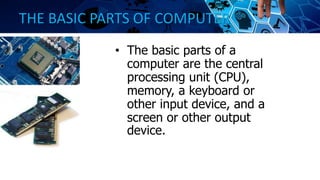
THE BASIC PARTS OF COMPUTER
• The basic parts of a
computer are the central
processing unit (CPU),
memory, a keyboard or
other input device, and a
screen or other output
device.
How does a computer add or subtract, and how can its
memory remember the answers it computes?
A computer does not have a human brain inside but
acts in many ways as though it does have a real one.
However, while we understand human language, the
computer can understand machine language. When a
person types on the computer's keyboard, the human
brain identifies the letters, numbers, and characters
combined to create words and sentences. But the
computer does not recognize letters as letters of the
alphabet; it sees the letters as a series of 0's and 1's
called the binary language.
What is Binary Language?
Binary is a base-2 numeral system that only has
two digits: 0 and 1. In computers, it is the
underlying language for representing and
processing data. Each digit in a binary integer is
called a bit, and its position corresponds to a
power of two. This technique is essential in digital
systems like computers, where electrical impulses
may be easily read as either on (1) or off (0). By
organizing these binary digits, electronic devices
may efficiently transfer and analyze complex data,
commands, and codes
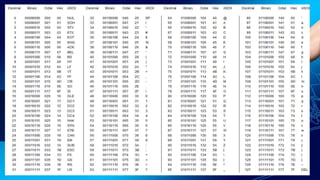
Computer Number Systems
Humans use the decimal number system to count, measure, and compute. The
decimal number system has ten digits, such as 0, 1, 2, 3, 4, 5, 6, 7, 8, and 9. A
computer, on the other hand, can only understand two digits-a 0 and a 1.
These two numbers play an important role in the way computers communicate
with one another. This type of number system is called the binary number
system, with the prefix bi, which means 2.
There are other types of number systems, such as the octal number system
(from the prefix octa, meaning it uses 8 digits) and the hexadecimal number
system (hexa means 6; deci means 10, meaning it uses 16 digits to represent
its values). However, these special number systems are merely a way to bridge
the computer's binary language to a somewhat understandable human
(decimal) language since computer data can be complicated.
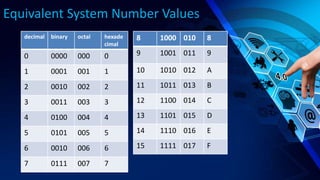
Equivalent System Number Values
decimal binary octal hexade
cimal
0 0000 000 0
1 0001 001 1
2 0010 002 2
3 0011 003 3
4 0100 004 4
5 0101 005 5
6 0010 006 6
7 0111 007 7
8 1000 010 8
9 1001 011 9
10 1010 012 A
11 1011 013 B
12 1100 014 C
13 1101 015 D
14 1110 016 E
15 1111 017 F
What is Binary Language?  Computer Number Systems

What is Binary Language? Computer Number Systems

  • 1.
  • 2.
    THE BASIC PARTSOF COMPUTER • The basic parts of a computer are the central processing unit (CPU), memory, a keyboard or other input device, and a screen or other output device.
  • 3.
    How does acomputer add or subtract, and how can its memory remember the answers it computes? A computer does not have a human brain inside but acts in many ways as though it does have a real one. However, while we understand human language, the computer can understand machine language. When a person types on the computer's keyboard, the human brain identifies the letters, numbers, and characters combined to create words and sentences. But the computer does not recognize letters as letters of the alphabet; it sees the letters as a series of 0's and 1's called the binary language.
  • 4.
    What is BinaryLanguage? Binary is a base-2 numeral system that only has two digits: 0 and 1. In computers, it is the underlying language for representing and processing data. Each digit in a binary integer is called a bit, and its position corresponds to a power of two. This technique is essential in digital systems like computers, where electrical impulses may be easily read as either on (1) or off (0). By organizing these binary digits, electronic devices may efficiently transfer and analyze complex data, commands, and codes
  • 5.
    Computer Number Systems Humansuse the decimal number system to count, measure, and compute. The decimal number system has ten digits, such as 0, 1, 2, 3, 4, 5, 6, 7, 8, and 9. A computer, on the other hand, can only understand two digits-a 0 and a 1. These two numbers play an important role in the way computers communicate with one another. This type of number system is called the binary number system, with the prefix bi, which means 2. There are other types of number systems, such as the octal number system (from the prefix octa, meaning it uses 8 digits) and the hexadecimal number system (hexa means 6; deci means 10, meaning it uses 16 digits to represent its values). However, these special number systems are merely a way to bridge the computer's binary language to a somewhat understandable human (decimal) language since computer data can be complicated.
  • 6.
    Equivalent System NumberValues decimal binary octal hexade cimal 0 0000 000 0 1 0001 001 1 2 0010 002 2 3 0011 003 3 4 0100 004 4 5 0101 005 5 6 0010 006 6 7 0111 007 7 8 1000 010 8 9 1001 011 9 10 1010 012 A 11 1011 013 B 12 1100 014 C 13 1101 015 D 14 1110 016 E 15 1111 017 F