Digital Circuit
Design
18B11EC215
Lecture 8
Karnaugh Maps
Outline
▪ K-Map Introduction
▪ 2-variable K-maps
▪ 3-variable K-maps
▪ 4-variable K-maps
▪ 5 –variable K-maps
▪ Simplification using K-maps
K-Map Introduction [1,2]
• Complexity of digital logic gates that implement a Boolean function is directly related
to the complexity of Boolean expression from which the function is implemented.
• Simplification of Boolean functions leads to simpler (and usually faster) digital
circuits.
• Simplifying Boolean functions using identities is time-consuming and error-prone.
• The map method provides a simple procedure for minimizing Boolean functions.
Function Simplification[1,2]
▪ Why simplify?
❖ Simpler expression uses less logic gates.
❖ Thus: cheaper, less power, faster.
▪ Simplification techniques:
❖ Algebraic Simplification.
➢ simplify symbolically using theorems/postulates.
➢ requires skill but extremely open-ended.
❖ Karnaugh Maps.
➢ diagrammatic technique
➢ easy for humans (pattern-matching skills).
➢ simplified standard forms.
➢ limited to not more than 6 variables.
Algebraic Simplification[1,2]
▪ Algebraic simplification aims to minimise
(i) number of literals, and
(ii) number of terms
Algebraic Simplification
▪ Difficulty – needs good algebraic manipulation skills.
▪ Advantage – very open-ended (to your desired form!)
Introduction to K-maps[1,2]
▪ Systematic method to obtain simplified sum-of-products (SOPs) Boolean
expressions.
▪ Objective: Fewest possible terms/literals.
▪ Diagrammatic technique
▪ Advantage: Easy with visual aid.
▪ Disadvantage: Limited to 5 or 6 variables.
2-variable K-maps[1]
▪ Karnaugh-map (K-map) is an abstract form of Venn diagram, organised as
a matrix of squares, where
❖each square represents a minterm
❖adjacent squares always differ by just one literal (so that the unifying
theorem may apply: a + a' = 1)
▪ For 2-variable case (e.g.: variables a,b), the map can be drawn as:
2-variable K-maps
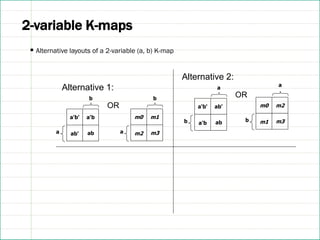
▪ Alternative layouts of a 2-variable (a, b) K-map
a'b' ab'
a'b ab
b
a
m0 m2
m1 m3
b
a
OR
Alternative 2:
a'b' a'b
ab' ab
a
b
m0 m1
m2 m3
a
b
Alternative 1:
OR
2-variable K-maps
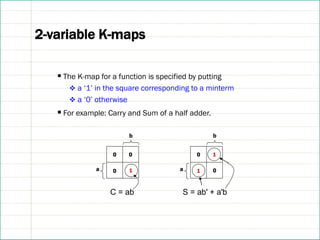
▪ The K-map for a function is specified by putting
❖ a ‘1’ in the square corresponding to a minterm
❖ a ‘0’ otherwise
▪ For example: Carry and Sum of a half adder.
0 0
0 1
a
b
0 1
1 0
a
b
C = ab S = ab' + a'b
3-variable K-maps[1,2]
▪ There are 8 minterms for 3 variables (a, b, c). Therefore, there are 8 cells in a 3-variable
K-map.
ab'c' ab'c
a
b
abc abc'
a'b'c' a'b'c a'bc a'bc'
0
1
00 01 11 10
c
a
bc
OR
m4 m5
a
b
m7 m6
m0 m1 m3 m2
0
1
00 01 11 10
c
a
bc
Note Gray code sequence
Above arrangement ensures that minterms of
adjacent cells differ by only ONE literal. (Other
arrangements which satisfy this criterion may also
be used.)
3-variable K-maps
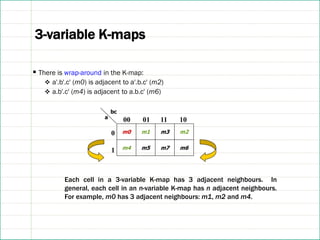
▪ There is wrap-around in the K-map:
❖ a'.b'.c' (m0) is adjacent to a'.b.c' (m2)
❖ a.b'.c' (m4) is adjacent to a.b.c' (m6)
m4 m5 m7 m6
m0 m1 m3 m2
0
1
00 01 11 10
a
bc
Each cell in a 3-variable K-map has 3 adjacent neighbours. In
general, each cell in an n-variable K-map has n adjacent neighbours.
For example, m0 has 3 adjacent neighbours: m1, m2 and m4.
4-variable K-maps
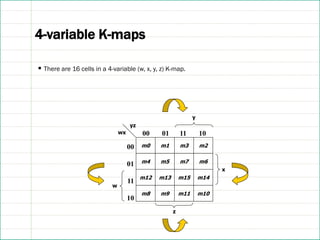
▪ There are 16 cells in a 4-variable (w, x, y, z) K-map.
m4 m5
w
y
m7 m6
m0 m1 m3 m2
00
01
11
10
00 01 11 10
z
wx
yz
m12 m13 m15 m14
m8 m9 m11 m10
x
4-variable K-maps
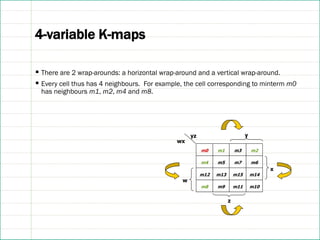
▪ There are 2 wrap-arounds: a horizontal wrap-around and a vertical wrap-around.
▪ Every cell thus has 4 neighbours. For example, the cell corresponding to minterm m0
has neighbours m1, m2, m4 and m8.
m4 m5
w
y
m7 m6
m0 m1 m3 m2
z
wx
yz
m12 m13 m15 m14
m8 m9 m11 m10
x
5-variable K-maps
▪ Maps of more than 4 variables are more difficult to use as combining adjacent
squares becomes difficult.
▪ For 5 variables, e.g. vwxyz, need 25
= 32 squares.
5-variable K-maps
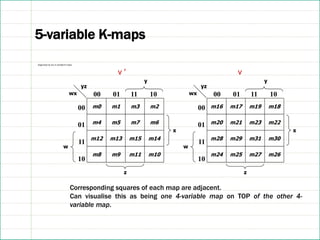
Organised as two 4-variable K-maps:
Corresponding squares of each map are adjacent.
Can visualise this as being one 4-variable map on TOP of the other 4-
variable map.
m20 m21
w
y
m23 m22
m16 m17 m19 m18
00
01
11
10
00 01 11 10
z
wx
yz
m28 m29 m31 m30
m24 m25 m27 m26
x
m4 m5
w
y
m7 m6
m0 m1 m3 m2
00
01
11
10
00 01 11 10
z
wx
yz
m12 m13 m15 m14
m8 m9 m11 m10
x
v ' v
Larger K-maps
▪ 6-variable K-map is pushing the limit of human “pattern-recognition”
capability.
▪ K-maps larger than 6 variables are practically unheard of!
Simplification Using K-maps
▪ Based on the Unifying Theorem:
A + A' = 1
▪ In a K-map, each cell containing a ‘1’ corresponds to a minterm of a given
function F.
▪ Each group of adjacent cells containing ‘1’ (group must have size in powers of
twos: 1, 2, 4, 8, …) then corresponds to a simpler product term of F.
▪ Grouping 2 adjacent squares eliminates 1 variable, grouping 4 squares
eliminates 2 variables, grouping 8 squares eliminates 3 variables, and so on.
In general, grouping 2n squares eliminates n variables.
Simplification Using K-maps
▪ Group as many squares as possible.
❖The larger the group is, the fewer the number of literals in the resulting
product term.
▪ Select as few groups as possible to cover all the squares (minterms) of the
function.
❖The fewer the groups, the fewer the number of product terms in the
minimized function.
Example
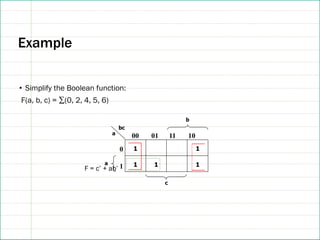
• Simplify the Boolean function:
F(a, b, c) = ∑(0, 2, 4, 5, 6)
F = c’ + ab’
1 1
a
b
1
1 1
0
1
00 01 11 10
c
a
bc
Example
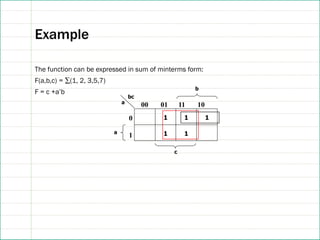
The function can be expressed in sum of minterms form:
F(a,b,c) = ∑(1, 2, 3,5,7)
F = c +a’b
1
a
b
1
1 1 1
0
1
00 01 11 10
c
a
bc
Simplification Using K-maps
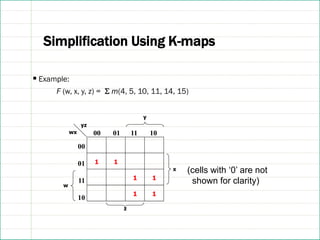
▪ Example:
F (w, x, y, z) =  m(4, 5, 10, 11, 14, 15)
z
1 1
w
y
00
01
11
10
00 01 11 10
wx
yz
1 1
1 1
x (cells with ‘0’ are not
shown for clarity)
Simplification Using K-maps
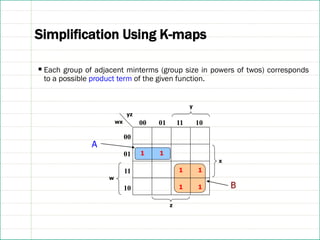
▪ Each group of adjacent minterms (group size in powers of twos) corresponds
to a possible product term of the given function.
1 1
w
00
01
11
10
00 01 11 10
z
wx
yz
1 1
1 1
x
A
B
y
Simplification Using K-maps
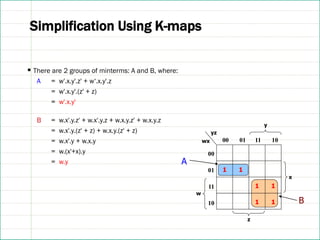
▪ There are 2 groups of minterms: A and B, where:
A = w'.x.y'.z' + w‘.x.y'.z
= w'.x.y'.(z' + z)
= w'.x.y'
B = w.x'.y.z' + w.x'.y.z + w.x.y.z' + w.x.y.z
= w.x'.y.(z' + z) + w.x.y.(z' + z)
= w.x'.y + w.x.y
= w.(x'+x).y
= w.y
1 1
w
00
01
11
10
00 01 11 10
z
wx
yz
1 1
1 1
x
A
B
y
Simplification Using K-maps
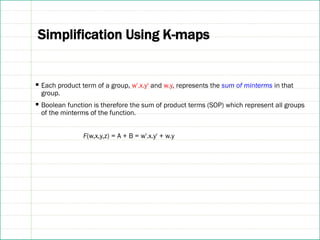
▪ Each product term of a group, w'.x.y' and w.y, represents the sum of minterms in that
group.
▪ Boolean function is therefore the sum of product terms (SOP) which represent all groups
of the minterms of the function.
F(w,x,y,z) = A + B = w'.x.y' + w.y
References
[1]. M. M. Mano, Digital logic and computer design, 5th ed., Pearson Prentice Hall, 2013.
[2]. M. M. Mano and M. D. Ciletti, Digital design, 5th ed., Pearson Prentice Hall, 2013.

Lecture08_Karnaug_hmaps_introduction.pdf

  • 1.
  • 2.
    Outline ▪ K-Map Introduction ▪2-variable K-maps ▪ 3-variable K-maps ▪ 4-variable K-maps ▪ 5 –variable K-maps ▪ Simplification using K-maps
  • 3.
    K-Map Introduction [1,2] •Complexity of digital logic gates that implement a Boolean function is directly related to the complexity of Boolean expression from which the function is implemented. • Simplification of Boolean functions leads to simpler (and usually faster) digital circuits. • Simplifying Boolean functions using identities is time-consuming and error-prone. • The map method provides a simple procedure for minimizing Boolean functions.
  • 4.
    Function Simplification[1,2] ▪ Whysimplify? ❖ Simpler expression uses less logic gates. ❖ Thus: cheaper, less power, faster. ▪ Simplification techniques: ❖ Algebraic Simplification. ➢ simplify symbolically using theorems/postulates. ➢ requires skill but extremely open-ended. ❖ Karnaugh Maps. ➢ diagrammatic technique ➢ easy for humans (pattern-matching skills). ➢ simplified standard forms. ➢ limited to not more than 6 variables.
  • 5.
    Algebraic Simplification[1,2] ▪ Algebraicsimplification aims to minimise (i) number of literals, and (ii) number of terms
  • 6.
    Algebraic Simplification ▪ Difficulty– needs good algebraic manipulation skills. ▪ Advantage – very open-ended (to your desired form!)
  • 7.
    Introduction to K-maps[1,2] ▪Systematic method to obtain simplified sum-of-products (SOPs) Boolean expressions. ▪ Objective: Fewest possible terms/literals. ▪ Diagrammatic technique ▪ Advantage: Easy with visual aid. ▪ Disadvantage: Limited to 5 or 6 variables.
  • 8.
    2-variable K-maps[1] ▪ Karnaugh-map(K-map) is an abstract form of Venn diagram, organised as a matrix of squares, where ❖each square represents a minterm ❖adjacent squares always differ by just one literal (so that the unifying theorem may apply: a + a' = 1) ▪ For 2-variable case (e.g.: variables a,b), the map can be drawn as:
  • 9.
    2-variable K-maps ▪ Alternativelayouts of a 2-variable (a, b) K-map a'b' ab' a'b ab b a m0 m2 m1 m3 b a OR Alternative 2: a'b' a'b ab' ab a b m0 m1 m2 m3 a b Alternative 1: OR
  • 10.
    2-variable K-maps ▪ TheK-map for a function is specified by putting ❖ a ‘1’ in the square corresponding to a minterm ❖ a ‘0’ otherwise ▪ For example: Carry and Sum of a half adder. 0 0 0 1 a b 0 1 1 0 a b C = ab S = ab' + a'b
  • 11.
    3-variable K-maps[1,2] ▪ Thereare 8 minterms for 3 variables (a, b, c). Therefore, there are 8 cells in a 3-variable K-map. ab'c' ab'c a b abc abc' a'b'c' a'b'c a'bc a'bc' 0 1 00 01 11 10 c a bc OR m4 m5 a b m7 m6 m0 m1 m3 m2 0 1 00 01 11 10 c a bc Note Gray code sequence Above arrangement ensures that minterms of adjacent cells differ by only ONE literal. (Other arrangements which satisfy this criterion may also be used.)
  • 12.
    3-variable K-maps ▪ Thereis wrap-around in the K-map: ❖ a'.b'.c' (m0) is adjacent to a'.b.c' (m2) ❖ a.b'.c' (m4) is adjacent to a.b.c' (m6) m4 m5 m7 m6 m0 m1 m3 m2 0 1 00 01 11 10 a bc Each cell in a 3-variable K-map has 3 adjacent neighbours. In general, each cell in an n-variable K-map has n adjacent neighbours. For example, m0 has 3 adjacent neighbours: m1, m2 and m4.
  • 13.
    4-variable K-maps ▪ Thereare 16 cells in a 4-variable (w, x, y, z) K-map. m4 m5 w y m7 m6 m0 m1 m3 m2 00 01 11 10 00 01 11 10 z wx yz m12 m13 m15 m14 m8 m9 m11 m10 x
  • 14.
    4-variable K-maps ▪ Thereare 2 wrap-arounds: a horizontal wrap-around and a vertical wrap-around. ▪ Every cell thus has 4 neighbours. For example, the cell corresponding to minterm m0 has neighbours m1, m2, m4 and m8. m4 m5 w y m7 m6 m0 m1 m3 m2 z wx yz m12 m13 m15 m14 m8 m9 m11 m10 x
  • 15.
    5-variable K-maps ▪ Mapsof more than 4 variables are more difficult to use as combining adjacent squares becomes difficult. ▪ For 5 variables, e.g. vwxyz, need 25 = 32 squares.
  • 16.
    5-variable K-maps Organised astwo 4-variable K-maps: Corresponding squares of each map are adjacent. Can visualise this as being one 4-variable map on TOP of the other 4- variable map. m20 m21 w y m23 m22 m16 m17 m19 m18 00 01 11 10 00 01 11 10 z wx yz m28 m29 m31 m30 m24 m25 m27 m26 x m4 m5 w y m7 m6 m0 m1 m3 m2 00 01 11 10 00 01 11 10 z wx yz m12 m13 m15 m14 m8 m9 m11 m10 x v ' v
  • 17.
    Larger K-maps ▪ 6-variableK-map is pushing the limit of human “pattern-recognition” capability. ▪ K-maps larger than 6 variables are practically unheard of!
  • 18.
    Simplification Using K-maps ▪Based on the Unifying Theorem: A + A' = 1 ▪ In a K-map, each cell containing a ‘1’ corresponds to a minterm of a given function F. ▪ Each group of adjacent cells containing ‘1’ (group must have size in powers of twos: 1, 2, 4, 8, …) then corresponds to a simpler product term of F. ▪ Grouping 2 adjacent squares eliminates 1 variable, grouping 4 squares eliminates 2 variables, grouping 8 squares eliminates 3 variables, and so on. In general, grouping 2n squares eliminates n variables.
  • 19.
    Simplification Using K-maps ▪Group as many squares as possible. ❖The larger the group is, the fewer the number of literals in the resulting product term. ▪ Select as few groups as possible to cover all the squares (minterms) of the function. ❖The fewer the groups, the fewer the number of product terms in the minimized function.
  • 20.
    Example • Simplify theBoolean function: F(a, b, c) = ∑(0, 2, 4, 5, 6) F = c’ + ab’ 1 1 a b 1 1 1 0 1 00 01 11 10 c a bc
  • 21.
    Example The function canbe expressed in sum of minterms form: F(a,b,c) = ∑(1, 2, 3,5,7) F = c +a’b 1 a b 1 1 1 1 0 1 00 01 11 10 c a bc
  • 22.
    Simplification Using K-maps ▪Example: F (w, x, y, z) =  m(4, 5, 10, 11, 14, 15) z 1 1 w y 00 01 11 10 00 01 11 10 wx yz 1 1 1 1 x (cells with ‘0’ are not shown for clarity)
  • 23.
    Simplification Using K-maps ▪Each group of adjacent minterms (group size in powers of twos) corresponds to a possible product term of the given function. 1 1 w 00 01 11 10 00 01 11 10 z wx yz 1 1 1 1 x A B y
  • 24.
    Simplification Using K-maps ▪There are 2 groups of minterms: A and B, where: A = w'.x.y'.z' + w‘.x.y'.z = w'.x.y'.(z' + z) = w'.x.y' B = w.x'.y.z' + w.x'.y.z + w.x.y.z' + w.x.y.z = w.x'.y.(z' + z) + w.x.y.(z' + z) = w.x'.y + w.x.y = w.(x'+x).y = w.y 1 1 w 00 01 11 10 00 01 11 10 z wx yz 1 1 1 1 x A B y
  • 25.
    Simplification Using K-maps ▪Each product term of a group, w'.x.y' and w.y, represents the sum of minterms in that group. ▪ Boolean function is therefore the sum of product terms (SOP) which represent all groups of the minterms of the function. F(w,x,y,z) = A + B = w'.x.y' + w.y
  • 26.
    References [1]. M. M.Mano, Digital logic and computer design, 5th ed., Pearson Prentice Hall, 2013. [2]. M. M. Mano and M. D. Ciletti, Digital design, 5th ed., Pearson Prentice Hall, 2013.