KUDREMUKH - A CASE STUDY


  KIOCL Limited                      Kudremukh
A Government of India Enterprise      The horse face


                Presented by Jyotshna, Michael & Morganna.
AGENDA

• Jyotshna – Purpose of Case Study
• Michael   – KIOCL Case Analysis
• Morganna - Final Conclusion
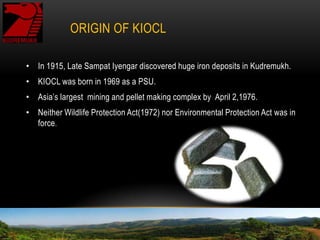
ORIGIN OF KIOCL
KUDREMUKH


     • In 1915, Late Sampat Iyengar discovered huge iron deposits in Kudremukh.
     • KIOCL was born in 1969 as a PSU.
     • Asia’s largest mining and pellet making complex by April 2,1976.
     • Neither Wildlife Protection Act(1972) nor Environmental Protection Act was in
       force.
KIOCL OVER YEARS

•   KIOCL is known for its high quality Iron ore concentrate and Iron Oxide pellets.
•   The company’s annual production is nearly 7.5 million tons and turnover is in the range of
    Rs.700 crores.
•   Chief Wildlife Warden, GOVT of Karnataka has awarded ‘greenest mine’ in the state.
•   Based on the overall performance, the company has been conferred the status of
    STAR TRADING HOUSE and a MINI RATHNA COMPANY.
•   Today KIOCL, with 28 years of pragmatic growth and trust, is capitalizing on its expertise
    and experience.
KIOCL GROWTH
KIOCL PAST AND PRESENT

•   NEGATIVES                              POSITIVES
     • Pollution                              KNP
     • Water                                  Lakya Dam
     • Trees                                  Community
     And many more…………Michael to follow:
IRON ORE MINING PROCESS

•   Strip Mining
     • Clearing and grubbing
     • Blasting and Drilling
     • Overburden dumping
IRON ORE MINING PROCESS
•   Crushing
•   Concentration
•   Pelletizing
•   Shipping


                    The Life Cycle of a Steel Item in a Multi-Material Product
NEGATIVE EFFECTS ON THE ENVIRONMENT

•   De-forestation
•   Alteration of Landscape patterns
•   Changes in drainage systems
•   Water contamination
•   Destruction of crops
•   Monsoon Erosion
•   Dust in non-monsoon periods
POSITIVE EFFECTS

•   Builds Communities
•   Creates Jobs
•   Creates Infrastructure
•   Higher Standard of Living
•   Better Healthcare
•   Increases population
•   Revenue Increased to 3.67 billion in 2006-2007
KIOCL IN THE COMMUNITY
COMMITTED TO SOCIAL IMPROVEMENTS
COMPROMISE: DEVELOPMENT VS
           CONSERVATION
•   Balance should be sought.
•   Company has brought improvement to the community
•   Detrimental effect on community and economy
CONSERVATION


•   Decrease company footprint
•   Progression of mining industry can help
    improve environment
•   Preservation, Reclamation and Rehabilitation
     • Experts and university students (Brazil)
     • Afforestation and restoration of
       endangered species around KNP
WHAT WE CAN DO TO HELP THE
                 ENVIRONMENT
Utilize new technologies
•   Tailing ponds
     •   1st thing mine considers for environment and individuals
     •   Filter, sifting, to clean ponds
     •   Thickeners are used as a modern innovation to preserve
         soil.


•   Soft-wall mining
     •   Tailings can be placed back into ground
     •   Water can be reclaimed and reused
     •   Can separate iron from sand and turn into concentrate
         at the face of the mine
BUSINESS ALTERNATIVES

•   Become the leader in pellet making
•   Opening new processing plants
     • Pellet Processing
     • Beneficiation
•   Joint Ventures
     • Mining
     • Steel Making
•   26% Stake
CONCLUSION
•   By seeking compromise we hope to achieve continual value for the company and its
    employees while improving the quality of the environment
•   By doing this we can sustain a workforce and allow economic growth for an area that was
    once full of indigenous tribes.
STRIKING THE RIGHT BALANCE


Conservation is a
state of harmony
between mankind
and land.
         --Aldo
REFERENCES

•   KIOCL: The sun sets on its mining operations by K.N. Murthy and D.V.R. Seshadri.
•   KIOCL 36th Annual Report 2011-2012
•   http://kioclltd.in/downloads/36-Annual-Report-2011-12.pdf
•   http://www.flickriver.com/places/India/Karnataka/Kalasa/search
•   http://www.scribd.com/doc/49847173/FINAL-prject

Kiocl presentation final

  • 1.
    KUDREMUKH - ACASE STUDY KIOCL Limited Kudremukh A Government of India Enterprise The horse face Presented by Jyotshna, Michael & Morganna.
  • 2.
    AGENDA • Jyotshna –Purpose of Case Study • Michael – KIOCL Case Analysis • Morganna - Final Conclusion
  • 3.
    ORIGIN OF KIOCL KUDREMUKH • In 1915, Late Sampat Iyengar discovered huge iron deposits in Kudremukh. • KIOCL was born in 1969 as a PSU. • Asia’s largest mining and pellet making complex by April 2,1976. • Neither Wildlife Protection Act(1972) nor Environmental Protection Act was in force.
  • 4.
    KIOCL OVER YEARS • KIOCL is known for its high quality Iron ore concentrate and Iron Oxide pellets. • The company’s annual production is nearly 7.5 million tons and turnover is in the range of Rs.700 crores. • Chief Wildlife Warden, GOVT of Karnataka has awarded ‘greenest mine’ in the state. • Based on the overall performance, the company has been conferred the status of STAR TRADING HOUSE and a MINI RATHNA COMPANY. • Today KIOCL, with 28 years of pragmatic growth and trust, is capitalizing on its expertise and experience.
  • 5.
  • 6.
    KIOCL PAST ANDPRESENT • NEGATIVES POSITIVES • Pollution KNP • Water Lakya Dam • Trees Community And many more…………Michael to follow:
  • 7.
    IRON ORE MININGPROCESS • Strip Mining • Clearing and grubbing • Blasting and Drilling • Overburden dumping
  • 8.
    IRON ORE MININGPROCESS • Crushing • Concentration • Pelletizing • Shipping The Life Cycle of a Steel Item in a Multi-Material Product
  • 9.
    NEGATIVE EFFECTS ONTHE ENVIRONMENT • De-forestation • Alteration of Landscape patterns • Changes in drainage systems • Water contamination • Destruction of crops • Monsoon Erosion • Dust in non-monsoon periods
  • 10.
    POSITIVE EFFECTS • Builds Communities • Creates Jobs • Creates Infrastructure • Higher Standard of Living • Better Healthcare • Increases population • Revenue Increased to 3.67 billion in 2006-2007
  • 11.
    KIOCL IN THECOMMUNITY
  • 12.
    COMMITTED TO SOCIALIMPROVEMENTS
  • 13.
    COMPROMISE: DEVELOPMENT VS CONSERVATION • Balance should be sought. • Company has brought improvement to the community • Detrimental effect on community and economy
  • 14.
    CONSERVATION • Decrease company footprint • Progression of mining industry can help improve environment • Preservation, Reclamation and Rehabilitation • Experts and university students (Brazil) • Afforestation and restoration of endangered species around KNP
  • 15.
    WHAT WE CANDO TO HELP THE ENVIRONMENT Utilize new technologies • Tailing ponds • 1st thing mine considers for environment and individuals • Filter, sifting, to clean ponds • Thickeners are used as a modern innovation to preserve soil. • Soft-wall mining • Tailings can be placed back into ground • Water can be reclaimed and reused • Can separate iron from sand and turn into concentrate at the face of the mine
  • 16.
    BUSINESS ALTERNATIVES • Become the leader in pellet making • Opening new processing plants • Pellet Processing • Beneficiation • Joint Ventures • Mining • Steel Making • 26% Stake
  • 17.
    CONCLUSION • By seeking compromise we hope to achieve continual value for the company and its employees while improving the quality of the environment • By doing this we can sustain a workforce and allow economic growth for an area that was once full of indigenous tribes.
  • 18.
    STRIKING THE RIGHTBALANCE Conservation is a state of harmony between mankind and land. --Aldo
  • 19.
    REFERENCES • KIOCL: The sun sets on its mining operations by K.N. Murthy and D.V.R. Seshadri. • KIOCL 36th Annual Report 2011-2012 • http://kioclltd.in/downloads/36-Annual-Report-2011-12.pdf • http://www.flickriver.com/places/India/Karnataka/Kalasa/search • http://www.scribd.com/doc/49847173/FINAL-prject

Editor's Notes

  • #2 Good Morning ! We are here to present to you our team stance on the kudremukhcase study - future of KIOCL.The organization named after Kudremukh, meaning horse’s face in Kannada, is a prominent 1882 meter high peak in the Western Ghats.…
  • #3 Today’s Agenda, I will be giving the KIOCL introduction and purpose of our case study, following is michael who gives you the analysis and our beautiful Morganna gives final conclusion.
  • #4 In the year1915 Sampat Iyengar discovered huge iron deposits in Kudremukh region. The country’s prestigious 100% export oriented unit (EOU) . Mini Ruthann Company, Kudremukh Iron Company Limited was incorporated on April 2, 1976. KIOCL has engaged in the business of manufacturing and exporting high quality Iron oxide pellets and supply of pig iron for domestic market. KIOCL Limited is a public sector company where 99%of the company’s shares are owned by the central government of India.
  • #5 140million
  • #6 KIOCL Growth - Sharp rise in growth 9% in 19507.6% Between 1990-9110% in April of June 2002 In late 90s KIOCL faced problems because of a recession in the international markets, arising tot east asian crisis,. Stocks piled up.production stopped for 46 days.but still continued to demostrate its stellar performance.India is projected to be the 2nd largest steel producing country in the world by 2015. (Currently 7th)Independence of India in 1947
  • #7  The NGO(nongovt org) , wildlife conservationalists and environmentalists opposing KIOCL with the negatives even when KICOL has many positives.
  • #8 The iron ore mining process starts as an open pit operation or strip job. The forest and vegetation are excavated to expose the top soil and the soil is drilled, blasted and loosened so mining can begin.
  • #9 After the iron is separated from the soil it is sent to the to the processing plant and is converted into a slurry concentration which is then heated and cooled into small pellets that are then sent to the load-outs for shipping and export. The iron is used for an array of products ranging from tools, home furniture, automobiles, houses, infrastructure and etc. At the end of the life cycle of iron ore mining, there is a concern for the environment. As you can see on the diagram, pre consumer and post consumer scrap iron and metals can be recycled and new iron ore pellets can be produced and re-sold in the iron market both creating more revenue for the company, saving costs and having less iron waste in mining yards. This is one action we can take to help the environment but as a company we need to explore other ways to decrease our effect on the environment and continue mining through the life of our contract. And understand what are the effects on the environment and the surrounding communities.
  • #10 The activities that are associated with iron ore mining have a direct effect on the environment. De-forestation and landscape alteration is of huge concern because the plant and vegetation should be observed and extracted to ensure they can be replaced in the reclamation process. The change in the landscape requires the company to create dump sites for overburden and create new drainage systems for the excess water from the mine. If water and slurry are not properly contained, a breach in these systems can cause water contamination in the rivers and streams, which can lead to the destruction of crops. Especially in the monsoon season. Where flooding carries iron ore deposits into the soil which hardens and makes it difficult to grow vegetation. Air quality is also a concern due to the dust created from mining.
  • #11 There are many positive things that can come from mining. The mining company helps build the infrastructure of the surrounding areas which in turn will new small business and will create jobs for the residents of the area. This will give the community a higher standard of living by offering jobs that have competitive wages and will provide better healthcare for the employees. Better jobs and competitive wages are attractive and people from other areas are more willing to move to a thriving mining town therefore increasing the population. KIOCL has been considered to be a leader in iron ore mining and due to the company’s success and growth, KIOCL experienced an increase in revenue of 3.67 billion between the years of 2006 to 2007.
  • #12 Community of employeesFew examples of how we are giving back to the community include the building of new medical facilities, forming community service activities such as health clinics and blood drives, and raising funds to provide a public transit system
  • #13 Transformed living environments for indigenous people from simple huts to modern and stable communities of houses. The company also improved living conditions by providing better electric grids, water systems, and an improved educational system.
  • #14 We want to keep the business in operation. In every business arrangement there has to be compromise between the various entities. Specifically KIOCL has brought numerous jobs to the community. Through a risk analysis performed it was found that to shut the operation down would not only mean the loss of jobs within the mine, but over a total of 12,500 jobs within the community. It would create a domino effect where nurses, doctors, service professionals and every other stabilizing profession would be lost. A long term effect would be the doubt that is incurred by consumers that with the pressure to continuously shut down mines throughout the region would decrease the quality of the product provided. This is proof that mining within the area does and can continue to have great economic effect on the surrounding state and the nation in regards to lower unemployment, increased exports, and tax revenue from the mining, production, and outsourcing of the iron ore and products.
  • #15 It is obviously important to consider the protection of the environment. It is evident that KIOCL has been actively supporting the natural habitat by reclaiming land and also by trying to preserve and create as little amount of damage as possible to the already disturbed land. The question still remains, what can we do to continue to help the environment? Most importantly KIOCL is committed to decreasing the company’s footprint. When the company first started mining iron ore there were no regulations so dumping into water sources and destruction of the forest area was a common practice for most mining productions throughout the industry. During the progression of mining and continued technological and process advancements environmental professionals were able to pinpoint the effects of unregulated mining on the environment. Since the property in question has already been disturbed, it is pertinent to focus on the rehabilitation of the land during mining. Reclamation of the area by wildlife experts and the implementation of an environmental management team. We are currently taking old mining sites and restoring them to include endangered species of animals and vegetation. To go a step further, we can involve ecology experts and university students to research and evaluate the surroundings in progressive state in order to monitor the environment remain proactive.
  • #16 Regardless of opinion, most of the damage has already been done – but we can learn from mistakes to try to make less of a harmful environmental impact. Some new technologies include the advancement in tailing ponds instead of shifting waste into water sources which was previously practiced. Tailings are the residue of an ore that remains after it has been milled and the desired metals have been extracted. Determining how the toxins or tailings are to be disposed of is one of the central questions before the start of mining. Returning a tailings pond to a sustainable landscape takes many years, because the fine silts in the ponds settle to the bottom very slowly. Once settling occurs, we remove the water and send it to another area of the mining operation. When the pond is properly drained, we contour it, replace topsoil and plant vegetation, trees and shrubs. Tailings can be placed back into ground. Water can be reclaimed and reused.Can separate iron from sand and turn into concentrate at the face of the mine. Reduces transportation cost since it is at the face of the mine.
  • #17 KIOCL Is currently looking into new ways to increase revenue. One in particular is to become the leader in pellet making by opening new pellet processing plants to process iron ore pellets for other mining companies. These third party ventures in the mining and steel making which is expected to earn the company a 26% stake within the industry.