House of Tata
Acquiring global footprint
Introduction
Tata Group is an Indian multinational conglomerate holding
company headquartered in Mumbai, Maharashtra, India.
One of India's largest conglomerates, Tata Group is owned by Tata
Sons.
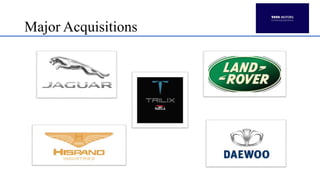
Tata Motors is bidding for Land Rover and Jaguar. Two iconic
British bands owned by US based automaker ‘Ford’
Strategy was to internationalize their operations through Global
Expansion.
2
The House of Tata
Founded in 1868 as a trading firm by Jamsetji N.Tata.
Tata throughout its 139 year life had a adaptable portfolio that
changed as per the economics of the country.
House of Tata formed the base of the country's developing industries
such as the first luxury hotel, First private steel company, first airline
etc.
Tata Group’s portfolio grew from 13 to 300 companies (1938 to 1991)
including subsidiaries and associate companies.
3
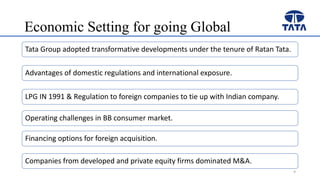
Economic Setting for going Global
Tata Group adopted transformative developments under the tenure of Ratan Tata.
Advantages of domestic regulations and international exposure.
LPG IN 1991 & Regulation to foreign companies to tie up with Indian company.
Operating challenges in BB consumer market.
Financing options for foreign acquisition.
Companies from developed and private equity firms dominated M&A.
4
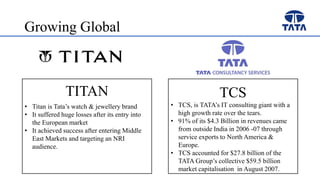
• Titan is Tata’s watch & jewellery brand
• It suffered huge losses after its entry into
the European market
• It achieved success after entering Middle
East Markets and targeting an NRI
audience.
TCS
• TCS, is TATA’s IT consulting giant with a
high growth rate over the tears.
• 91% of its $4.3 Billion in revenues came
from outside India in 2006 -07 through
service exports to North America &
Europe.
• TCS accounted for $27.8 billion of the
TATA Group’s collective $59.5 billion
market capitalisation in August 2007.
TITAN
Growing Global
Indian Hotels Ltd
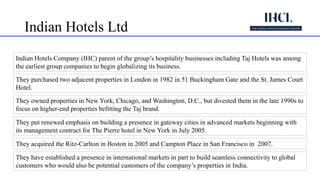
Indian Hotels Company (IHC) parent of the group’s hospitality businesses including Taj Hotels was among
the earliest group companies to begin globalizing its business.
They purchased two adjacent properties in London in 1982 in 51 Buckingham Gate and the St. James Court
Hotel.
They owned properties in New York, Chicago, and Washington, D.C., but divested them in the late 1990s to
focus on higher-end properties befitting the Taj brand.
They put renewed emphasis on building a presence in gateway cities in advanced markets beginning with
its management contract for The Pierre hotel in New York in July 2005.
They acquired the Ritz-Carlton in Boston in 2005 and Campton Place in San Francisco in 2007.
They have established a presence in international markets in part to build seamless connectivity to global
customers who would also be potential customers of the company’s properties in India.
TATA Tea
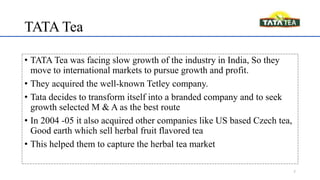
• TATA Tea was facing slow growth of the industry in India, So they
move to international markets to pursue growth and profit.
• They acquired the well-known Tetley company.
• Tata decides to transform itself into a branded company and to seek
growth selected M & A as the best route
• In 2004 -05 it also acquired other companies like US based Czech tea,
Good earth which sell herbal fruit flavored tea
• This helped them to capture the herbal tea market
7
TATA Steel
• Tata steel acquired many steel companies to globalized it not only help Tata
to stand as a global competitor it also made Tata to be in 6th largest steel
maker from 56th.
• Tisco faced problem when in 1990’s after the Indian government at the time
of liberalization
• Acquired the steel business of Singapore based Mat steel Asia in February
2005
• It also established a joint venture shipping company with MYK line of
japan in December.
• By acquiring Corus, Tata steel became the 6th largest steel maker in the
world
8
TATA Motors
Tata Group’s largest operating company and India’s largest automaker.
Significant share in the passenger car market.
Dominated the commercial truck market in India.
Compatible to poor road conditions in India.
TATA Motors (Cont.)
Company posted $105 million loss, first time since 1945.
The business was hit hard by an economic downturn as it was trying to plan for Indica,
India’s first largely indigenously developed passenger car.
The loss demanded building a more comprehensive global strategy.
Main challenge was to de-risk the cyclical nature of commercial truck business.
Major Acquisitions
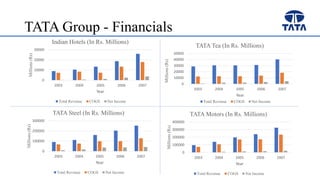
TATA Group - Financials
0
10000
20000
30000
2003 2004 2005 2006 2007
Millions(Rs)
Year
Indian Hotels (In Rs. Millions)
Total Revenue COGS Net Income
0
10000
20000
30000
40000
50000
2003 2004 2005 2006 2007
Millions(Rs)
Year
TATA Tea (In Rs. Millions)
Total Revenue COGS Net Income
0
100000
200000
300000
2003 2004 2005 2006 2007
Millions(Rs)
Year
TATA Steel (In Rs. Millions)
Total Revenue COGS Net Income
0
100000
200000
300000
400000
2003 2004 2005 2006 2007
Millions(Rs)
Year
TATA Motors (In Rs. Millions)
Total Revenue COGS Net Income
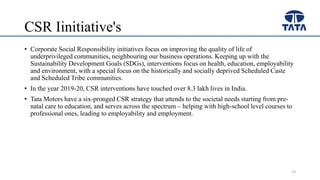
CSR Iinitiative's
• Corporate Social Responsibility initiatives focus on improving the quality of life of
underprivileged communities, neighbouring our business operations. Keeping up with the
Sustainability Development Goals (SDGs), interventions focus on health, education, employability
and environment, with a special focus on the historically and socially deprived Scheduled Caste
and Scheduled Tribe communities.
• In the year 2019-20, CSR interventions have touched over 8.3 lakh lives in India.
• Tata Motors have a six-pronged CSR strategy that attends to the societal needs starting from pre-
natal care to education, and serves across the spectrum – helping with high-school level courses to
professional ones, leading to employability and employment.
13
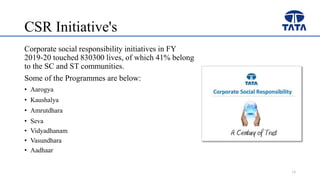
Corporate social responsibility initiatives in FY
2019-20 touched 830300 lives, of which 41% belong
to the SC and ST communities.
Some of the Programmes are below:
• Aarogya
• Kaushalya
• Amrutdhara
• Seva
• Vidyadhanam
• Vasundhara
• Aadhaar
14
CSR Initiative's
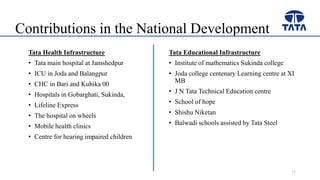
Contributions in the National Development
Tata Health Infrastructure
• Tata main hospital at Jamshedpur
• ICU in Joda and Balangpur
• CHC in Bari and Kuhika 00
• Hospitals in Gobarghati, Sukinda,
• Lifeline Express
• The hospital on wheels
• Mobile health clinics
• Centre for hearing impaired children
Tata Educational Infrastructure
• Institute of mathematics Sukinda college
• Joda college centenary Learning centre at XI
MB
• J N Tata Technical Education centre
• School of hope
• Shishu Niketan
• Balwadi schools assisted by Tata Steel
15

House of tata - Complete case study

  • 1.
    House of Tata Acquiringglobal footprint
  • 2.
    Introduction Tata Group isan Indian multinational conglomerate holding company headquartered in Mumbai, Maharashtra, India. One of India's largest conglomerates, Tata Group is owned by Tata Sons. Tata Motors is bidding for Land Rover and Jaguar. Two iconic British bands owned by US based automaker ‘Ford’ Strategy was to internationalize their operations through Global Expansion. 2
  • 3.
    The House ofTata Founded in 1868 as a trading firm by Jamsetji N.Tata. Tata throughout its 139 year life had a adaptable portfolio that changed as per the economics of the country. House of Tata formed the base of the country's developing industries such as the first luxury hotel, First private steel company, first airline etc. Tata Group’s portfolio grew from 13 to 300 companies (1938 to 1991) including subsidiaries and associate companies. 3
  • 4.
    Economic Setting forgoing Global Tata Group adopted transformative developments under the tenure of Ratan Tata. Advantages of domestic regulations and international exposure. LPG IN 1991 & Regulation to foreign companies to tie up with Indian company. Operating challenges in BB consumer market. Financing options for foreign acquisition. Companies from developed and private equity firms dominated M&A. 4
  • 5.
    • Titan isTata’s watch & jewellery brand • It suffered huge losses after its entry into the European market • It achieved success after entering Middle East Markets and targeting an NRI audience. TCS • TCS, is TATA’s IT consulting giant with a high growth rate over the tears. • 91% of its $4.3 Billion in revenues came from outside India in 2006 -07 through service exports to North America & Europe. • TCS accounted for $27.8 billion of the TATA Group’s collective $59.5 billion market capitalisation in August 2007. TITAN Growing Global
  • 6.
    Indian Hotels Ltd IndianHotels Company (IHC) parent of the group’s hospitality businesses including Taj Hotels was among the earliest group companies to begin globalizing its business. They purchased two adjacent properties in London in 1982 in 51 Buckingham Gate and the St. James Court Hotel. They owned properties in New York, Chicago, and Washington, D.C., but divested them in the late 1990s to focus on higher-end properties befitting the Taj brand. They put renewed emphasis on building a presence in gateway cities in advanced markets beginning with its management contract for The Pierre hotel in New York in July 2005. They acquired the Ritz-Carlton in Boston in 2005 and Campton Place in San Francisco in 2007. They have established a presence in international markets in part to build seamless connectivity to global customers who would also be potential customers of the company’s properties in India.
  • 7.
    TATA Tea • TATATea was facing slow growth of the industry in India, So they move to international markets to pursue growth and profit. • They acquired the well-known Tetley company. • Tata decides to transform itself into a branded company and to seek growth selected M & A as the best route • In 2004 -05 it also acquired other companies like US based Czech tea, Good earth which sell herbal fruit flavored tea • This helped them to capture the herbal tea market 7
  • 8.
    TATA Steel • Tatasteel acquired many steel companies to globalized it not only help Tata to stand as a global competitor it also made Tata to be in 6th largest steel maker from 56th. • Tisco faced problem when in 1990’s after the Indian government at the time of liberalization • Acquired the steel business of Singapore based Mat steel Asia in February 2005 • It also established a joint venture shipping company with MYK line of japan in December. • By acquiring Corus, Tata steel became the 6th largest steel maker in the world 8
  • 9.
    TATA Motors Tata Group’slargest operating company and India’s largest automaker. Significant share in the passenger car market. Dominated the commercial truck market in India. Compatible to poor road conditions in India.
  • 10.
    TATA Motors (Cont.) Companyposted $105 million loss, first time since 1945. The business was hit hard by an economic downturn as it was trying to plan for Indica, India’s first largely indigenously developed passenger car. The loss demanded building a more comprehensive global strategy. Main challenge was to de-risk the cyclical nature of commercial truck business.
  • 11.
  • 12.
    TATA Group -Financials 0 10000 20000 30000 2003 2004 2005 2006 2007 Millions(Rs) Year Indian Hotels (In Rs. Millions) Total Revenue COGS Net Income 0 10000 20000 30000 40000 50000 2003 2004 2005 2006 2007 Millions(Rs) Year TATA Tea (In Rs. Millions) Total Revenue COGS Net Income 0 100000 200000 300000 2003 2004 2005 2006 2007 Millions(Rs) Year TATA Steel (In Rs. Millions) Total Revenue COGS Net Income 0 100000 200000 300000 400000 2003 2004 2005 2006 2007 Millions(Rs) Year TATA Motors (In Rs. Millions) Total Revenue COGS Net Income
  • 13.
    CSR Iinitiative's • CorporateSocial Responsibility initiatives focus on improving the quality of life of underprivileged communities, neighbouring our business operations. Keeping up with the Sustainability Development Goals (SDGs), interventions focus on health, education, employability and environment, with a special focus on the historically and socially deprived Scheduled Caste and Scheduled Tribe communities. • In the year 2019-20, CSR interventions have touched over 8.3 lakh lives in India. • Tata Motors have a six-pronged CSR strategy that attends to the societal needs starting from pre- natal care to education, and serves across the spectrum – helping with high-school level courses to professional ones, leading to employability and employment. 13
  • 14.
    Corporate social responsibilityinitiatives in FY 2019-20 touched 830300 lives, of which 41% belong to the SC and ST communities. Some of the Programmes are below: • Aarogya • Kaushalya • Amrutdhara • Seva • Vidyadhanam • Vasundhara • Aadhaar 14 CSR Initiative's
  • 15.
    Contributions in theNational Development Tata Health Infrastructure • Tata main hospital at Jamshedpur • ICU in Joda and Balangpur • CHC in Bari and Kuhika 00 • Hospitals in Gobarghati, Sukinda, • Lifeline Express • The hospital on wheels • Mobile health clinics • Centre for hearing impaired children Tata Educational Infrastructure • Institute of mathematics Sukinda college • Joda college centenary Learning centre at XI MB • J N Tata Technical Education centre • School of hope • Shishu Niketan • Balwadi schools assisted by Tata Steel 15

Editor's Notes